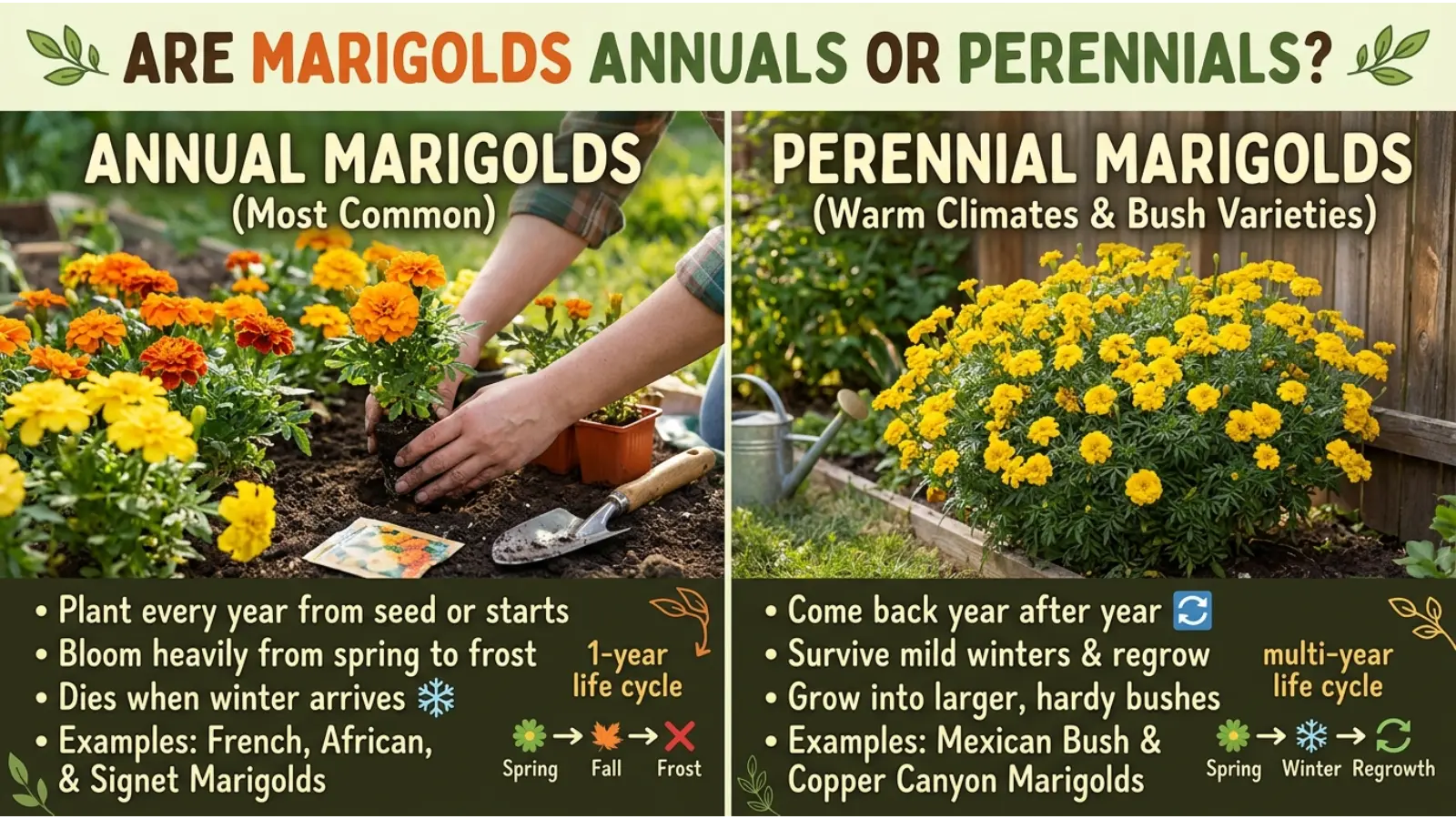
Imagine planting bright yellow or orange marigolds in your garden. They grow well, produce beautiful flowers, and make your outdoor space look colorful. However, when the if gets cold, you may notice the flowers fading. This raises an important question: are marigolds annuals or perennials?
The answer depends on the type of marigold you grow and the climate where you live. Most common garden marigolds are annuals. This means they complete their life cycle in one growing season. They grow from seeds, produce flowers, make new seeds, and then die.
However, some plants commonly called marigolds can live for several years in warm climates. These plants are often grown as perennials, which means they can return year after year under suitable conditions.
Understanding the difference helps you choose the right plants for your garden. It also helps you decide whether to collect seeds, buy new plants each spring, or protect your flowers from cold weather.
You may see marigolds in home gardens, school projects, parks, flower beds, and gardening videos on social media. They are popular because they are colorful, easy to grow, and useful for adding beauty to outdoor spaces.
If you are a beginner, do not worry. You do not need advanced gardening skills to grow healthy marigolds. In this guide, you’ll learn the meaning, examples, usage, differences, common mistakes, and simple explanations in easy English.
Are Marigolds Annuals or Perennials? – Quick Answer
Most garden marigolds are annuals, not perennials. They grow, flower, produce seeds, and die within one growing season. However, certain plants known as marigolds can live for several years in warm climates.
Here is a simple explanation:
- Annual marigolds: Grow and flower for one season, then die.
- Perennial marigolds: Live for several years and may flower again each growing season.
- Self-seeding marigolds: Drop seeds that may grow into new plants the following year.
Examples include:
- French marigolds (Tagetes patula) are usually grown as annuals.
- African marigolds (Tagetes erecta) are also annuals.
- Mexican marigold (Tagetes lemmonii) is a perennial shrub in suitable warm climates.
Simple rule: Most common marigolds last one season, but some marigold species can live for years.
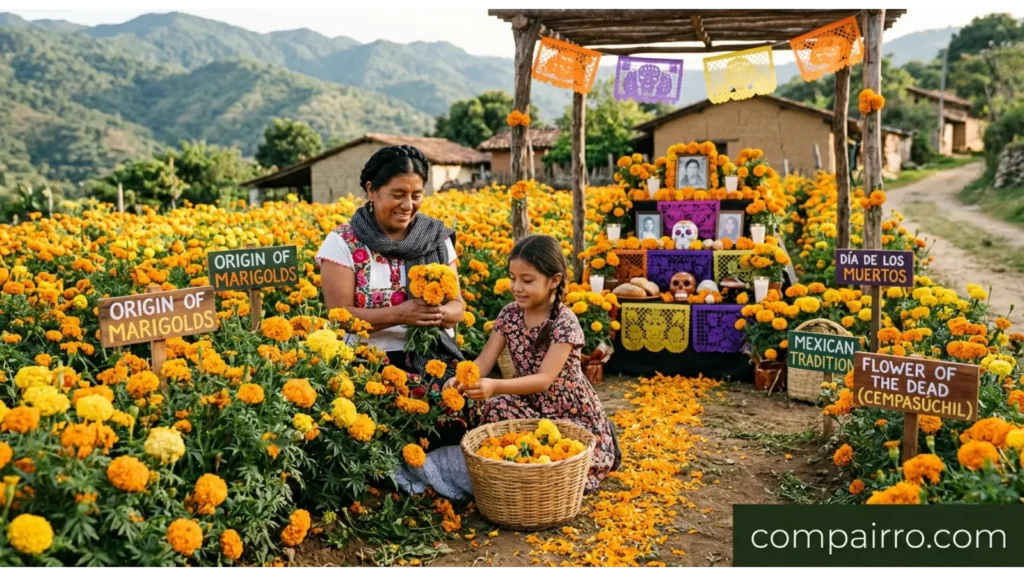
The Origin of Marigolds
Marigolds belong to the genus Tagetes, a group of flowering plants in the sunflower family. Many popular garden varieties originally came from Mexico and other parts of the Americas.
These plants became popular around the world because they grow quickly and produce bright flowers in shades of yellow, orange, gold, and red.
Over time, gardeners developed many varieties for flower beds, pots, borders, and other garden spaces. Today, French and African marigolds are among the most common types grown in home gardens.
The word “marigold” is also used for some unrelated plants, including marsh marigold (Caltha palustris). This is important because different plants with similar common names may have different life cycles.
As a result, identifying the plant’s scientific name is the best way to understand whether it is an annual or perennial.
British English vs American English Usage
The meaning of annual and perennial is the same in British and American English. However, gardeners may use different words for certain marigold varieties.
| Feature | British English | American English | Notes |
|---|---|---|---|
| Annual | Annual | Annual | Lives for one growing season |
| Perennial | Perennial | Perennial | Lives for several years |
| French marigold | French marigold | French marigold | Usually grown as an annual |
| African marigold | African marigold | African marigold | Usually grown as an annual |
| Growing season | Growing season | Growing season | May vary with local climate |
In both countries, common garden marigolds are generally treated as annual flowers.
However, local weather affects how long plants survive. A plant that dies during a cold winter may survive longer in a warm region.
Which One Should You Grow?
If you want to grow marigolds, your best choice depends on your garden, local climate, and how much time you want to spend caring for them.
Consider these points before choosing a variety:
- For colorful seasonal flowers: Choose French or African marigolds.
- For pots and containers: French marigolds are often a good choice because many varieties stay compact.
- For large flower displays: African marigolds are popular because some varieties produce large blooms.
- For a plant that can return each year: Look for a genuine perennial species, such as Mexican marigold, and check whether it suits your climate.
- For a low-cost garden: Save seeds from mature annual marigolds and plant them the following season.
Most marigolds grow best in full sun and well-drained soil. They also need regular watering while young, although the soil should not remain waterlogged.
If you live in a region with cold winters, annual marigolds are usually best replanted each growing season. In warm areas, some perennial species can remain in the garden for years.
Common Mistakes With Marigolds
Gardeners sometimes misunderstand the life cycle of marigolds. Avoid these common mistakes to get better results.
Mistake 1: Thinking All Marigolds Are Perennials
❌ Incorrect: Every marigold plant returns next year.
✔ Correct: Most common garden marigolds are annuals. Only certain species are perennial.
Mistake 2: Assuming a New Plant Is the Same Old Plant
❌ Incorrect: Marigolds appeared again, so the original plant survived winter.
✔ Correct: The original plant may have died, while seeds it dropped grew into new plants.
Mistake 3: Planting Marigolds in Heavy, Wet Soil
❌ Incorrect: Marigolds need lots of water all the time.
✔ Correct: They need moisture, but poorly drained soil can damage their roots.
Mistake 4: Expecting Annual Marigolds to Survive Frost
❌ Incorrect: All marigolds will survive freezing weather.
✔ Correct: Common annual varieties are sensitive to frost and may die when temperatures fall too low.
Mistake 5: Confusing Plants With Similar Names
❌ Incorrect: Every plant called a marigold has the same life cycle.
✔ Correct: Common names can refer to different species. Check the scientific name when you need an accurate answer.
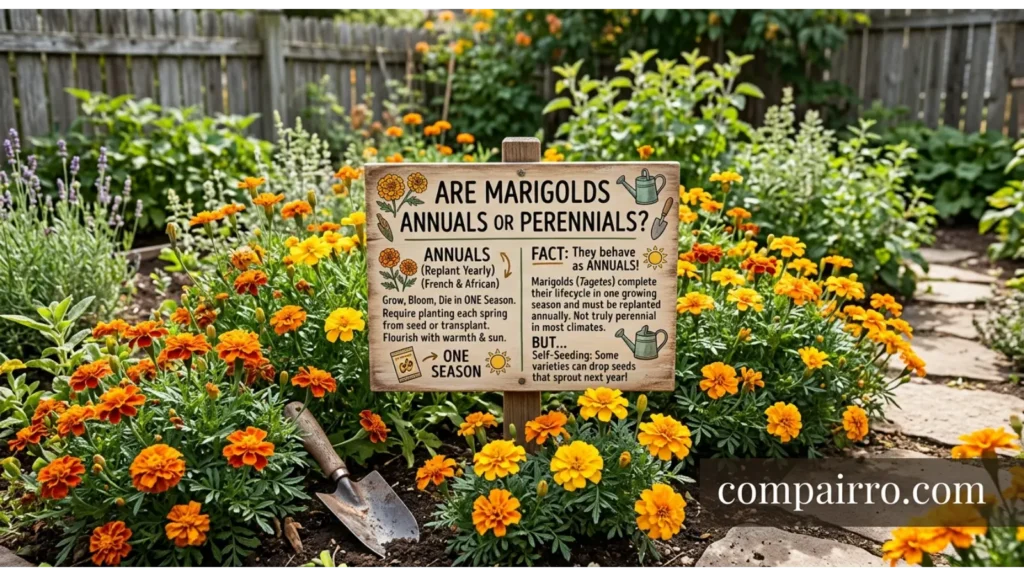
Are Marigolds Annuals or Perennials in Everyday Gardening?
The answer becomes easier to understand when you consider common gardening situations.
At Home
You plant French marigolds in a sunny flower bed in spring. They flower throughout the warm months, but cold weather eventually kills them.
Result: They behave as annuals.
At School
A student grows marigolds for a science project and records their growth from seed to flower.
Result: The plant completes its life cycle within one growing season.
On Social Media
A gardening video shows marigolds growing in the same garden year after year.
Result: The plants may be perennial species, or new seedlings may have grown from seeds dropped by the previous plants.
In a Warm Climate
A gardener grows Mexican marigold in a suitable warm location. The plant survives mild winters and produces flowers again.
Result: This species can behave as a perennial.
When Saving Seeds
You allow some flowers to mature and collect their dry seeds. You plant those seeds during the next growing season.
Result: New plants grow, but this does not mean the original annual plants survived.
Are Marigolds Annuals or Perennials? – Google Trends and Usage Data
People search for “are marigolds annuals or perennials” because they want to know how long these flowers live and whether they need to replant them each year.
The question is especially useful for new gardeners who want colorful flowers without spending too much money or time.
Common reasons people search for this topic include:
- Learning whether marigolds return after winter.
- Finding flowers suitable for a garden or container.
- Understanding the difference between annual and perennial plants.
- Learning how to save seeds.
- Choosing flowers that suit local weather.
Gardeners in the US, UK, India, Pakistan, Canada, and Australia may all ask this question. However, the answer can differ depending on local temperatures and the plant species.
For example, gardeners in colder parts of Canada may grow common marigolds as summer annuals. In warmer areas of India or Pakistan, the growing season may be longer, but common French and African marigolds are still generally grown as annuals.
Australia also has different growing conditions across its regions. Some locations have mild winters, while others experience frost.
Exact search volumes and country rankings should be checked in Google Trends or a keyword research tool. Without current data, it would be misleading to claim that a particular country has the highest search interest.
Comparison Table: Annual vs Perennial Marigolds
The easiest way to understand marigold life cycles is to compare the two types.
| Feature | Annual Marigolds | Perennial Marigolds |
|---|---|---|
| Lifespan | One growing season | Several years |
| Flowering | Usually during the growing season | Often returns in suitable seasons |
| Winter survival | Commonly die in cold weather | Depends on species and climate |
| Replanting | Usually needed each year | Often not needed while the plant survives |
| Examples | French and African marigolds | Mexican marigold |
| Seed collection | Often useful for growing new plants | May also be possible |
| Best conditions | Warm growing season | Suitable conditions for the species |
Remember that these are general patterns. A plant’s actual lifespan depends on its species, growing conditions, and local weather.
Marigolds in Professional Gardening
Gardeners, landscapers, and nursery workers often use marigolds to add bright colors to outdoor spaces.
Annual marigolds are useful when a garden needs seasonal flowers. They are often planted along paths, around borders, in containers, and in public flower beds.
Perennial species can be useful when a gardener wants a plant that stays in place for several years. However, the plant must suit the local climate and available space.
Professional gardeners consider several factors before choosing marigolds:
- Local temperature and frost risk.
- Soil drainage and sunlight.
- Flower size and plant height.
- Watering needs.
- Whether the garden needs seasonal or long-term plants.
Choosing the right species can save money and make garden care easier.
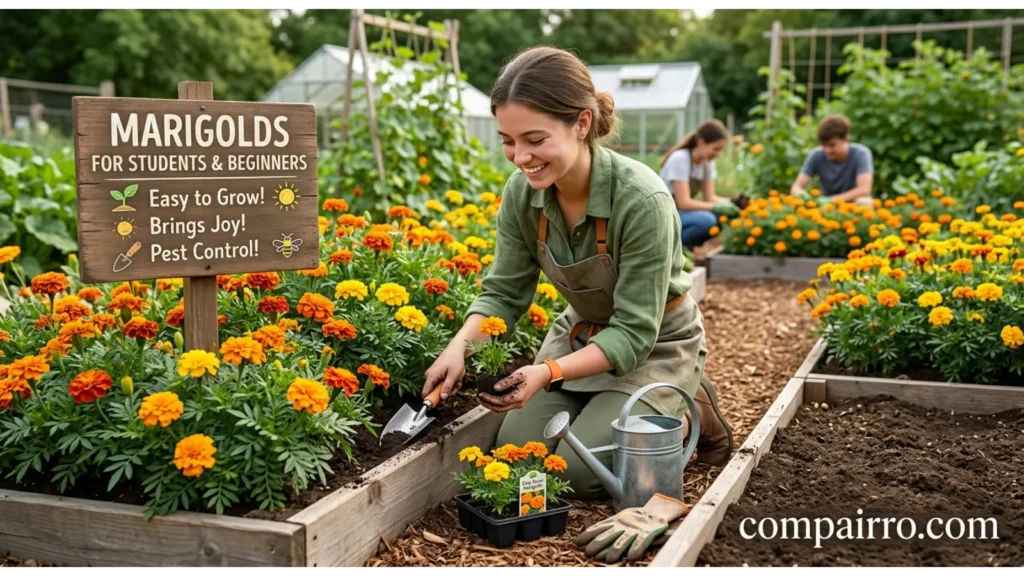
Marigolds for Students or Beginners
If you are new to gardening, learning the difference between annuals and perennials is a good starting point.
An annual completes its life cycle in one growing season. A perennial can live for several years.
One reason beginners get confused is that a garden may have marigolds every year, even when the original plants have died. This can happen when seeds fall onto the soil and grow into new plants.
Here are some simple learning tips:
- Check the plant label for its common and scientific names.
- Learn whether the species is an annual or perennial.
- Watch how the plant changes through the seasons.
- Collect mature seeds if you want to grow annual marigolds again.
- Keep notes about temperature, watering, and flowering time.
Growing marigolds from seed is a simple way to observe the plant life cycle in real life.
Signs or Characteristics of Annual and Perennial Marigolds
You can learn about a marigold’s life cycle by observing its growth and checking its identity.
Characteristics of Annual Marigolds
- Grow quickly from seeds.
- Produce flowers during the growing season.
- Set seeds as the flowers mature.
- Usually die after the growing season or following frost.
- Can produce new plants from saved or naturally dropped seeds.
Characteristics of Perennial Marigolds
- Can survive for several years in suitable conditions.
- May develop into shrubs or larger plants, depending on the species.
- Can produce new growth after a suitable winter.
- Need conditions that match their natural climate.
- May still be damaged by severe cold or unsuitable soil.
Important: Appearance alone cannot always tell you whether a plant is an annual or perennial. Checking its species is more reliable.
Simple Trick to Remember Are Marigolds Annuals or Perennials
Here is an easy way to remember the difference:
- Annual = One growing season.
- Perennial = Persists for years.
Think of it this way: if you plant a common French marigold in spring and it dies after the growing season, it has behaved as an annual.
If a suitable perennial species survives winter and grows again the next season, it has behaved as a perennial.
Also, remember that new marigolds growing from old seeds are not the same as the original plant returning.
This simple rule can help you understand most marigold gardening questions.
FAQs:
1. Do marigolds come back every year?
Most common garden marigolds do not return as the same plants because they are annuals. However, new plants may grow from seeds dropped the previous year.
2. Are French marigolds annuals or perennials?
French marigolds (Tagetes patula) are annuals. They usually grow, flower, produce seeds, and die within one growing season.
3. Are African marigolds annuals or perennials?
African marigolds (Tagetes erecta) are generally grown as annuals. They are known for their large, bright flowers.
4. Can marigolds survive winter?
Common garden marigolds usually struggle with frost and cold weather. Some perennial species can survive mild winters if the conditions suit them.
5. Will marigolds reseed themselves?
Yes, some annual marigolds can drop seeds that grow into new plants when conditions are suitable. However, natural reseeding is not guaranteed.
6. What is a perennial marigold?
Mexican marigold (Tagetes lemmonii) is an example of a perennial species. It can live for several years in suitable warm climates.
7. Should I remove marigolds after flowering?
You can remove dead annual plants after flowering and collect mature seeds before doing so. If you are growing a perennial species, check whether it needs pruning instead of removal.
Conclusion
So, are marigolds annuals or perennials? Most common garden marigolds are annuals, while certain species, such as Mexican marigold, can be perennials.
French and African marigolds usually grow and flower during one growing season. They may die when the season ends, although their seeds can produce new plants the following year.
If you want marigolds that return naturally, choose a suitable perennial species and check whether it can survive your local winter.
The easiest rule to remember is this: annuals last one growing season, while perennials can live for several years. With the right plant and proper care, you can enjoy bright marigold flowers in your garden season after season.

Sara Taylor is a passionate English content writer who specializes in word meanings, spelling comparisons, and modern slang explanations. She creates easy-to-understand articles that help readers avoid common English mistakes and improve their writing skills. Her content focuses on simple learning, real-life examples, and clear explanations for everyday readers.