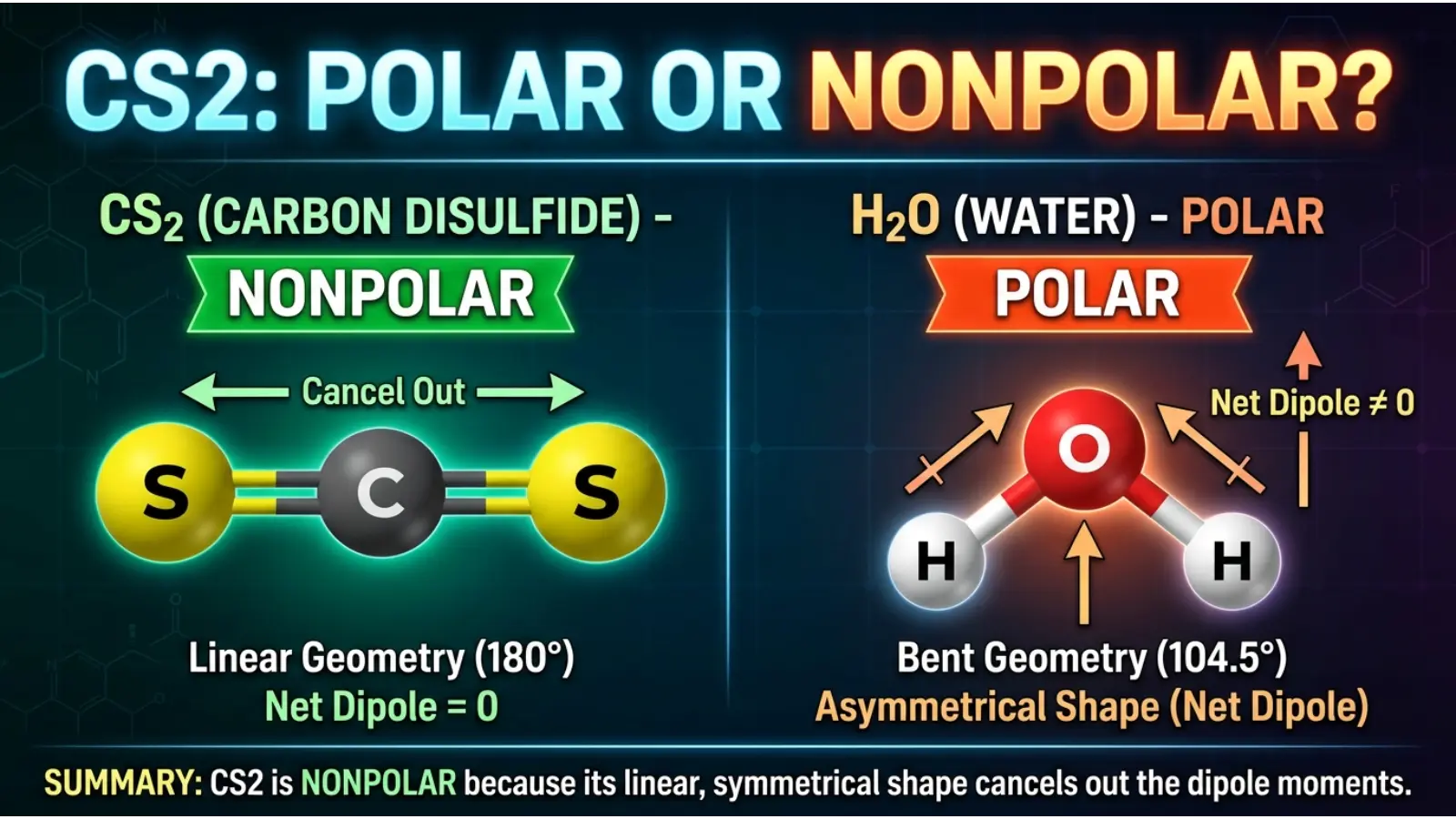
CS2 Polar or Nonpolar is a common chemistry question among students learning about molecular polarity and chemical bonding. Understanding if CS2 (carbon disulfide) is polar or nonpolar helps explain how molecular shape and bond polarity affect a molecule’s overall charge distribution. At first, its polar bonds may make the answer seem confusing.
The question CS2 polar or nonpolar is popular among chemistry students because its chemical bonds and molecular shape can be confusing at first. You may notice that carbon and sulfur have different electronegativity values, which can make you think that CS2 is a polar molecule. However, the final answer depends on more than just the atoms in a molecule.
CS2 is often studied in school chemistry, college science classes, homework assignments, laboratory lessons, and online chemistry discussions. Understanding its polarity can also help students learn about molecular geometry, electron distribution, and chemical bonding.
The good news is that the concept is not difficult once you understand how the molecule is shaped. CS2 has a simple linear structure, and its two identical C=S bonds are arranged in opposite directions. This arrangement plays an important role in deciding its overall polarity.
In this guide, you’ll learn the meaning, examples, usage, differences, common mistakes, and simple explanations in easy English.
Is CS2 Polar or Nonpolar? – Quick Answer
CS2 (carbon disulfide) is a nonpolar molecule.
CS2 is nonpolar because it has a linear molecular shape. Its two C=S bonds point in opposite directions, so their bond dipoles cancel each other out.
In simple words, the electrons are distributed symmetrically across the molecule, resulting in no overall dipole moment.
Quick facts about CS2:
- Chemical name: Carbon disulfide
- Chemical formula: CS2
- Central atom: Carbon
- Bond type: Covalent
- Molecular shape: Linear
- Bond angle: 180°
- Molecular polarity: Nonpolar
- Overall dipole moment: 0 D (approximately)
Examples:
- CS2 is a nonpolar molecule because its bond dipoles cancel.
- Its linear shape creates a symmetrical arrangement.
- Both sulfur atoms pull electron density in opposite directions.
Simple rule:
CS2 = Nonpolar.
Remember: When two identical bond dipoles point in opposite directions, they cancel each other out.
The Origin of CS2
CS2 stands for carbon disulfide. It is a chemical compound made from two elements: carbon and sulfur.
The name comes from its chemical composition:
- Carbon (C): One carbon atom.
- Disulfide (S2): Two sulfur atoms.
Carbon disulfide has been known to scientists since the late 18th century. It became important in chemistry because of its use as an industrial solvent and in different chemical processes.
Its molecular structure is simple. One carbon atom sits between two sulfur atoms, creating a straight arrangement.
The chemical formula is written as CS2 because every molecule contains one carbon atom and two sulfur atoms.
Today, CS2 is commonly discussed in chemistry lessons about covalent bonding, molecular geometry, Lewis structures, and molecular polarity.
British English vs American English Usage
There is no spelling or scientific meaning difference between British English and American English when discussing CS2.
Both countries use the same chemical formula, molecular structure, and explanation of polarity.
However, some scientific words may have different spelling or pronunciation in general chemistry writing.
| Feature | British English | American English | Notes |
|---|---|---|---|
| Chemical formula | CS2 | CS2 | Same worldwide |
| Chemical name | Carbon disulfide | Carbon disulfide | Same spelling |
| Molecular shape | Linear | Linear | Same meaning |
| Polarity | Nonpolar | Nonpolar | Same result |
| Chemistry | Chemistry | Chemistry | Same spelling |
Therefore, students in the UK and US can use the same scientific explanation when answering whether CS2 is polar or nonpolar.
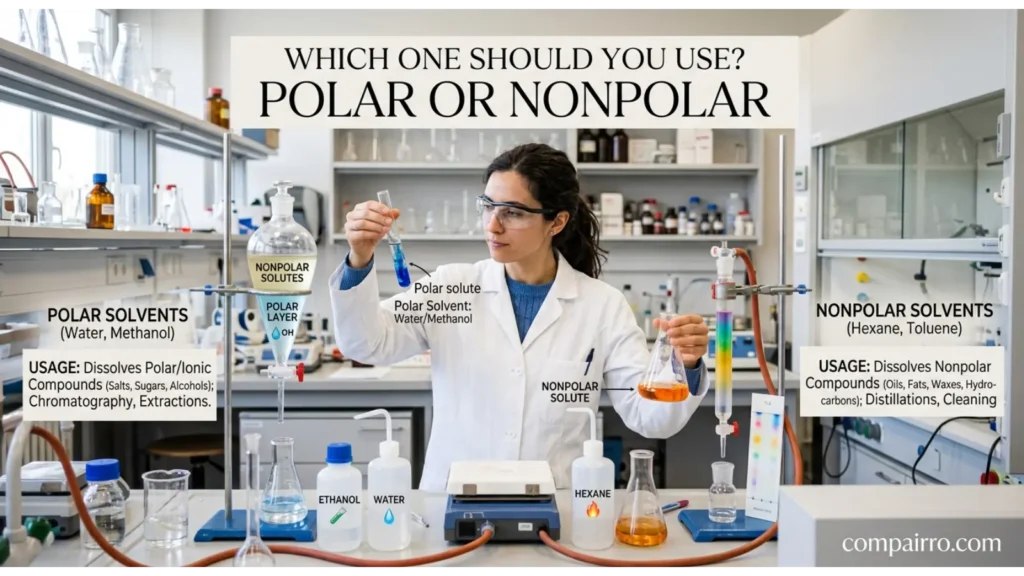
Which One Should You Use: Polar or Nonpolar?
When describing CS2, the correct answer is nonpolar.
However, it is important to understand why this answer is correct.
A molecule’s polarity depends on two main things:
- The polarity of its individual bonds.
- The overall shape of the molecule.
CS2 has two C=S bonds. These bonds are arranged in a straight line, with carbon in the middle and one sulfur atom on each side.
The bond dipoles point in opposite directions. Because the molecule is symmetrical, they cancel each other out.
When should you describe CS2 as nonpolar?
- In chemistry homework about molecular polarity.
- During lessons about covalent bonds.
- When studying molecular geometry.
- In Lewis structure questions.
- When comparing polar and nonpolar molecules.
- During chemistry exams and science discussions.
Remember that a molecule can contain slightly polar bonds and still be nonpolar overall. This is exactly why understanding molecular shape is important.
Common Mistakes With CS2
Students sometimes make mistakes when deciding whether CS2 is polar or nonpolar. Here are four common misunderstandings.
Mistake 1: Thinking all molecules with different atoms are polar
❌ Incorrect: CS2 must be polar because carbon and sulfur are different elements.
✔ Correct: Different atoms do not automatically make a molecule polar. Molecular shape and bond dipoles also matter.
Mistake 2: Ignoring molecular geometry
❌ Incorrect: Only the atoms in CS2 determine its polarity.
✔ Correct: The linear shape of CS2 is important because it allows the two bond dipoles to cancel.
Mistake 3: Confusing bond polarity with molecular polarity
❌ Incorrect: If a molecule has polar bonds, the whole molecule must be polar.
✔ Correct: Bond polarity and molecular polarity are different concepts. A symmetrical molecule can have bond dipoles that cancel.
Mistake 4: Forgetting the bond angle
❌ Incorrect: CS2 has a bent molecular shape.
✔ Correct: CS2 has a linear molecular shape with a bond angle of 180 degrees.
Understanding these mistakes will make it easier to solve similar chemistry questions.
CS2 in Everyday Examples
CS2 is not a common household chemical, but its molecular structure provides useful examples for understanding chemistry.
Here is how the concept can be connected to different learning situations.
1. At School
A chemistry teacher may ask:
Question: Is CS2 polar or nonpolar?
Answer: CS2 is nonpolar because it has a symmetrical linear structure.
2. In College Chemistry
Students may study CS2 while learning about molecular geometry, electron distribution, and dipole moments.
They can use its structure to understand how bond dipoles cancel.
3. In Chemistry Homework
A student may need to draw the Lewis structure of CS2 and identify its molecular shape.
The correct structure is:
S=C=S
This shows carbon in the center and sulfur atoms on both sides.
4. During Online Learning
Students often search for questions such as:
- Is CS2 polar or nonpolar?
- What is the molecular shape of CS2?
- Does CS2 have a dipole moment?
- Why is carbon disulfide nonpolar?
These questions help students understand the relationship between molecular shape and polarity.
CS2 – Google Trends and Usage Data
The keyword CS2 polar or nonpolar is related to educational chemistry searches.
Students commonly search for this topic when preparing for exams, completing chemistry assignments, or learning about molecular structures.
Here are some reasons people may search for this keyword:
- They want to know whether CS2 is polar or nonpolar.
- They need help understanding its molecular shape.
- They are confused about bond polarity.
- They want to understand its dipole moment.
- They need a simple explanation for chemistry homework.
Countries where students may search for this topic:
- United States: Students may search for CS2 polarity while studying high school and college chemistry.
- United Kingdom: Chemistry learners may look for explanations of molecular geometry and bonding.
- India: Students may search for CS2-related questions while preparing for school and entrance examinations.
- Pakistan: Chemistry students may look for simple explanations of molecular polarity and chemical bonding.
- Canada: Students may search for molecular structure examples as part of science lessons.
- Australia: Chemistry learners may study CS2 while learning about covalent compounds.
Important: These are possible search audiences, not verified Google Trends rankings. Exact search popularity and country rankings require current Google Trends data.
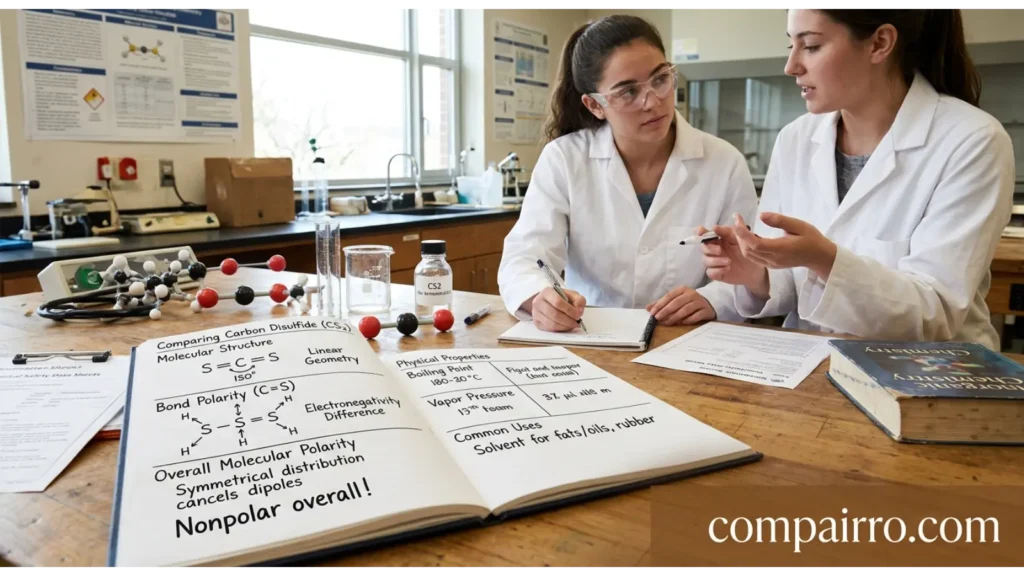
Comparison Table: CS2 Polar or Nonpolar?
Understanding the difference between polar and nonpolar molecules makes the answer easier to remember.
| Feature | CS2 | Polar Molecule |
|---|---|---|
| Molecular polarity | Nonpolar | Polar |
| Molecular shape | Linear | Depends on the molecule |
| Bond arrangement | Symmetrical | May be asymmetrical |
| Dipole moment | 0 D | Usually nonzero |
| Electron distribution | Symmetrical overall | Asymmetrical overall |
| Example | CS2 | H2O |
| Bond dipoles | Cancel each other | Do not fully cancel |
CS2 vs H2O:
CS2 is nonpolar because its two bond dipoles cancel due to its linear and symmetrical structure.
Water (H2O), on the other hand, is polar because it has a bent shape. Its bond dipoles do not cancel each other.
This comparison shows why molecular geometry is important when identifying polarity.
CS2 in Professional Life
Carbon disulfide has different industrial and scientific uses. It is known for its role as a solvent and as a chemical used in certain manufacturing processes.
Understanding its polarity is useful in chemistry because molecular properties can affect how substances interact with other materials.
Some practical areas where knowledge of CS2 may be relevant include:
- Chemical education and research.
- Industrial chemistry.
- Molecular structure studies.
- Chemical bonding lessons.
- Solvent-related chemistry.
However, carbon disulfide is a highly flammable and toxic chemical. It should only be handled by trained professionals in suitable laboratory or industrial settings.
For students, understanding its molecular structure and polarity is more important than handling the chemical itself.
CS2 for Students or Beginners
Beginners sometimes find molecular polarity confusing because they think only about the atoms in a chemical formula.
However, the shape of a molecule is equally important.
Here are some easy tips to understand CS2:
1. Learn the Chemical Formula
CS2 contains one carbon atom and two sulfur atoms.
2. Understand Its Lewis Structure
Its basic Lewis structure is:
S=C=S
Carbon is in the middle, while sulfur atoms are on opposite sides.
3. Remember the Molecular Shape
CS2 has a linear molecular shape with a 180-degree bond angle.
4. Understand Bond Dipoles
Each C=S bond has a bond dipole. These dipoles point in opposite directions and cancel.
5. Learn the Final Result
Since the bond dipoles cancel, CS2 has no overall dipole moment.
Beginner learning tip: Always check both bond polarity and molecular geometry before deciding whether a molecule is polar or nonpolar.

Signs or Characteristics Related to CS2
CS2 has several important characteristics that help explain why it is nonpolar.
Here are its main features:
- Chemical formula: CS2 contains one carbon atom and two sulfur atoms.
- Central atom: Carbon is the central atom.
- Molecular shape: It has a straight or linear structure.
- Bond angle: The angle between the two bonds is 180 degrees.
- Bonding: Carbon and sulfur are connected through double covalent bonds in its common Lewis structure.
- Symmetry: Both sulfur atoms are arranged equally on opposite sides of carbon.
- Dipole cancellation: The two bond dipoles cancel each other.
- Overall polarity: CS2 is nonpolar.
- Dipole moment: Its overall molecular dipole moment is zero.
These characteristics make CS2 a useful example when learning about symmetrical molecular structures.
Simple Trick to Remember CS2 Polarity
If you have difficulty remembering whether CS2 is polar or nonpolar, use this simple trick.
CS2 = Straight Shape = Dipoles Cancel = Nonpolar
Think of it this way:
Imagine two people pulling an object with equal force in opposite directions. Their forces balance each other.
Similarly, the two bond dipoles in CS2 point in opposite directions and cancel each other out.
Easy memory rule:
- CS2 = Linear = Nonpolar.
- H2O = Bent = Polar.
Remember that molecular shape helps determine whether bond dipoles cancel.
This simple comparison can help you answer many chemistry questions more confidently.
FAQs:
1. Is CS2 polar or nonpolar?
CS2 is nonpolar because it has a symmetrical linear shape, and its two bond dipoles cancel each other.
2. Why is CS2 a nonpolar molecule?
CS2 is nonpolar because its two identical C=S bond dipoles point in opposite directions and cancel.
3. What is the molecular shape of CS2?
CS2 has a linear molecular shape with a bond angle of 180 degrees.
4. Does CS2 have a dipole moment?
No. Its overall molecular dipole moment is zero because the two bond dipoles cancel.
5. Is CS2 a polar covalent compound?
CS2 is classified as a nonpolar molecule overall. Its individual bonds may have slight bond polarity, but their dipoles cancel.
6. What is the Lewis structure of CS2?
The Lewis structure of CS2 is S=C=S. Carbon is in the center, with one sulfur atom on each side.
7. Is CS2 symmetrical or asymmetrical?
CS2 is symmetrical because its two sulfur atoms are arranged equally on opposite sides of the central carbon atom.
Conclusion
So, is CS2 polar or nonpolar? The correct answer is CS2 is nonpolar.
Carbon disulfide has a linear molecular shape with a bond angle of 180 degrees. Its two C=S bond dipoles point in opposite directions and cancel each other out. As a result, the molecule has no overall dipole moment.
The most important thing to remember is that molecular polarity depends on both bond polarity and molecular geometry.
Final memory rule: CS2 = Linear Shape = Dipoles Cancel = Nonpolar.
Once you understand this simple concept, you can identify the polarity of many other molecules more easily.

Sara Taylor is a passionate English content writer who specializes in word meanings, spelling comparisons, and modern slang explanations. She creates easy-to-understand articles that help readers avoid common English mistakes and improve their writing skills. Her content focuses on simple learning, real-life examples, and clear explanations for everyday readers.