Imagine watching a shark swimming through the ocean. It has a large body, powerful fins, and a mouth full of sharp teeth. Because sharks live in water and look somewhat like dolphins, whales, and other sea animals, many people wonder: Are sharks fish or mammals?
This is a common question among students, teachers, nature lovers, and people searching for simple science facts. At first glance, sharks may look similar to some marine mammals. However, their bodies work in a very different way.
You may come across this question in school science lessons, biology books, documentaries, educational websites, social media posts, or everyday conversations. Understanding the difference helps you learn more about ocean animals and how scientists classify living things.
The interesting thing is that sharks are not mammals, even though they live in the same oceans as whales and dolphins. They have special body features that make them members of the fish family. They also have a unique skeleton, special breathing systems, and different ways of giving birth or laying eggs.
So, what makes a shark a fish? How does it breathe underwater? Can sharks give birth to babies? And how are they different from dolphins?
In this guide, you’ll learn the meaning, examples, usage, differences, common mistakes, and simple explanations in easy English.
Are Sharks Fish or Mammals? – Quick Answer
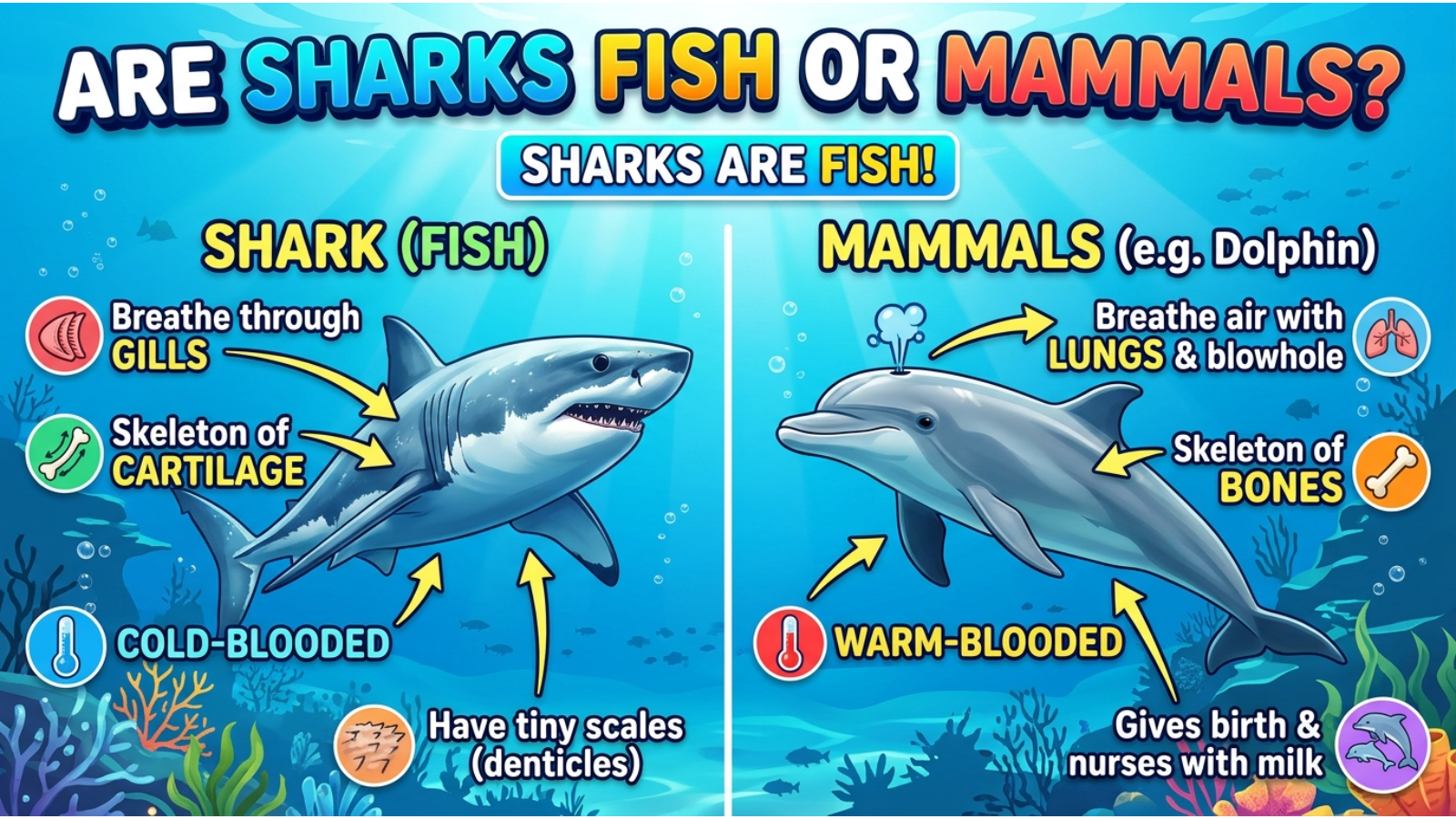
Sharks are fish, not mammals. More specifically, they belong to a group of fish called cartilaginous fish.
Sharks are classified as fish because:
- They breathe through gills.
- They live in water.
- Their skeletons are made of cartilage instead of bone.
- They are cold-blooded.
- They do not feed their babies with milk.
Unlike mammals, sharks do not have lungs or mammary glands.
Simple examples:
- Great white shark = Fish.
- Whale shark = Fish.
- Hammerhead shark = Fish.
Easy memory rule:
👉 Sharks = Fish.
👉 Whales and dolphins = Mammals.
Remember, living in water does not automatically make an animal a fish.
The Origin and History of Sharks
Sharks have a very long history on Earth. Scientists believe that early shark-like animals appeared more than 400 million years ago.
This means sharks existed long before humans and many modern animals.
Over millions of years, sharks developed special body features that helped them survive in oceans. Their bodies became well suited for swimming, finding food, and living in different underwater environments.
Today, there are more than 500 known shark species.
Some examples include:
- Great white shark
- Tiger shark
- Hammerhead shark
- Whale shark
- Bull shark
- Thresher shark
Sharks belong to a group called Chondrichthyes. This scientific group includes cartilaginous fish such as sharks, rays, and skates.
The word cartilaginous refers to animals whose skeletons are made mainly of cartilage.
British English vs American English Usage
The question “Are sharks fish or mammals?” has the same meaning in British English and American English.
There is no spelling or classification difference between the two forms of English.
Both British and American scientists classify sharks as fish.
| Feature | British English | American English | Notes |
|---|---|---|---|
| Shark | Shark | Shark | Same spelling |
| Fish | Fish | Fish | Same meaning |
| Mammal | Mammal | Mammal | Same meaning |
| Cartilage | Cartilage | Cartilage | Same spelling |
| Classification | Fish | Fish | No difference |
Whether you are studying in the UK, USA, Pakistan, India, Canada, or Australia, the scientific answer remains the same.

Which One Should You Use? Fish or Mammal?
When discussing sharks, the correct scientific classification is fish.
Here are some situations where you can use this information:
- School assignments: Write that sharks are cartilaginous fish.
- Science exams: Remember that sharks breathe through gills.
- Educational articles: Explain their differences from marine mammals.
- Casual conversations: You can simply say that sharks are fish.
- Scientific discussions: Use the term Chondrichthyes when discussing their animal group.
There is no need to call a shark a mammal just because it lives underwater.
Common Mistakes About Sharks
Many people misunderstand shark classification because they focus only on where sharks live.
Here are five common mistakes.
Mistake 1: Thinking sharks are mammals because they live in water.
❌ Incorrect: All animals living in oceans are fish or mammals.
✔ Correct: Oceans contain many types of animals, including fish, mammals, reptiles, and invertebrates.
Mistake 2: Thinking sharks breathe with lungs.
❌ Incorrect: Sharks breathe air using lungs like dolphins.
✔ Correct: Sharks use gills to take oxygen from water.
Mistake 3: Thinking all sharks lay eggs.
❌ Incorrect: Every shark lays eggs.
✔ Correct: Some sharks lay eggs, while others give birth to live young.
Mistake 4: Thinking sharks have bones.
❌ Incorrect: Sharks have skeletons made of hard bones.
✔ Correct: Their skeletons are made mainly of cartilage.
Mistake 5: Thinking sharks feed their babies milk.
❌ Incorrect: Mother sharks produce milk for their babies.
✔ Correct: Sharks do not have mammary glands and do not feed their young with milk.
Are Sharks Fish or Mammals in Everyday Examples?
Let’s understand shark classification through simple real-life examples.
1. At School
A science teacher asks:
“Are sharks fish or mammals?”
Correct answer: Sharks are fish because they breathe through gills and have cartilage skeletons.
2. At Work
A marine biology researcher studies shark behavior, feeding habits, and reproduction.
The researcher classifies sharks as cartilaginous fish.
3. On Social Media
You see a video of a huge whale shark swimming underwater.
You may think it is a whale because of its name and size.
However, a whale shark is actually the largest known fish species.
4. In Daily Life
Someone says:
“Sharks and dolphins are both fish because they swim in the ocean.”
You can explain that dolphins are mammals, while sharks are fish.
5. In Text Messages
Friend: Are sharks mammals?
You: No! Sharks are fish. They breathe through gills.
Are Sharks Fish or Mammals? – Google Trends and Usage Data
People search for “are sharks fish or mammals” because they want a simple and clear scientific answer.
The question is especially useful for students, parents, teachers, and people interested in marine animals.
Some common reasons behind these searches include:
- Preparing for school science tests.
- Completing biology homework.
- Learning about ocean animals.
- Understanding the difference between sharks and dolphins.
- Watching wildlife documentaries.
- Finding interesting animal facts.
Popular countries and search interest
People may search for this question in different English-speaking and English-learning countries, including:
- United States: Students and nature lovers often search for shark facts.
- United Kingdom: Biology learners explore animal classification.
- India: Students search for simple science explanations.
- Pakistan: School students and beginners look for educational information.
- Canada: Marine animal facts attract nature enthusiasts.
- Australia: Interest in ocean life and shark species makes this a relevant topic.
Important Google Trends note: These are potential audiences and search contexts, not verified search-volume rankings. Actual popularity can change over time. Google Trends can help compare interest by country and date.
Comparison Table: Sharks vs Fish vs Mammals
To understand why sharks are fish, it helps to compare them with other animals.
| Feature | Sharks | Bony Fish | Marine Mammals |
|---|---|---|---|
| Animal group | Fish | Fish | Mammals |
| Breathing | Gills | Gills | Lungs |
| Skeleton | Cartilage | Bone | Bone |
| Body temperature | Generally cold-blooded | Generally cold-blooded | Warm-blooded |
| Milk production | No | No | Yes |
| Reproduction | Eggs or live young | Mostly eggs | Mostly live birth |
| Examples | Great white shark | Salmon, tuna | Whale, dolphin |
The biggest difference is how these animals breathe, reproduce, and care for their young.
Although sharks and dolphins both swim in oceans, they belong to different animal groups.
Sharks in Professional Life and Marine Research
Sharks are important animals in marine biology and ocean research.
Scientists study them to understand ocean ecosystems, animal behavior, and marine biodiversity.
Here are some important areas where shark research is useful:
- Marine biology: Scientists study shark species and their body structures.
- Ocean conservation: Researchers work to protect endangered shark species.
- Environmental science: Sharks help scientists understand changes in ocean ecosystems.
- Education: Teachers use sharks to explain animal classification.
- Wildlife research: Experts study shark migration, feeding, and reproduction.
Sharks also play an important role in maintaining balance in many marine ecosystems.
Are Sharks Fish or Mammals? For Students and Beginners
Students sometimes find shark classification confusing because sharks share some features with marine mammals.
For example, both sharks and dolphins have streamlined bodies that help them swim.
However, their internal body systems are different.
Why beginners get confused:
- Sharks and dolphins both live in oceans.
- Both have fins or fin-like body parts.
- Both swim using powerful body movements.
- Some sharks give birth to live young.
- Large sharks may look similar to whales from a distance.
Easy learning tips:
- Remember that sharks breathe through gills.
- Learn that dolphins breathe through lungs.
- Understand that shark skeletons contain cartilage.
- Remember that mammals produce milk for their young.
- Study examples such as great white sharks and dolphins.
These simple facts make animal classification easier to understand.
Signs or Characteristics That Show Sharks Are Fish
Sharks have several important characteristics that place them in the fish group.
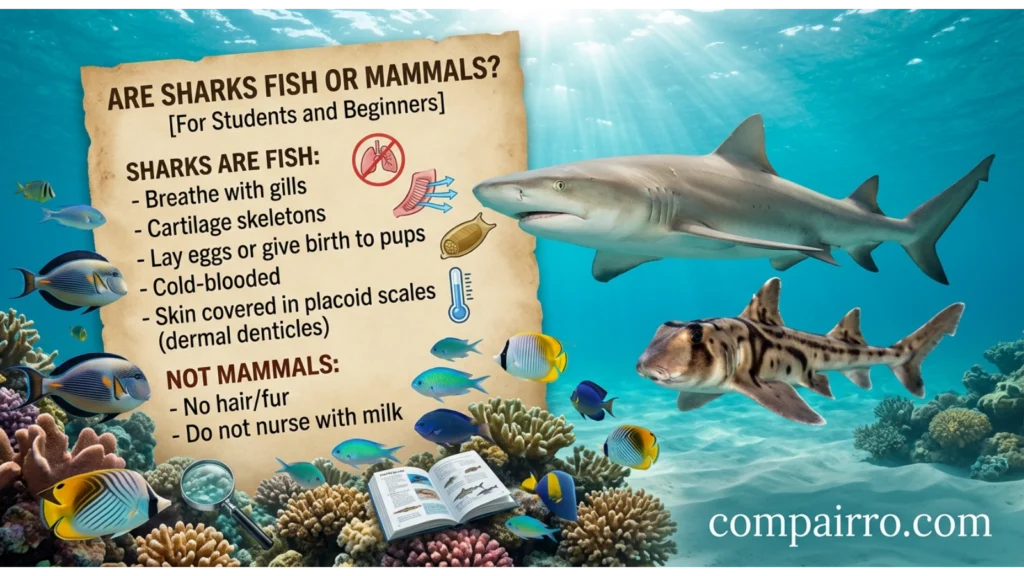
1. Gills for Breathing
Sharks use gills to take oxygen from water. This is one of the main features that separates them from marine mammals.
2. Cartilage Skeleton
Unlike most familiar fish, which have bony skeletons, sharks have skeletons made mainly of flexible cartilage.
3. Fins for Swimming
Sharks use their fins to move, balance, and change direction underwater.
4. Cold-Blooded Nature
Most sharks are ectothermic, meaning their body temperature depends largely on the surrounding environment. Some species can keep certain body parts warmer than the surrounding water.
5. Different Reproduction Methods
Depending on the species, sharks may lay eggs or give birth to live young.
6. No Milk Production
Sharks do not have mammary glands, so they cannot produce milk for their babies.
7. Underwater Lifestyle
Sharks are adapted to life in water and have special body features that help them survive in marine environments.
Simple Trick to Remember: Are Sharks Fish or Mammals?
Here is an easy way to remember the answer:
Shark = Fish.
Dolphin = Mammal.
Whale = Mammal.
Think of it this way:
A shark breathes through gills, while a dolphin comes to the water’s surface to breathe air through its blowhole.
This simple difference helps you remember their classification.
For example:
- Great white shark = Fish.
- Hammerhead shark = Fish.
- Bottlenose dolphin = Mammal.
- Blue whale = Mammal.
Remember: An animal’s habitat does not decide its animal group. Its body features and biological classification matter.
FAQs:
1. Are sharks fish or mammals?
Sharks are fish, not mammals. They belong to a group called cartilaginous fish because their skeletons are made mainly of cartilage.
2. Why are sharks not mammals?
Sharks are not mammals because they breathe through gills, do not produce milk, and have no mammary glands.
3. Do sharks give birth to babies?
Yes. Some shark species give birth to live young, while others lay eggs. Their reproduction methods depend on the species.
4. Do sharks have bones?
No. Sharks have skeletons made mainly of cartilage, which is softer and more flexible than bone.
5. Are dolphins and sharks the same type of animal?
No. Sharks are fish, while dolphins are mammals. They both live in oceans but have different body systems.
6. Is a whale shark a fish or a mammal?
A whale shark is a fish. Despite its name and enormous size, it is not a whale or a mammal.
7. Can sharks breathe outside water?
Sharks are adapted to breathe through their gills in water. They cannot breathe air like humans or dolphins, although some species can survive briefly out of water under certain conditions.
Conclusion
So, are sharks fish or mammals? The answer is simple: Sharks are fish, not mammals.
They belong to a special group called cartilaginous fish because their skeletons are made mainly of cartilage instead of bone.
Sharks breathe through gills, have fins for swimming, and do not produce milk for their young. Some species lay eggs, while others give birth to live young.
Although sharks, whales, and dolphins share the same ocean environment, they belong to different animal groups.
The easiest way to remember this fact is:
- Sharks = Fish.
- Whales = Mammals.
- Dolphins = Mammals.
Understanding these differences makes learning about marine animals easier and more interesting.

Sara Taylor is a passionate English content writer who specializes in word meanings, spelling comparisons, and modern slang explanations. She creates easy-to-understand articles that help readers avoid common English mistakes and improve their writing skills. Her content focuses on simple learning, real-life examples, and clear explanations for everyday readers.