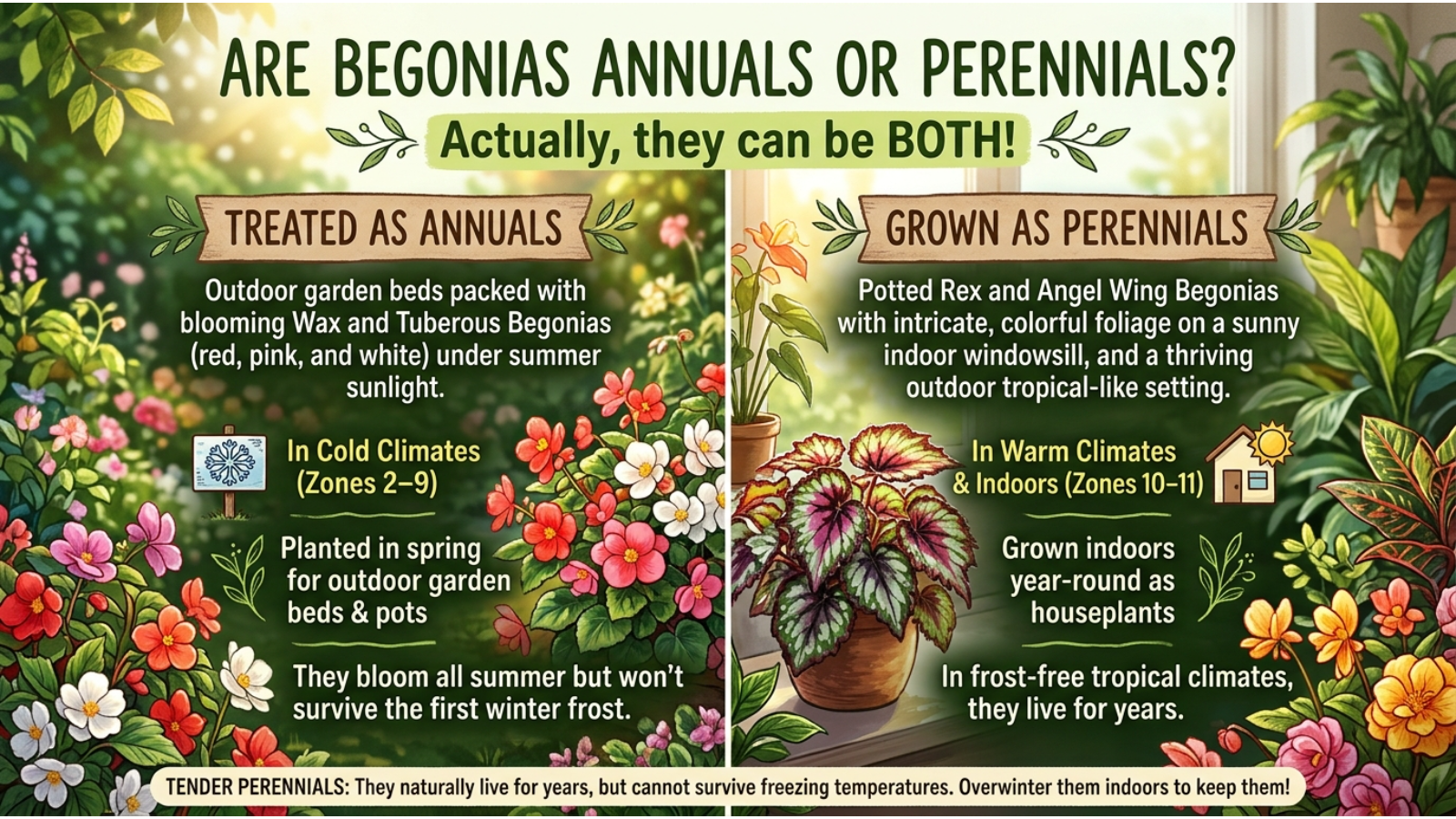
Imagine buying a beautiful begonia plant for your garden. Its colorful flowers and attractive leaves make your outdoor space look fresh and lively. However, when winter arrives, you may notice that the plant starts losing its leaves or stops growing. This often raises an important question: are begonias annuals or perennials?
Many gardeners are confused about how long begonias live. Some people believe begonias are annual flowers because they often replace them every year. Others say they are perennials because they can grow again after winter. So, which answer is correct?
The truth is that begonias can be both annuals and perennials, depending on their type and the climate where they grow. Most begonias are naturally perennial plants, but many gardeners grow them as annuals in places with cold winters. Some varieties can survive for several years when they receive the right care and protection.
You may come across this question while shopping for garden plants, reading gardening guides, watching plant-care videos, or searching for information online. Understanding the difference can help you choose the right begonia for your home, garden, or outdoor space.
In this guide, you’ll learn the meaning, examples, usage, differences, common mistakes, and simple explanations in easy English.
Are Begonias Annuals or Perennials? – Quick Answer
Begonias are generally tender perennials, but many gardeners grow them as annuals. Their lifespan depends on the variety, growing conditions, and winter temperatures.
Here is a simple explanation:
- Annual plants: Complete their life cycle in one growing season.
- Perennial plants: Can live and grow for more than two years.
- Begonias: Many varieties can live for several years, but they may not survive freezing winter temperatures outdoors.
Examples:
- Wax begonias are often grown as annuals in colder climates.
- Tuberous begonias are tender perennials that can be kept alive by protecting their tubers during winter.
- Hardy begonias can survive outdoors in suitable climates and return each year.
Simple rule:
Begonias are usually perennials in warm conditions but are often treated as annuals in cold regions.
The Origin of Begonias
Begonias belong to the plant genus Begonia. These plants are native to tropical and subtropical regions, including parts of Central America, South America, Africa, and Asia.
They grow naturally in warm and humid environments. Many varieties prefer shaded areas, moist soil, and protection from extreme weather.
The name Begonia comes from Michel Bégon, a French official and plant enthusiast who lived during the 17th century. The plant was named in his honor by botanist Charles Plumier.
Over time, begonias became popular around the world because of their beautiful flowers and decorative leaves.
Today, gardeners grow them in:
- Home gardens
- Hanging baskets
- Indoor pots
- Shaded outdoor areas
- Flower beds
- Greenhouses
Their popularity has also increased through gardening websites, YouTube tutorials, Pinterest, and social media.
British English vs American English Usage
The word begonia has the same spelling and meaning in both British and American English.
There is no major difference in how people classify begonias as annual or perennial plants. However, local weather conditions can affect how gardeners grow them.
For example, a gardener in a warmer part of the United States may keep begonias outdoors for several years. Meanwhile, someone in a colder part of the UK may grow the same variety as an annual.
| Feature | British English | American English | Notes |
|---|---|---|---|
| Spelling | Begonia | Begonia | Same spelling |
| Meaning | Flowering plant | Flowering plant | Same meaning |
| Annual | Annual | Annual | Same definition |
| Perennial | Perennial | Perennial | Same definition |
| Gardening use | Indoor and outdoor | Indoor and outdoor | Depends on climate |
Therefore, the difference is not related to language. It is mainly related to growing conditions and local temperatures.
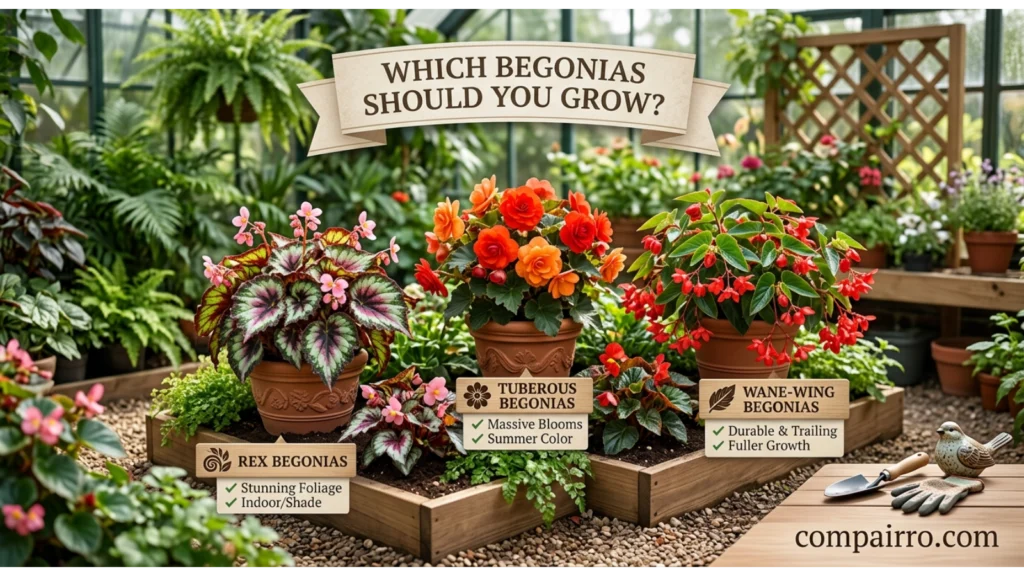
Which Begonias Should You Grow?
Choosing the right begonia depends on your climate, available space, and gardening needs.
Here are some common situations where different varieties work well.
- For garden beds: Wax begonias are popular because they are easy to grow and produce colorful flowers.
- For hanging baskets: Trailing begonias are a good choice because their stems grow downward.
- For indoor decoration: Rex begonias are popular for their attractive and colorful leaves.
- For large flowers: Tuberous begonias are known for their beautiful, showy blooms.
- For outdoor perennial growth: Hardy begonias can be suitable for gardens in climates where they can survive winter.
Formal vs. informal gardening use
In gardening guides, begonias are often described as tender perennials. However, garden centers may sell them as annual bedding plants because many customers replace them each spring.
Both descriptions can be correct when the growing climate is considered.
Common Mistakes With Begonias
Begonias are not difficult to grow, but beginners sometimes misunderstand their growing needs.
Here are five common mistakes to avoid.
Mistake 1: Thinking all begonias are annuals
❌ Incorrect: Every begonia dies after one growing season.
✔ Correct: Many begonias are perennial plants that can live for several years under suitable conditions.
Mistake 2: Leaving tender begonias outside during freezing weather
❌ Incorrect: All begonias can survive freezing temperatures.
✔ Correct: Most popular begonias are sensitive to frost. Bring tender varieties indoors or protect them before temperatures become too cold.
Mistake 3: Giving begonias too much water
❌ Incorrect: Begonias need constantly wet soil.
✔ Correct: They generally prefer moist but well-drained soil. Too much water can cause root problems.
Mistake 4: Assuming every begonia needs direct sunlight
❌ Incorrect: All begonias grow best in full sunlight.
✔ Correct: Many varieties prefer bright, indirect light or partial shade. Their exact light needs depend on the type.
Mistake 5: Throwing away tuberous begonias after flowering
❌ Incorrect: A tuberous begonia cannot grow again after its flowers fade.
✔ Correct: Its tuber can often be stored during dormancy and replanted when growing conditions improve.
Are Begonias Annuals or Perennials in Everyday Examples?
Understanding how begonias behave in different situations makes their lifespan easier to understand.
Here are some practical examples.
1. Home Gardening
A homeowner plants wax begonias in a flower bed during spring. The plants produce flowers throughout the warm season, but they may die when winter frost arrives.
In this situation, the homeowner treats them as annuals.
2. School Gardening Projects
A student grows a begonia in a pot and keeps it indoors during winter.
If the plant continues growing the following year, it demonstrates how a perennial plant can survive beyond one growing season.
3. Social Media Gardening
A gardening creator shares a video showing a begonia returning after winter.
This may happen because the plant is a hardy variety or because its tuber or roots survived the cold season.
4. Daily Life
Someone buys a beautiful begonia for an indoor table. They provide suitable light, water, and temperature.
The plant may continue growing for several years with proper care.
5. Garden Center Shopping
A garden center sells begonias as summer bedding plants.
Although the plants may naturally be perennials, they are often sold as annuals in areas with cold winters.
Begonias – Google Trends and Usage Data
People search for “are begonias annuals or perennials” because they want to understand how long these plants live and whether they need to buy new ones every year.
The keyword is especially useful for people who are new to gardening.
Common reasons people search for this topic include:
- Understanding the lifespan of begonias.
- Learning whether begonias survive winter.
- Finding out which varieties return every year.
- Understanding how to care for begonias indoors.
- Learning how to protect begonias from cold weather.
- Deciding whether to grow begonias in pots or garden beds.
Popular countries and gardening interest
Gardeners in different countries may have different experiences with begonias.
| Country | Common Gardening Interest |
|---|---|
| United States | Growing begonias in flower beds and containers |
| United Kingdom | Protecting tender begonias during winter |
| India | Growing begonias in suitable seasonal conditions |
| Pakistan | Growing begonias in pots and shaded gardens |
| Canada | Protecting begonias from freezing temperatures |
| Australia | Growing begonias in suitable warm and shaded areas |
Are search trends seasonal?
Interest in begonia care may increase during spring and summer when people prepare their gardens.
However, searches about overwintering begonias can also become popular during autumn and winter.
These are general gardening patterns, not verified Google Trends rankings or live search-volume figures.
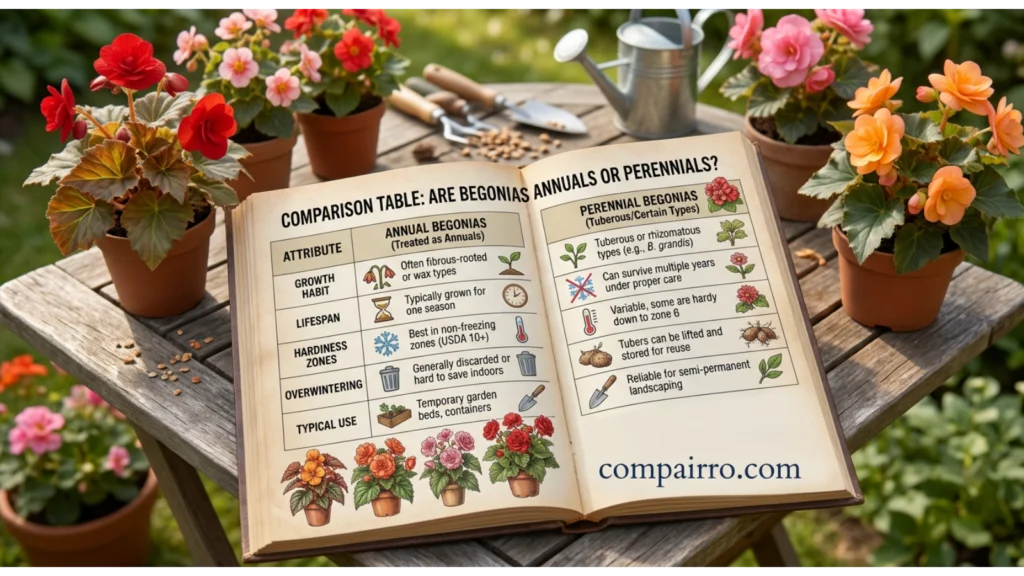
Comparison Table: Are Begonias Annuals or Perennials?
The following table explains the difference between annual and perennial begonias.
| Feature | Annual Begonias | Perennial Begonias |
|---|---|---|
| Lifespan | Usually one growing season in the garden | More than two years |
| Winter survival | Often do not survive outdoors | May survive with suitable protection |
| Growing conditions | Often grown in warm seasons | Depend on the variety |
| Maintenance | Often replaced each year | Can require winter care |
| Examples | Wax begonias grown as annuals | Hardy begonias |
| Best use | Seasonal flower displays | Long-term gardening |
Important: Annual and perennial describe how plants live, but gardeners may use these terms differently depending on their local climate.
Begonias in Professional Gardening
Begonias are widely used by professional gardeners, landscapers, nurseries, and garden designers.
Their attractive flowers and leaves make them useful for decorating different spaces.
Here are some common professional uses:
- Landscaping: Wax begonias are often used in flower beds and garden borders.
- Interior decoration: Rex begonias are popular for their colorful foliage.
- Nursery businesses: Different begonia varieties are grown and sold in pots.
- Hanging displays: Trailing varieties are used in hanging baskets.
- Garden design: Begonias help add color to shaded areas.
Professional gardeners select begonia varieties based on their climate, flowering season, and maintenance needs.
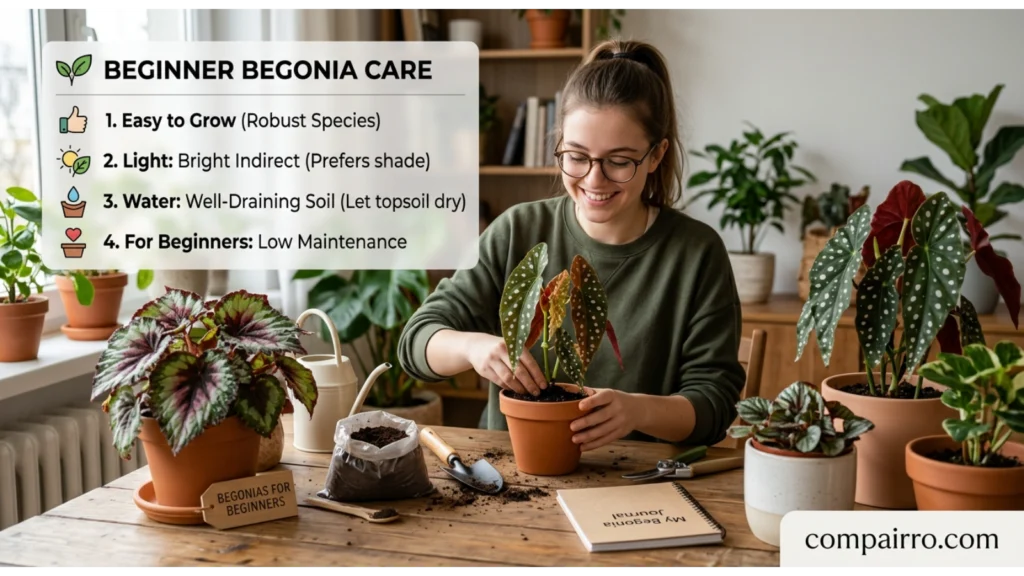
Begonias for Students or Beginners
Begonias are excellent plants for beginners who want to learn about annuals and perennials.
However, beginners sometimes struggle because different begonia varieties have different growing needs.
For example, one variety may grow well indoors, while another may need more outdoor space.
Easy tips for beginners:
- Identify your begonia variety before planting it.
- Use well-drained soil.
- Avoid overwatering.
- Provide suitable light based on the variety.
- Protect tender begonias from frost.
- Learn whether your plant grows from a tuber, rhizome, or fibrous roots.
A useful tip is to check the plant label when buying begonias. It often provides important information about sunlight, watering, and temperature.
Signs or Characteristics Related to Begonias
Begonias have several features that make them easy to recognize.
Here are some common characteristics.
1. Beautiful Flowers
Many begonias produce flowers in different colors, including:
- Pink
- Red
- White
- Orange
- Yellow
2. Attractive Leaves
Some varieties are grown mainly for their leaves rather than their flowers. Rex begonias, for example, have colorful leaves with interesting patterns.
3. Different Growth Types
Begonias can grow in different ways:
- Upright plants
- Trailing plants
- Bushy plants
- Rhizomatous plants
4. Seasonal Growth
Many begonias grow actively during warm weather. Some tuberous varieties become dormant during colder or less favorable periods.
5. Different Root Systems
Depending on the variety, begonias may have fibrous roots, rhizomes, or tubers.
6. Sensitivity to Cold
Many popular begonias cannot tolerate freezing temperatures. This is one of the main reasons gardeners grow them as annuals.
Simple Trick to Remember: Are Begonias Annuals or Perennials?
Here is an easy way to remember the difference.
- Annual = One growing season
- Perennial = More than two years
- Begonia = Usually a tender perennial
Think of it this way:
Imagine planting a begonia in a garden.
If it cannot survive winter outdoors and you replace it the next spring, you are growing it as an annual.
However, if you protect the plant during winter and it grows again next year, you are keeping it as a perennial.
Easy memory rule:
Begonias can live for years, but cold weather can make them behave like annual plants in your garden.
FAQs:
1. Are begonias annuals or perennials?
Most begonias are naturally tender perennials. However, gardeners often grow them as annuals in areas with cold winters.
2. Do begonias come back every year?
Yes, some begonias can return every year if their roots, tubers, or other growing parts survive winter.
3. Can begonias survive winter outdoors?
Some hardy begonias can survive winter outdoors in suitable climates. Most popular tender varieties need protection from frost.
4. Should I bring begonias inside for winter?
Yes, many tender begonias should be brought indoors before frost arrives. Make sure they receive suitable light and care.
5. How long do begonias live?
Perennial begonias can live for several years with proper care. Their lifespan depends on the variety and growing conditions.
6. Do begonias like sun or shade?
Many begonias prefer partial shade or bright, indirect light. However, some varieties can tolerate more sunlight when properly grown.
7. Are wax begonias annuals or perennials?
Wax begonias are tender perennials, but they are commonly grown as annuals in colder climates because they cannot tolerate frost.
Conclusion
So, are begonias annuals or perennials? The simple answer is that most begonias are tender perennials, but many gardeners grow them as annuals because they cannot survive freezing winter temperatures.
Some varieties, such as wax begonias, are commonly used for seasonal garden displays. Others, including hardy begonias, can return year after year in suitable climates. Tuberous begonias can also survive from one growing season to another when their tubers receive proper winter care.
Before buying a begonia, always check its variety and growing requirements. Give it suitable light, water, soil, and protection from cold if.
Remember: Begonias are generally perennials, but their ability to return every year depends on their variety and climate.

Sara Taylor is a passionate English content writer who specializes in word meanings, spelling comparisons, and modern slang explanations. She creates easy-to-understand articles that help readers avoid common English mistakes and improve their writing skills. Her content focuses on simple learning, real-life examples, and clear explanations for everyday readers.