Have you ever followed a cooking recipe and wondered whether a pint or a quart is bigger? You may see these measurements on milk cartons, juice bottles, ice cream containers, and cooking instructions. However, if you are unfamiliar with liquid measurements, it can be confusing to know which one holds more.
The question “pint or quart bigger” is common among students, home cooks, shoppers, and people learning measurement units. Both pint and quart are used to measure liquid volume, but they do not have the same capacity.
For example, when you buy milk at a grocery store, you might see a pint or a quart container. Similarly, cooking recipes may ask you to use one pint of milk or one quart of water. Knowing the difference helps you choose the right amount without making mistakes.
These measurements are commonly used in the United States and other places that follow US customary units. You may also come across them in British English, school lessons, online searches, and everyday conversations.
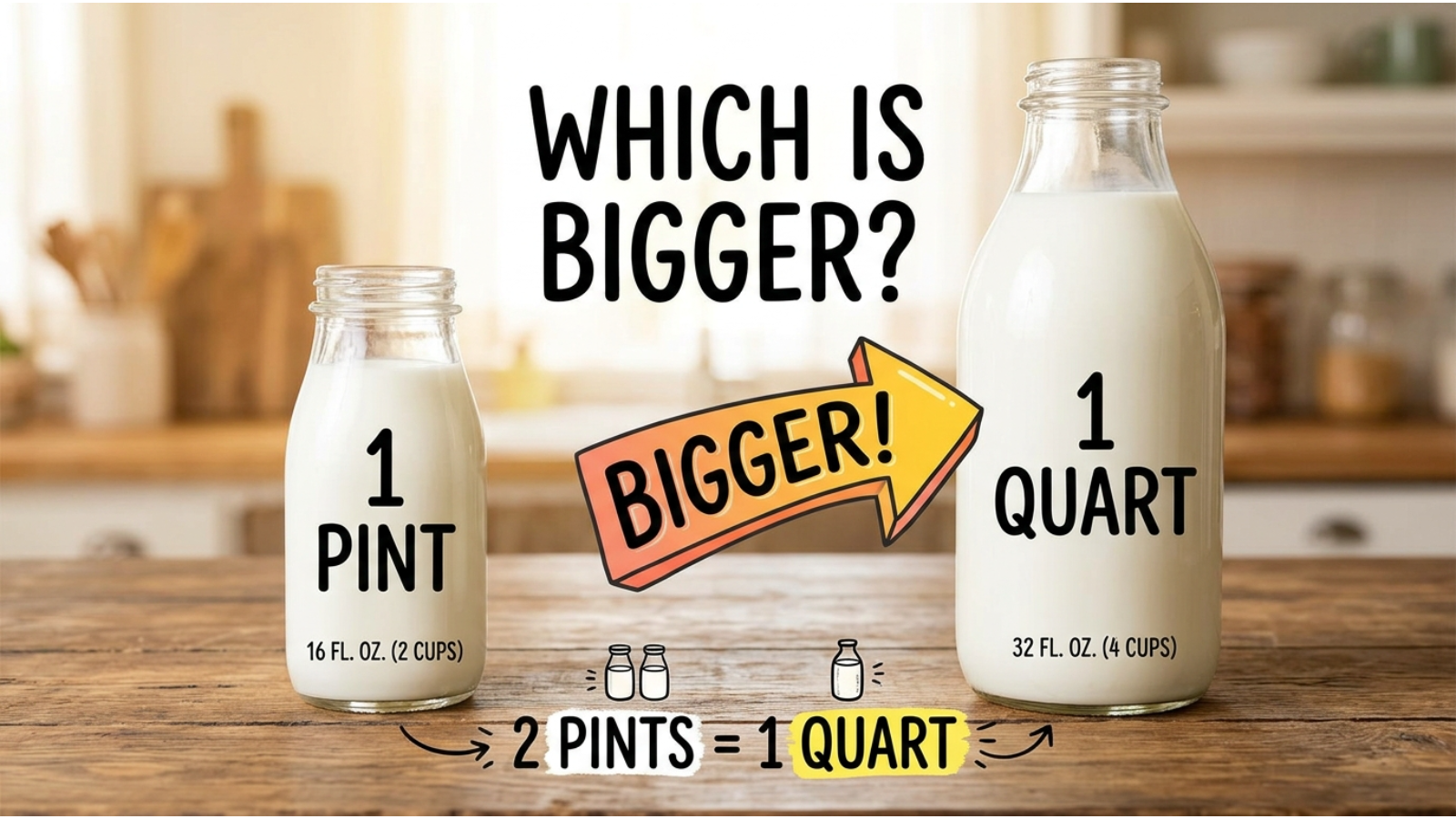
The good news is that understanding the difference is very easy. You only need to remember one simple rule: one quart is equal to two pints. Therefore, a quart is bigger than a pint.
In this guide, you’ll learn the meaning, examples, usage, differences, common mistakes, and simple explanations in easy English.
Pint or Quart Bigger – Quick Answer
Quick Answer
A quart is bigger than a pint. One quart contains two pints, which means it holds twice as much liquid as one pint.
- 1 pint = 2 cups (US)
- 1 quart = 4 cups (US)
- 1 quart = 2 pints
Examples:
- A quart of milk is bigger than a pint of milk.
- Two pints of water make one quart.
- One pint of juice is half a quart.
Simple rule:
Remember: Quart = 2 Pints.
If you have one pint and one quart of the same liquid, the quart container holds more.
The Origin of Pint and Quart
The words pint and quart have been used for hundreds of years to measure liquids and other goods.
Both words come from older European measurement systems.
- Pint: The word comes through Old French and Middle English from earlier measurement terms. It became a common unit for measuring liquids.
- Quart: The word comes from the Latin word quartus, meaning “fourth.” It refers to one-fourth of a gallon.
Over time, these measurements became part of different measurement systems.
Today, pints and quarts are commonly used in cooking, grocery shopping, food packaging, and everyday measurements.
In the United States, both units are part of the US customary measurement system.
British English vs American English Usage
Pints and quarts are used in both British and American English. However, their exact sizes are different.
This is important because a US pint is not the same size as a UK pint.
The United States uses US customary measurements, while the United Kingdom uses imperial measurements.
| Feature | British English | American English |
|---|---|---|
| Pint | 568 ml | 473 ml |
| Quart | 1,136 ml | 946 ml |
| 1 quart | 2 pints | 2 pints |
| Measurement system | Imperial | US customary |
Important: A quart is bigger than a pint in both systems. However, British pints and quarts hold more liquid than their US equivalents.
For example, a British pint of milk contains approximately 568 milliliters, while an American pint contains approximately 473 milliliters.
Which One Should You Use?
Choosing between a pint and a quart depends on how much liquid you need.
Both measurements are correct, but they are used for different amounts.
Use a pint when:
- You need a smaller amount of milk.
- You are following a recipe that asks for one pint.
- You want a small container of juice.
- You are measuring a small amount of liquid.
Use a quart when:
- You need twice as much liquid as a pint.
- You are buying a larger container of milk.
- You need more water for cooking.
- A recipe specifically asks for one quart.
Formal vs informal use
Pint and quart are standard measurement terms. You can use them in school assignments, cooking instructions, shopping, and everyday conversations.
However, always check whether a recipe uses US or imperial measurements.

Common Mistakes With Pint or Quart
People sometimes confuse pints and quarts because both are used to measure liquid volume.
Here are four common mistakes to avoid.
Mistake 1: Thinking a Volume Unit is bigger than a quart
❌ Incorrect: One Volume Unit holds more liquid than one quart.
✔ Correct: One quart holds twice as much liquid as one pint.
Mistake 2: Thinking one quart equals one Volume Unit
❌ Incorrect: 1 quart = 1 pint.
✔ Correct: 1 quart = 2 pints.
Mistake 3: Confusing pints with cups
❌ Incorrect: One pint equals four US cups.
✔ Correct: One US Volume Unit equals two US cups.
Mistake 4: Forgetting measurement differences
❌ Incorrect: A US pint and a UK Volume Unit have exactly the same size.
✔ Correct: A UK imperial pint is larger than a US customary Volume Unit.
Understanding these differences can help you avoid measurement mistakes when cooking, shopping, or studying.
Pint or Quart in Everyday Examples
Pints and quarts are not just school measurements. You can find them in many everyday situations.
Here are some simple examples.
1. At Work
A restaurant worker may need to measure milk for a drink.
- One Volume Unit of milk is suitable for a smaller amount.
- One quart of milk provides twice as much.
2. At School
A student may learn about liquid measurements in a mathematics class.
For example:
- 2 pints = 1 quart.
- 4 cups = 1 quart.
- 8 cups = 2 quarts.
3. On Social Media
People sometimes share cooking videos and recipes that use pints and quarts.
For example:
“Add one quart of water to the cooking pot.”
Understanding the measurement helps viewers follow the recipe correctly.
4. In Daily Life
Imagine buying ice cream from a grocery store.
You may find different container sizes, including pints and quarts.
A quart container holds twice as much ice cream as a Volume Unit container if both use the same measurement system.
5. In Cooking
A recipe might say:
- Add one pint of milk.
- Use one quart of water.
- Mix two pints of cream.
These instructions become easier when you know that two pints make one quart.
Pint or Quart – Google Trends and Usage Data
People search for “Volume Unit or quart bigger” because they want a quick and simple answer about liquid measurements.
Some people need this information for schoolwork, while others want to understand cooking recipes or compare grocery products.
Here are some common reasons behind these searches:
- Students learning measurement conversions.
- Parents helping children with homework.
- People following American cooking recipes.
- Shoppers comparing milk and juice containers.
- Beginners learning US customary units.
Search interest around the world
The topic may be relevant to people in several countries.
- US: Pints and quarts are common in everyday measurements.
- UK: Both terms are used, especially in imperial measurements.
- India: Students and home cooks may search for simple measurement conversions.
- Pakistan: Beginners may search for Volume Unit and quart differences when following international recipes.
- Canada: People may come across these units in older recipes and imported products.
- Australia: These terms may appear in older recipes and international cooking content.
Are Volume Unit or quart searches trending?
There is no verified live Google Trends data included here, so exact popularity rankings and search volumes cannot be confirmed.
However, measurement comparison searches are useful because people often need quick answers and simple conversion examples.
Comparison Table: Pint vs Quart
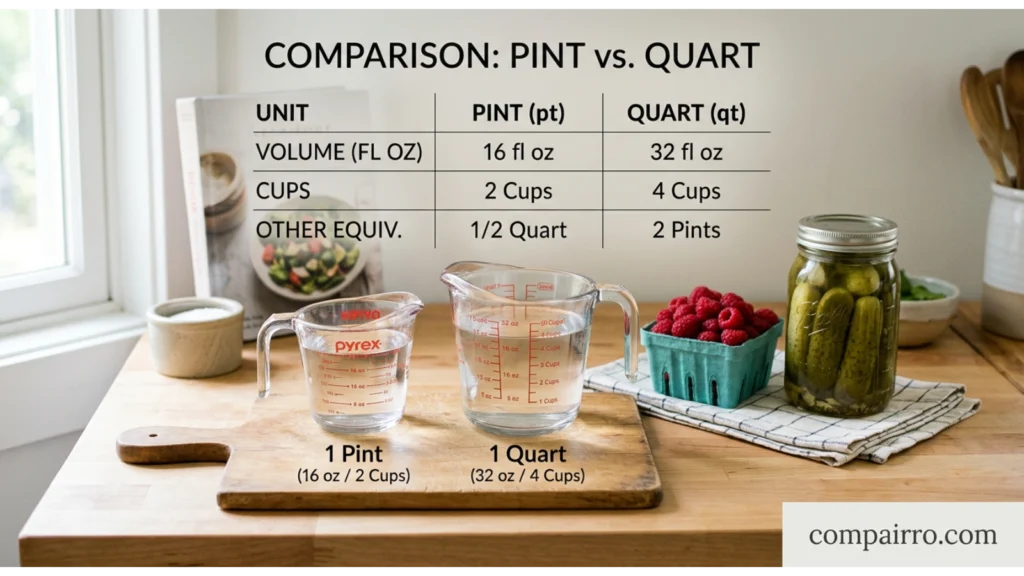
The easiest way to understand the difference is to compare both measurements side by side.
| Feature | Pint | Quart |
|---|---|---|
| Size | Smaller | Bigger |
| US cups | 2 cups | 4 cups |
| US fluid ounces | 16 fl oz | 32 fl oz |
| Milliliters (approx.) | 473 ml | 946 ml |
| Relationship | Half a quart | Two pints |
| Common use | Smaller quantities | Larger quantities |
Remember
A quart is always twice the size of a Volume Unit within the same measurement system.
US liquid measurement conversion:
| Measurement | Equivalent |
|---|---|
| 1 pint | 2 cups |
| 2 pints | 1 quart |
| 1 quart | 4 cups |
| 2 quarts | 1/2 gallon |
| 4 quarts | 1 gallon |
These conversions are useful for cooking, shopping, and school mathematics.
Pint or Quart in Professional Life
Pints and quarts are useful in many professional fields.
Although they are simple measurement units, they help people measure liquids correctly.
1. Restaurants
Restaurant workers use these measurements when preparing drinks, sauces, and recipes.
2. Grocery Stores
Shop workers may use Volume Unit and quart labels to identify different product sizes.
3. Food Production
Food companies use liquid measurements when preparing and packaging products.
4. Cooking Businesses
Professional cooks follow recipes that may include pints and quarts.
5. Education
Teachers use these measurements to explain volume, fractions, and unit conversions.
In all these situations, knowing the difference helps people understand quantities more easily.
Pint or Quart for Students or Beginners
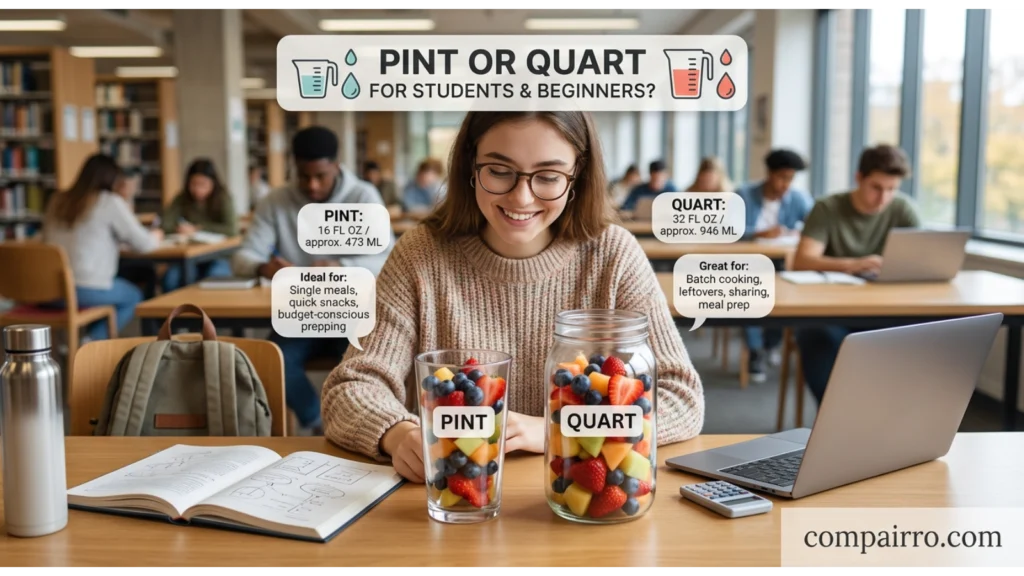
Students sometimes struggle with Volume Unit and quart because they look like similar measurement terms.
However, learning their relationship makes the topic much easier.
Why do beginners get confused?
- Both units measure liquid volume.
- Their names are not directly related to their sizes.
- Different countries use different measurement systems.
- Students may confuse pints with cups or gallons.
Easy learning tips:
- Remember that a Volume Unit is smaller than a quart.
- Learn that two pints equal one quart.
- Practice converting pints into quarts.
- Use measuring cups to understand liquid volume.
- Solve simple examples every day.
Practice question:
If you have four pints of water, how many quarts do you have?
Answer: 2 quarts.
Why? Because every two pints make one quart.
Signs or Characteristics Related to Pint and Quart
Pints and quarts have some important features that make them easy to understand.
Characteristics of a pint:
- It is a unit of liquid volume.
- It is smaller than a quart.
- One US pint equals two US cups.
- Two US pints equal one US quart.
- It is commonly used for milk, cream, and other liquids.
Characteristics of a quart:
- It is a unit of liquid volume.
- It is larger than a pint.
- One US quart equals four US cups.
- One US quart equals two US pints.
- It is commonly used for larger liquid quantities.
Main difference:
The biggest difference is their capacity. A quart holds twice as much liquid as a pint when both measurements follow the same system.
Simple Trick to Remember Pint or Quart Bigger
Here is an easy trick to remember the difference.👉 Volume Unit = Smaller
Quart = Bigger
2 Pints = 1 Quart
Think of it this way:
Imagine you have two small bottles. Each bottle contains one Volume Unit of water.
When you combine both amounts, you get one quart.
This simple example makes the relationship easy to remember.
Another memory trick:
Think of the word “quarter.”
A quart represents one-quarter of a gallon.
So, remember:
- 1 gallon = 4 quarts.
- 1 quart = 2 pints.
- 1 pint = 2 cups (US).
With these three simple rules, you can understand the basic liquid measurement system.
FAQs:
1. Is a Volume Unit bigger than a quart?
No. A quart is bigger than a Volume Unit. One quart contains two pints.
2. How many pints are in one quart?
There are two pints in one US quart. The same two-to-one relationship applies to imperial measurements.
3. How many cups are in a pint?
One US pint equals two US cups. An imperial pint is approximately 2.4 US customary cups.
4. How many cups are in a quart?
One US quart equals four US cups. This makes it easy to convert quarts into cups.
5. Is two pints equal to one quart?
Yes. Two pints always equal one quart within the same measurement system.
6. Which is bigger, 2 pints or 1 quart?
They are equal. Two pints contain exactly the same volume as one quart.
7. Is a UK pint bigger than a US pint?
Yes. A UK imperial pint is approximately 568 ml, while a US liquid pint is approximately 473 ml.
Conclusion
So, pint or quart bigger? The simple answer is that a quart is bigger than a Volume Unit.
One quart contains two pints, which means it holds twice as much liquid. One US pint equals two US cups, while one US quart equals four US cups.
Both measurements are useful in cooking, shopping, education, and everyday life.
The most important thing is to remember their relationship and check whether you are using US or British measurements.
Final memory rule:
- Pint = Smaller measurement.
- Quart = Bigger measurement.
- 2 Pints = 1 Quart.
Once you learn this simple rule, you will never confuse a pint with a quart again.

Sara Taylor is a passionate English content writer who specializes in word meanings, spelling comparisons, and modern slang explanations. She creates easy-to-understand articles that help readers avoid common English mistakes and improve their writing skills. Her content focuses on simple learning, real-life examples, and clear explanations for everyday readers.