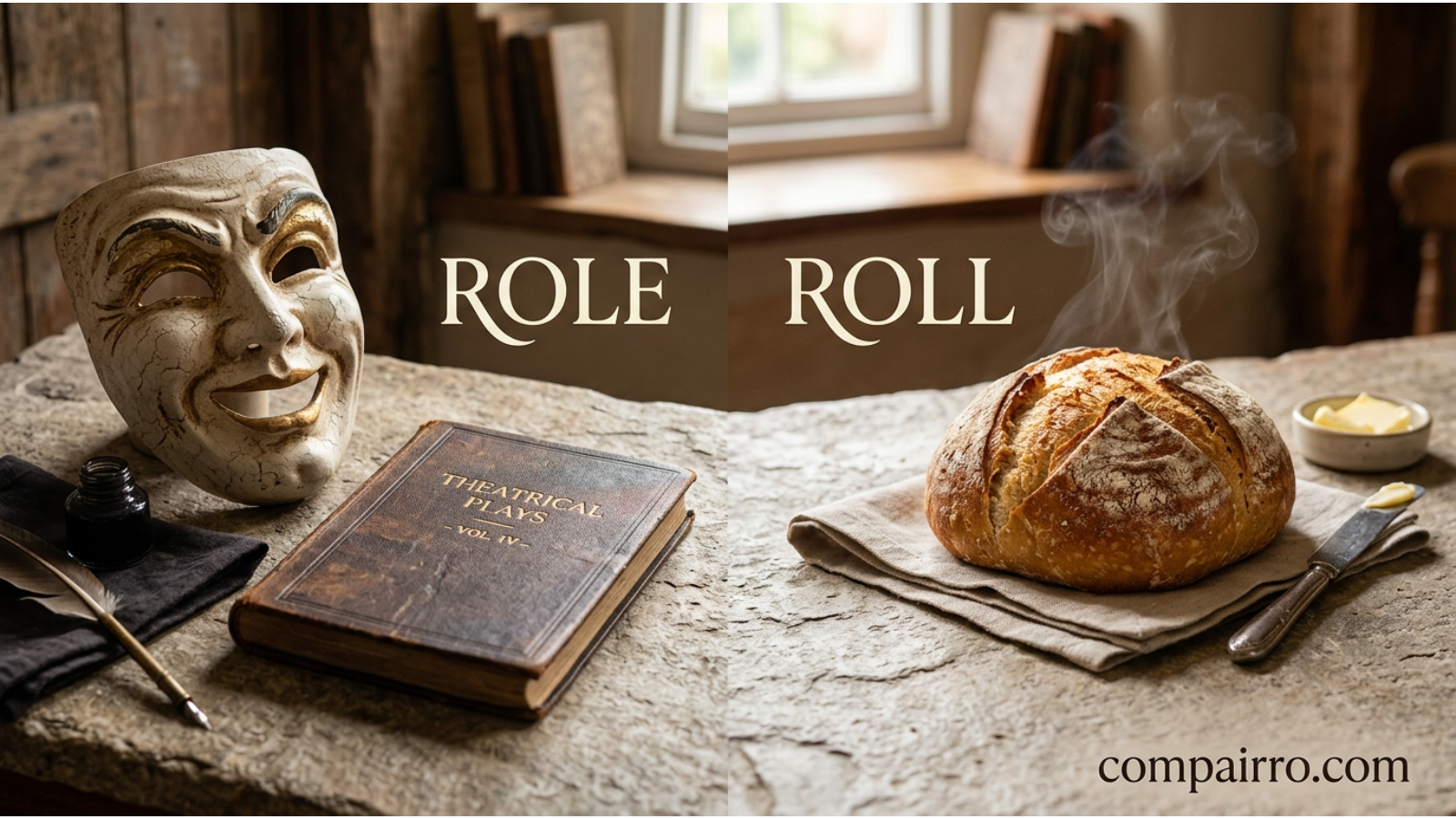
Role or roll is a common grammar topic that confuses many English learners. Have you ever written a sentence and stopped to think whether you should use role or roll? You are not alone.
These two words sound exactly the same, which makes them easy to mix up. People often see them in school assignments, workplace emails, social media posts, text messages, and everyday conversations. Because they are homophones (words that sound alike but have different meanings), many writers use the wrong one without realizing it.
For example, should you say, “She played an important role in the project” or “She played an important roll in the project”? Small mistakes like this can change the meaning of a sentence and make writing look less professional.
Understanding the difference between these words helps improve your English skills. It can also make your communication clearer whether you are a student, employee, content creator, or casual writer.
In this guide, you’ll learn the meaning, examples, usage, differences, common mistakes, and simple explanations in easy English.
Role or Roll – Quick Answer
👉 Role = A function, position, duty, or character someone has.
👉 Roll = To move by turning over, a list of names, or a type of bread.
Examples
1 She has an important role in the company.
2 The ball will roll down the hill.
3 The teacher called the class roll.
Simple Rule
👉 Role = Responsibility
👉 Roll = Rotation or Movement
If you are talking about a job, duty, or character, use role.
If you are talking about movement, a list, or bread, use roll.
THE ORIGIN OF ROLE OR ROLL
The word role comes from French. It was originally connected to actors and the characters they played in a performance. Over time, it began to mean any function or responsibility a person has.
The word roll comes from old Germanic and Latin roots related to turning, rotating, or moving in a circular way.
Today, both words are widely used around the world. Because they sound identical, they continue to be one of the most searched grammar comparisons online.
BRITISH ENGLISH VS AMERICAN ENGLISH USAGE
There is no major difference between British English and American English when using role and roll.
| Feature | British English | American English | Notes |
|---|---|---|---|
| Role meaning | Same | Same | Function or responsibility |
| Roll meaning | Same | Same | Movement, list, or bread |
| Pronunciation | Similar | Similar | Sound almost identical |
| Grammar usage | Same | Same | No spelling difference |
The usage is the same worldwide.
WHICH ONE SHOULD YOU USE?
Use role when talking about:
- A person’s responsibility
- A job position
- A character in a movie or play
- A function in a group
Examples:
- She has a leadership role.
- His role is to manage the team.
Use roll when talking about:
- Movement
- A list of names
- Bread rolls
- Wrapping or turning something
Examples:
- Please roll the paper.
- The teacher checked the class roll.
Formal vs Informal Use
- Role is common in academic and workplace writing.
- Roll can be used in both formal and informal situations depending on meaning.
COMMON MISTAKES WITH ROLE OR ROLL
Mistake 1
❌ She played an important roll in the event.
✔ Use role because it means function or responsibility.
Mistake 2
❌ The ball began to role down the hill.
✔ Use roll because the ball is moving.
Mistake 3
❌ My company gave me a new roll.
✔ Use role because it refers to a job position.
Mistake 4
❌ The teacher checked the class role.
✔ Use roll because it means a list of names.
ROLE OR ROLL IN EVERYDAY EXAMPLES

Work
✅ My role is to answer customer questions.
✅ The manager explained everyone’s roles.
School
✅ Sarah has the role of class monitor.
✅ The teacher completed the attendance roll.
Social Media
✅ Influencers play a big role in online trends.
Daily Life
✅ Parents have an important role in a child’s growth.
✅ The wheel began to roll forward.
Text Messages
✅ “What is your role in the project?”
✅ “Watch the bottle roll across the table!”
ROLE OR ROLL – GOOGLE TRENDS & USAGE DATA

Many people search for role or roll because the words sound exactly alike.
Popular reasons for searching include:
- School grammar lessons
- English learning
- Workplace writing
- Social media captions
- Blog and content writing
Countries where this topic is commonly searched include:
- United States
- United Kingdom
- India
- Pakistan
- Canada
- Australia
Search interest remains steady because English learners frequently confuse homophones. Teachers, students, and professionals often look for quick explanations and examples.
On social media and online forums, grammar questions about role and roll appear regularly because many people want to avoid writing mistakes.
COMPARISON TABLE: ROLE OR ROLL
| Feature | Role | Roll |
|---|---|---|
| Meaning | Function or responsibility | Movement, list, or bread |
| Part of Speech | Noun | Noun and verb |
| Workplace Usage | Very common | Less common |
| School Usage | Character or responsibility | Attendance list |
| Example | Leadership role | Roll the ball |
| Related Idea | Duty | Movement |
ROLE OR ROLL IN PROFESSIONAL LIFE
In professional settings, role is used much more often than roll.
Examples:
- Job role
- Leadership role
- Management role
- Team role
Employers often discuss roles and responsibilities during interviews and meetings.
Examples:
✅ What is your role in the company?
✅ Her role includes project planning.
The word roll may appear in professional settings when discussing attendance rolls, payroll systems, or physical movement of objects.
ROLE OR ROLL FOR STUDENTS OR BEGINNERS
Students often struggle with role and roll because both words sound the same.
Common confusion includes:
- Hearing the word but not knowing the spelling
- Mixing up meanings
- Writing quickly without checking context
Easy Learning Tips
- Think about the sentence meaning first.
- Ask yourself if it refers to responsibility or movement.
- Read examples regularly.
- Practice writing both words in different sentences.
The more you use them correctly, the easier they become to remember.
SIGNS OR CHARACTERISTICS RELATED TO ROLE OR ROLL
Characteristics of Role
- Refers to a responsibility
- Describes a position or function
- Common in education and workplaces
- Often linked to people
Examples:
- Teacher role
- Parent role
- Leadership role
Characteristics of Roll
- Connected to movement
- Can be a verb or noun
- May refer to attendance records
- Can describe food items
Examples:
- Roll a ball
- Class roll
- Bread roll
SIMPLE TRICK TO REMEMBER ROLE OR ROLL
👉 Role = Responsibility
👉 Roll = Rotation
Think of it this way:
- A manager has a role.
- A wheel can roll.
Another easy trick:
The word role contains the letter E.
Think:
E = Employment or responsibility
The word roll has double L.
Think:
L = Like a rolling wheel
This simple memory trick helps many beginners remember the difference quickly.
FAQs:
1. What is the difference between role and roll?
Role means a function or responsibility. Roll usually means movement, a list, or bread.
2. Is it role or roll in a job position?
Use role because it refers to a person’s responsibility or position.
3. Why do people confuse role and roll?
They sound exactly the same when spoken.
4. Can roll be used as a verb?
Yes. For example, “The ball will roll down the hill.”
5. Is role only used for actors?
No. It can refer to any responsibility, duty, or position.
6. What is a class roll?
A class roll is a list of students’ names used for attendance.
7. Which word is more common in business writing?
Role is more common because workplaces often discuss roles and responsibilities.
CONCLUSION
Understanding role or roll is easier once you know their meanings.
Role refers to a person’s function, responsibility, or position. Roll usually relates to movement, a list of names, or a type of bread. Although they sound the same, they have very different meanings.
The most important thing is to look at the context of the sentence before choosing the word.
Final memory rule:
👉 Role = Responsibility
👉 Roll = Rotation or Movement
With this simple trick, you’ll be able to use role and roll correctly in school, work, social media, and everyday conversations.

Sara Taylor is a passionate English content writer who specializes in word meanings, spelling comparisons, and modern slang explanations. She creates easy-to-understand articles that help readers avoid common English mistakes and improve their writing skills. Her content focuses on simple learning, real-life examples, and clear explanations for everyday readers.