Shelf or shelve is a common grammar topic that confuses many English learners. You may have seen these words in school books, workplaces, online articles, social media posts, or everyday conversations. At first glance, they look very similar, but they have different meanings and uses.
Many people wonder whether they should write shelf or shelve. Some think one is simply the plural form of the other, while others use them incorrectly in sentences. Because the words are closely related, it is easy to mix them up.
Understanding the difference is important if you want to write and speak English correctly. Whether you are a student, a professional, a content writer, or someone learning English, knowing when to use each word can improve your communication.
The good news is that the difference is quite simple once you understand the basic rule. A few examples can help you remember it forever.
In this guide, you’ll learn the meaning, examples, usage, differences, common mistakes, and simple explanations in easy English.
Shelf or Shelve – Quick Answer
👉 Shelf is a noun. It means a flat surface used for holding items.
👉 Shelve is a verb. It means to place something on a shelf or to postpone something.
Examples
1 The books are on the shelf.
2 Please shelve these books after reading them.
3 The company decided to shelve the project for now.
Simple Rule
👉 Shelf = Thing
👉 Shelve = Action
If it is an object, use shelf.
If it is an action, use shelve.
The Origin of Shelf or Shelve
The word shelf comes from Old English and has been used for hundreds of years to describe a flat surface used for storing items.
The word shelve developed from shelf and became a verb. It originally meant putting something on a shelf. Over time, people also began using it to mean delaying or putting aside plans, ideas, or projects.
Today, both words are widely used in books, workplaces, schools, and online communication.
British English vs American English Usage
The usage of shelf and shelve is generally the same in British English and American English.
| Feature | British English | American English | Notes |
|---|---|---|---|
| Shelf meaning | Same | Same | Noun |
| Shelve meaning | Same | Same | Verb |
| Everyday use | Common | Common | No major difference |
| Formal writing | Accepted | Accepted | Standard English |
There are no important spelling differences between British and American English for these words.
Which One Should You Use?
Shelf when talking about an object.
Use shelve when talking about an action.
Use Shelf When:
- Talking about furniture
- Describing storage spaces
- Referring to a physical object
- Writing academic or formal content
Choose Shelve When:
- Placing items on shelves
- Delaying plans or projects
- Talking about actions
- Writing formal or informal English
Examples
✅ Put the vase on the shelf.
✅ We decided to shelve the proposal.
Common Mistakes With Shelf or Shelve
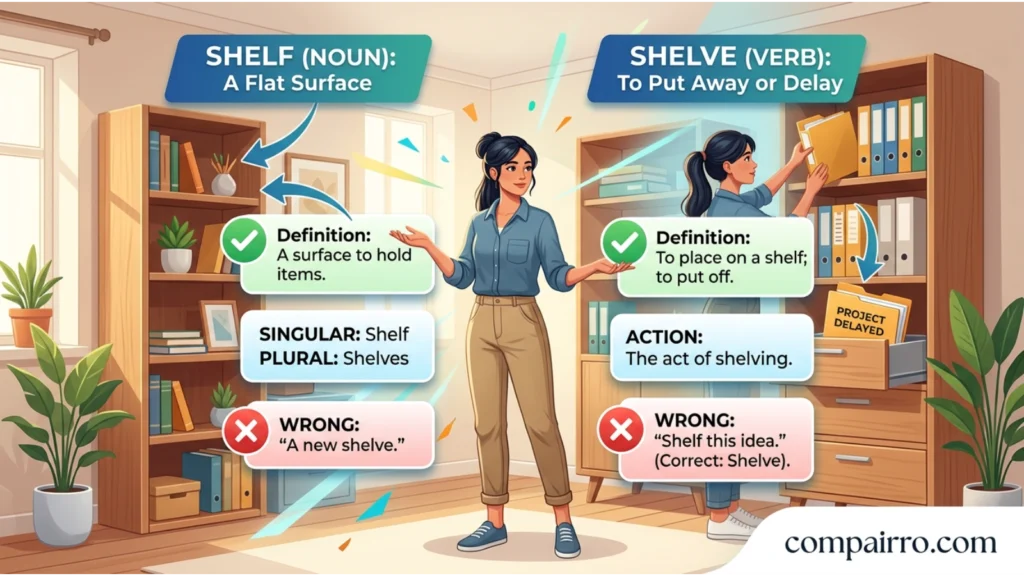
Mistake 1
❌ Please shelf the books.
✔ Use shelve because it is an action.
Correct: Please shelve the books.
Mistake 2
❌ The books are on the shelve.
✔ Use shelf for the object.
Correct: The books are on the shelf.
Mistake 3
❌ We will shelf the project.
✔ Use shelve when postponing something.
Correct: We will shelve the project.
Mistake 4
❌ I bought a new shelve.
✔ The singular noun is shelf.
Correct: I bought a new shelf.
Shelf or Shelve in Everyday Examples

Work
✅ The manager decided to shelve the idea until next year.
✅ The files are stored on the top shelf.
School
✅ Place your books on the classroom shelf.
✅ The teacher asked students to shelve library books properly.
Social Media
✅ Many creators have shelved old content plans.
✅ My favorite books are displayed on a decorative shelf.
Daily Life
✅ We installed a new kitchen shelf.
✅ They had to shelve their vacation plans.
Text Messages
✅ “Can you put this on the shelf?”
✅ “We may have to shelve that idea for now.”
Shelf or Shelve – Google Trends & Usage Data
Many people search for shelf or shelve because the words look very similar but serve different purposes.
Common search questions include:
- Is shelve a verb?
- What is the difference between shelf and shelve?
- How do I use shelf in a sentence?
- What does shelve mean in business?
Countries where searches are common include:
- United States
- United Kingdom
- India
- Pakistan
- Canada
- Australia
The confusion usually comes from the fact that one word is a noun and the other is a verb. English learners often want simple explanations and examples.
Comparison Table: Shelf or Shelve
| Feature | Shelf | Shelve |
|---|---|---|
| Part of Speech | Noun | Verb |
| Meaning | Storage surface | Place on shelf or postpone |
| Physical Object | Yes | No |
| Action Word | No | Yes |
| Used in Sentences | The book is on the shelf | Please shelve the book |
| Workplace Usage | Storage | Delay projects |
Shelf or Shelve in Professional Life
Both words appear in professional settings.
Shelf
Professionals use shelf when discussing storage, inventory, products, documents, or office organization.
Example:
✅ Keep the records on the lower shelf.
Shelve
Businesses often use shelve when discussing projects that are delayed.
Example:
✅ Management decided to shelve the plan due to budget issues.
This meaning is very common in meetings and workplace communication.
Shelf or Shelve for Students or Beginners
Many students struggle because the words are nearly identical.
Common confusion includes:
- Thinking shelve is the plural of shelf
- Using shelf as a verb
- Forgetting that shelve means postpone
Easy Learning Tips
- Remember that shelf is a thing.
- Remember that shelve is an action.
- Read example sentences daily.
- Practice using both words in conversations.
The more examples you see, the easier it becomes.
Signs or Characteristics Related to Shelf or Shelve
Characteristics of Shelf
- Physical object
- Used for storage
- Found in homes, schools, and offices
- Holds books, decorations, and supplies
Characteristics of Shelve
- Action word
- Can mean placing items on shelves
- Can mean delaying plans
- Common in workplace discussions
Common Uses
- Organizing books
- Storing products
- Managing projects
- Planning future work
Simple Trick to Remember Shelf or Shelve
👉 Shelf = Stuff
👉 Shelve = Store or Stop for now
Think of it this way:
If you can touch it, it is probably a shelf.
If you are doing something, it is probably shelve.
Examples
✅ The toy is on the shelf.
✅ We decided to shelve the idea.
This simple rule works in most situations.
FAQs:
1. Is shelf a noun or a verb?
Shelf is a noun. It refers to a storage surface.
2. Is shelve a verb?
Yes. Shelve is a verb that means to place something on a shelf or postpone it.
3. What is the difference between shelf and shelve?
Shelf is an object, while shelve is an action.
4. Can shelve mean postpone?
Yes. In business and daily life, shelve often means to delay something.
5. Is shelve formal English?
Yes. It is accepted in both formal and informal writing.
6. Are shelf and shelve used worldwide?
Yes. Both words are commonly used in English-speaking countries.
7. How can I remember the difference?
Remember: Shelf is a thing. Shelve is an action.
Conclusion
Understanding shelf or shelve is easier than it first appears. The key difference is that shelf is a noun, while shelve is a verb. A shelf is something you can see and touch, while shelve describes an action such as storing something or delaying a plan.
This distinction is useful in school, work, writing, and everyday conversations. Once you know the basic rule, you can avoid common mistakes and use both words correctly.
👉 Final memory rule:
Shelf = Object
Shelve = Action
Keep this simple rule in mind, and you’ll always know which word to use.

Sara Taylor is a passionate English content writer who specializes in word meanings, spelling comparisons, and modern slang explanations. She creates easy-to-understand articles that help readers avoid common English mistakes and improve their writing skills. Her content focuses on simple learning, real-life examples, and clear explanations for everyday readers.