Have you ever looked at a chemistry question and wondered if a molecule is polar or nonpolar? If you are studying chemical bonds, molecular shapes, or intermolecular forces, you may have come across the question: Is CCl4 polar or nonpolar?
CCl4 stands for carbon tetrachloride, a chemical compound made of one carbon atom and four chlorine atoms. At first, you might think CCl4 is polar because chlorine attracts electrons more strongly than carbon. This creates polar bonds between carbon and chlorine.
However, there is an important difference between a polar bond and a polar molecule. A molecule’s overall polarity depends on both its bonds and its three-dimensional shape. This is where many students become confused.
CCl4 is a common example in chemistry classes because it helps explain how molecular symmetry affects polarity. Understanding this concept can help you answer exam questions, solve chemistry problems, and understand other molecules such as CO2 and CH4.
You may encounter this topic in school lessons, college chemistry, laboratory discussions, or online educational searches. Once you understand the basic rule, deciding whether a molecule is polar or nonpolar becomes much easier.
In this guide, you’ll learn the meaning, examples, usage, differences, common mistakes, and simple explanations in easy English.
CCl4 Polar or Nonpolar – Quick Answer
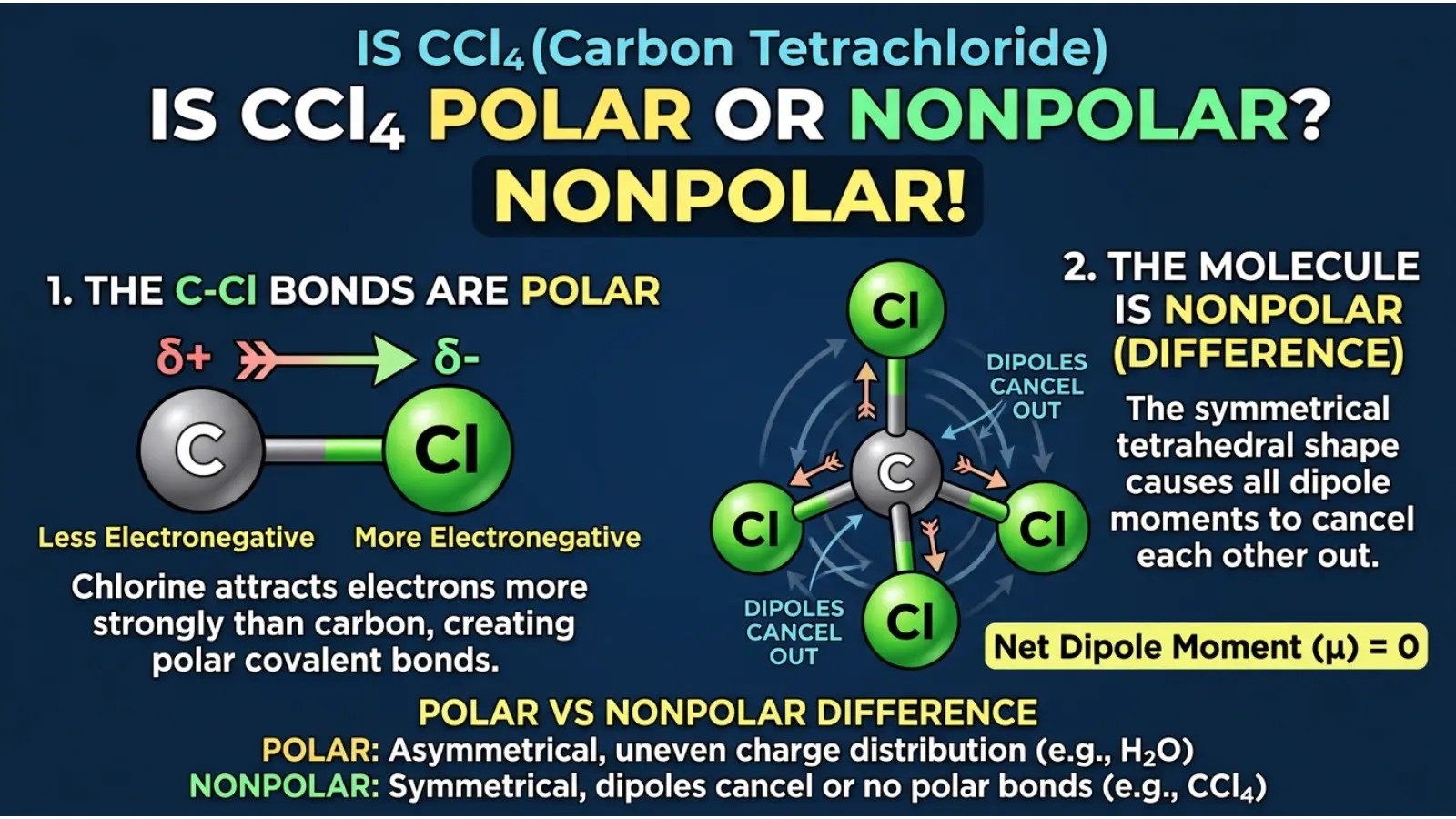
CCl4 is nonpolar. Although each carbon–chlorine bond is polar, the molecule has a symmetrical tetrahedral shape. The bond dipoles cancel each other out, so the molecule has no overall dipole moment.
In simple words, the chlorine atoms pull electrons away from the central carbon atom, but they are arranged evenly in three dimensions. Their individual pulls balance each other.
Examples
- CCl4: Nonpolar because its bond dipoles cancel.
- H2O (water): Polar because its bent shape prevents its bond dipoles from canceling.
- CO2 (carbon dioxide): Nonpolar because its two polar bonds point in opposite directions and cancel.
Simple rule: A molecule’s polarity depends on its bond polarity and molecular shape, not just on the atoms it contains.
The Origin of CCl4
CCl4 is the chemical formula for carbon tetrachloride. The name tells us what the compound contains.
- C: One carbon atom.
- Cl4: Four chlorine atoms.
- Tetra: Four.
- Chloride: Refers to chlorine in the compound’s name.
Carbon tetrachloride is a molecular compound formed from carbon and chlorine. It has been used in industrial applications and laboratory settings, although many uses have been restricted because of its health and environmental risks.
In chemistry education, CCl4 is often used to explain molecular geometry, covalent bonds, and polarity. Its symmetrical structure makes it a useful example of a nonpolar molecule with polar bonds.
British English vs American English Usage
There is no meaningful difference between British and American English when discussing the polarity of CCl4. Both use the same chemical formula and scientific principles.
The main differences involve spelling and pronunciation of certain scientific terms, not the chemistry itself.
| Feature | British English | American English | Notes |
|---|---|---|---|
| Chemical formula | CCl4 | CCl4 | Identical |
| Compound name | Carbon tetrachloride | Carbon tetrachloride | Identical |
| Polarity | Nonpolar | Nonpolar | Same scientific answer |
| Chemistry | Chemistry | Chemistry | Same spelling |
| Molecular shape | Tetrahedral | Tetrahedral | Same structure |
Students in the UK, US, Pakistan, India, Canada, and Australia can use the same explanation in chemistry assignments and exams.
Which One Should You Use? Understanding Polarity
When a chemistry question asks whether CCl4 is polar or nonpolar, the correct answer is nonpolar. To understand why, you need to examine two things: bond polarity and molecular shape.
1. Bond polarity
Chlorine is more electronegative than carbon. This means chlorine attracts shared bonding electrons more strongly.
As a result, each C–Cl bond is polar. The chlorine end has a partial negative charge, while the carbon end has a partial positive charge.
2. Molecular shape
CCl4 has a tetrahedral shape. The carbon atom sits in the center, and the four chlorine atoms are arranged evenly around it.
The bond angles are approximately 109.5 degrees. This arrangement creates a symmetrical molecule.
3. Overall molecular polarity
Each C–Cl bond has a dipole, which represents the direction of unequal electron sharing. However, the four dipoles cancel because of the molecule’s symmetrical arrangement.
Therefore, CCl4 has no overall dipole moment and is classified as nonpolar.
Remember these points:
- Polar bonds: Yes.
- Symmetrical molecular shape: Yes.
- Overall dipole moment: Zero.
- Final classification: Nonpolar.
Common Mistakes With CCl4 Polar or Nonpolar
Students often make a few mistakes when answering this question. Here are four common ones and how to avoid them.
Mistake 1: Thinking polar bonds always make a polar molecule
❌ Incorrect: CCl4 is polar because every C–Cl bond is polar.
✔ Correct: The bonds are polar, but their dipoles cancel because of the molecule’s symmetrical shape.
Mistake 2: Ignoring molecular geometry
❌ Incorrect: The atoms are different, so the molecule must be polar.
✔ Correct: Different atoms can form a nonpolar molecule when their bond dipoles cancel.
Mistake 3: Thinking CCl4 has a bent shape
❌ Incorrect: CCl4 is polar because its bonds point in different directions without balancing.
✔ Correct: CCl4 has a symmetrical tetrahedral shape, not a bent shape.
Mistake 4: Confusing bond polarity with molecular polarity
❌ Incorrect: CCl4 has polar bonds, so its overall dipole moment cannot be zero.
✔ Correct: Bond polarity and molecular polarity are different. The overall dipole moment depends on the combined direction and strength of all bond dipoles.
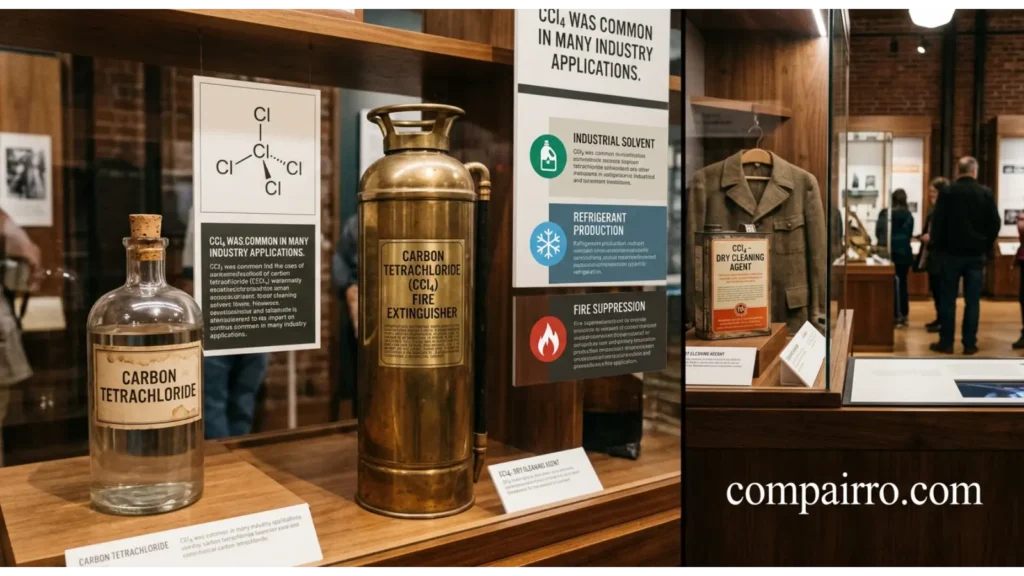
CCl4 in Everyday Examples
Carbon tetrachloride is not a common household chemical today because it can be harmful. However, its molecular structure provides useful examples for learning chemistry.
At school
A teacher may ask, “Is CCl4 polar or nonpolar?” The expected answer is nonpolar because its tetrahedral structure is symmetrical.
In chemistry laboratories
Students may compare CCl4 with water to study how molecular polarity affects physical properties. Such comparisons help explain why different liquids behave differently.
Carbon tetrachloride should only be handled under appropriate professional controls because exposure can harm health.
In online learning
Educational websites and chemistry videos often use CCl4 to show why polar bonds do not always create polar molecules.
In daily chemistry questions
If you are given a molecular formula, look at its Lewis structure, shape, and bond dipoles before deciding whether it is polar or nonpolar.
CCl4 – Google Trends and Usage Data
The keyword “CCl4 polar or nonpolar” is an educational chemistry search. People generally use it to find a direct answer to homework questions, prepare for exams, or understand molecular polarity.
However, without checking live Google Trends data, it is not possible to confirm its exact search volume, current popularity, or leading countries.
Students in the following countries may search for this topic as part of their chemistry studies:
- United States: High school and college chemistry courses.
- United Kingdom: Chemistry lessons and exam preparation.
- India: School chemistry and competitive examinations.
- Pakistan: Matriculation, intermediate, and university chemistry.
- Canada: General and advanced chemistry courses.
- Australia: Secondary school and university science studies.
Search interest may change around school exams and academic terms. Related searches often include “CCl4 molecular geometry,” “why is CCl4 nonpolar,” “CCl4 Lewis structure,” and “polar bonds vs polar molecules.”
These are related learning topics, not verified search-volume rankings.

Comparison Table: CCl4 Polar or Nonpolar?
The following table compares CCl4 with other common molecules to make the concept easier to understand.
| Molecule | Bond Polarity | Molecular Shape | Overall Polarity |
|---|---|---|---|
| CCl4 | Polar bonds | Tetrahedral | Nonpolar |
| H2O | Polar bonds | Bent | Polar |
| CO2 | Polar bonds | Linear | Nonpolar |
| NH3 | Polar bonds | Trigonal pyramidal | Polar |
| CH4 | Nonpolar bonds or very weak bond polarity | Tetrahedral | Nonpolar |
| CH3Cl | Polar bonds | Tetrahedral around carbon | Polar |
The main lesson is that molecular shape matters. CCl4 and CH4 are both tetrahedral and symmetrical, while H2O and NH3 have shapes that lead to an overall dipole moment.
CCl4 in Professional Life
Understanding CCl4 polarity is useful in chemistry, chemical engineering, materials science, and laboratory education.
Polarity helps scientists understand how molecules interact with one another. It can influence solubility, boiling points, and other physical properties.
For example, carbon tetrachloride is generally classified as a nonpolar solvent. Historically, it has been used in some industrial and laboratory applications, but its serious health risks and environmental effects have led to restrictions on many uses.
Chemistry students should understand both its molecular properties and its safety concerns. Its nonpolar nature does not mean it is safe to handle.
CCl4 for Students or Beginners
If you are new to chemistry, the words “electronegativity,” “dipole,” and “tetrahedral” may sound difficult. You can understand CCl4 polarity by learning these three ideas.
Step 1: Learn electronegativity
Electronegativity means how strongly an atom attracts shared electrons in a chemical bond. Chlorine attracts bonding electrons more strongly than carbon.
Step 2: Understand dipoles
A dipole forms when electrons are shared unequally. Each C–Cl bond has a dipole pointing toward chlorine.
Step 3: Learn the molecular shape
CCl4 has four chlorine atoms arranged evenly around one central carbon atom. The four bond dipoles cancel in three dimensions.
Easy learning tips
- Draw the molecule’s Lewis structure.
- Identify whether its bonds are polar.
- Determine its three-dimensional shape.
- Check whether the bond dipoles cancel.
- State the final polarity clearly.
This method works for many other molecules, too.
Signs or Characteristics Related to CCl4 Polarity
CCl4 has several important features that explain why it is nonpolar.
- Chemical formula: CCl4.
- Number of atoms: Five in total.
- Central atom: Carbon.
- Bond type: Covalent.
- Bond polarity: Each C–Cl bond is polar.
- Molecular shape: Tetrahedral.
- Molecular symmetry: Symmetrical.
- Overall dipole moment: Zero.
- Molecular classification: Nonpolar.
- Solvent behavior: Generally behaves as a nonpolar solvent.
- Safety: Toxic and hazardous; it must not be treated as a safe household chemical.
The most important characteristic is its symmetrical shape. Without considering the three-dimensional arrangement, it is easy to reach the wrong conclusion.
Simple Trick to Remember CCl4 Polar or Nonpolar
Here is an easy way to remember the answer:
CCl4 = Polar bonds + Symmetrical shape = Nonpolar molecule.
Think of four people pulling equally in four balanced directions. Although each person applies a force, the total force can be zero when everything balances.
Similarly, the four C–Cl bond dipoles balance each other in CCl4.
Compare this with water. Its bent shape means its bond dipoles do not cancel, so water is polar.
Remember these two examples:
- CCl4: Symmetrical tetrahedral shape → nonpolar.
- H2O: Bent shape → polar.
The key is to examine the complete molecule rather than looking only at its individual bonds.
FAQs:
1. Is CCl4 polar or nonpolar?
CCl4 is nonpolar because its four polar C–Cl bond dipoles cancel due to its symmetrical tetrahedral shape.
2. Why is CCl4 nonpolar if chlorine is more electronegative than carbon?
Chlorine attracts shared electrons more strongly, making each C–Cl bond polar. However, the four bond dipoles cancel, leaving no overall dipole moment.
3. Does CCl4 have polar bonds?
Yes. Each carbon–chlorine bond is polar because carbon and chlorine have different electronegativities.
4. What is the molecular shape of CCl4?
CCl4 has a tetrahedral molecular shape, with four chlorine atoms arranged around a central carbon atom.
5. What is the dipole moment of CCl4?
The net molecular dipole moment of ideal CCl4 is zero because the four bond dipoles cancel through symmetry.
6. Is CCl4 soluble in water?
CCl4 is only very slightly soluble in water. Its nonpolar nature means it does not mix well with polar water, although solubility is not determined by polarity alone.
7. Is CCl4 a safe chemical to use?
No. Carbon tetrachloride is toxic and can damage the liver, kidneys, and other organs. It also harms the environment, so it should not be used casually or handled without appropriate professional controls.
Conclusion
So, is CCl4 polar or nonpolar? The correct answer is nonpolar.
Carbon tetrachloride contains four polar carbon–chlorine bonds, but its symmetrical tetrahedral shape causes the bond dipoles to cancel. As a result, the molecule has no overall dipole moment.
When answering similar chemistry questions, remember to check both bond polarity and molecular geometry. A molecule can have polar bonds and still be nonpolar overall.
Final memory rule: Polar bonds do not always mean a polar molecule. In CCl4, the symmetrical shape makes the whole molecule nonpolar.

Sara Taylor is a passionate English content writer who specializes in word meanings, spelling comparisons, and modern slang explanations. She creates easy-to-understand articles that help readers avoid common English mistakes and improve their writing skills. Her content focuses on simple learning, real-life examples, and clear explanations for everyday readers.