Imagine you are studying chemistry and see the formula NaOH in your textbook. Your teacher asks, “Is NaOH an acid or a base?” If you are new to chemistry, you may find this question confusing. However, the answer becomes easy when you understand what NaOH is and how it behaves in water.
People search for “naoh acid or base” because they want a simple answer for homework, exams, laboratory work, or general science learning. Some students confuse NaOH with acids because both acids and bases are important chemical substances. Others may not know what the letters Na, O, and H mean in its formula.
NaOH is commonly known as sodium hydroxide. It is used in many industries, including soap making, paper production, and chemical manufacturing. You may also hear it called caustic soda.
Understanding whether NaOH is an acid or a base helps you learn more about pH, chemical reactions, and neutralization. It is also important to remember that sodium hydroxide can cause serious burns, so it must be handled carefully in laboratories.
In this guide, you’ll learn the meaning, examples, usage, differences, common mistakes, and simple explanations in easy English.
NAOH Acid or Base – Quick Answer
NaOH is a strong base, not an acid. Its full name is sodium hydroxide. When NaOH dissolves in water, it separates into sodium ions (Na⁺) and hydroxide ions (OH⁻). The hydroxide ions make the solution basic.
In simple words, NaOH is a chemical substance that acts as a strong base in water.
Examples:
- NaOH: A strong base commonly used in chemical manufacturing.
- HCl: Hydrochloric acid, a strong acid.
- KOH: Potassium hydroxide, another strong base.
Simple rule: If you see NaOH in a basic chemistry question, remember that it is a strong base.
The Origin of NaOH
NaOH is the chemical formula for sodium hydroxide. Its name comes from the elements and ions that form the compound.
- Na: Sodium
- O: Oxygen
- H: Hydrogen
- OH: The hydroxide group
Sodium hydroxide has been used for many years in soap making and industrial processes. It is also known as caustic soda because it can damage skin and other materials.
Today, NaOH is an important chemical in laboratories, factories, and many manufacturing processes.
British English vs American English Usage
There is no difference between British and American English when it comes to the chemical formula NaOH. It means sodium hydroxide in both forms of English.
The scientific name, chemical formula, and classification remain the same worldwide.
| Feature | British English | American English | Notes |
|---|---|---|---|
| Chemical formula | NaOH | NaOH | Same formula |
| Chemical name | Sodium hydroxide | Sodium hydroxide | Same name |
| Classification | Strong base | Strong base | Same scientific meaning |
| Common name | Caustic soda | Caustic soda | Also called lye in some contexts |
| Scientific use | Chemistry and industry | Chemistry and industry | Same uses |
Therefore, students in the UK, US, Pakistan, India, Canada, and Australia can use the same scientific explanation.
Which One Should You Use?
When studying NaOH, you should identify it as a strong base. The correct explanation depends on the question you are answering.
Use the following guidance:
- For school exams: Write that NaOH is a strong base.
- For chemistry homework: Explain that it produces hydroxide ions in water.
- For pH questions: Remember that an ordinary aqueous NaOH solution has a pH above 7 at 25°C.
- For chemical equations: Show NaOH separating into Na⁺ and OH⁻ ions in water.
- For laboratory work: Follow proper safety rules because sodium hydroxide is corrosive.
NaOH is not an acid simply because its formula contains hydrogen. Its chemical behavior is what determines its classification.
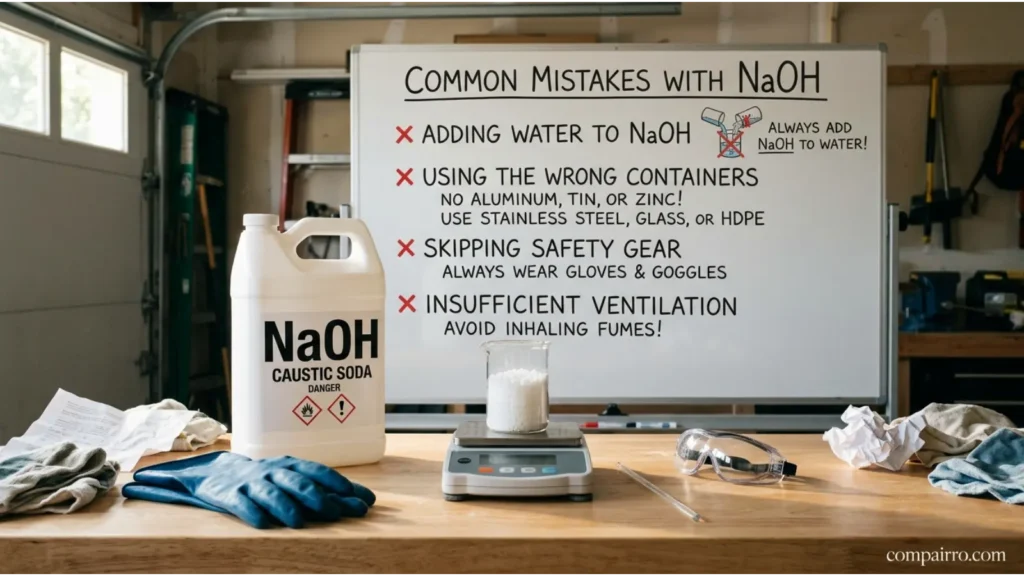
Common Mistakes With NaOH
Students often make a few mistakes when learning about acids and bases. Here are four common ones.
Mistake 1: Thinking NaOH Is an Acid
❌ Incorrect: NaOH is an acid because it contains hydrogen.
✔ Correct: NaOH is a strong base. In water, it releases hydroxide ions.
Mistake 2: Confusing NaOH With HCl
❌ Incorrect: NaOH and HCl are both strong acids.
✔ Correct: NaOH is a strong base, while HCl is a strong acid.
Mistake 3: Thinking Every Substance Containing OH Is a Base
❌ Incorrect: Every chemical containing oxygen and hydrogen must be a base.
✔ Correct: The presence of an OH group alone does not always determine whether a substance is a base. Its chemical structure and behavior matter.
Mistake 4: Confusing Strength With Concentration
❌ Incorrect: Every NaOH solution is equally concentrated because NaOH is a strong base.
✔ Correct: Strength and concentration are different ideas. NaOH is a strong base, but its concentration depends on how much is dissolved in a given amount of solution.
NaOH in Everyday Examples
Sodium hydroxide has several practical uses. However, it is not safe to handle it casually at home.
1. Work and Industry
NaOH is used in industrial processes such as:
- Making soap and detergents.
- Producing paper and textiles.
- Manufacturing other chemicals.
- Controlling acidity in certain industrial processes.
2. School and Chemistry Labs
Students learn about NaOH when studying acids, bases, pH, and neutralization.
For example, sodium hydroxide reacts with hydrochloric acid to form sodium chloride and water.
\[ \mathrm{NaOH + HCl \rightarrow NaCl + H_2O} \]
This is an example of a neutralization reaction.
3. Daily Life
Sodium hydroxide may be used in the production of some cleaning products and soap. Certain drain cleaners also contain it.
However, concentrated NaOH can cause severe chemical burns. Never touch it directly or mix it with other cleaning products.
4. Online Learning
Students often search for phrases such as “Is NaOH acid or base?”, “NaOH pH value,” and “Why is sodium hydroxide a strong base?” These questions help learners understand chemical properties and prepare for exams.

NAOH – Google Trends and Usage Data
The keyword “naoh acid or base” is mainly an educational search term. People commonly use it to find quick answers to chemistry questions.
The search intent is usually informational rather than commercial.
Common reasons for searching include:
- Finding out whether NaOH is an acid or a base.
- Preparing for chemistry tests and exams.
- Learning about sodium hydroxide and its properties.
- Understanding pH and neutralization reactions.
- Checking homework answers.
Students and science learners in the US, UK, India, Pakistan, Canada, and Australia may search for this topic as part of their chemistry studies.
However, exact search volumes and country rankings require current keyword research or Google Trends data. Without checking those figures, it would be misleading to claim that one country searches for this keyword more than another.
Comparison Table: NaOH Acid or Base?
The easiest way to understand NaOH is to compare it with common acids and bases.
| Chemical | Chemical Name | Type | Main Feature |
|---|---|---|---|
| NaOH | Sodium hydroxide | Strong base | Produces OH⁻ ions in water |
| HCl | Hydrochloric acid | Strong acid | Produces H₃O⁺ ions in water |
| KOH | Potassium hydroxide | Strong base | Produces OH⁻ ions in water |
| H₂SO₄ | Sulfuric acid | Strong acid | Donates protons in aqueous reactions |
| NH₃ | Ammonia | Weak base | Reacts with water to form OH⁻ ions |
| CH₃COOH | Acetic acid | Weak acid | Partially ionizes in water |
This table shows that NaOH belongs to the base group, while HCl and sulfuric acid belong to the acid group.
NaOH in Professional Life
Sodium hydroxide plays an important role in several industries. Its strong basic properties make it useful in controlled chemical processes.
Some major applications include:
- Soap manufacturing: It reacts with fats and oils to help produce soap.
- Paper production: It helps process wood materials.
- Textile production: It is used in certain fabric-processing steps.
- Chemical manufacturing: It helps produce a range of chemical products.
- Water treatment: It can be used to adjust pH in controlled systems.
Professionals must use proper protective equipment and follow workplace safety procedures when working with NaOH.

NaOH for Students or Beginners
If you are a beginner, the best way to learn about NaOH is to understand three basic ideas.
First, learn its name. NaOH stands for sodium hydroxide.
Second, remember its type. Sodium hydroxide is a strong base because it separates into ions almost completely in water.
Third, understand its reaction. NaOH can react with an acid to produce salt and water in a neutralization reaction.
Here are some easy learning tips:
- Write NaOH and HCl side by side to remember the difference.
- Practice identifying acids and bases from their formulas.
- Learn the difference between strong and weak acids or bases.
- Remember that a substance’s behavior matters more than simply looking for hydrogen or oxygen in its formula.
For exams, a useful short answer is: “NaOH is a strong base because it dissociates in water to produce hydroxide ions.”
Signs or Characteristics Related to NaOH
Sodium hydroxide has several important chemical and physical properties.
- Strong base: It is classified as a strong base in water.
- White solid: Pure sodium hydroxide is usually a white solid at room temperature.
- Water-soluble: It dissolves readily in water.
- Corrosive: It can damage skin, eyes, and other materials.
- Heat-producing dissolution: Dissolving NaOH in water releases heat.
- Neutralization: It reacts with acids to form salt and water under suitable conditions.
- Industrial uses: It is used in soap making, paper production, and chemical manufacturing.
Remember that concentrated sodium hydroxide solutions can be dangerous. Its solutions should never be tested by touching or tasting them.
Simple Trick to Remember NaOH
Here is an easy memory trick:
NaOH = Sodium Hydroxide = Strong Base
Think of it this way:
- NaOH: Strong base.
- HCl: Strong acid.
- KOH: Strong base.
You can also remember the hydroxide ion, OH⁻, which is the key reason NaOH acts as a base in water.
For example, if an exam asks, “Is NaOH acid or base?”, you can answer:
“NaOH is a strong base because it dissociates in water to produce sodium ions and hydroxide ions.”
This short explanation gives both the answer and the scientific reason.
FAQs:
1. Is NaOH an acid or a base?
NaOH is a strong base. Its full chemical name is sodium hydroxide.
2. Why is NaOH called a strong base?
NaOH is called a strong base because it dissociates almost completely into sodium and hydroxide ions when dissolved in water.
3. What is the full form of NaOH?
NaOH stands for sodium hydroxide. It contains sodium, oxygen, and hydrogen.
4. Is NaOH a strong acid?
No. NaOH is a strong base, not an acid.
5. What is the pH of NaOH?
An aqueous NaOH solution generally has a pH above 7 at 25°C. The exact pH depends on its concentration.
6. Does NaOH react with acids?
Yes. NaOH reacts with acids in neutralization reactions. For example, it reacts with HCl to form sodium chloride and water.
7. Is sodium hydroxide dangerous?
Yes. Sodium hydroxide is corrosive and can cause serious skin and eye burns. It must be handled using proper safety equipment and procedures.
Conclusion
So, is NaOH acid or base? The answer is simple: NaOH is a strong base, also known as sodium hydroxide or caustic soda.
It dissolves in water and produces sodium ions and hydroxide ions. This property explains why it acts as a base and why it is useful in neutralization reactions, soap making, and many industrial processes.
For students, the most important point is to remember the difference between NaOH and common acids such as HCl.
Final memory rule: NaOH = strong base; HCl = strong acid.

Sara Taylor is a passionate English content writer who specializes in word meanings, spelling comparisons, and modern slang explanations. She creates easy-to-understand articles that help readers avoid common English mistakes and improve their writing skills. Her content focuses on simple learning, real-life examples, and clear explanations for everyday readers.