Have you ever stopped while writing a sentence because you were unsure whether to use that or which? You are not alone. Many English learners, students, and even experienced writers find these two words confusing. They look similar because both can introduce extra information about a person, place, thing, or idea. However, they do not always work in the same way.
Understanding that or which is important when writing school assignments, emails, blog posts, business documents, and social media content. Choosing the right word can make your sentences clearer and easier to understand. It can also help you avoid common grammar mistakes.
For example, should you write “The book that I bought” or “The book which I bought”? Are both sentences correct? What about commas? Does British English follow different rules from American English?
The answers depend on the type of sentence you are writing. In many cases, both words can be correct, but they may follow different punctuation rules or create a slightly different meaning. Learning a few simple rules can make this topic much easier.
Whether you are preparing for an English test, improving your writing skills, or creating content for a website, knowing when to use each word will help you communicate more clearly.
In this guide, you’ll learn the meaning, examples, usage, differences, common mistakes, and simple explanations in easy English.
That or Which – Quick Answer
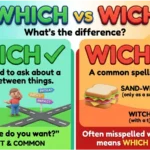
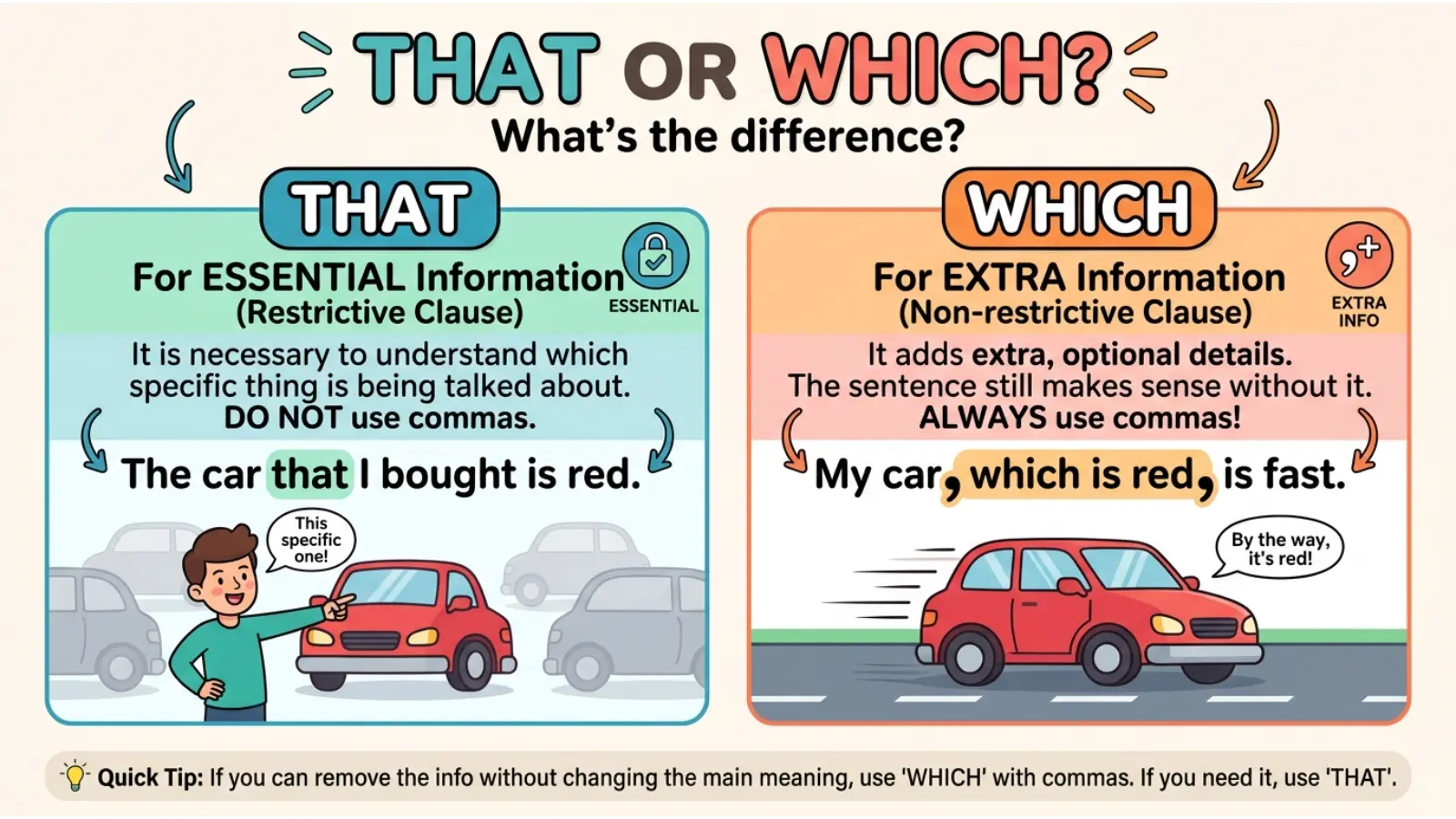
That and which are words used to give information about something. The main difference is that that usually introduces essential information, while which often introduces extra information set apart by commas.
- That: The phone that has a cracked screen is mine.
- Which: My phone, which has a cracked screen, still works.
In the first sentence, the information helps identify the phone. In the second, the sentence already identifies the phone, and the cracked screen is additional information.
Simple rule
- Use that for information that is needed to identify something.
- Use which for extra information, usually with commas in standard American English.
Remember that which can also appear in questions, such as “Which phone is yours?”

The Origin of That or Which
The words that and which have been part of English for many centuries.
The word that developed from old English forms and has long been used to point to something or introduce information about it. Today, it has several roles in a sentence, including acting as a demonstrative word and a relative pronoun.
The word which also comes from Old English. It developed into a word used to ask questions and connect additional information to a noun.
As English grammar developed, writers and grammar guides established different ways to use these words. In modern American English, many style guides recommend using that for essential information and which for nonessential information.
Online writing, social media, and search engines have made clear grammar more important for students, bloggers, and professionals. However, the basic difference between the two words remains the same.
British English vs American English Usage
The rules for that and which are similar in British and American English, but there is an important difference in common writing styles.
American English style guides often prefer that in essential clauses and which in nonessential clauses. British English allows which in some essential clauses more freely.
An essential clause gives information needed to identify the noun. A nonessential clause adds information that can be removed without changing the main meaning.
| Feature | British English | American English | Notes |
|---|---|---|---|
| Essential information | That or which | Usually that | Both may be grammatically possible in British usage |
| Extra information | Which, with commas | Which, with commas | Common in both varieties |
| Comma before which | Depends on meaning | Usually used for extra information | Punctuation matters |
| Formal writing | Both words are used | That is often preferred for essential clauses | Follow the chosen style guide |
| Everyday speech | Both are common | Both are common | Context determines the choice |
Example in British English: The car which I bought last year is blue.
Example in American English: The car that I bought last year is blue.
Both sentences can be understood easily. If you are writing for an American audience, using that for essential information is a safe choice.
Which One Should You Use?
Choosing between that and which becomes easier when you understand the purpose of the information in your sentence.
Use that when information is essential
Use that when the information helps the reader understand exactly which person or thing you mean.
Examples:
- The cake that you made tastes delicious.
- The student that won the prize is my friend.
- The website that ranks first gets many visitors.
- The shoes that I ordered have arrived.
In each example, the clause helps identify the specific person or thing.
Use which when information is extra
Use which when you want to add information that is not necessary to identify the noun. In this case, place commas around the extra information when it appears in the middle of a sentence.
Examples:
- My laptop, which I bought last year, still works well.
- Lahore, which is a major city in Pakistan, has many historic places.
- The exam, which was held on Monday, was difficult.
The main sentences still make sense without the extra clauses.
What about formal and informal writing?
- School assignments: Follow the grammar rules taught by your teacher.
- Academic writing: Use clear, consistent punctuation.
- Workplace emails: Choose the wording that makes your message easy to understand.
- Blog posts and SEO articles: Use the correct word naturally rather than forcing keywords.
- Casual conversations: Both words may appear, depending on the sentence.

Common Mistakes With That or Which
Here are five common mistakes to avoid when using these words.
Mistake 1: Using which without the right punctuation
❌ My car which is red belongs to my brother.
✔ My car, which is red, belongs to my brother.
Explanation: If the information is extra, use commas to set it apart.
Mistake 2: Using that for extra information
❌ My phone, that I bought yesterday, is expensive.
✔ My phone, which I bought yesterday, is expensive.
Explanation: In standard American English, which is normally used for a nonessential clause set apart by commas.
Mistake 3: Thinking which is always wrong in essential clauses
❌ The sentence “The book which I borrowed is interesting” is always incorrect.
✔ The book that I borrowed is interesting.
Explanation: The second sentence is a safe choice in American English. However, the first sentence is also accepted in British English and other varieties.
Mistake 4: Forgetting that punctuation can change meaning
❌ The employees which arrived early received a reward.
✔ The employees who arrived early received a reward.
Explanation: When referring to people, who is often the better choice. The correct use of that or which depends on whether you are referring to people or things and what information you want to give.
Mistake 5: Choosing a word without checking the sentence
❌ This is the restaurant, that serves the best pizza.
✔ This is the restaurant that serves the best pizza.
Explanation: The clause identifies the restaurant, so that is a natural choice in standard American English.
That or Which in Everyday Examples
The easiest way to learn grammar is to see how it works in real situations.
At work
- The report that you sent needs a few changes.
- The meeting, which lasted two hours, ended at noon.
The first sentence identifies the report. The second adds extra information about the meeting.
At school
- The student that answered correctly received a mark.
- The science project, which took three days to finish, won first prize.
The first clause identifies a student. The second gives additional information about a project.
On social media
- The video that you shared was funny.
- My latest post, which I uploaded this morning, has many comments.
Both sentences are natural ways to describe online activity.
In daily life
- The bag that is on the table belongs to me.
- My house, which is near the market, is easy to find.
The first sentence helps someone identify the bag. The second adds information about the house.
In text messages
- “Send me the photo that you took yesterday.”
- “I watched your video, which was really funny.”
These examples show how the words can be used in everyday messages.

That or Which – Google Trends and Usage Data
People search for that or which because they want to improve their grammar, write better sentences, or prepare for English tests.
The topic is especially useful for people learning English as an additional language. Students and content writers often want a quick rule that helps them choose the correct word without making their sentences complicated.
Why do people search for this keyword?
Common reasons include:
- Understanding the difference between that and which.
- Learning when to use commas.
- Preparing for school exams and grammar tests.
- Improving professional emails and reports.
- Writing clearer website content and blog posts.
Usage across different countries
English learners and writers in the following countries may look for explanations of this grammar topic:
- United States: Writers often follow the distinction between essential that clauses and nonessential which clauses.
- United Kingdom: Learners encounter both words in essential clauses, depending on the sentence and writing style.
- India: Students often study this topic as part of English grammar.
- Pakistan: English learners may search for simple explanations and examples for school, college, and competitive exams.
- Canada: Writers use both words, with many formal writing guides following North American conventions.
- Australia: Both words are common, and the correct choice depends on the sentence and the style guide.
These are general observations about English usage, not a verified ranking of countries by search volume.
Google Trends can help compare interest in related search phrases over a selected period and location. Without checking live Trends data, it would be inaccurate to claim that a particular country has the highest search volume or that searches are currently increasing.
Comparison Table: That or Which
Use this table as a quick reference when choosing the right word.
| Feature | That | Which |
|---|---|---|
| Main use | Often introduces essential information | Often introduces extra information |
| Commas | Usually no commas around an essential clause | Usually commas around a nonessential clause |
| Example | The book that I read was useful. | The book, which I read yesterday, was useful. |
| Identifies a specific item | Commonly used | Also possible in some varieties of English |
| Adds extra details | Usually avoided in standard American usage for this purpose | Commonly used |
| Questions | Not normally used to ask “which one?” | Used in questions, such as “Which one is yours?” |
Important: Which is not limited to adding extra information. It also appears in questions and other sentence structures. The essential-versus-extra rule mainly applies when that and which introduce clauses describing a noun.
That or Which in Professional Life
Correct grammar helps you communicate clearly at work. Whether you are writing an email, preparing a report, or publishing an article, the right sentence structure makes your message easier to understand.
Consider these examples:
- “Please review the document that I attached.”
- “The presentation, which includes our latest results, is ready.”
- “We need the file that contains the updated figures.”
- “The website, which was redesigned last month, loads faster now.”
In the first and third examples, the clauses identify specific documents or files. In the second and fourth, the clauses add extra details.
For SEO writers, grammar is one part of creating helpful content. Clear sentences improve the reader’s experience, but using that or which does not automatically improve search rankings. The goal is to write naturally and accurately.
That or Which for Students and Beginners
Students sometimes struggle with these words because the rules can appear confusing at first. They may also learn slightly different guidelines from different teachers or grammar books.
Here are a few simple learning tips:
- Find the noun. Identify the person, place, or thing being described.
- Check the clause. Ask whether the information is needed to identify that noun.
- Look at the commas. Extra information is often separated by commas.
- Read the sentence without the clause. If the main meaning remains clear, the clause may be nonessential.
- Practise with short sentences. Start with books, phones, bags, and other familiar things.
For example:
- The shirt that I bought is blue.
- My shirt, which is blue, is hanging outside.
In the first sentence, that I bought identifies the shirt. In the second, the sentence already identifies the shirt as belonging to the speaker, and its color is extra information.
Signs or Characteristics Related to That or Which
The words have different roles, but you can recognize their common uses by looking for these features.
Characteristics of that
- Often introduces information needed to identify a noun.
- Commonly appears without commas in essential clauses.
- Works naturally in sentences such as “The key that opens this door is missing.”
- Can also be used as a pointing word, as in “That is my bag.”
Features of Which
- Often introduces extra information about a noun.
- Commonly appears with commas when the clause is nonessential.
- Can be used in questions, such as “Which book do you want?”
- Can refer to things or ideas, as in “The plan, which sounded simple, took a week.”
Characteristics they share
- Both can relate information to a noun.
- Both appear in written and spoken English.
- Both can help connect ideas in a sentence.
- Their correct use depends on the sentence structure and intended meaning.
Remember that that and which have other grammatical uses, so these characteristics are helpful guidelines rather than rules for every possible sentence.
Simple Trick to Remember That or Which
Here is an easy way to remember the main difference:
- That = identifies
- Which = adds extra information
Think of it this way: Imagine that you have three books on a table.
If you say, “Give me the book that has a blue cover,” the words that has a blue cover help the listener choose the correct book.
Now imagine that you are holding one book and say, “This book, which has a blue cover, is my favorite.” The listener already knows which book you mean. The cover information is an extra detail.
Try asking yourself two questions before choosing:
- Does this information help identify the thing? If yes, that is often the best choice in American English.
- Is this information just an extra detail? If yes, use which and separate the clause with commas.
This simple trick will help you make better choices in most everyday sentences.
FAQs:
1. What is the main difference between that and which?
That usually introduces essential information, while which often introduces extra information separated by commas in standard American English.
2. Is that or which grammatically correct?
Both can be correct. The right choice depends on the sentence, the type of clause, and the style of English you are using.
3. Should I use a comma before which?
Use a comma when which introduces nonessential information. Do not add a comma automatically; first check the meaning of the sentence.
4. Can I use which instead of that?
Sometimes. British English commonly allows which in essential clauses, while American English style guides generally prefer that in those cases.
5. Can that refer to people?
Yes, that can refer to people in some essential clauses, such as “The student that won the prize is my friend.” However, who is often preferred when referring to people.
6. Is which always used with commas?
No. Which can appear in questions and essential clauses without commas. The punctuation depends on its role in the sentence.
7. How can I remember when to use that or which?
Remember that that often identifies something, while which often adds extra information. Then check the sentence structure and punctuation.
Conclusion
Understanding that or which does not have to be difficult. Both words connect ideas, but they can serve different purposes when describing a noun.
In standard American English, use that for essential information and which for extra information, usually with commas. British English allows more flexibility in some essential clauses, so you may see both words used differently across books and websites.
The most useful memory rule is simple: that identifies, while which often adds extra information. Check the meaning of your sentence, use punctuation carefully, and practise with everyday examples. With time, choosing between these words will become much easier.

Sara Taylor is a passionate English content writer who specializes in word meanings, spelling comparisons, and modern slang explanations. She creates easy-to-understand articles that help readers avoid common English mistakes and improve their writing skills. Her content focuses on simple learning, real-life examples, and clear explanations for everyday readers.