Have you ever written a sentence like, “The pain was bareable” and then wondered if the spelling was correct?
Many people search for bareable or bearable because the two words look and sound very similar. This confusion is common among students, office workers, writers, and even native English speakers.
You may see this word in school assignments, workplace emails, social media posts, text messages, books, or online articles. Since English contains many words that sound alike but have different spellings, it is easy to make mistakes.
Understanding the correct spelling matters because using the wrong word can make your writing look less professional. Whether you are writing an essay, sending an email, posting on social media, or chatting with friends, knowing the correct form helps you communicate clearly.
The good news is that the answer is simple. One spelling is correct in standard English, while the other is usually considered a spelling mistake.
In this guide, you’ll learn the meaning, examples, usage, differences, common mistakes, and simple explanations in easy English.
Bareable or Bearable – Quick Answer
👉 Bearable is the correct spelling.
👉 Bareable is generally considered a misspelling and is not recognized as a standard English word.
Bearable means:
- Something that can be tolerated
- Something that is not too difficult, painful, or unpleasant
- Something you can endure
Examples
1 The weather became more bearable after sunset.
2 The pain was bearable, so I did not need medicine.
3 Her workload was difficult but still bearable.
Simple Rule
👉 Bearable comes from the word “bear,” which means to carry or endure.
If you can bear something, it is bearable.
The Origin of Bareable or Bearable
The word bearable comes from the Old English word bearan, which means “to carry,” “support,” or “endure.”
Over time, English speakers began using bearable to describe situations, pain, weather, stress, and other things that a person could tolerate.
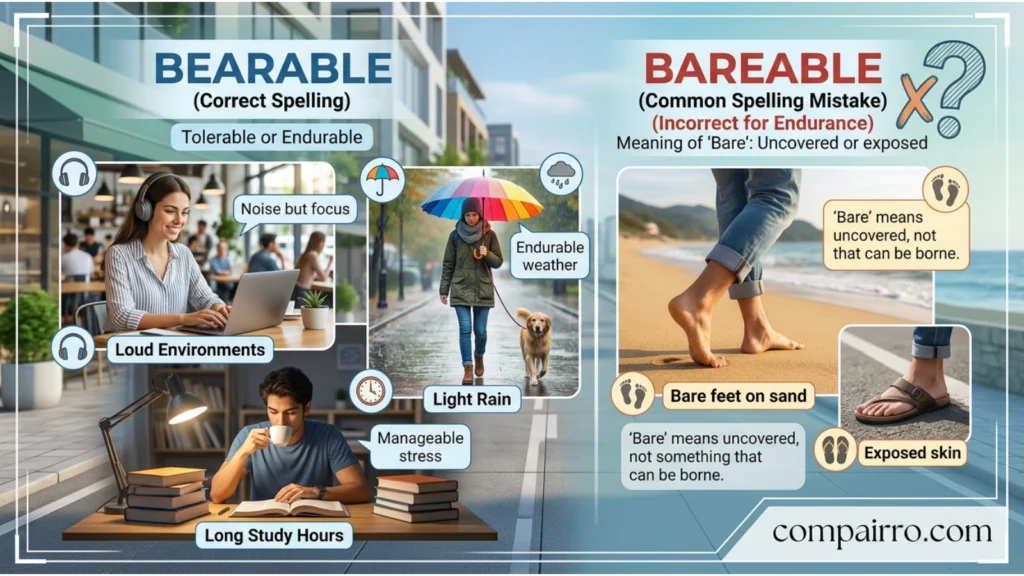
The spelling bareable likely appeared because people confused it with the word bare, which means uncovered or naked. However, bare has no connection to enduring or tolerating something.
Today, dictionaries, schools, businesses, and professional writers use bearable as the correct form.
British English vs American English Usage
Unlike some English words, there is no spelling difference between British and American English for this word.
Both countries use bearable.
| Feature | British English | American English | Notes |
|---|---|---|---|
| Correct spelling | Bearable | Bearable | Same spelling |
| Meaning | Tolerable | Tolerable | Same meaning |
| Formal usage | Yes | Yes | Accepted everywhere |
| Bareable | Incorrect | Incorrect | Usually a spelling error |
Conclusion: The usage is the same worldwide.
Which One Should You Use?
You should always use bearable when talking about something that can be tolerated.
Use Bearable For:
- Pain levels
- Weather conditions
- Work stress
- School workload
- Difficult situations
- Emotional challenges
Formal Situations
1 Academic writing
2 Business emails
3 Reports
4 Professional communication
Informal Situations
1 Text messages
2 Social media posts
3 Casual conversations
❌ Avoid using bareable, as it is considered incorrect.
Common Mistakes With Bareable or Bearable
Mistake 1
❌ The heat was bareable today.
✔ The heat was bearable today.
Mistake 2
❌ This workload is barely bareable.
✔ This workload is barely bearable.
Mistake 3
❌ The pain became more bareable after treatment.
✔ The pain became more bearable after treatment.
Mistake 4
❌ She remained calm because the stress was bareable.
✔ She remained calm because the stress was bearable.
Mistake 5
❌ Bareable means something you can tolerate.
✔ Bearable means something you can tolerate.
Bareable or Bearable in Everyday Examples
Work
✅ The meeting was long but still bearable.
✅ The deadline pressure was difficult yet bearable.
School
✅ The homework load was bearable this week.
✅ The exam was challenging but bearable.
Social Media
✅ Monday mornings are only bearable with coffee.
✅ The waiting time was finally bearable.
Daily Life
✅ The traffic was bearable because it moved slowly.
✅ The cold weather became bearable after wearing a jacket.
Text Messages
✅ “The movie was okay. It was bearable.”
✅ “The headache is bearable now.”
Bareable or Bearable – Google Trends & Usage Data

Many people search for bareable or bearable because they hear the word more often than they write it.
Since both spellings sound nearly identical, confusion happens frequently.
Why People Search It
- Spelling uncertainty
- School assignments
- Workplace writing
- English learning
- Social media posts
- Search engine corrections
Popular Countries Searching This Term
- United States
- United Kingdom
- India
- Pakistan
- Canada
- Australia
Search Trends
Search interest remains steady because English learners and native speakers continue to confuse the spelling.
Google often suggests bearable when users type bareable.
Internet Popularity
The word commonly appears in:
- Blogs
- News articles
- Reviews
- Health discussions
- Social media posts
- Educational websites
Comparison Table: Bareable or Bearable
| Feature | Bareable | Bearable |
|---|---|---|
| Is it a standard English word? | No | Yes |
| Dictionary accepted? | No | Yes |
| Correct spelling? | No | Yes |
| Used professionally? | No | Yes |
| Means tolerable? | No | Yes |
| Recommended for writing? | No | Yes |
Bareable or Bearable in Professional Life
In professional environments, correct spelling is important.
Using bearable correctly helps create a positive impression in:
- Emails
- Reports
- Presentations
- Business communication
- Customer support messages
Examples
✅ The workload is challenging but bearable.
✅ The project timeline remains bearable.
Using bareable may appear as a spelling mistake and reduce the professionalism of your writing.
Bareable or Bearable for Students or Beginners
Students often struggle with this word because both spellings seem logical.
Common Confusion
People see:
- Bear = animal
- Bare = uncovered
As a result, they accidentally choose the wrong spelling.
Easy Learning Tips
- Remember that bear also means “to endure.”
- Connect bearable with “able to endure.”
- Practice writing the word in sentences.
- Read examples regularly.
Beginner Example
✅ The situation was difficult but bearable.
Think: I can bear it.
Signs or Characteristics Related to Bearable
Things described as bearable often share these characteristics:
Typical Features
- Not too painful
- Not too stressful
- Can be managed
- Can be tolerated
- Temporary discomfort
- Within a person’s limits
Common Uses
- Physical pain
- Emotional stress
- Weather conditions
- Work pressure
- School challenges
- Waiting times
Common Expressions
- Barely bearable
- More bearable
- Less bearable
- Quite bearable
- Still bearable
Simple Trick to Remember Bareable or Bearable
👉 Bear = Endure
👉 Bearable = Able to endure
Think of it this way:
If you can bear it, it is bearable.
Examples:
- You can bear the heat → The heat is bearable.
- You can bear the pain → The pain is bearable.
- You can bear the stress → The stress is bearable.
Another memory trick:
👉 Bearable contains the word “bear.”
Since bear means endure, bearable is the correct spelling.
FAQs:
Is bareable a real English word?
No. It is generally considered a misspelling of bearable.
Which spelling is correct: bareable or bearable?
Bearable is the correct spelling.
What does bearable mean?
It means something that can be tolerated or endured.
Why do people write bareable?
Because it sounds almost identical to bearable when spoken.
Can I use bearable in formal writing?
Yes. It is acceptable in academic, professional, and everyday writing.
Is bearable used in British and American English?
Yes. Both varieties use the same spelling.
What is an example of bearable?
“The weather became more bearable after the rain stopped.”
Conclusion
The answer to bareable or bearable is simple: bearable is the correct spelling, while bareable is usually a spelling mistake.
The word bearable means something that can be tolerated, endured, or managed. It is commonly used to describe pain, stress, weather, workloads, and difficult situations.
The easiest rule to remember is:
👉 If you can bear it, it is bearable.
Keep that simple memory trick in mind, and you’ll never confuse bareable or bearable again.

Sara Taylor is a passionate English content writer who specializes in word meanings, spelling comparisons, and modern slang explanations. She creates easy-to-understand articles that help readers avoid common English mistakes and improve their writing skills. Her content focuses on simple learning, real-life examples, and clear explanations for everyday readers.