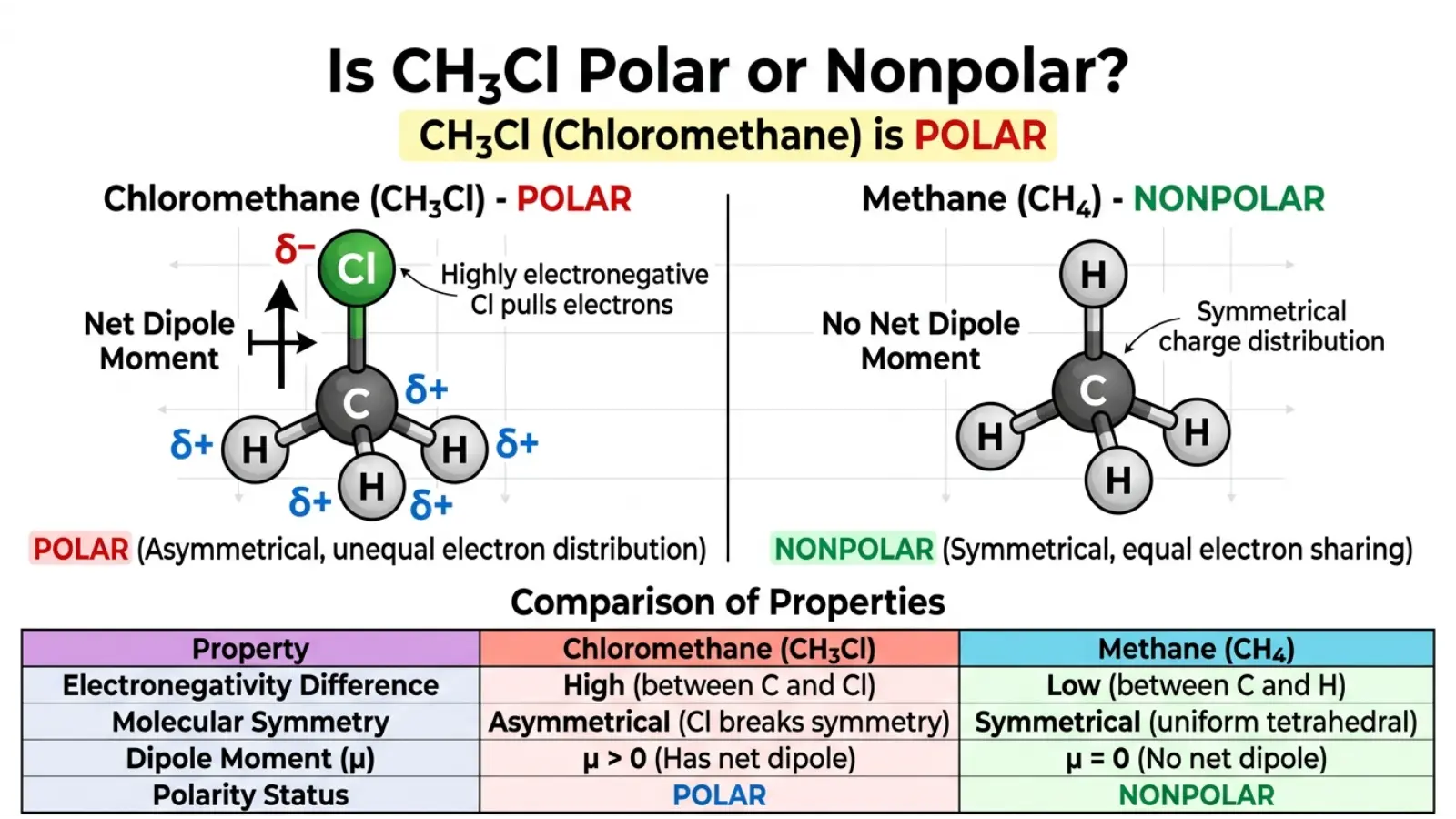
CH3Cl Polar or Nonpolar is a popular chemistry question for students learning molecular polarity, electronegativity, and molecular geometry. Understanding whether chloromethane (CH3Cl) is polar or nonpolar helps explain how atoms share electrons and how molecular shape affects charge distribution. So, is CH3Cl polar or nonpolar? The answer is simple: CH3Cl is a polar molecule.
One common question students ask is, “Is CH3Cl polar or nonpolar?” You may see this question in school assignments, chemistry textbooks, online quizzes, or exam preparation materials. Although the formula looks simple, its answer depends on how electrons are shared between atoms and how those atoms are arranged.
CH3Cl is the chemical formula for chloromethane, also called methyl chloride. It contains one carbon atom, three hydrogen atoms, and one chlorine atom. The difference in how these atoms attract electrons makes the molecule polar.
However, there is more to understand than just memorizing the answer. You should also know why CH3Cl is polar, how its molecular shape affects its polarity, and how it differs from nonpolar molecules such as CH4.
Learning these ideas will help you solve similar chemistry questions with confidence. It will also make topics such as electronegativity, dipole moments, and molecular geometry easier to understand.
CH3Cl Polar or Nonpolar – Quick Answer
CH3Cl is a polar molecule. Its carbon–chlorine bond is polar because chlorine attracts shared electrons more strongly than carbon. The molecule’s shape does not allow the bond dipoles to cancel completely, so CH3Cl has a net dipole moment.
In simple words, the electrons are not shared equally throughout the molecule.
Examples:
- CH3Cl: Polar molecule because its bond dipoles do not cancel.
- CH4: Nonpolar molecule because its symmetrical shape causes its bond dipoles to cancel.
- H2O: Polar molecule because its bent shape creates an uneven distribution of charge.
Simple rule: A molecule is polar when its bond dipoles do not cancel each other out.
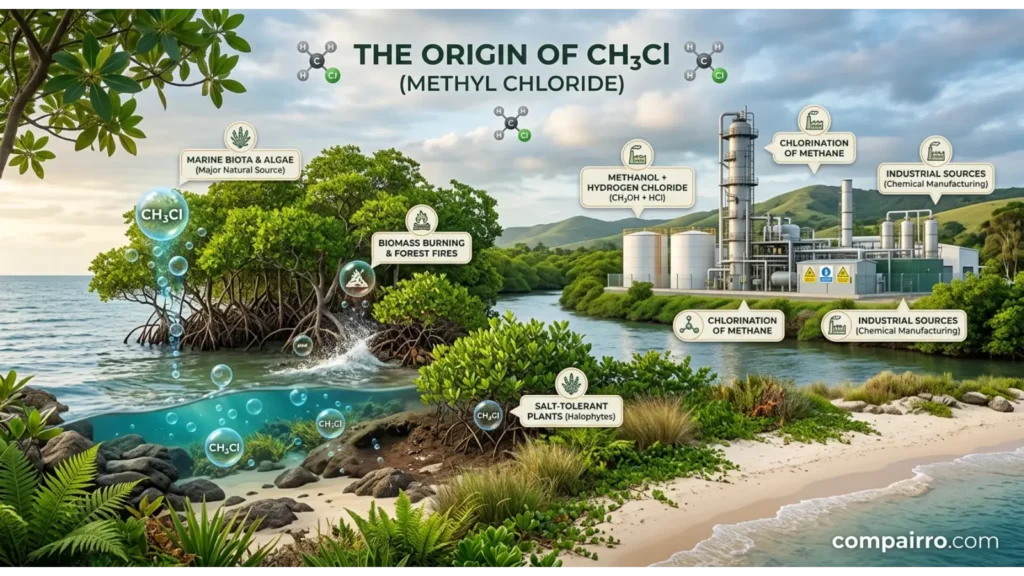
The Origin of CH3Cl
CH3Cl is the chemical formula for chloromethane, an organic compound made of carbon, hydrogen, and chlorine.
The compound is also known as methyl chloride. Its name comes from the methyl group (CH3) attached to a chlorine atom.
Chloromethane is a colorless gas under normal room conditions. It has been used in industrial processes, including chemical manufacturing and certain refrigeration applications. Its uses are subject to safety and environmental controls.
The question of whether CH3Cl is polar comes from the study of chemical bonding. Scientists examine how atoms share electrons and how the arrangement of atoms affects the distribution of electrical charge.
British English vs American English Usage
The chemistry answer is the same in British English and American English. CH3Cl is polar regardless of the language or country in which it is studied.
Some chemistry terms may have different spellings, but the scientific meaning remains unchanged.
| Feature | British English | American English | Notes |
|---|---|---|---|
| Chemical formula | CH3Cl | CH3Cl | Same formula |
| Compound name | Chloromethane | Chloromethane | Same name |
| Polarity | Polar | Polar | Same scientific result |
| Chemical behavior | Same | Same | Not affected by spelling |
| Common study term | Dipole moment | Dipole moment | Same concept |
Students in the UK, US, India, Pakistan, Canada, and Australia can use the same scientific explanation.
Which One Should You Use?
If you are answering a question about CH3Cl polarity, the correct answer is polar.
Here is how to explain it in different situations:
- In a school exam: Write that CH3Cl is polar because the C–Cl bond is polar and the bond dipoles do not cancel.
- In a chemistry assignment: Explain the role of electronegativity and molecular geometry.
- In a multiple-choice question: Select “polar molecule.”
- In a science discussion: Use terms such as bond dipole, net dipole moment, and molecular polarity.
- When comparing molecules: Remember that CH4 is nonpolar, while CH3Cl is polar.
For a complete answer, do not simply write “chlorine is more electronegative.” Also explain that the molecule’s overall dipole moment is not zero.
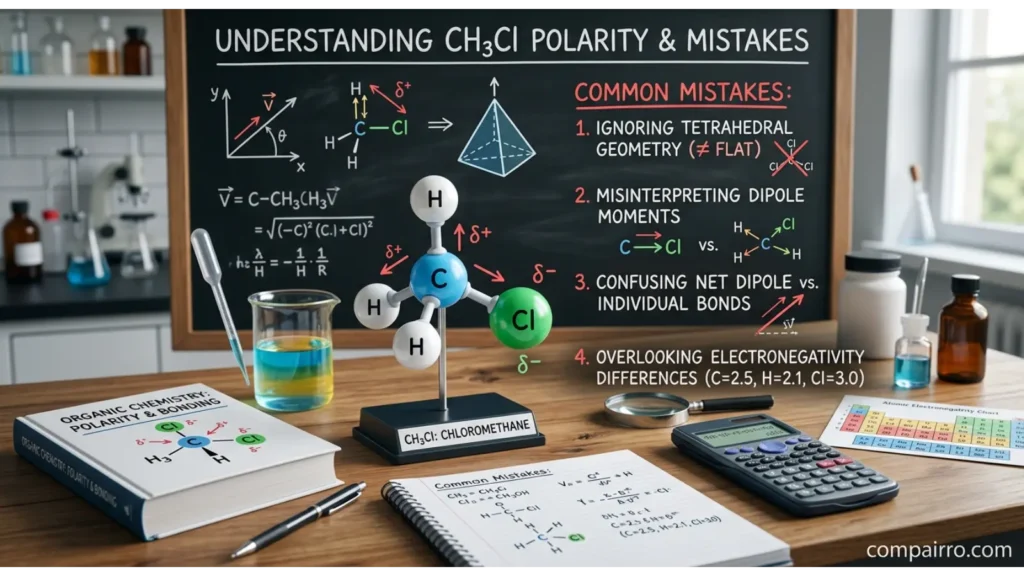
Common Mistakes With CH3Cl Polarity
Students often understand individual chemical bonds but become confused when deciding whether the entire molecule is polar. Here are four common mistakes to avoid.
Mistake 1: Saying CH3Cl Is Nonpolar
❌ Incorrect: CH3Cl is nonpolar because it contains carbon and hydrogen.
✔ Correct: CH3Cl is polar because chlorine attracts electrons more strongly than carbon, and the bond dipoles do not cancel.
Mistake 2: Thinking Every Bond Is Polar
❌ Incorrect: Every bond in CH3Cl is equally polar.
✔ Correct: The C–Cl bond is clearly polar. The C–H bonds have much smaller electronegativity differences. Their contributions must still be considered when determining the molecule’s overall polarity.
Mistake 3: Ignoring Molecular Shape
❌ Incorrect: A polar bond always makes the entire molecule polar.
✔ Correct: Molecular shape matters. In some molecules, bond dipoles cancel because of symmetry. In CH3Cl, they do not cancel completely.
Mistake 4: Confusing CH3Cl With CH4
❌ Incorrect: CH3Cl and CH4 are both nonpolar because they contain carbon and hydrogen.
✔ Correct: CH4 is symmetrical and nonpolar. CH3Cl has one chlorine atom replacing a hydrogen atom, so its charge distribution is uneven and the molecule is polar.
CH3Cl in Everyday Examples
Molecular polarity is not something you can usually see directly. However, it helps explain how substances interact with other molecules.
At School
A student may be asked to identify whether CH3Cl is polar or nonpolar during a chemistry lesson.
Example: “CH3Cl is polar because its net dipole moment is not zero.”
In Chemistry Homework
A homework question may ask you to compare CH3Cl with CH4.
Example: CH3Cl is polar, whereas CH4 is nonpolar because of its symmetrical structure.
In Science Videos and Online Learning
Chemistry teachers often use molecular diagrams to show how electrons are distributed.
Example: A diagram showing a partial negative charge near chlorine helps explain the polarity of CH3Cl.
In Daily Life
You are unlikely to encounter pure chloromethane in ordinary household activities. It is mainly important in chemistry and industrial settings.
Its molecular polarity helps scientists understand its physical properties and interactions with other substances.
CH3Cl – Google Trends and Usage Data
People search for “CH3Cl polar or nonpolar” mainly because they want a quick, clear answer for chemistry homework, tests, or revision.
The query is especially useful for students learning chemical bonds, electronegativity, and molecular geometry.
Students in the following countries may encounter this topic in school or college chemistry:
- United States: Students studying molecular polarity and introductory chemistry.
- United Kingdom: Learners reviewing covalent bonding and molecular structure.
- India: Students preparing for school examinations and competitive chemistry tests.
- Pakistan: Students studying chemistry concepts for board examinations and college courses.
- Canada: Learners studying chemical bonds and molecular properties.
- Australia: Students learning about molecular shape and the distribution of charge.
These are potential audiences for the topic, not a verified ranking of search demand.
Actual Google Trends data would be needed to identify which country has the highest search interest or whether searches have increased over time. No specific search volume or trend ranking is claimed here.
A common reason for searching this keyword is that students confuse the polarity of an individual bond with the polarity of the entire molecule.
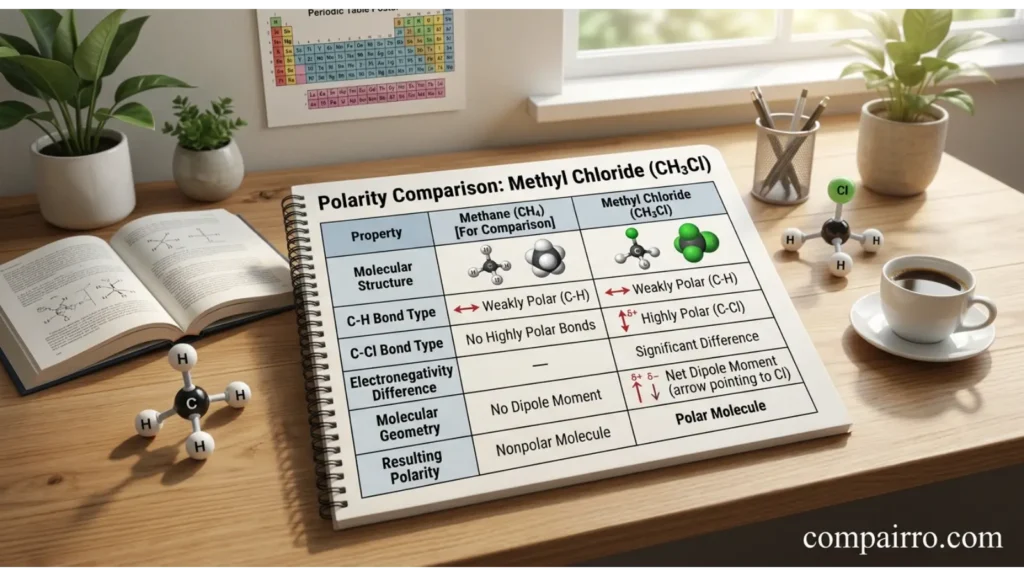
Comparison Table: CH3Cl Polar or Nonpolar?
The easiest way to understand CH3Cl is to compare it with other familiar molecules.
| Molecule | Polar or Nonpolar? | Main Reason |
|---|---|---|
| CH3Cl | Polar | Bond dipoles do not cancel |
| CH4 | Nonpolar | Symmetrical tetrahedral shape |
| H2O | Polar | Bent shape creates a net dipole |
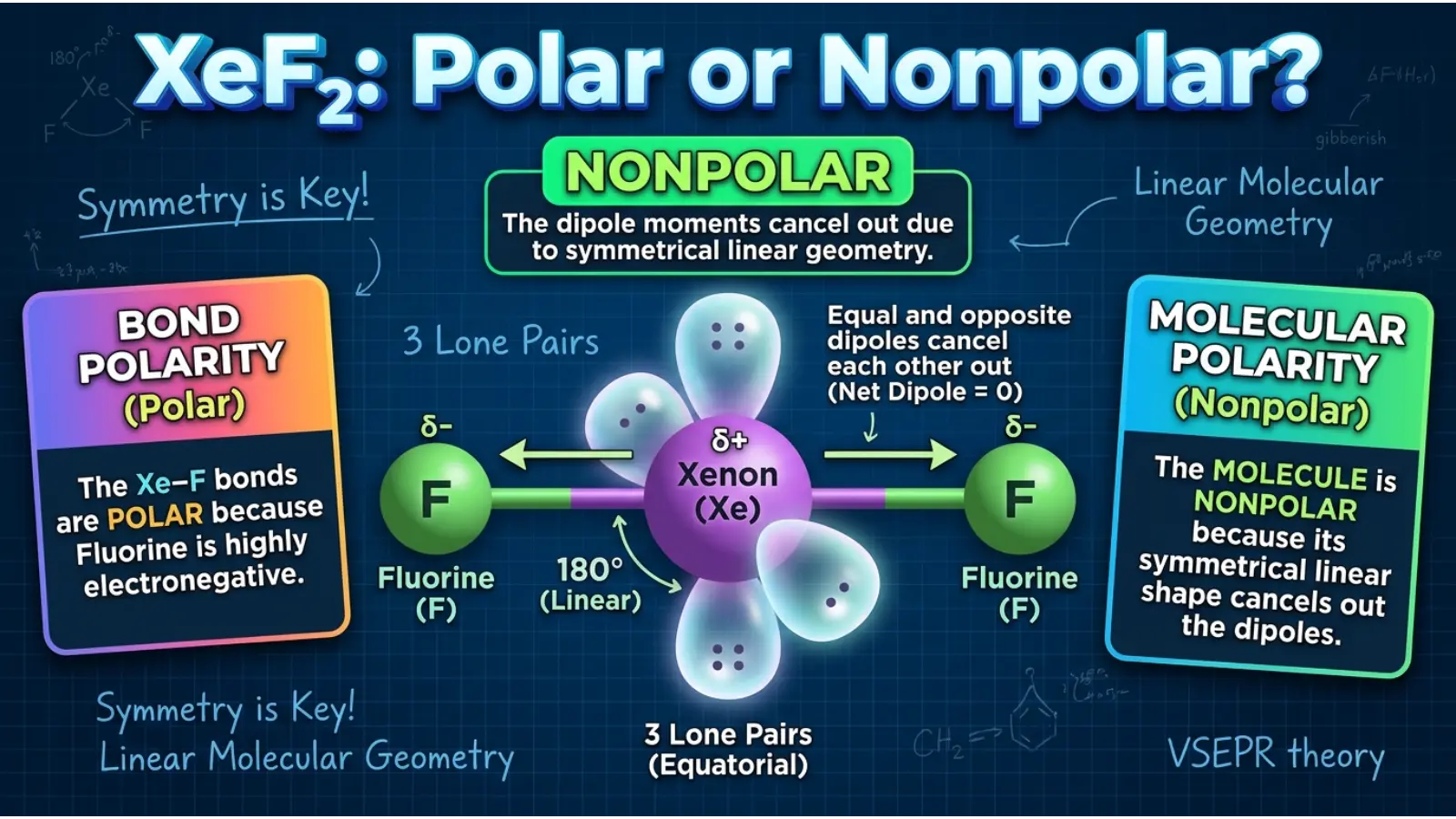
| CO2 | Nonpolar | Linear shape causes bond dipoles to cancel |
| NH3 | Polar | Trigonal pyramidal shape |
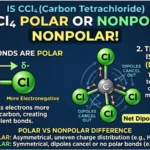
| CCl4 | Nonpolar | Symmetrical tetrahedral structure |
This comparison shows that the number of polar bonds alone does not determine whether a molecule is polar. The arrangement of the bonds is also important.
For example, CO2 has polar C=O bonds, but its linear shape makes their dipoles cancel. CH3Cl has an uneven arrangement of bond dipoles, so it remains polar.
CH3Cl in Professional Life
Understanding molecular polarity is useful in chemistry, chemical engineering, materials science, and laboratory research.
Scientists use polarity to help explain:
- How molecules interact with other molecules.
- Why different substances have different physical properties.
- How molecular structure affects chemical behavior.
- Why some substances mix more easily than others.
- How intermolecular forces influence boiling points and other properties.
For example, chemists consider polarity when studying chloromethane’s physical and chemical properties. However, polarity alone does not determine every property or industrial use of a substance.
Chloromethane must also be handled according to appropriate safety procedures because exposure can be harmful.
CH3Cl for Students or Beginners
If you are learning molecular polarity for the first time, the topic may seem confusing. The good news is that you can solve many polarity questions by following a few simple steps.
Step 1: Identify the Atoms
CH3Cl contains:
- One carbon atom.
- Three hydrogen atoms.
- One chlorine atom.
Step 2: Check Electronegativity
Electronegativity describes how strongly an atom attracts shared electrons.
Chlorine attracts electrons more strongly than carbon. Therefore, the C–Cl bond has an uneven distribution of electrons.
Step 3: Look at the Molecular Shape
The carbon atom has a tetrahedral arrangement of four bonds. Three positions contain hydrogen atoms, while the fourth contains chlorine.
Because chlorine is different from hydrogen, the bond dipoles do not cancel completely.
Step 4: Determine the Overall Polarity
The molecule has a net dipole moment, so CH3Cl is polar.
Easy Learning Tips
- Learn the difference between bond polarity and molecular polarity.
- Practice drawing simple molecular structures.
- Compare CH3Cl with symmetrical molecules such as CH4.
- Remember to consider molecular geometry before choosing an answer.
Signs or Characteristics Related to CH3Cl Polarity
The following features help identify CH3Cl as a polar molecule.
- Unequal electron attraction: Chlorine attracts electrons more strongly than carbon.
- Polar C–Cl bond: The C–Cl bond has an uneven electron distribution.
- Tetrahedral molecular geometry: Carbon forms four bonds arranged approximately tetrahedrally.
- Uneven molecular charge distribution: The chlorine side has greater electron density.
- Nonzero dipole moment: The individual bond dipoles do not cancel completely.
- Partial charges: Chlorine carries a partial negative charge relative to carbon, which carries a partial positive charge along the C–Cl bond.
These characteristics work together to explain why CH3Cl is polar.
Simple Trick to Remember CH3Cl Polarity
Here is an easy way to remember the answer:
CH3Cl = Polar
CH4 = Nonpolar
Think of it this way: CH4 has four hydrogen atoms arranged symmetrically around carbon. Its bond dipoles cancel because of the molecule’s symmetry.
In CH3Cl, one hydrogen atom is replaced by chlorine. This changes the distribution of electrons and breaks the symmetry, leaving a net dipole moment.
A simple memory rule is:
Symmetrical molecules may be nonpolar when their bond dipoles cancel. Uneven molecular arrangements can produce polarity.
Remember that symmetry is a useful clue, but you must also consider bond dipoles to determine molecular polarity correctly.
FAQs:
1. Is CH3Cl polar or nonpolar?
CH3Cl is polar because the C–Cl bond is polar and the molecule’s bond dipoles do not cancel completely.
2. Why is CH3Cl a polar molecule?
Chlorine attracts shared electrons more strongly than carbon. The molecule’s shape creates an uneven charge distribution and a net dipole moment.
3. What is the molecular shape of CH3Cl?
CH3Cl has a tetrahedral arrangement around its central carbon atom, with bond angles close to 109.5 degrees.
4. Is the C–Cl bond polar?
Yes. Chlorine is more electronegative than carbon, so the shared electrons are pulled toward chlorine.
5. Is CH4 polar or nonpolar?
CH4 is nonpolar because its symmetrical tetrahedral shape causes its bond dipoles to cancel.
6. Does CH3Cl have a dipole moment?
Yes. CH3Cl has a nonzero molecular dipole moment because its bond dipoles do not cancel.
7. Is CH3Cl more polar than CH4?
CH3Cl is polar, while CH4 is nonpolar. CH4 has no net molecular dipole moment, whereas CH3Cl does.
Conclusion
So, is CH3Cl polar or nonpolar? CH3Cl is a polar molecule. Its chlorine atom attracts electrons more strongly than carbon, creating a polar C–Cl bond. Because the molecule’s bond dipoles do not cancel, it has a net dipole moment.
The most important lesson is that molecular polarity depends on both bond polarity and molecular shape. A molecule can contain polar bonds but still be nonpolar if the bond dipoles cancel, as seen in CO2.
For a quick chemistry revision, remember this comparison: CH3Cl is polar, while CH4 is nonpolar. Understanding this difference will help you answer other molecular polarity questions more confidently.

Sara Taylor is a passionate English content writer who specializes in word meanings, spelling comparisons, and modern slang explanations. She creates easy-to-understand articles that help readers avoid common English mistakes and improve their writing skills. Her content focuses on simple learning, real-life examples, and clear explanations for everyday readers.