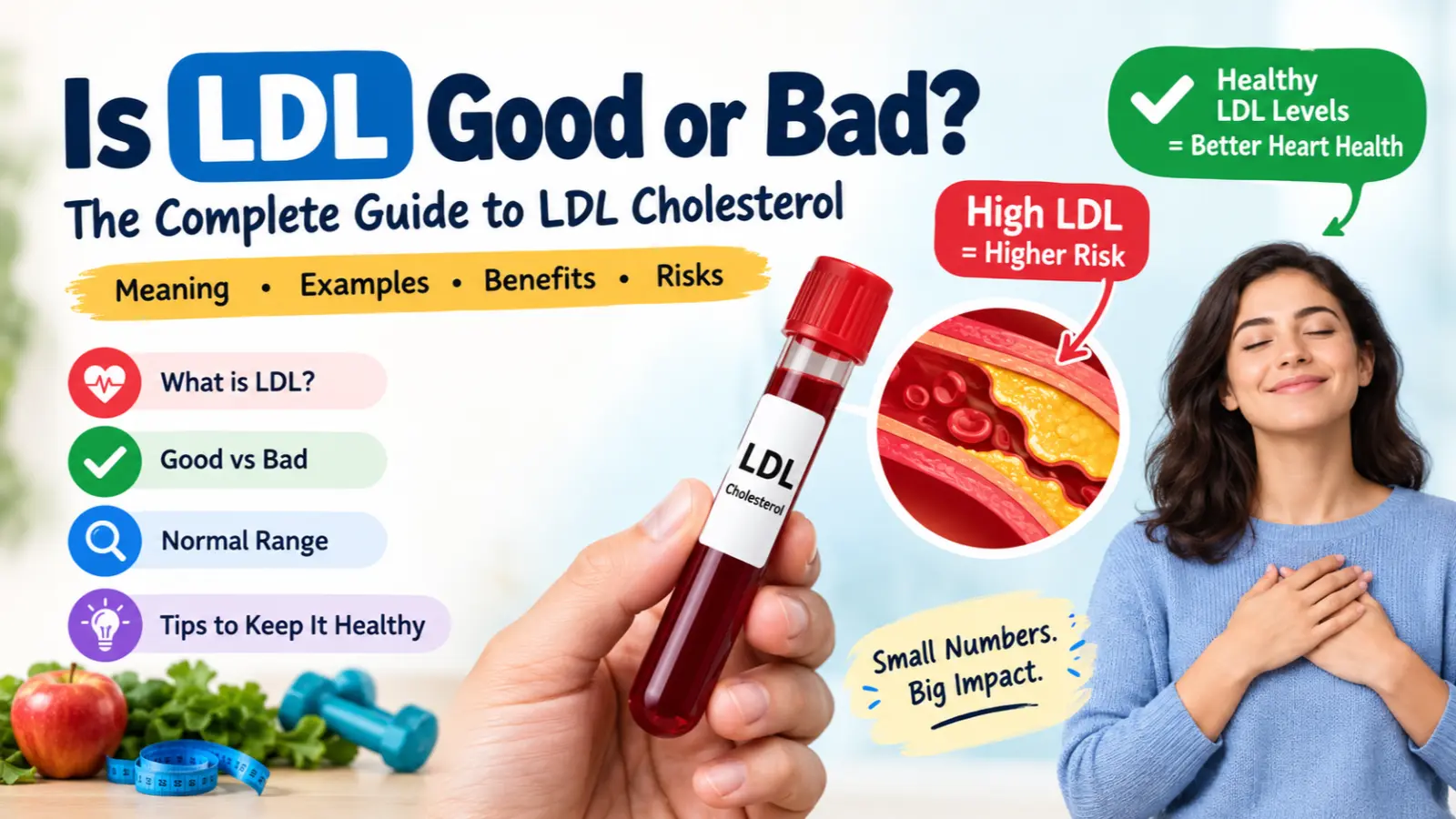
Have you ever received a cholesterol blood test and seen the term LDL on the report? You may wonder, “Is LDL good or bad?” This is a very common question, especially when people see that their LDL number is marked as high or outside the lab’s usual range.
LDL stands for low-density lipoprotein. It is often called “bad cholesterol,” but that name can make the topic sound simpler than it really is. Your body needs cholesterol for important jobs, such as making hormones and building cell membranes. The problem is that too much LDL in the blood can contribute to cholesterol buildup inside artery walls.
That is why doctors look at LDL when checking heart and blood vessel health. However, one LDL number does not tell the whole story. Age, health history, blood pressure, diabetes, smoking, family history, and other cholesterol levels can also matter.
People may search “is LDL good or bad” after a routine blood test, during a school health lesson, while reading a medical report, or after hearing someone talk about cholesterol on social media. The term can also appear in health websites, fitness discussions, and everyday conversations.
Understanding LDL can help you read your blood test more confidently. It can also help you know which questions to ask a healthcare professional.
In this guide, you’ll learn the meaning, examples, usage, differences, common mistakes, and simple explanations in easy English.
IS LDL GOOD OR BAD – QUICK ANSWER
👉 LDL is not simply good or bad. Your body needs cholesterol, but too much LDL cholesterol can increase the risk of heart and blood vessel problems.
Bad Cholesterol carries cholesterol through the bloodstream. When Bad Cholesterol levels are too high over time, cholesterol can build up in artery walls. This can contribute to plaque formation.
For this reason, Bad Cholesterol is commonly called “bad cholesterol.”
Simple examples
- Low or healthy LDL: Often linked with a lower risk of cholesterol-related artery problems.
- High LDL: Can increase the chance of plaque building up in arteries over time.
- Very high LDL: May require medical evaluation, especially when it runs in a family or occurs with other risk factors.
Simple rule
👉 LDL = the cholesterol carrier you usually want to keep from becoming too high.
Remember that the best Bad Cholesterol level can depend on a person’s overall health and heart disease risk. A healthcare professional can explain what a specific result means.
THE ORIGIN OF LDL
LDL is short for low-density lipoprotein. It is a type of lipoprotein, which means it helps carry fats and cholesterol through the blood.
Scientists developed a better understanding of lipoproteins and cholesterol during the 20th century. Research later showed that higher levels of Bad Cholesterol cholesterol are linked with a greater risk of atherosclerosis, a condition in which plaque builds up in artery walls.
The phrase “bad cholesterol” became popular because it gives people an easy way to remember LDL’s role in heart health.
Today, Bad Cholesterol is widely discussed in medical tests, health articles, nutrition education, and online searches.

BRITISH ENGLISH VS AMERICAN ENGLISH USAGE
There is no important British-versus-American difference in the meaning or spelling of LDL.
The abbreviation Bad Cholesterol is used in both British and American English. The phrase “Bad Cholesterol cholesterol” is also widely understood in both.
| Feature | British English | American English | Notes |
|---|---|---|---|
| LDL | LDL | LDL | Same abbreviation |
| Full term | Low-density lipoprotein | Low-density lipoprotein | Same |
| Common phrase | Bad cholesterol | Bad cholesterol | Same |
| Blood test term | LDL cholesterol | LDL cholesterol | Same |
| Spelling | Cholesterol | Cholesterol | Same |
So, whether you are reading a British medical website or an American health article, LDL means the same thing.
WHICH ONE SHOULD YOU USE?
If you are writing or talking about this topic, LDL cholesterol is the clearest term.
Use it when:
- Reading or discussing a blood test.
- Asking a doctor about cholesterol.
- Writing a school health project.
- Reading medical information.
- Discussing heart health.
- Explaining cholesterol to someone else.
For formal or academic writing, it is better to write the full term first:
Low-density lipoprotein (LDL)
After that, you can simply use LDL.
Also, avoid saying that LDL is completely “bad.” A more accurate explanation is that higher LDL levels can increase cardiovascular risk, and the right target depends on the person.

COMMON MISTAKES WITH IS LDL GOOD OR BAD
Mistake 1: Thinking all cholesterol is bad
❌ “All cholesterol is harmful.”
✔ Cholesterol has useful roles in the body. The concern is having unhealthy levels or patterns of blood lipids, especially when Bad Cholesterol is elevated.
Mistake 2: Thinking LDL is always dangerous
❌ “Any amount of Bad Cholesterol is dangerous.”
✔ The body uses cholesterol for important functions. The health concern is mainly elevated LDL over time and the person’s overall risk.
Mistake 3: Looking at LDL alone
❌ “My LDL is normal, so everything about my heart health must be perfect.”
✔ LDL is only one part of a health assessment. Blood pressure, blood sugar, smoking, family history, age, and other factors can also matter.
Mistake 4: Changing medicine without medical advice
❌ “My LDL is high, so I will stop or start medicine myself.”
✔ Never change a prescribed medicine based only on an internet article. Discuss your result and treatment with a qualified healthcare professional.
Mistake 5: Believing one test tells the whole story
❌ “One cholesterol test gives a complete picture of my future health.”
✔ A healthcare professional may consider your test result along with your medical history and other risk factors.
IS LDL GOOD OR BAD IN EVERYDAY EXAMPLES?
Work
Imagine an employee gets a routine health check. Their report includes total cholesterol, HDL, Bad Cholesterol , and triglycerides.
They may ask:
“What does my LDL number mean?”
The correct next step is to discuss the result with a healthcare professional rather than judging the number alone.
School
A student studying biology may learn that cholesterol travels through the blood using lipoproteins.
A simple study note could be:
LDL carries cholesterol around the body and is often called bad cholesterol because higher LDL can contribute to artery plaque.
Social Media
Health videos often use the terms “good cholesterol” and “bad cholesterol.”
These labels can be useful for beginners, but they are simplified. HDL is commonly called “good cholesterol,” while Bad Cholesterol is commonly called “bad cholesterol.” However, cholesterol and heart health are more complex than two simple labels.
Daily Life
Someone may see “Bad Cholesterol” on a blood test and immediately become worried.
Instead, they should look at the complete report and ask a healthcare professional what the result means for them.
Text Messages
If someone texts:
“Is LDL good or bad?”
A simple reply could be:
“LDL is often called bad cholesterol because high LDL can increase the risk of plaque buildup in arteries.”
IS LDL GOOD OR BAD – GOOGLE TRENDS & USAGE DATA
The question “is Bad Cholesterol good or bad” is a natural health-information search. People commonly use questions like this when they want a quick explanation of a medical term.
Search interest can change when people receive blood-test results, read health news, or see cholesterol-related content online.
The exact search volume also changes by country and time. Therefore, it is better not to assume a fixed ranking or search number without checking current Google Trends data.
Interest in Bad Cholesterol -related health information can appear across countries such as:
- United States: Cholesterol testing and heart-health education are common reasons for Bad Cholesterol searches.
- United Kingdom: People may search Bad Cholesterol while reading blood-test results or NHS-related health information.
- India: Growing interest in preventive health can lead people to search cholesterol terms online.
- Pakistan: People may search Bad Cholesterol after seeing cholesterol results or learning about heart health.
- Canada: Bad Cholesterol is commonly discussed in cholesterol and cardiovascular health information.
- Australia: Blood tests and heart-health resources also use Bad Cholesterol terminology.
One reason beginners search this question is that the phrase “bad cholesterol” sounds absolute. In reality, Bad Cholesterol needs to be understood as part of a person’s overall cardiovascular risk.
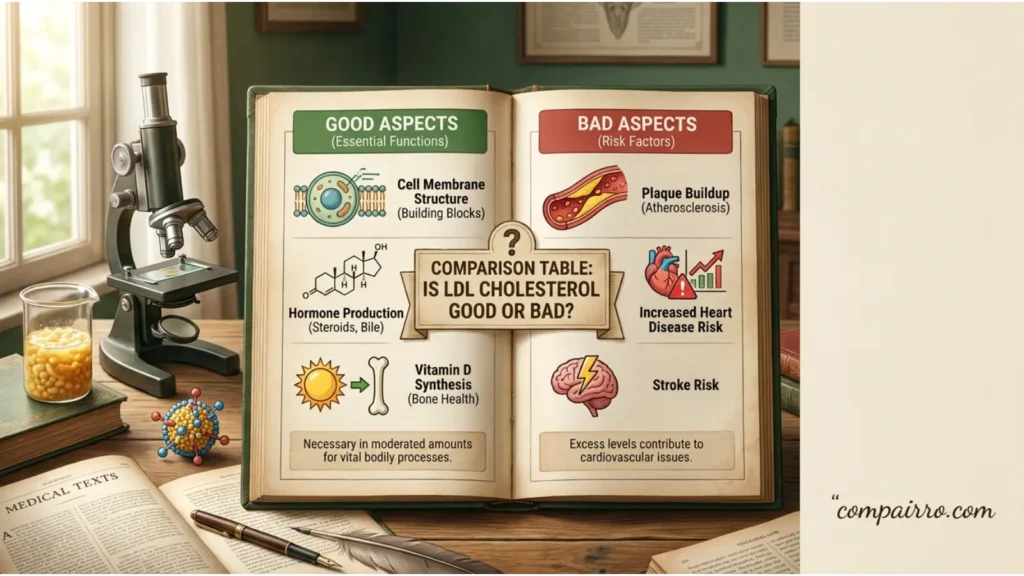
COMPARISON TABLE: IS LDL GOOD OR BAD?
| Factor | LDL | HDL |
|---|---|---|
| Full name | Low-density lipoprotein | High-density lipoprotein |
| Common label | “Bad cholesterol” | “Good cholesterol” |
| Main role | Carries cholesterol through the bloodstream | Helps carry cholesterol back toward the liver |
| Why it matters | Higher levels can contribute to artery plaque | Higher levels are generally associated with better heart health, although the full picture is more complex |
| Is it useful? | Yes, cholesterol has important body functions | Yes, HDL is also part of normal cholesterol transport |
| Should you look at it alone? | No | No |
This table is a simple learning tool. It should not be used to diagnose a health condition or decide treatment.

IS LDL GOOD OR BAD IN PROFESSIONAL LIFE?
LDL is important in many healthcare settings.
Doctors, nurses, laboratory professionals, and dietitians may discuss Bad Cholesterol when reviewing blood-test results. Medical professionals may also look at Bad Cholesterolwhen assessing cardiovascular risk.
For example, a healthcare professional may review:
- Bad Cholesterol
- HDL cholesterol
- Triglycerides
- Total cholesterol
- Blood pressure
- Blood sugar
- Medical history
- Family history
- Other cardiovascular risk factors
This is why a professional does not usually make a health decision from one number alone.
For workplace health programs, Bad Cholesterol may also appear in routine health reports. If you receive such a report, ask a qualified healthcare professional if you are unsure what your numbers mean.
IS LDL GOOD OR BAD FOR STUDENTS OR BEGINNERS?
Beginners often struggle with Bad Cholesterol because cholesterol has several different terms.
You may see LDL, HDL, total cholesterol, and triglycerides on the same report. At first, these names can feel confusing.
Here are some easy learning tips:
- Learn the full name: Bad Cholesterol means low-density lipoprotein.
- Remember the common label: Bad Cholesterol is often called bad cholesterol.
- Understand the reason: Higher Bad Cholesterol can contribute to plaque buildup in arteries.
- Do not study Bad Cholesterol alone: Learn how Bad Cholesterol fits into the wider cholesterol picture.
- Use simple diagrams: A blood vessel diagram can make the idea easier to understand.
- Ask questions: If a real blood-test result concerns you, ask a healthcare professional.
Most importantly, do not compare your blood-test numbers with a friend’s. Health results need to be interpreted in the right personal context.
SIGNS OR CHARACTERISTICS RELATED TO IS LDL GOOD OR BAD
One important point is that high Bad Cholesterol does not cause obvious symptoms.
That means a person can have high Bad Cholesterol and feel completely normal.
Common characteristics of Bad Cholesterol include:
- It is a lipoprotein: Bad Cholesterol helps transport cholesterol through the blood.
- It carries cholesterol: Cholesterol is needed for several normal body functions.
- High LDL can be a risk factor: Elevated Bad Cholesterolcan contribute to plaque buildup in artery walls.
- It often has no clear symptoms: A blood test is commonly needed to measure LDL.
- It can be affected by several factors: Genetics, diet, physical activity, health conditions, and some medicines can affect cholesterol levels.
- It is part of a bigger picture: Healthcare professionals consider LDL along with other risk factors.
- Very high levels may need special attention: Extremely high LDL can sometimes be linked with inherited cholesterol conditions.
If you are concerned about a cholesterol result, it is best to discuss it with a healthcare professional rather than trying to diagnose yourself.
SIMPLE TRICK TO REMEMBER IS LDL GOOD OR BAD
Here is an easy memory trick:
👉 LDL = Usually Lower is better
👉 HDL = Usually Higher is better
Think of it this way:
LDL → “Leave Deposits Lurking”
This is only a memory trick, not a medical definition. It can help you remember that higher LDL can be linked with plaque buildup in arteries.
Another simple phrase is:
LDL: too much can be a problem.
For example, if you see LDL on a blood test, remember:
LDL → low-density lipoprotein → often called bad cholesterol → high levels can increase cardiovascular risk.
FAQs:
1. Is LDL good or bad?
LDL is often called “bad cholesterol” because high LDL can contribute to plaque buildup in arteries. However, cholesterol itself has important functions in the body.
2. What does LDL stand for?
LDL stands for low-density lipoprotein. It is a particle that carries cholesterol through the bloodstream.
3. Is low LDL always better?
Lower LDL is generally associated with lower cardiovascular risk, but the best target depends on a person’s overall health and risk factors.
4. Can high LDL cause symptoms?
High LDL usually does not cause noticeable symptoms. A blood test is commonly used to measure LDL cholesterol.
5. What is the difference between LDL and HDL?
LDL carries cholesterol through the bloodstream and is commonly called bad cholesterol. HDL helps transport cholesterol toward the liver and is commonly called good cholesterol.
6. Should I worry if my LDL is high?
A high LDL result does not automatically mean that something is immediately wrong. However, it is worth discussing with a healthcare professional to understand your overall risk.
7. Can food affect LDL cholesterol?
Yes. Diet can affect cholesterol levels, but genetics, physical activity, health conditions, medicines, and other factors can also play a role.
CONCLUSION
So, is LDL good or bad? The simplest answer is that LDL is often called “bad cholesterol” because higher levels can contribute to plaque buildup in artery walls and increase cardiovascular risk.
However, LDL is not something to fear simply because it exists. Cholesterol has important jobs in the body, and one LDL number should not be viewed by itself.
If your blood test shows an LDL result that concerns you, discuss it with a qualified healthcare professional. They can consider your complete health picture and explain what your result means.

Sara Taylor is a passionate English content writer who specializes in word meanings, spelling comparisons, and modern slang explanations. She creates easy-to-understand articles that help readers avoid common English mistakes and improve their writing skills. Her content focuses on simple learning, real-life examples, and clear explanations for everyday readers.