Have you ever typed a sentence and stopped because you were unsure whether to use leach or leech? You are not alone. These two words look and sound very similar, but they have completely different meanings.
This confusion often happens because both words are pronounced almost the same in everyday English. However, using the wrong one can change the meaning of your sentence. Leach is mainly used as a verb related to liquid passing through a material and carrying substances away. Leech can refer to a blood-feeding animal or a person who takes too much from others.
You may see these words in school, science lessons, workplace writing, online articles, social media posts, or everyday conversations. For example, a science book may explain how water can leach chemicals from soil. On the other hand, someone may call a person a leech if that person keeps taking help, money, or resources without giving anything back.
Understanding leach or leech is important because the spelling is only one letter apart, while the meanings are very different. Once you learn the simple difference, choosing the correct word becomes much easier.
In this guide, you’ll learn the meaning, examples, usage, differences, common mistakes, and simple explanations in easy English.
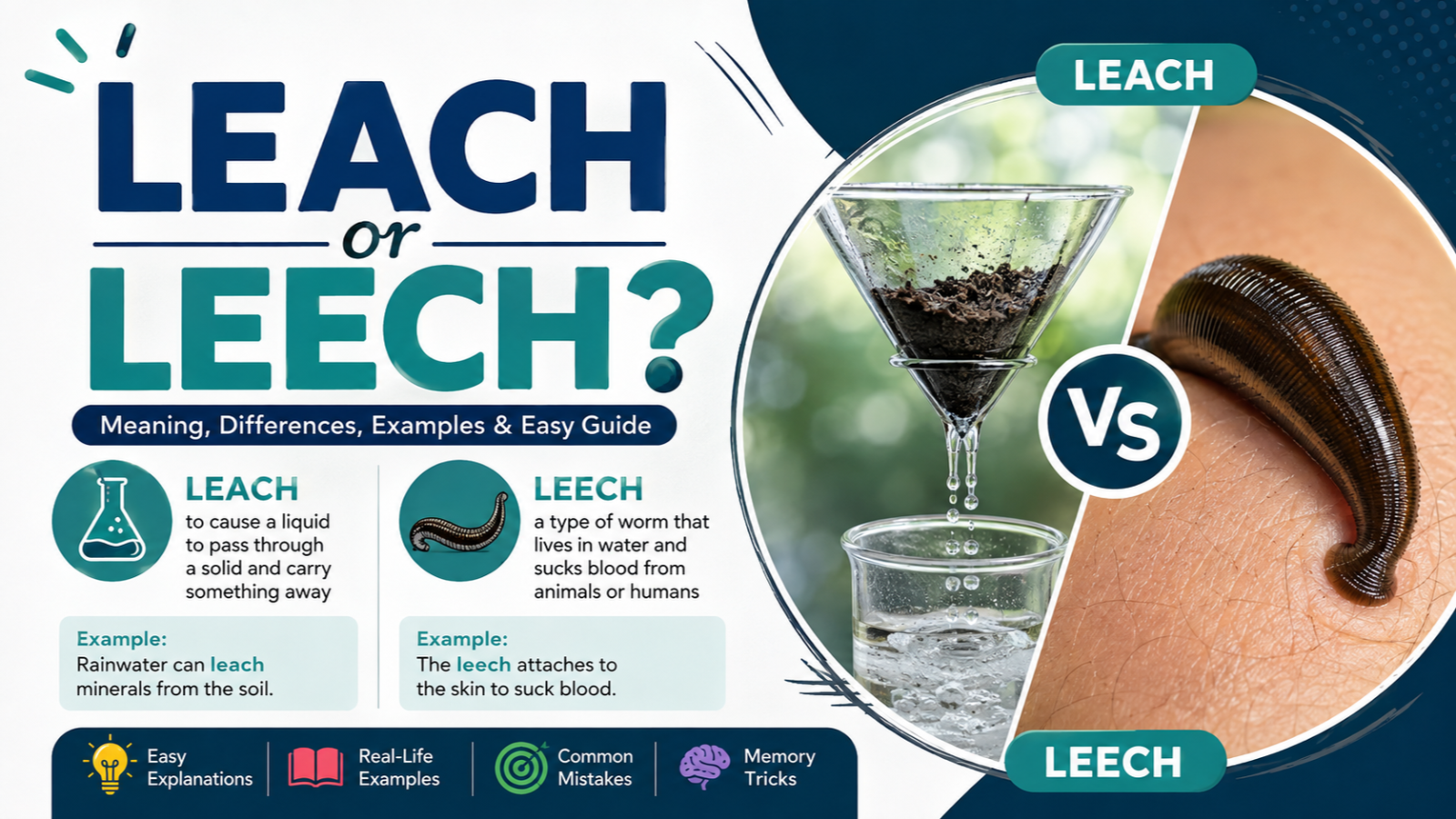
Leach or Leech – Quick Answer
👉 Leach = to remove a substance from something, usually by using liquid.
👉 Leech = a small blood-feeding animal, or a person who takes advantage of others.
Examples
- Water can leach minerals from the soil. ✅
- Farmers must understand how nutrients leach from farmland. ✅
- A leech is a small animal that can attach to animals or people. ✅
- He is acting like a leech by always asking others for money. ✅
Simple rule
👉 Leach = liquid removes something.
👉 Leech = animal or person that takes from others.
Think of leach as something being washed out, while a leech is something that takes.
The Origin of Leach or Leech
The words leach and leech have different histories, even though they look and sound similar.
Leach comes from an old English word connected with washing or filtering. Over time, it became associated with liquid moving through a material and carrying soluble substances away.
For example, when rainwater passes through soil, it can leach certain minerals deeper into the ground.
Leech has a different history. It comes from an Old English word referring to the blood-feeding animal. Leeches have been known for centuries because they attach to animals and feed on blood.
The word leech later developed a figurative meaning. Today, you can call someone a leech when they keep taking money, time, attention, or other benefits from people without giving much in return.
So, although leach or leech can be confusing, their meanings developed separately.

British English vs American English Usage
There is no major spelling difference between British and American English for these words. Both varieties use leach and leech in the same basic ways.
| Feature | British English | American English | Notes |
|---|---|---|---|
| Leach | Leach | Leach | Same spelling and meaning |
| Leech | Leech | Leech | Same spelling and meaning |
| Pronunciation | Similar | Similar | Usually pronounced nearly the same |
| Scientific use | Common | Common | Especially with soil and chemicals |
| Figurative use | Common | Common | Usually refers to a person who takes advantage |
The important point is that this is not a British vs American spelling issue. The correct choice depends on the meaning you want.
Which One Should You Use?
Choose between leach or leech based on what you are trying to say.
Use leach when:
- A liquid removes a substance from soil or another material.
- A substance is washed or carried away by liquid.
- You are writing about chemistry, soil, farming, or environmental science.
- You are using the word as a verb.
Example:
Rainwater can leach nutrients from the soil.
Use leech when:
- You mean the small blood-feeding animal.
- You describe someone who constantly takes from others.
- You are using the word as a noun.
- You are writing in a casual or figurative context.
Example:
The doctor explained how a leech feeds on blood.
Formal vs informal use
Leach is common in scientific and technical writing, especially when discussing soil, water, chemicals, and pollution.
Leech is common in biology and everyday speech. Its figurative meaning can sound negative or insulting when used for a person.
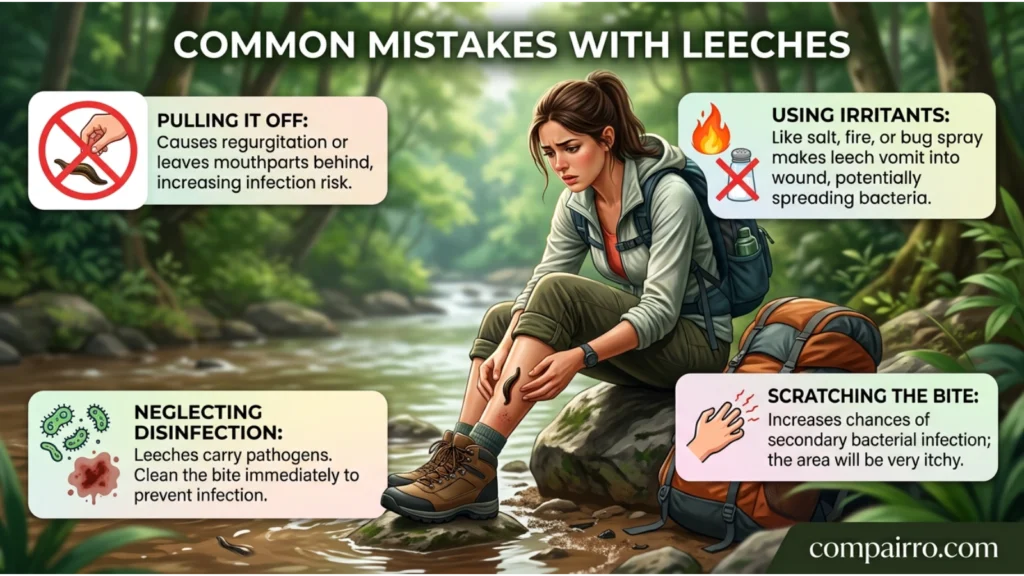
Common Mistakes With Leach or Leech
Mistake 1: Using “leech” for liquid movement
❌ Water can leech chemicals from the soil.
✔ Water can leach chemicals from the soil.
Why?
Use leach when liquid carries a substance away from a material.
Mistake 2: Using “leach” for the animal
❌ A leach attached to the animal.
✔ A leech attached to the animal.
Why?
The blood-feeding animal is spelled leech.
Mistake 3: Confusing the figurative meaning
❌ He is such a leach; he always asks for money.
✔ He is such a leech; he always asks for money.
Why?
A person who constantly takes advantage of others can be called a leech.
Mistake 4: Thinking they are different spellings of the same word
❌ “Leach” and “leech” are just two spellings of one word.
✔ Leach and leech are different words with different meanings.
Why?
Their similar spelling and pronunciation cause confusion, but their meanings are not the same.
Mistake 5: Using “leech” in scientific soil writing
❌ Heavy rain may leech nutrients from farmland.
✔ Heavy rain may leach nutrients from farmland.
Why?
The process of liquid removing soluble substances is called leaching.
Leach or Leech in Everyday Examples
Work
Leach:
“Excess water can leach useful minerals from the soil around the crops.”
Leech:
“Everyone avoids him because they think he is a leech who only asks for favors.”
School
Leach:
“Rainwater can leach minerals from the ground.”
Leech:
“We learned that a leech is an animal that feeds on blood.”
Social Media
You may see leech used as an insult or criticism online.
Example:
“Stop acting like a leech and start helping the group.”
This is informal language, so it may not be suitable for formal writing.
Daily Life
Leach:
“Water can leach some substances out of certain materials.”
Leech:
“My friend joked that his brother was a leech because he always borrowed things.”
Text Messages
Leach:
“Rain can leach nutrients from the soil.”
Leech:
“Don’t be a leech 😂.”
In texting, leech is usually used in its animal or figurative sense.
Leach or Leech – Google Trends & Usage Data
People search for leach or leech mainly because the words are easy to confuse. They have similar spellings and very similar sounds, so students, writers, and English learners often check which one is correct.
Search interest can come from several areas:
- US: Common in school, science, gardening, and environmental topics.
- UK: Often searched by English learners and people studying science or grammar.
- India: Frequently relevant to English-learning searches and school subjects.
- Pakistan: English learners may search the difference when writing or studying.
- Canada: The words appear in science, environmental, and general English searches.
- Australia: Both words are used in environmental, farming, and educational contexts.
Search interest can change over time depending on school topics, environmental discussions, gardening questions, and English-learning content.
There is also a simple reason beginners search these words: leach and leech differ by only one letter, but they describe completely different things.
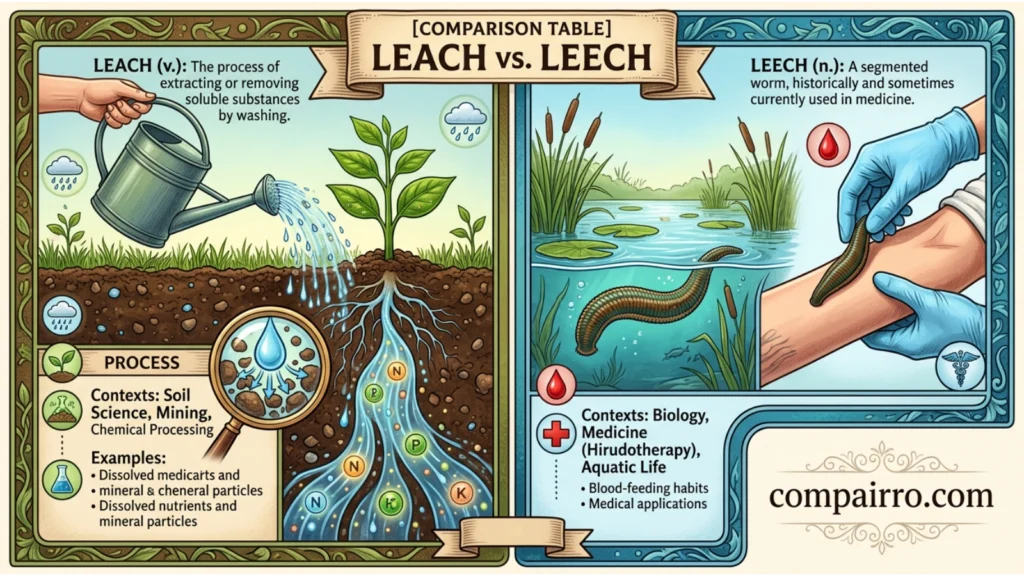
Comparison Table: Leach or Leech
| Word | Part of Speech | Main Meaning | Common Context | Example |
|---|---|---|---|---|
| Leach | Verb | Remove a substance using liquid | Science, soil, environment | Water can leach minerals from soil. |
| Leaching | Noun/verb form | The process of removing substances with liquid | Farming, chemistry | Leaching can move nutrients downward. |
| Leech | Noun | A blood-feeding animal | Biology | A leech can attach to a host. |
| Leech | Noun | A person who takes advantage of others | Everyday speech | He acts like a leech. |
The easiest difference is simple: leach describes a process, while leech usually names an animal or a person who takes from others.
Leach or Leech in Professional Life
Both words can appear in professional settings, but leach is much more common in technical writing.
For example, scientists, farmers, environmental workers, and engineers may use leach when discussing water, soil, chemicals, minerals, or waste.
Example:
“Rainwater may leach chemicals into nearby groundwater.”
In professional communication, be careful with the figurative word leech. Calling a coworker a leech can sound rude or insulting.
Instead, use more neutral language when discussing workplace behavior.
For example, instead of saying:
❌ “He is a leech.”
You could say:
✔ “He often depends on others without contributing.”
This sounds more professional and respectful.
Leach or Leech for Students or Beginners
Students often struggle with leach or leech because the words look almost identical.
The best way to learn them is to connect each spelling with its meaning instead of trying to remember the letters alone.
Easy learning tips
- Remember leach = liquid removes something.
- Remember leech = an animal.
- Learn one sentence for each word.
- Notice the context before choosing the spelling.
- Practice writing both words in your own sentences.
For science class, remember:
Water → leach → substances
For biology or everyday speech, remember:
Leech → animal/person who takes
A few minutes of practice can make the difference much easier to remember.
Signs or Characteristics Related to Leach or Leech
Because leach or leech is a word comparison, it is better to look at their main characteristics.
Characteristics of “leach”
- Usually works as a verb.
- Involves liquid.
- Often relates to soil or other materials.
- Can involve minerals, chemicals, or nutrients.
- Common in science and environmental writing.
- Describes something being carried away or removed.
Characteristics of “leech”
- Usually works as a noun.
- Can refer to a small animal.
- Has a biological meaning.
- Can also describe a person who takes advantage of others.
- Common in casual or figurative speech.
- Often has a negative meaning when used for a person.
Simple Trick to Remember Leach or Leech
Here is the easiest memory trick:
👉 LEACH = LIQUID
Think: Leach = liquid takes something away.
👉 LEECH = LIVING ANIMAL
Think: Leech = the animal.
Think of it this way:
Leach → water moves through soil and takes substances with it.
Leech → a small animal that attaches to a host.
You can also remember the extra E in leech by thinking:
LEECH = living creature.
This is not a spelling rule, but it is a useful memory trick.
FAQs:
1. What is the difference between leach and leech?
Leach means to remove or carry a substance away using liquid. Leech is a blood-feeding animal or a person who takes advantage of others.
2. Is it “leach” or “leech” nutrients from soil?
The correct word is leach. For example: “Rain can leach nutrients from the soil.”
3. Is a blood-sucking animal called a leach or leech?
It is called a leech. The spelling with “ee” is correct.
4. Can leech describe a person?
Yes. Leech can describe someone who keeps taking money, help, or other benefits from others without giving much back.
5. Is “leach” a verb?
Yes. Leach is commonly used as a verb, especially when talking about liquids carrying substances away.
6. Are leach and leech pronounced the same?
They are very similar in pronunciation, which is one reason people often confuse them. Their meanings and spellings are different.
7. Is leach or leech different in British and American English?
No major spelling difference exists. Both British and American English use leach and leech with the same basic meanings.
Conclusion
The difference between leach or leech is simple once you connect each word with its meaning.
Leach means to remove or carry a substance away with liquid. It is common when talking about soil, water, minerals, chemicals, and environmental processes.
Leech usually means a small blood-feeding animal. It can also describe a person who takes advantage of others.
The easiest memory rule is:
👉 Leach = liquid removes.
👉 Leech = living animal or someone who takes.
So, when writing about water moving through soil, choose leach. When talking about the animal or a person who constantly takes from others, choose leech.

Sara Taylor is a passionate English content writer who specializes in word meanings, spelling comparisons, and modern slang explanations. She creates easy-to-understand articles that help readers avoid common English mistakes and improve their writing skills. Her content focuses on simple learning, real-life examples, and clear explanations for everyday readers.