Have you ever seen mushrooms growing in a garden, noticed mold on old bread, or learned about yeast in your science class? All these organisms belong to the fungi kingdom. They are common in our daily lives, but many students get confused about one important question: is fungi prokaryotic or eukaryotic?
This question often appears in biology homework, school exams, quizzes, and online searches. The confusion happens because fungi are different from plants and animals in several ways. For example, fungi cannot make their own food through photosynthesis like most plants do. However, this does not mean they are prokaryotic.
To understand the answer, you need to know the difference between prokaryotic and eukaryotic cells. These two types of cells have different structures, especially when it comes to the nucleus. A nucleus is an important part of a cell that contains its genetic material.
Fungi include mushrooms, molds, and yeasts. Although they can look very different from one another, they share an important feature: their cells have a true nucleus and other membrane-bound structures.
Understanding this topic can help you learn basic biology, prepare for exams, and understand how living organisms are classified. It also makes it easier to compare fungi with bacteria, plants, and animals.
Is Fungi Prokaryotic or Eukaryotic? – Quick Answer
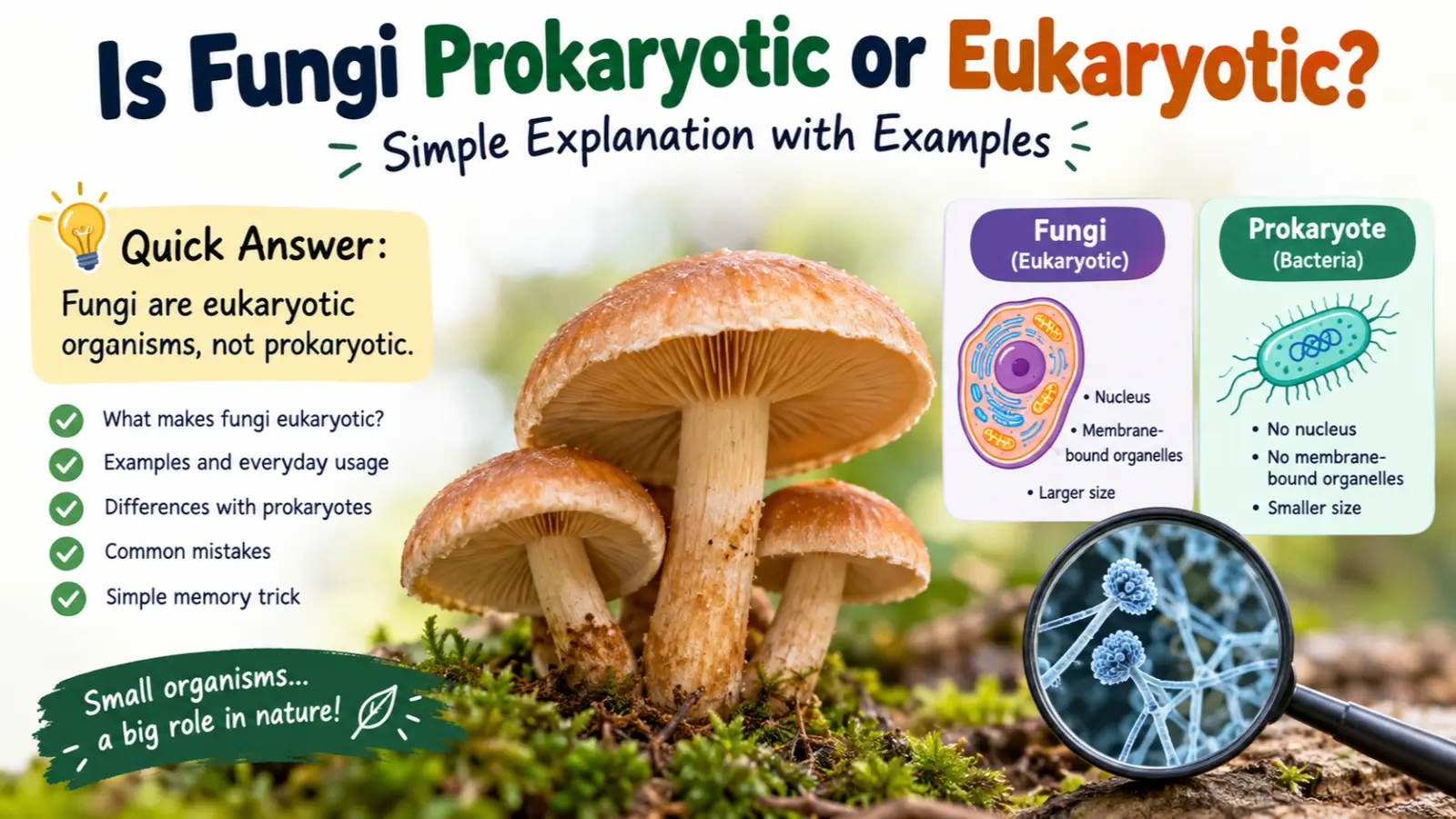
Fungi are eukaryotic organisms because their cells contain a true nucleus and membrane-bound organelles. Their genetic material is stored inside the nucleus, which separates them from prokaryotic organisms such as bacteria.
In simple words, fungi have more complex cell structures than prokaryotes.
Examples of fungi include:
- Mushrooms: Their cells contain a nucleus.
- Yeast: This single-celled fungus is eukaryotic.
- Mold: The cells of most common molds have a nucleus.
Simple rule: Fungi = Eukaryotic.
Remember that fungi can be single-celled or multicellular. Both types are eukaryotic because their cells have a true nucleus.
The Origin of Fungi
The word fungus comes from Latin, where it referred to mushrooms or similar growths. The plural form is fungi, which is commonly used in biology.
Scientists classify living organisms into different groups based on their cell structure, features, and evolutionary relationships. Fungi belong to the kingdom Fungi, a group separate from plants, animals, and bacteria.
As scientists learned more about cells through microscopes, they discovered that fungi have a nucleus and other structures found in eukaryotic cells.
Today, the term eukaryotic is used to describe organisms whose cells contain a nucleus enclosed by a membrane. This scientific classification helps students and researchers understand how fungi differ from other organisms.
British English vs American English Usage
The scientific answer is the same in British English and American English: fungi are eukaryotic.
There is no difference in the biological classification. However, some words related to fungi may be pronounced differently, and scientific writing can vary slightly by region.
| Feature | British English | American English | Notes |
|---|---|---|---|
| Singular form | Fungus | Fungus | Same spelling |
| Plural form | Fungi | Fungi | Same spelling |
| Cell type | Eukaryotic | Eukaryotic | Same scientific meaning |
| Example | Mushrooms are fungi. | Mushrooms are fungi. | Same usage |
Students in the UK, US, Pakistan, India, Canada, and Australia can use the same scientific explanation in their biology assignments.
Which One Should You Use?
When answering the question “Is fungi prokaryotic or eukaryotic?”, the correct choice is eukaryotic.
Here is how to use this fact in different situations:
- In school exams: Write that fungi are eukaryotic because their cells have a true nucleus.
- In biology homework: Explain that fungi may be single-celled or multicellular, but their cells are eukaryotic.
- In scientific writing: Use the term eukaryotic organisms when discussing fungi.
- In everyday conversations: You can simply say that mushrooms, molds, and yeasts are fungi with eukaryotic cells.
- When comparing organisms: Remember that bacteria are prokaryotic, while fungi are eukaryotic.
For formal schoolwork, include the reason along with the answer. This shows that you understand the concept instead of only memorizing a word.
Common Mistakes About Fungi
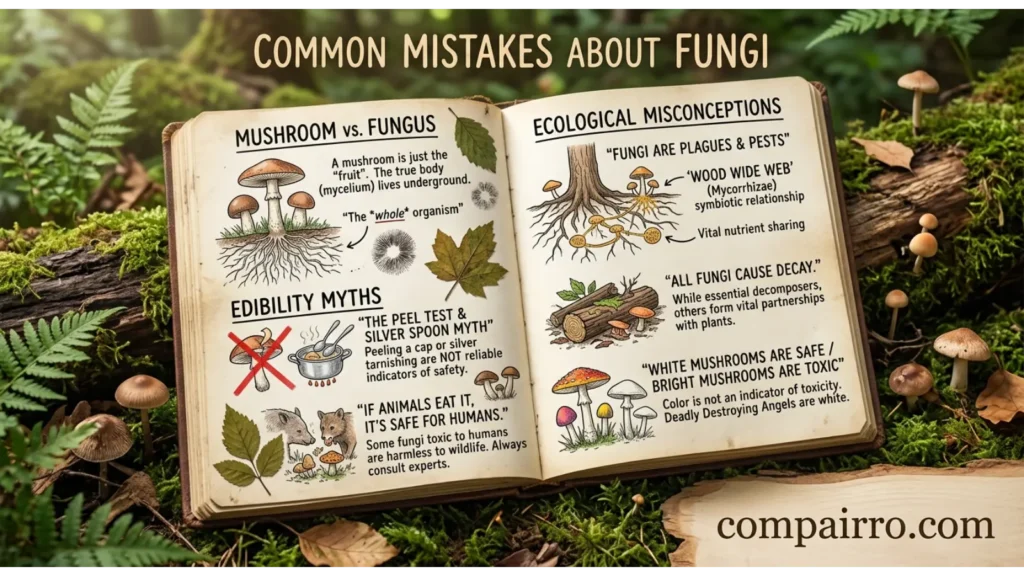
Students sometimes mix up fungi with other organisms. Here are four common mistakes and their correct explanations.
Mistake 1: Saying fungi are prokaryotic
❌ Incorrect: Fungi are prokaryotic because they are simple organisms.
✔ Correct: Fungi are eukaryotic because their cells contain a true nucleus. An organism’s apparent simplicity does not determine whether it is prokaryotic.
Mistake 2: Thinking all single-celled organisms are prokaryotic
❌ Incorrect: Yeast is single-celled, so it must be prokaryotic.
✔ Correct: Yeast is a single-celled eukaryote. Some single-celled organisms, such as bacteria, are prokaryotic, while others, such as yeast, are eukaryotic.
Mistake 3: Believing fungi are plants
❌ Incorrect: Mushrooms are plants because they grow in soil.
✔ Correct: Mushrooms belong to the fungi kingdom, not the plant kingdom. Fungi obtain nutrients by absorbing them from organic material or other sources.
Mistake 4: Thinking fungi have no cell walls
❌ Incorrect: Only plants have cell walls.
✔ Correct: Fungi have cell walls, usually made mainly of chitin and other substances. Plant cell walls are mainly made of cellulose.
Mistake 5: Confusing fungi with bacteria
❌ Incorrect: Mold and bacteria have the same cell structure.
✔ Correct: Fungi are eukaryotic, while bacteria are prokaryotic. One major difference is that fungi have a true nucleus and bacteria do not.
Fungi in Everyday Examples
Fungi are found in many places around us. Learning about familiar examples makes their cell type easier to remember.
1. School
In biology class, students may observe mushroom pictures, yeast samples, or mold under a microscope.
Example: “Our teacher explained that fungi are eukaryotic because their cells contain a nucleus.”
2. Work and Food Production
Fungi are useful in food production and scientific research. Yeast is used to make bread rise, while some fungi help produce certain cheeses.
Example: “The yeast used in bread-making is a eukaryotic fungus.”
3. Social Media and Online Learning
Educational videos and biology websites often compare fungi, bacteria, and plants to explain cell structure.
Example: “I watched a biology video explaining why mushrooms are eukaryotes.”
4. Daily Life
You may see mushrooms in markets, yeast in baking ingredients, or mold growing on food that has been stored for too long.
Example: “The mold on the bread belongs to the fungi kingdom.”
Remember that not all fungi are harmful. Many play useful roles in nature, food production, and medicine.
Is Fungi Prokaryotic or Eukaryotic? – Google Trends and Usage Data
People search for this question because they want a quick, clear answer about cell biology. It is especially useful for students preparing for tests, completing assignments, or reviewing basic science topics.
However, exact search popularity and country rankings require current Google Trends data. Without checking that data, it would be misleading to claim that a particular country has the highest search volume for this keyword.
Here is why this topic can be useful to learners in different countries:
- United States: Students may search for basic cell biology explanations and science test preparation.
- United Kingdom: Learners may use the question when studying cell structure and classification.
- India: Biology students may look for short answers and exam revision notes.
- Pakistan: Students may search for simple explanations to help with school and college biology.
- Canada: Learners may use online resources to review the differences between cell types.
- Australia: Students may search for examples of eukaryotic organisms and their features.
The topic also works well for educational websites because it has a clear answer, simple examples, and related questions about bacteria, yeast, mushrooms, and cell structure.
Common related searches include:
- Are fungi eukaryotic organisms?
- Why are fungi called eukaryotes?
- Is yeast prokaryotic or eukaryotic?
- What is the difference between fungi and bacteria?
- Do fungi have a nucleus?
These questions help learners explore the subject beyond a single definition.
Comparison Table: Fungi, Prokaryotes, and Other Eukaryotes
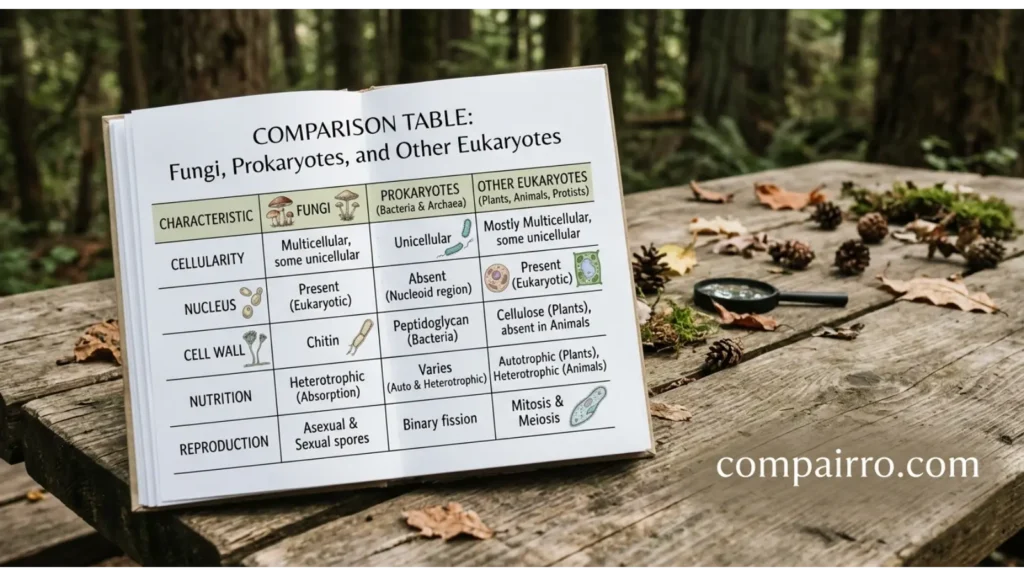
The easiest way to understand fungi is to compare them with bacteria, plants, and animals.
| Feature | Fungi | Bacteria | Plants | Animals |
|---|---|---|---|---|
| Cell type | Eukaryotic | Prokaryotic | Eukaryotic | Eukaryotic |
| True nucleus | Yes | No | Yes | Yes |
| Membrane-bound organelles | Yes | No | Yes | Yes |
| Cell wall | Usually present | Usually present | Present | Absent |
| Typical organization | Single-celled or multicellular | Usually single-celled | Multicellular | Multicellular |
| How they get nutrients | Absorb nutrients | Various methods | Mostly photosynthesis | Ingest food |
| Example | Mushroom, yeast | E. coli | Fern, grass | Human, dog |
Important: The table describes common patterns. For example, some bacteria do not have cell walls, and some fungi are single-celled.
The most important difference for this question is the nucleus. Yeasts have one, but bacteria do not have a membrane-bound nucleus.
Fungi in Professional Life
Fungi are important in several scientific and professional fields. Their eukaryotic cell structure is one reason scientists study them separately from bacteria.
- Medicine: Researchers study fungi to understand fungal infections and develop treatments.
- Food production: Yeast is used in baking and fermentation.
- Agriculture: Some fungi help plants absorb nutrients, while others can cause plant diseases.
- Biotechnology: Certain fungi are used to make enzymes, useful chemicals, and medicines.
- Environmental science: Fungi break down dead organic material and return nutrients to the environment.
For example, decomposer fungi help break down fallen leaves and dead wood. This process returns nutrients to the soil and supports healthy ecosystems.
Therefore, fungi are not only important in textbooks. They also have many real-world uses.
Fungi for Students or Beginners
If you are learning biology for the first time, the terms prokaryotic and eukaryotic may sound difficult. The good news is that the basic difference is easy to understand.
A prokaryotic cell does not have a true nucleus enclosed by a membrane. A eukaryotic cell does.
Fungi belong to the second group.
Easy learning tips
- Learn the nucleus first: A true nucleus is the key feature to remember.
- Memorize three examples: Mushroom, mold, and yeast are all fungi.
- Compare fungi with bacteria: Fungi are eukaryotic, while bacteria are prokaryotic.
- Use flashcards: Write “Fungi” on one side and “Eukaryotic” on the other.
- Practice short answers: Explain why fungi are eukaryotic in one complete sentence.
A useful exam answer is:
“Fungi are eukaryotic organisms because their cells contain a true nucleus and membrane-bound organelles.”
This sentence gives the correct classification and its main reason.
Signs or Characteristics Related to Fungi
Fungi have several features that help scientists identify and classify them.
- True nucleus: Their cells contain genetic material inside a membrane-bound nucleus.
- Membrane-bound organelles: Their cells contain structures such as mitochondria.
- Cell walls: Fungal cell walls usually contain chitin.
- No chlorophyll: Fungi do not use chlorophyll to carry out photosynthesis.
- Absorption of nutrients: They release enzymes that break down materials and then absorb the nutrients.
- Different sizes: Some fungi are single-celled, while others form large networks of thread-like structures called hyphae.
- Reproduction: Many fungi reproduce through spores, budding, or other methods.
- Important environmental roles: Many fungi break down dead material, while others live in helpful or harmful relationships with other organisms.
Not every fungus has exactly the same appearance or life cycle. However, their eukaryotic cell structure is a shared feature.
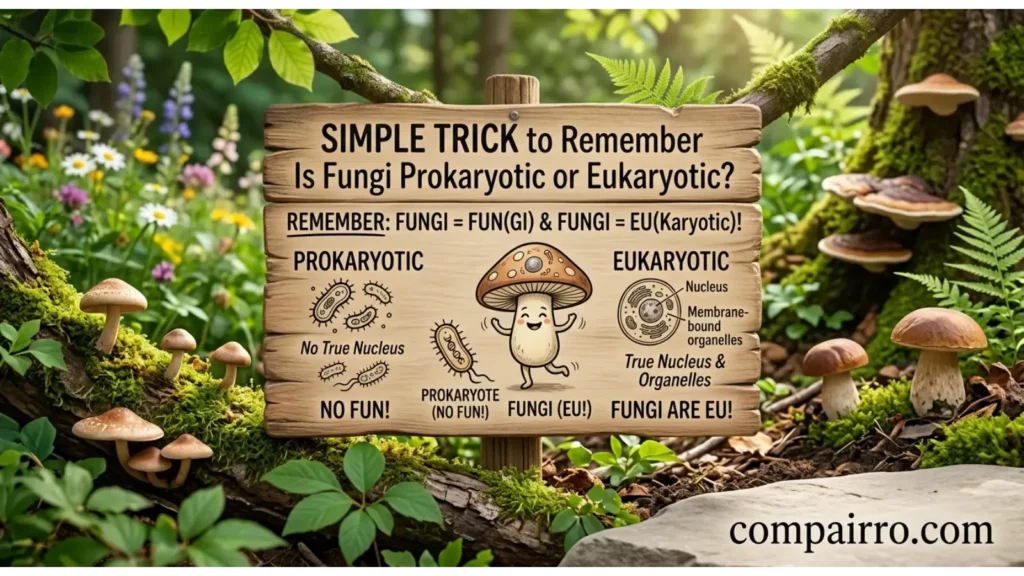
Simple Trick to Remember Is Fungi Prokaryotic or Eukaryotic
Here is a simple memory trick:
Fungi = Eukaryotic = True nucleus.
Think of it this way: when you see a mushroom, imagine its cells containing a small control center called the nucleus. That helps you remember that fungi are eukaryotic.
Compare the two groups:
- Prokaryotic: No true nucleus. Example: bacteria.
- Eukaryotic: Has a true nucleus. Examples: fungi, plants, and animals.
You can also remember the word EU in eukaryotic as a reminder to think of a cell with a true nucleus.
For exams, remember this short phrase: Fungi have a nucleus, so fungi are eukaryotic.
FAQs:
1. Are fungi prokaryotic or eukaryotic?
Fungi are eukaryotic organisms because their cells contain a true nucleus and membrane-bound organelles.
2. Why are fungi called eukaryotes?
Fungi are called eukaryotes because their cells have a nucleus enclosed by a membrane and other membrane-bound structures.
3. Is yeast prokaryotic or eukaryotic?
Yeast is eukaryotic. Although it is usually single-celled, it has a true nucleus.
4. Are mushrooms prokaryotic or eukaryotic?
Mushrooms are eukaryotic fungi. Their cells contain a nucleus and other organelles.
5. Do fungi have a nucleus?
Yes. Fungal cells contain a true nucleus that holds most of their genetic material.
6. What is the difference between fungi and bacteria?
Fungi are eukaryotic and have a true nucleus. Bacteria are prokaryotic and lack a membrane-bound nucleus.
7. Are all fungi multicellular?
No. Many fungi, such as mushrooms and molds, are multicellular, but some, such as common yeasts, are single-celled.
Conclusion
So, is fungi prokaryotic or eukaryotic? The correct answer is eukaryotic. Fungi have a true nucleus, membrane-bound organelles, and cell walls that usually contain chitin.
Mushrooms, molds, and yeasts all belong to the fungi kingdom. Some fungi are single-celled, while others are multicellular, but both types have eukaryotic cells.
Remember the main difference: bacteria are prokaryotic because they lack a membrane-bound nucleus, while fungi are eukaryotic because they have one.
Final memory rule: Fungi = Eukaryotic = True nucleus.

Sara Taylor is a passionate English content writer who specializes in word meanings, spelling comparisons, and modern slang explanations. She creates easy-to-understand articles that help readers avoid common English mistakes and improve their writing skills. Her content focuses on simple learning, real-life examples, and clear explanations for everyday readers.