Imagine you need to send a package to a friend, ship an online order to a customer, or return something you bought online. You want the package to arrive safely, but you also do not want to spend more money than necessary. That is when a common question comes to mind: is FedEx or UPS cheaper?
Both companies are popular shipping providers in the United States and many other countries. They offer different delivery options for small packages, large boxes, business orders, and international shipments. However, their prices are not always the same.
Sometimes FedEx offers a better price for a particular shipment. In other cases, UPS may cost less. The final price depends on several things, including package weight, box size, delivery distance, shipping speed, and available discounts.
People often compare these companies when shopping online, running a small business, sending gifts, or choosing a shipping service at work. You may also see discussions about their prices on social media, business websites, and shipping forums.
Understanding the differences can help you make a smarter choice. Instead of choosing a company based only on its name, you can compare the actual cost and delivery service for your package.
Is FedEx or UPS Cheaper? – Quick Answer
FedEx or UPS cheaper? Neither company is always the cheapest. The lower-cost option depends on the package’s weight, dimensions, destination, delivery speed, and any discounts you can use.
Both companies offer several shipping services, so comparing similar options is the best way to find the lowest price.
Here are three simple examples:
- Small package: Compare both companies’ available ground or economy services before choosing.
- Heavy package: Check the total cost, including dimensional weight and extra handling fees.
- Urgent delivery: Compare express services with the same delivery commitment rather than comparing a fast service with a slower one.
Simple rule: Compare the price for the same package, destination, and delivery speed.

The Origin of FedEx and UPS
FedEx and UPS are two major names in the shipping industry, but they started at different times.
UPS, short for United Parcel Service, began in the United States in 1907. It grew from a small messenger service into a major package delivery company.
FedEx, originally known as Federal Express, began operations in 1973. It became well known for its express shipping services and overnight delivery network.
Today, both companies provide domestic and international shipping, business delivery services, tracking, and options for different package sizes.
Their long history and large delivery networks make them common choices for individuals and businesses. However, their prices change based on the service selected and the details of each shipment.
British English vs American English Usage
The question “Is FedEx or UPS cheaper?” is mainly about shipping prices, not differences in English spelling.
Both company names are used internationally. However, the services and prices people compare can vary by country.
| Feature | British English | American English | Notes |
|---|---|---|---|
| Shipping | Common term | Common term | Used for sending goods |
| Postage | Often used for postal services | Used mainly for postal charges | Meaning depends on context |
| Package | Parcel is also common | Package is very common | Both refer to items being sent |
| Delivery | Common term | Common term | Refers to transporting an item |
| FedEx and UPS | Company names remain the same | Company names remain the same | Prices and services vary by location |
For example, someone in the UK may say, “Which parcel delivery service is cheaper?” An American may ask, “Is FedEx or UPS cheaper?”
Both questions have the same basic purpose: finding an affordable way to send a package.
Which One Should You Use?
The best choice depends on what you are shipping and how quickly it needs to arrive.
Choose FedEx when:
- Its quoted price is lower for your specific shipment.
- A FedEx service meets your delivery deadline at a reasonable cost.
- Your business has access to a useful FedEx shipping discount.
- Its pickup, drop-off, or delivery options are more convenient for you.
Choose UPS when:
- Its quoted price is lower for the same delivery requirements.
- UPS offers a suitable service for your package’s size and weight.
- Your business receives a better rate through a UPS account.
- Its pickup or drop-off locations fit your needs.
Consider both companies when:
- You are shipping a heavy or oversized box.
- You need express or overnight delivery.
- You ship packages regularly for an online store.
- You want to compare international shipping costs.
Remember that the cheapest service is not always the fastest. If your package is not urgent, a slower ground or economy service may save you money.
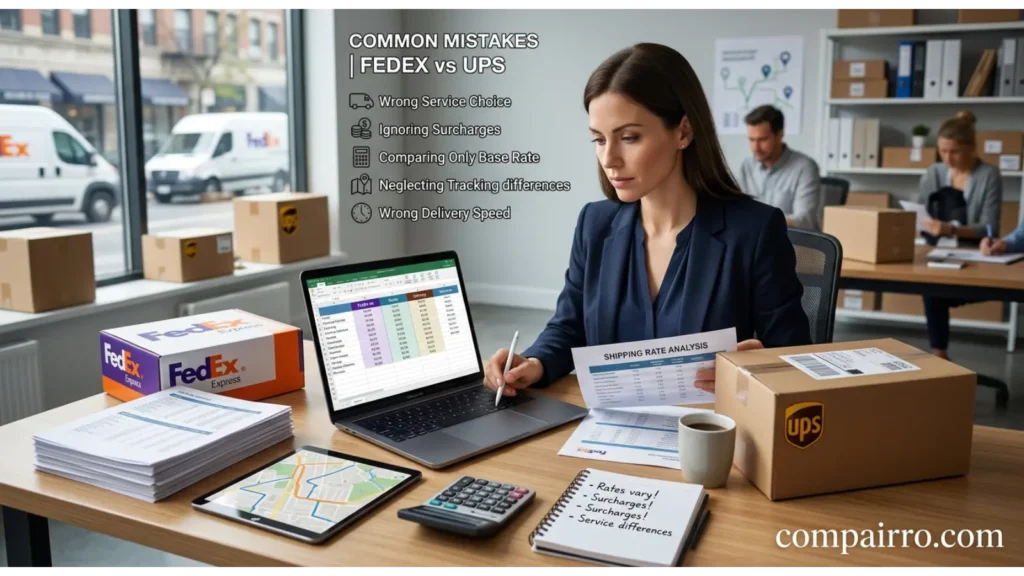
Common Mistakes When Comparing FedEx and UPS
People sometimes choose a shipping company without checking all the details. Here are five mistakes to avoid.
Mistake 1: Comparing Different Delivery Speeds
❌ Comparing an overnight service from one company with a ground service from the other.
✔ Compare services with similar delivery commitments. A faster service usually costs more.
Mistake 2: Looking Only at Package Weight
❌ Assuming a light but large box will always be cheap to ship.
✔ Carriers may use dimensional weight, which considers the size of a package as well as its actual weight.
Mistake 3: Ignoring Additional Fees
❌ Choosing the lowest advertised price without checking the final cost.
✔ Review possible residential delivery, remote-area, oversized-package, fuel, and other applicable surcharges.
Mistake 4: Forgetting About Discounts
❌ Assuming the standard public rate is the only price available.
✔ Check eligible business discounts, shipping accounts, and online shipping platforms.
Mistake 5: Assuming One Company Is Always Cheaper
❌ Believing UPS or FedEx will always offer the lowest price.
✔ Compare current quotes for each shipment. Prices can vary with distance, package details, and service type.
FedEx or UPS in Everyday Examples
Let’s look at how the comparison works in common situations.
1. At Work
A company needs to send documents to another office. The delivery must arrive the next business day.
The shipping manager compares express services from both companies and selects the option that meets the deadline at the lower total price.
2. At School
A student needs to send books to a family member in another state.
If the books are not needed immediately, the student compares ground services instead of paying extra for express delivery.
3. On Social Media
A seller promotes products on Instagram or Facebook. Customers ask about delivery charges.
The seller compares shipping prices and sets a fair delivery fee based on package size, destination, and service.
4. In Daily Life
You want to send a birthday gift to a friend.
You compare the total cost of both services, including packaging needs and the expected delivery date, before paying.
5. In Text Messages
A friend asks, “Should I use FedEx or UPS?”
You can reply, “Check both quotes first. The cheaper option depends on the package and delivery speed.”
These examples show why it is better to compare actual prices rather than rely on general opinions.
Is FedEx or UPS Cheaper? – Google Trends and Usage Data
People search for “is FedEx or UPS cheaper” because they want to save money while sending packages. The question is especially useful for online shoppers, small business owners, and people who ship items regularly.
However, without checking current Google Trends data, it would not be accurate to claim that one company is searched more often or is more popular in a particular country.
Here is how the question applies across different regions.
- United States: Consumers and businesses often compare domestic ground and express shipping options.
- United Kingdom: Customers may compare parcel delivery services available for their particular shipment.
- India: People may look for affordable international shipping or compare local delivery alternatives with global carriers.
- Pakistan: Individuals and businesses may compare international courier services for documents, gifts, and commercial shipments.
- Canada: Customers may compare cross-border shipping to the United States with domestic delivery options.
- Australia: Businesses and individuals may compare international shipping costs and delivery times.
Actual service availability and prices depend on the route. Neither company’s full range of services is available in every country.
What Affects Shipping Search Trends?
Several factors can influence interest in shipping comparisons:
- Holiday shopping seasons
- Online sales and special promotions
- Changes in shipping rates
- Growth in online businesses
- International shipping needs
- Fuel costs and delivery surcharges
For reliable search-volume comparisons, use Google Trends and a keyword research tool. Search interest shows what people are looking for, but it does not tell you which carrier is cheaper.

Comparison Table: FedEx vs UPS
The following table gives a practical overview of the two companies. Actual rates and service availability must be checked for your shipment.
| Feature | FedEx | UPS |
|---|---|---|
| Cheapest shipping option | Depends on shipment details | Depends on shipment details |
| Ground shipping | Available for eligible routes | Available for eligible routes |
| Express delivery | Multiple speed options | Multiple speed options |
| Heavy packages | Suitable services available | Suitable services available |
| International shipping | Available on eligible routes | Available on eligible routes |
| Package tracking | Available | Available |
| Business discounts | May be available | May be available |
| Residential delivery | Available for eligible services | Available for eligible services |
| Best choice | When its total quote is lower | When its total quote is lower |
Important: This table does not rank either company as the overall winner because shipping prices change with package details, destination, and service.
How to Compare the Actual Prices
Follow these steps before booking:
- Measure the package’s length, width, and height.
- Weigh the packed box.
- Enter the same destination and shipping date on both companies’ shipping tools.
- Choose services with comparable delivery times.
- Review the full price, including applicable fees and surcharges.
- Check whether you qualify for a discount.
You can start with the official websites:
These pages can help you find the appropriate shipping tools and service details.
FedEx or UPS in Professional Life
Businesses often ship dozens or hundreds of packages every month. Even a small difference in the cost of each shipment can affect the total shipping budget.
For example, an online store sending products to customers may compare the rates offered by both carriers. It can then choose the lower-cost service for each shipment, provided that the delivery time and service quality meet customer needs.
Businesses should also consider:
- Contract rates and account discounts
- Pickup fees, if applicable
- Delivery area surcharges
- Package handling requirements
- Tracking and delivery confirmation
- Claims procedures and insurance options
- Returns and customer service
The lowest price is important, but it should not be the only factor. Late deliveries or poor service can create extra work and unhappy customers.
For frequent shipping, businesses may benefit from comparing carrier invoices over several weeks rather than making a decision based on a single package.
FedEx or UPS for Students and Beginners
If you have never shipped a package before, comparing two companies can seem confusing. You may see different service names, delivery estimates, and prices.
Start with the basics.
First, understand your package. Know its weight and dimensions before requesting a quote.
Next, choose your delivery speed. If the package is not urgent, compare slower services first.
Then, check the destination. Shipping costs can change depending on how far the package travels and whether the address is residential or commercial.
Finally, compare the total prices rather than just the starting rates.
Easy Tips for Beginners
- Use a suitable box that protects the item without unnecessary extra space.
- Pack the item before weighing and measuring it.
- Check the expected delivery date.
- Review extra charges before paying.
- Keep your tracking number after shipping.
If you are sending a package internationally, check customs forms, restricted items, duties, and taxes where applicable.
Signs or Characteristics Related to Shipping Costs
Several factors help determine whether FedEx or UPS will be cheaper for a particular shipment.
- Package weight: Heavier packages may cost more to transport.
- Package dimensions: Large boxes may be charged using dimensional weight.
- Shipping distance: Longer routes can affect the final rate.
- Delivery speed: Express delivery generally costs more than slower options.
- Destination type: Residential, rural, or remote addresses may involve extra fees.
- Package contents: Certain goods require special handling or have shipping restrictions.
- Discounts: Business accounts or eligible promotions can reduce costs.
- Extra services: Signature requirements, declared value coverage, and other options may increase the total.
These factors explain why two packages with similar weights can have different shipping prices.
Simple Trick to Remember: Is FedEx or UPS Cheaper?
Think of this simple phrase:
Same package + same destination + same delivery speed = fair price comparison.
Think of it this way:
- If you need the lowest price, compare both quotes.
- If you need fast delivery, compare similar express services.
- If your package is large, check dimensional weight.
- If you ship often, look for business discounts.
For example, imagine you need to send a box of books across the United States. FedEx quotes one price, while UPS quotes another. If both options meet your delivery deadline, the lower total quote may be the better choice.
The important point is to compare the same shipping requirements.
FAQs:
1. Is FedEx or UPS cheaper for small packages?
It depends on the package’s weight, dimensions, destination, and delivery speed. Compare both companies’ current rates for the same shipment.
2. Is FedEx or UPS cheaper for heavy packages?
Neither is always cheaper. Heavy packages may have different handling and dimensional-weight charges, so compare the full quotes.
3. Is FedEx or UPS cheaper for overnight shipping?
The price depends on the exact express services and delivery commitment. Compare equivalent overnight options from both companies.
4. Is FedEx or UPS cheaper for international shipping?
It depends on the origin, destination, package size, service, and customs-related charges. Compare the complete cost before booking.
5. Is FedEx or UPS better for small businesses?
Both offer shipping services for businesses. The better choice depends on account discounts, delivery needs, pickup options, and the total cost.
6. Does UPS or FedEx charge by package size?
Both may use dimensional weight when calculating charges. A large, lightweight box can cost more than its actual weight alone might suggest.
7. How can I find the cheapest shipping option?
Measure and weigh your packed item, enter the same details on both carriers’ shipping tools, compare similar delivery speeds, and review all applicable fees.
Conclusion
So, is FedEx or UPS cheaper? There is no single winner for every package. FedEx may offer a better rate for one shipment, while UPS may be less expensive for another.
The best way to save money is to compare the total cost for the same package, destination, and delivery speed. Remember to check package dimensions, additional fees, and any discounts before making your choice.
Whether you are shipping a gift, sending documents, or running an online business, a quick comparison can help you avoid unnecessary costs.
Final memory rule: Do not choose FedEx or UPS by name alone. Compare the actual prices, check the delivery dates, and choose the service that fits your budget and needs.

Sara Taylor is a passionate English content writer who specializes in word meanings, spelling comparisons, and modern slang explanations. She creates easy-to-understand articles that help readers avoid common English mistakes and improve their writing skills. Her content focuses on simple learning, real-life examples, and clear explanations for everyday readers.