Imagine you run a small business and sell products to a customer for $1,000. However, the customer does not pay you immediately. Instead, they promise to pay you next week. Now, you need to record this transaction in your accounting books. But one question may confuse you: Should you record accounts receivable as a debit or a credit?
This is a common question for accounting students, business owners, bookkeepers, and beginners. Understanding the correct entry is important because even a small accounting mistake can affect your financial records.
You may come across this topic in school, college, accounting software, workplace tasks, or online searches. It is also important when preparing financial statements, tracking customer payments, and managing business money.
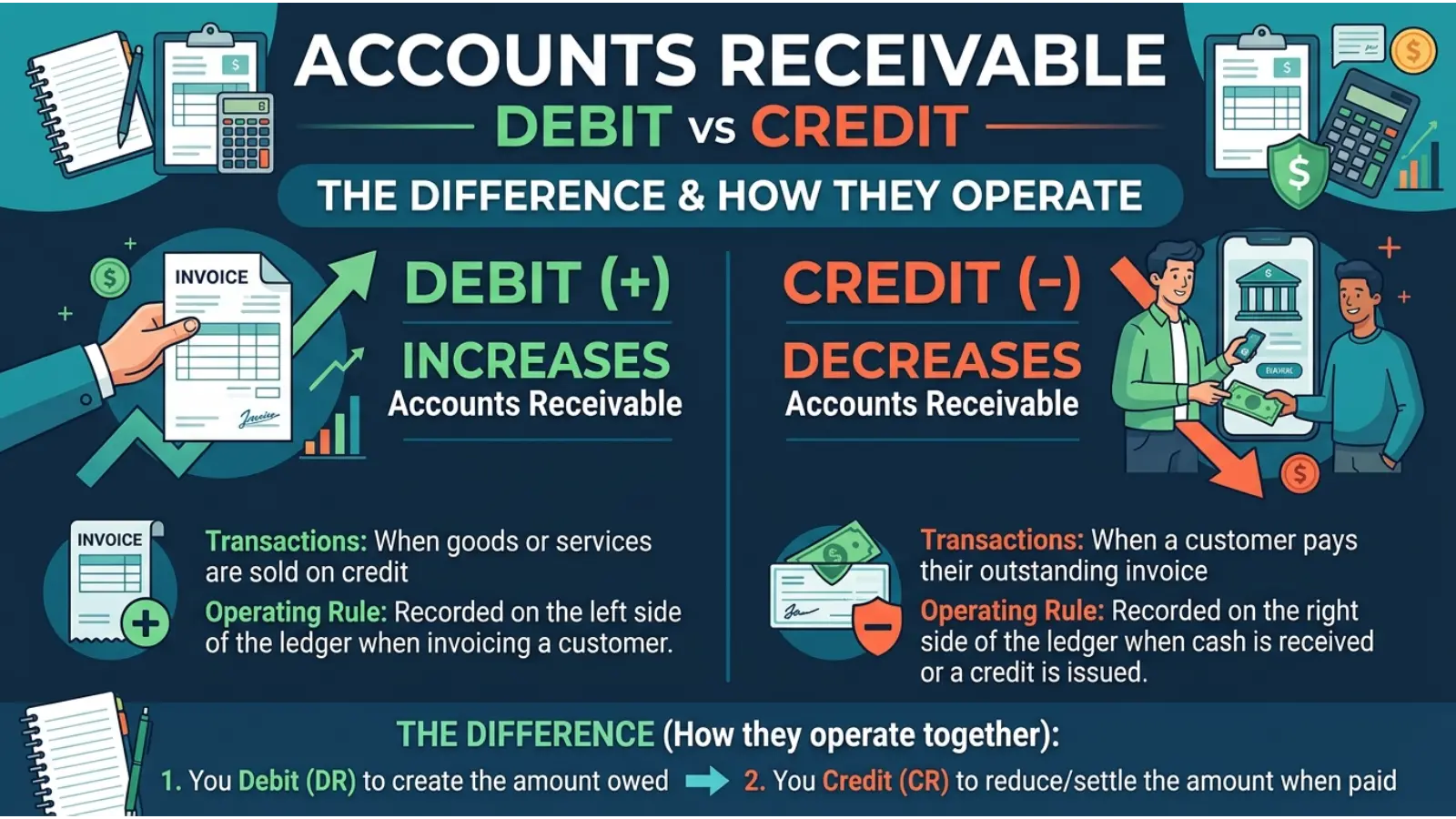
The good news is that the basic rule is easy to understand. Accounts receivable is normally an asset because it represents money that customers owe to a business. Since assets increase with debits, accounts receivable increases with a debit and decreases with a credit.
Once you understand this simple rule, recording customer transactions becomes much easier.
In this guide, you’ll learn the meaning, examples, usage, differences, common mistakes, and simple explanations in easy English.
Accounts Receivable Debit or Credit – Quick Answer
Accounts receivable is normally a debit. It is an asset account that represents money customers owe to a business for products or services they have received but have not yet paid for.
Here is the simple rule:
- Debit: Increases accounts receivable.
- Credit: Decreases accounts receivable.
Examples:
- A business sells products worth $500 on credit. Accounts receivable increases by $500 (debit).
- A customer pays $300 toward an outstanding bill. Accounts receivable decreases by $300 (credit).
- A business provides services worth $1,000 on credit. Accounts receivable increases by $1,000 (debit).
Simple rule: Accounts receivable is an asset, and assets normally increase with debits and decrease with credits.
The Origin of Accounts Receivable
Accounts receivable comes from traditional business accounting. It refers to money that a company expects to receive from customers after selling products or providing services on credit.
In the past, businesses used written records, ledgers, and account books to track unpaid customer bills. As businesses grew, they needed a clear way to record these amounts.
This is why accounts receivable became an important part of the accounting system.
Today, businesses use accounting software and digital payment systems to manage customer balances. However, the basic debit and credit rules remain the same.
British English vs American English Usage
The term accounts receivable is mainly used in American English. British English commonly uses the term debtors or trade receivables.
Both terms describe money that customers owe to a business.
| Feature | British English | American English | Notes |
|---|---|---|---|
| Common term | Trade receivables | Accounts receivable | Same basic meaning |
| Informal term | Debtors | Debtors | Refers to customers who owe money |
| Account type | Asset | Asset | Both are assets |
| Increase | Debit | Debit | Same accounting rule |
| Decrease | Credit | Credit | Same accounting rule |
Although the wording may change, the accounting treatment is generally the same worldwide.
Which One Should You Use?
If you are recording customer payments or unpaid invoices, you should use accounts receivable according to the transaction.
Use a debit when:
- A customer buys products on credit.
- A business provides services without immediate payment.
- A new customer invoice is created.
- The amount owed by customers increases.
Use a credit when:
- A customer pays an outstanding invoice.
- A business gives a customer a credit adjustment.
- An unpaid balance is written off.
- The amount owed by customers decreases.
Important: Accounts receivable is not the same as accounts payable. Accounts receivable is money customers owe your business, while accounts payable is money your business owes suppliers.

Common Mistakes With Accounts Receivable
Beginners often confuse debit and credit entries. Here are four common mistakes to avoid.
Mistake 1: Thinking accounts receivable is a credit account
❌ Incorrect: Accounts receivable always increases with a credit.
✔ Correct: Accounts receivable normally increases with a debit because it is an asset.
Mistake 2: Confusing accounts receivable with accounts payable
❌ Incorrect: Both accounts represent money customers owe.
✔ Correct: Accounts receivable represents money owed to your business. Accounts payable represents money your business owes.
Mistake 3: Recording customer payments as a debit to accounts receivable
❌ Incorrect: Debit accounts receivable when a customer pays an invoice.
✔ Correct: Credit accounts receivable when a customer pays because the outstanding balance decreases.
Mistake 4: Forgetting the other side of a journal entry
❌ Incorrect: Record only accounts receivable when making a credit sale.
✔ Correct: A typical credit sale also requires a credit to sales revenue.
For example:
- Debit Accounts Receivable: $500
- Credit Sales Revenue: $500
Accounts Receivable in Everyday Examples
Let’s understand how accounts receivable works in real-life situations.
1. Work Example
A company provides website design services worth $800 but allows the customer to pay later.
Journal entry:
| Account | Debit | Credit |
|---|---|---|
| Accounts Receivable | $800 | |
| Service Revenue | $800 |
The company records $800 as money it expects to receive.
2. School Example
An accounting teacher asks students whether accounts receivable is a debit or credit.
The correct answer is debit when the account increases because it is an asset.
3. Social Media Example
A business sells products through social media and allows customers to pay after delivery.
The unpaid invoice becomes accounts receivable.
4. Daily Life Example
Imagine you own a small clothing shop. A customer purchases clothes worth $200 but promises to pay tomorrow.
You record:
- Debit Accounts Receivable: $200
- Credit Sales Revenue: $200
When the customer pays, you record:
- Debit Cash: $200
- Credit Accounts Receivable: $200
Accounts Receivable – Google Trends & Usage Data
People search for accounts receivable debit or credit because they want to understand basic accounting rules and prepare correct journal entries.
Common reasons include:
- Accounting homework and exam preparation.
- Learning debit and credit rules.
- Understanding balance sheets.
- Managing business invoices.
- Learning bookkeeping and accounting software.
- Preparing for accounting jobs.
The keyword may attract learners and professionals in countries such as:
- United States: Students and business professionals learning bookkeeping.
- United Kingdom: People studying trade receivables and financial accounting.
- India: Accounting students preparing for exams and professional courses.
- Pakistan: Students learning basic accounting and journal entries.
- Canada: Small businesses and accounting learners.
- Australia: Bookkeepers and students studying financial records.
However, exact country rankings, search volumes, and current Google Trends data should be checked directly in Google Trends. These locations are relevant English-speaking and accounting-learning markets, not a verified popularity ranking.

Comparison Table: Accounts Receivable Debit or Credit
The following table explains how accounts receivable behaves in different transactions.
| Transaction | Debit | Credit |
|---|---|---|
| Selling products on credit | Accounts Receivable | Sales Revenue |
| Providing services on credit | Accounts Receivable | Service Revenue |
| Receiving customer payment | Cash | Accounts Receivable |
| Giving a sales allowance | Sales Allowances | Accounts Receivable |
| Writing off an unpaid balance | Allowance for Doubtful Accounts | Accounts Receivable |
| Customer makes a partial payment | Cash | Accounts Receivable |
Remember that some transactions may require additional accounts depending on the accounting method and business situation.
Accounts Receivable in Professional Life
Accounts receivable plays an important role in daily business operations. Companies use it to track money customers still need to pay.
Here are some common professional uses:
1. Bookkeeping
Bookkeepers record customer invoices and payments to keep financial records accurate.
2. Accounting
Accountants check outstanding customer balances and prepare financial statements.
3. Business Management
Business owners use accounts receivable records to understand how much money customers owe them.
4. Financial Reporting
Accounts receivable appears under current assets on the balance sheet when the amount is expected to be collected within the normal operating cycle or applicable reporting period.
5. Cash Flow Management
Businesses monitor unpaid invoices to estimate when money may come into the company.
Good accounts receivable management helps businesses maintain better financial control.

Accounts Receivable for Students or Beginners
Many accounting students find debit and credit confusing at first. This happens because debit does not always mean money coming in, and credit does not always mean money going out.
The meaning depends on the type of account.
Here are some easy learning tips:
- Learn the five main account types: assets, liabilities, equity, revenue, and expenses.
- Remember that accounts receivable is an asset.
- Understand that assets increase with debits.
- Practice simple journal entries.
- Use T-accounts to understand how balances change.
Beginner example:
A customer owes your business $400.
Your business records:
| Account | Debit | Credit |
|---|---|---|
| Accounts Receivable | $400 | |
| Sales Revenue | $400 |
This means your business has earned revenue and expects to receive $400 from the customer.
Signs or Characteristics Related to Accounts Receivable
Accounts receivable has several important characteristics that make it different from other accounting accounts.
- Asset account: It represents money expected from customers.
- Normal debit balance: Its usual balance is on the debit side.
- Current asset: It is generally reported as a current asset when expected to be collected within the operating cycle or applicable period.
- Customer-related: It usually comes from credit sales or services.
- Payment tracking: It helps businesses monitor unpaid invoices.
- Decreases with credits: Customer payments reduce the outstanding balance.
- Supports cash flow planning: It helps businesses estimate future collections.
These characteristics make accounts receivable an important part of financial accounting.
Simple Trick to Remember Accounts Receivable
Here is an easy memory trick:
Accounts Receivable = Money customers owe you.
Debit = Increase in receivables.
Credit = Decrease in receivables.
Think of it this way:
Imagine you sell a laptop for $700, but the customer promises to pay next week.
Your business now has a claim to receive $700. Therefore, accounts receivable increases with a debit.
When the customer pays the money, the amount they owe becomes zero. Therefore, accounts receivable decreases with a credit.
Easy memory sentence:
Assets increase with debits and decrease with credits.
Since accounts receivable is an asset, this rule always helps you remember its normal accounting treatment.
FAQs:
1. Is accounts receivable a debit or credit?
Accounts receivable is normally a debit account because it is an asset. It increases with debits and decreases with credits.
2. Why is accounts receivable a debit?
Accounts receivable represents money customers owe a business. Since assets increase with debits, recording a new customer invoice requires a debit.
3. Does accounts receivable increase with a debit?
Yes. When a business sells products or provides services on credit, accounts receivable increases with a debit.
4. Does accounts receivable decrease with a credit?
Yes. When a customer pays an invoice, the business credits accounts receivable to reduce the outstanding balance.
5. Is accounts receivable an asset or liability?
Accounts receivable is an asset because it represents money a business expects to receive from customers.
6. Is accounts receivable a current asset?
Yes. It is generally a current asset when the business expects to collect the amount within its normal operating cycle or applicable reporting period.
7. What is the journal entry for accounts receivable?
For a $500 credit sale, the entry is:
- Debit Accounts Receivable: $500
- Credit Sales Revenue: $500
This records the amount the customer owes the business.
Conclusion
Understanding if accounts receivable is debit or credit is an important part of learning accounting. The basic rule is simple: accounts receivable is an asset, so it normally increases with a debit and decreases with a credit.
When a business sells products or services on credit, it debits accounts receivable. When the customer pays, it credits accounts receivable to reduce the outstanding balance.
Final memory rule: Accounts Receivable = Debit to Increase, Credit to Decrease.
Learn this simple rule, practice a few journal entries, and you will find accounts receivable much easier to understand.

Sara Taylor is a passionate English content writer who specializes in word meanings, spelling comparisons, and modern slang explanations. She creates easy-to-understand articles that help readers avoid common English mistakes and improve their writing skills. Her content focuses on simple learning, real-life examples, and clear explanations for everyday readers.