Have you ever stopped while writing an English sentence because you were unsure whether to use has been or have been? You are not alone. Many English learners find these two expressions confusing, especially when speaking or writing.
For example, should you say “She has been busy” or “She have been busy”? Is it correct to say “They has been working” or “They have been working”?
Both expressions are correct, but they are used with different subjects. The main difference depends on whether the subject is singular or plural. However, there are also some important grammar rules that help you use them correctly.
You may see has been or have been in school lessons, English exams, workplace emails, text messages, social media posts, and everyday conversations. Understanding these expressions can help you speak more naturally and write better English.
These expressions are also important when learning the present perfect tense and present perfect continuous tense. They help describe past actions, experiences, situations, and activities that connect to the present.
The good news is that you do not need to memorize difficult grammar rules. A few simple examples can make everything clear.
In this guide, you’ll learn the meaning, examples, usage, differences, common mistakes, and simple explanations in easy English.
Has Been or Have Been – Quick Answer
Has been and have been are helping verb combinations used to describe situations, experiences, or actions that started in the past or are connected to the present.
The main difference is the subject.
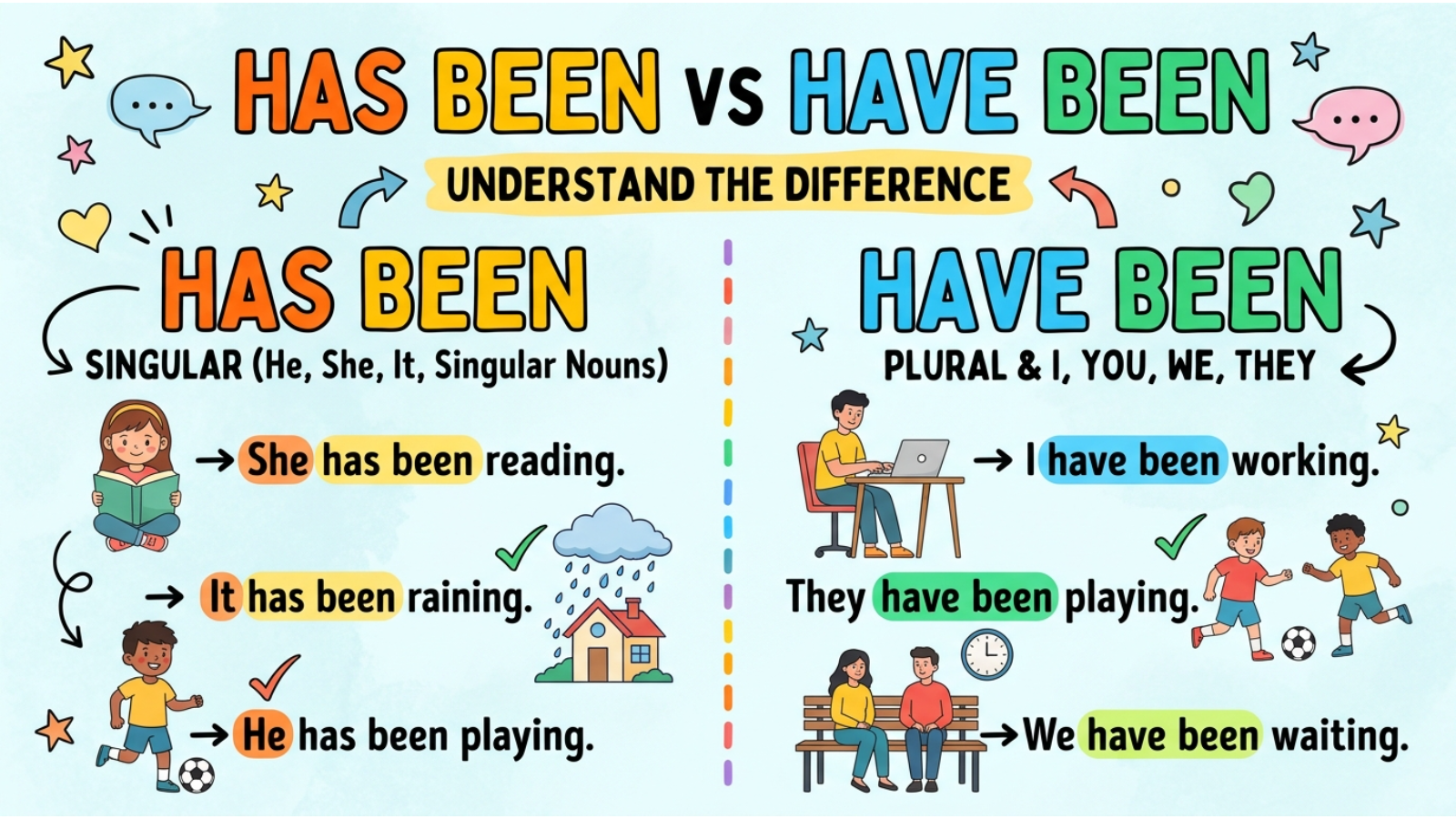
- Has been: Used with he, she, it, and singular nouns.
- Have been: Used with I, you, we, they, and plural nouns.
Examples
- She has been sick since Monday.
- They have been friends for years.
- I have been learning English for six months.
Simple Rule
Remember this easy formula:
- He / She / It = Has been
- I / You / We / They = Have been
This simple rule will help you choose the correct expression in most everyday sentences.
The Origin of Has Been and Have Been
The expressions has been and have been come from the English verb “to be.”
The word “been” is the past participle of the verb “be.” The words “has” and “have” are forms of the helping verb “have.”
English grammar uses these combinations to form perfect tenses.
Over time, these expressions became an important part of everyday English because people need to describe actions and situations that connect the past with the present.
For example:
- She has been a teacher for ten years.
- We have been waiting for an hour.
Today, you can find these expressions in books, school lessons, professional writing, online conversations, and daily speech.
British English vs American English Usage
There is no major difference between British and American English when using has been or have been.
Both forms follow the same subject-verb agreement rules in standard English.
| Feature | British English | American English | Notes |
|---|---|---|---|
| Singular subject | Has been | Has been | Same rule |
| Plural subject | Have been | Have been | Same rule |
| Present perfect | Common | Common | Same grammar |
| Present perfect continuous | Common | Common | Same grammar |
| Formal writing | Accepted | Accepted | Both are correct |
Examples
British English:
- He has been working all day.
- They have been studying English.
American English:
- He has been working all day.
- They have been studying English.
As you can see, the grammar does not change between these two varieties of English.
Which One Should You Use?
Choosing between has been or have been depends mainly on the subject of your sentence.
Use Has Been When:
Use has been with:
- He: He has been busy.
- She: She has been studying.
- It: It has been raining.
- Ali: Ali has been working.
- My brother: My brother has been sleeping.
- The teacher: The teacher has been helpful.
For Have Been When:
Use have been with:
- I: I have been waiting.
- You: You have been kind.
- We: We have been learning.
- They: They have been playing.
- My friends: My friends have been traveling.
- The students: The students have been studying.
Formal vs Informal Usage
Both expressions are correct in formal and informal English.
Formal examples:
- The manager has been informed about the issue.
- The employees have been working on the project.
Informal examples:
- She has been really busy.
- We have been having fun.
You can use both expressions in emails, school assignments, conversations, and everyday messages.
Common Mistakes With Has Been and Have Been
English learners often make small mistakes when choosing between these expressions.
Here are four common mistakes and their correct forms.
Mistake 1: Using Have Been With He
❌ He have been sick.
✔ He has been sick.
Explanation: Use has been with he because it is a singular subject.
Mistake 2: Using Has Been With They
❌ They has been working.
✔ They have been working.
Explanation: They always takes have been in standard English.
Mistake 3: Using Has Been With I
❌ I has been waiting.
✔ I have been waiting.
Explanation: Always use have been with I.
Mistake 4: Using Have Been With She
❌ She have been studying.
✔ She has been studying.
Explanation: She is a singular subject, so has been is correct.
Mistake 5: Forgetting the Verb’s Correct Form
❌ She has been work here for years.
✔ She has been working here for years.
Explanation: When using the present perfect continuous tense, use the -ing form of the main verb after been.

Has Been or Have Been in Everyday Examples
The easiest way to understand these expressions is through real-life examples.
1. At Work
- The manager has been very helpful.
- We have been working on a new project.
- She has been preparing the report.
- They have been attending meetings.
2. At School
- He has been absent for two days.
- We have been studying mathematics.
- The teacher has been explaining the lesson.
- The students have been preparing for exams.
3. On Social Media
- She has been posting interesting videos.
- They have been sharing funny pictures.
- I have been following this page for months.
- We have been watching your content.
4. In Daily Life
- My brother has been sleeping since morning.
- I have been feeling tired today.
- It has been raining since yesterday.
- They have been living here for years.
5. In Text Messages
- I have been waiting for your reply.
- She has been asking about you.
- We have been missing our old days.
- He has been calling you all morning.
These examples show how naturally both expressions fit into everyday English.
Has Been or Have Been – Google Trends and Usage Data
People search for “has been or have been” because they want to understand which expression is grammatically correct.
The confusion is especially common among students and people learning English as a second language.
Why Do People Search This Keyword?
Common reasons include:
- Preparing for English grammar tests.
- Learning present perfect tense.
- Improving spoken English.
- Writing correct school assignments.
- Understanding subject-verb agreement.
- Improving professional communication.
Countries Where People Learn These Grammar Rules
People in several English-learning markets may search for this topic, including:
- United States: Students and English learners study perfect tenses.
- United Kingdom: Learners use these expressions in spoken and written English.
- India: English grammar is an important part of school education.
- Pakistan: Students often practice these rules for exams and communication.
- Canada: English learners study correct sentence structures.
- Australia: Students learn these expressions as part of standard English grammar.
Search Trends
The exact search volume and country rankings for this keyword can change over time. Without checking live Google Trends data, it would not be accurate to claim which country searches it the most.
However, the topic has clear educational value because it answers a common grammar question.
Comparison Table: Has Been or Have Been
Here is a simple comparison to help you understand the difference.
| Feature | Has Been | Have Been |
|---|---|---|
| Main use | Singular subjects | I, you, and plural subjects |
| He | Correct | Incorrect |
| She | Correct | Incorrect |
| It | Correct | Incorrect |
| I | Incorrect | Correct |
| You | Incorrect | Correct |
| We | Incorrect | Correct |
| They | Incorrect | Correct |
| Example | She has been busy. | They have been busy. |
More Sentence Comparisons
| Has Been | Have Been |
|---|---|
| He has been working. | We have been working. |
| She has been sleeping. | They have been sleeping. |
| Ali has been studying. | Ali and Ahmed have been studying. |
| It has been raining. | You have been waiting. |
The key is to check the subject before choosing the helping verb.
Has Been or Have Been in Professional Life
Correct grammar is important in professional communication.
Whether you are writing an email, preparing a report, or talking to a manager, using the correct expression makes your message clearer.
Workplace Examples
Using Has Been:
- The project has been completed.
- The manager has been informed.
- The meeting has been postponed.
- The company has been growing quickly.
Using Have Been:
- We have been working on this project.
- The employees have been informed.
- They have been reviewing the documents.
- You have been very helpful.
Why Is It Important?
Using has been or have been correctly can help you:
- Write professional emails.
- Communicate clearly with colleagues.
- Prepare better reports.
- Improve your English confidence.
- Avoid common grammar mistakes.
Remember that good grammar helps your message sound clear and professional.
Has Been or Have Been for Students and Beginners
Students sometimes struggle with these expressions because English has different helping verbs for different subjects.
However, the rule is easier than it looks.
Why Do Beginners Get Confused?
There are three common reasons:
- They forget which subjects use has.
- They use has and have without checking the subject.
- They confuse present perfect and present perfect continuous tenses.
Easy Learning Tips
- Memorize the subject groups.
- Practice five sentences every day.
- Read English books and short stories.
- Speak simple sentences aloud.
- Check the subject before choosing has or have.
Practice Exercise
Choose the correct answer for each sentence.
Test your grammar
5 questions
1. She ___ been waiting for you.hashave
2. They ___ been studying English.hashave
3. I ___ been busy today.hashave
4. Ali ___ been working here.hashave
5. We ___ been friends for years.hashave
Check my answers

Signs or Characteristics Related to Has Been and Have Been
These expressions have some important grammar characteristics.
1. Has Been Uses Singular Subjects
Examples:
- He has been busy.
- She has been happy.
- The dog has been sleeping.
2. Have Been Uses Specific Subjects
Examples:
- I have been learning.
- You have been helpful.
- They have been waiting.
3. Both Connect the Past With the Present
Examples:
- She has been sick since Monday.
- We have been friends for years.
4. Both Can Be Used in Passive Sentences
Examples:
- The work has been completed.
- The documents have been signed.
5. Both Can Be Used in Continuous Tenses
Examples:
- He has been running.
- They have been playing.
These characteristics help you understand how the two expressions work in different sentence structures.
Simple Trick to Remember Has Been or Have Been
Here is an easy memory trick:
HAS
He, She, It
Singular subjects
HAVE
I, You, We, They
Other subject group
Think of it this way:
- She = Has been studying.
- They = Have been studying.
- I = Have been studying.
- He = Has been studying.
Another Easy Memory Rule
Remember these two groups:
- HAS = He, She, It
- HAVE = I, You, We, They
If you remember these groups, choosing between has been and have been becomes much easier.
FAQs:
1. Which Is Correct, Has Been or Have Been?
Both are correct. Use has been with he, she, it, and singular nouns. Use have been with I, you, we, they, and plural nouns.
2. Is It Has Been or Have Been With I?
The correct expression is I have been.
Example: I have been studying English.
3. Is It Has Been or Have Been With They?
The correct expression is they have been.
Example: They have been working together.
4. Can We Use Has Been With She?
Yes. Has been is correct with she.
Example: She has been very helpful.
5. What Is the Difference Between Has Been and Have Been?
The main difference is the subject. Has been is used with third-person singular subjects, while have been is used with I, you, we, they, and plural subjects.
6. Can Has Been and Have Been Be Used in Past Tense?
They are used in perfect tenses to connect an earlier time or action with the present. They are not simple past tense forms.
7. Which Is Correct: He Has Been Working or He Have Been Working?
“He has been working” is correct because he is a singular subject.
Conclusion
Understanding has been or have been is an important part of learning English grammar. Although both expressions look similar, they follow different subject rules.
Use has been with he, she, it, and singular nouns. On the other hand, use have been with I, you, we, they, and plural nouns.
You can use both expressions in school assignments, workplace emails, social media posts, and everyday conversations.
The easiest way to remember the difference is:
- HAS BEEN = He, She, It
- HAVE BEEN = I, You, We, They
Practice these simple rules regularly, and you will become more confident in using has been or have been correctly.

Sara Taylor is a passionate English content writer who specializes in word meanings, spelling comparisons, and modern slang explanations. She creates easy-to-understand articles that help readers avoid common English mistakes and improve their writing skills. Her content focuses on simple learning, real-life examples, and clear explanations for everyday readers.