Are Turtles Reptiles or Amphibians? This is a common question for animal lovers, students, and anyone curious about the natural world. Turtles spend much of their lives in or near water, so many people wonder if they belong to the amphibian family. However, their classification might surprise you.
This is a common question for students, nature lovers, and anyone who wants to learn more about animals. Turtles have hard shells, spend time on land or in water, and come in many different types. These features can make it difficult to understand where they belong in the animal world.
You may come across this question in school science lessons, homework assignments, online quizzes, social media posts, or everyday conversations. Understanding the answer can also help you learn how animals are grouped according to their bodies, skin, breathing, and life cycles.
The good news is that the answer is simple. Turtles are reptiles, not amphibians. Even though many turtles live in water, they have the main features of reptiles. They breathe air using lungs, have scaly skin, and lay eggs on land in most cases.
Are Turtles Reptiles or Amphibians? – Quick Answer
Turtles are reptiles, not amphibians. They belong to the reptile group because they have lungs, scaly skin, and other features shared by reptiles.
A reptile is an animal that usually has dry, scaly skin and breathes through lungs. An amphibian is an animal, such as a frog or salamander, that usually has moist skin and often has a life cycle that includes water and land.
Examples
- Sea turtles are reptiles: They live in the ocean but must come to the surface to breathe air.
- Box turtles are reptiles: They usually live on land and have a hard protective shell.
- Freshwater turtles are reptiles: They may spend much of their lives in ponds, rivers, or lakes.
Simple rule: Living in water does not automatically make an animal an amphibian. Turtles are reptiles because of their biological features.
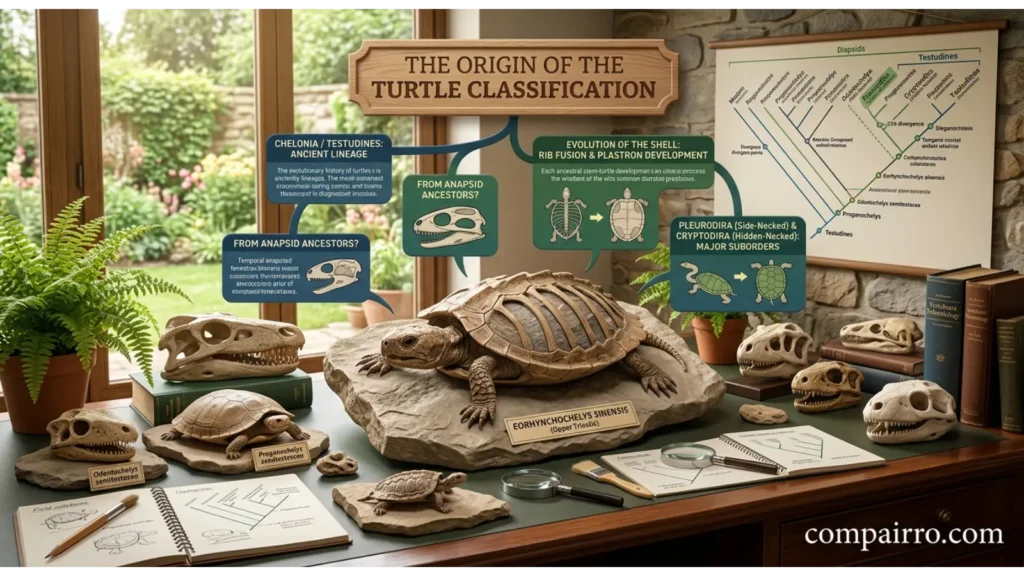
The Origin of the Turtle Classification
Turtles are part of a group of animals called reptiles. Scientists classify animals by studying their body structures, development, and evolutionary history.
Turtles have existed for more than 200 million years. Their ancestors lived long before humans appeared, and turtles developed special shells that help protect their bodies.
The word reptile comes from a Latin word related to crawling. However, not all reptiles crawl in the same way. Snakes, lizards, crocodiles, and turtles all belong to this group.
The term amphibian comes from Greek words that refer to living a double life. Many amphibians spend part of their lives in water and part on land.
Turtles sometimes live in both environments, but their habitat alone does not decide their classification. Their body features and evolutionary relationships make them reptiles.
British English vs American English Usage
The answer to whether turtles are reptiles or amphibians is the same in British and American English. Both varieties of English classify turtles as reptiles.
However, there is a small difference in how people use the words turtle and tortoise.
| Feature | British English | American English | Notes |
|---|---|---|---|
| Turtle | Often used for aquatic or semi-aquatic species | Used broadly for many species, including aquatic and land-dwelling types | Usage can vary |
| Tortoise | Usually refers to land-dwelling turtles | Usually refers to land-dwelling turtles | Both are reptiles |
| Reptile | Same scientific meaning | Same scientific meaning | No difference |
| Amphibian | Same scientific meaning | Same scientific meaning | Turtles are not amphibians |
In both countries, turtles belong to the reptile group. Differences in everyday names do not change their scientific classification.
Which One Should You Use?
If someone asks whether a turtle is a reptile or an amphibian, the correct answer is reptile.
Here is how to use this information in different situations:
- At school: Write that turtles are reptiles because they breathe air with lungs and have scaly skin.
- In science assignments: Explain that turtles belong to the reptile group, even when they live in water.
- In everyday conversations: You can simply say, “A turtle is a reptile, not an amphibian.”
- In nature studies: Look at the animal’s skin, breathing system, and life cycle rather than its habitat alone.
- In online quizzes: Remember that frogs are amphibians, while turtles are reptiles.
The term reptile is correct in both formal scientific writing and casual conversations.

Common Mistakes About Turtles
People sometimes confuse turtles with amphibians because both groups may live near water. Here are four common mistakes to avoid.
Mistake 1: Thinking All Water Animals Are Amphibians
❌ Incorrect: Turtles live in water, so they must be amphibians.
✔ Correct: Many reptiles live in water. Turtles are reptiles even when they spend most of their time swimming.
Mistake 2: Thinking a Shell Makes an Animal an Amphibian
❌ Incorrect: A turtle’s shell means it belongs to a special amphibian group.
✔ Correct: A turtle’s shell is a distinctive feature of turtles, which are reptiles. Most amphibians do not have shells.
Mistake 3: Believing Turtles Can Breathe Underwater
❌ Incorrect: Turtles breathe underwater just like fish.
✔ Correct: Turtles breathe air with lungs. Some species can absorb limited amounts of oxygen through special body surfaces while underwater, but they still need access to air.
Mistake 4: Thinking Turtles and Frogs Are the Same Type of Animal
❌ Incorrect: Turtles and frogs are both amphibians because they can live near ponds.
✔ Correct: Turtles are reptiles, while frogs are amphibians. Their skin, breathing, and development are different.
Mistake 5: Assuming Every Reptile Lives on Land
❌ Incorrect: Turtles cannot be reptiles because some live in the ocean.
✔ Correct: Reptiles can live on land, in freshwater, or in the sea. Sea turtles are reptiles adapted to ocean life.
Turtles in Everyday Examples
Learning about turtles becomes easier when you connect the facts to real-life situations.
At Work
Teachers, wildlife researchers, and animal-care workers may need to explain the difference between reptiles and amphibians.
For example, a wildlife educator might tell visitors that sea turtles are reptiles because they breathe air and have lungs.
At School
A student may be asked to name three reptiles for a science assignment.
A correct answer could include turtles, snakes, and lizards. Frogs and salamanders would belong to the amphibian group instead.
On Social Media
A video showing a turtle swimming may lead viewers to ask whether it is an amphibian.
A simple educational caption could say: “Turtles live in water, but they are reptiles, not amphibians!”
In Daily Life
If you see a turtle near a pond, remember that its surroundings do not determine its animal group.
A turtle may swim, walk on land, or rest in the sun. It remains a reptile in all these situations.
In Text Messages
You might explain the difference to a friend like this:
Friend: Are turtles amphibians?
You: No, turtles are reptiles. Frogs are amphibians!
Are Turtles Reptiles or Amphibians? – Google Trends and Usage Data
People search for questions such as “are turtles reptiles or amphibians” because turtles share some habitats with amphibians. Their ability to live in water makes the difference less obvious to beginners.
This question is also useful for school homework, animal facts, science quizzes, and general knowledge.
Why People Search for This Keyword
Common reasons include:
- Students need a quick answer for schoolwork.
- Parents want simple explanations for children.
- Animal lovers want to understand turtle biology.
- Quiz participants need to remember animal classifications.
- Online readers want to know the difference between reptiles and amphibians.
People in the United States, United Kingdom, India, Pakistan, Canada, and Australia may search for this topic in English.
However, without checking current Google Trends data, it is not possible to confirm which country has the highest search interest or provide exact popularity figures.
Search Trends and Beginner Confusion
This is an educational question rather than a social media slang term. Its search interest may change with school schedules, nature-related content, and interest in animal facts.
The main source of confusion is that turtles can live in water, while many people associate amphibians with water.
The key lesson is that habitat does not determine animal classification on its own. Scientists consider several biological features when grouping animals.

Comparison Table: Turtles vs Reptiles vs Amphibians
A turtle is a type of reptile, so it is not scientifically correct to treat turtles and reptiles as two separate animal groups. The table below compares turtles with the wider reptile group and amphibians.
| Feature | Turtles | Reptiles Generally | Amphibians Generally |
|---|---|---|---|
| Animal group | Reptiles | Reptiles | Amphibians |
| Skin | Scaly skin | Usually dry, scaly skin | Usually moist, without scales |
| Breathing | Lungs | Lungs | Gills, lungs, or skin, depending on life stage and species |
| Shell | Present | Usually absent | Absent |
| Habitat | Land, freshwater, or sea | Land or water | Often linked to water and moist habitats |
| Eggs | Most lay eggs on land | Varies by species | Often lay eggs in water or moist places |
| Examples | Sea turtle, box turtle | Snake, lizard, crocodile | Frog, toad, salamander |
This comparison shows that turtles share the main classification of reptiles, even though they have a special body feature: their shell.
Turtles in Professional Life
Understanding turtle classification can be useful in several fields.
- Education: Science teachers explain the differences between reptiles and amphibians.
- Wildlife research: Researchers study turtle behavior, habitats, and reproduction.
- Veterinary care: Animal-care professionals need to understand the health needs of reptiles.
- Wildlife conservation: Conservation teams protect turtles and their habitats.
- Environmental education: Nature centers teach visitors how different animal groups live.
For example, sea turtle conservation workers study nesting beaches because female sea turtles generally return to land to lay their eggs.
Knowing that turtles are reptiles helps people understand their needs and protect them more effectively.
Turtles for Students and Beginners
Students sometimes struggle with this question because turtles and amphibians can both be found near water.
The easiest way to learn the difference is to compare a few basic features.
Easy Learning Tips
- Remember the animal group: Turtles are reptiles.
- Learn common examples: Snakes and lizards are reptiles; frogs and salamanders are amphibians.
- Do not focus only on habitat: Living in water does not make an animal an amphibian.
- Compare skin: Reptiles generally have scales, while amphibians usually have moist skin.
- Remember breathing: Turtles breathe air through lungs.
You can also make flashcards with pictures of different animals. Put turtles, snakes, and crocodiles under “reptiles,” and frogs and salamanders under “amphibians.”
This simple activity can make science lessons easier to remember.
Signs or Characteristics Related to Turtles
Turtles have several features that help identify them as reptiles.
1. A Protective Shell
A turtle’s shell protects its body. It is part of the animal’s skeleton and includes a top section called the carapace and a bottom section called the plastron.
2. Scaly Skin
Turtles have skin with scales or scaly coverings on parts of their bodies. This is one of the features associated with reptiles.
3. Lungs for Breathing
Turtles breathe air using lungs. Aquatic turtles must reach the surface to breathe, although some species can absorb limited oxygen underwater through special body surfaces.
4. Egg-Laying Behavior
Most turtles lay eggs on land. Even sea turtles return to beaches to lay their eggs.
5. Different Habitats
Turtles can live in oceans, rivers, lakes, wetlands, or on land. Their habitats vary depending on the species.
6. Cold-Blooded Bodies
Turtles are ectothermic animals. This means their body temperature depends largely on the temperature of their surroundings.
These features help explain why turtles are classified as reptiles rather than amphibians.
Simple Trick to Remember: Are Turtles Reptiles or Amphibians?
Here is an easy memory trick:
Turtles = Reptiles
Frogs = Amphibians
Think of it this way: a turtle may swim like a frog, but it does not belong to the same animal group.
Remember these three points:
- Turtles have protective shells.
- Turtles breathe air with lungs.
- Turtles belong to the reptile group.
For example, if a science quiz asks, “Is a sea turtle a reptile or an amphibian?” choose reptile.
Do not let the word sea confuse you. Sea turtles live in the ocean, but they are still reptiles.
FAQs:
1. Are turtles reptiles or amphibians?
Turtles are reptiles, not amphibians. They have lungs, scaly skin, and other features associated with reptiles.
2. Why are turtles considered reptiles?
Turtles are classified as reptiles because of their biological features and evolutionary relationships. They breathe air through lungs and have scaly skin.
3. Can turtles live in water and still be reptiles?
Yes. Many turtles live in freshwater or the ocean. Their aquatic lifestyle does not change their classification as reptiles.
4. Are sea turtles reptiles or amphibians?
Sea turtles are reptiles. They live in the ocean, breathe air with lungs, and females generally come onto beaches to lay eggs.
5. What is the difference between turtles and amphibians?
Turtles are reptiles with protective shells and scaly skin. Amphibians, such as frogs, usually have moist skin and often have a life cycle that includes an aquatic stage.
6. Are tortoises reptiles or amphibians?
Tortoises are reptiles. They are a group of turtles adapted mainly to life on land.
7. Do turtles breathe underwater?
Turtles breathe air through lungs and must surface to breathe. Some species can absorb limited oxygen through special body surfaces while underwater, but this does not replace breathing air.
Conclusion
So, are turtles reptiles or amphibians? The answer is simple: turtles are reptiles, not amphibians.
Although many turtles live in water, they have the main features of reptiles, including lungs, scaly skin, and a protective shell. Frogs and salamanders, on the other hand, belong to the amphibian group.
Turtles can live on land, in freshwater, or in the ocean. Their habitat does not change their animal classification.
Final memory rule: Turtles are reptiles, and frogs are amphibians. Remember this simple difference, and you will be ready to answer the question in school, science quizzes, or everyday conversations.

Sara Taylor is a passionate English content writer who specializes in word meanings, spelling comparisons, and modern slang explanations. She creates easy-to-understand articles that help readers avoid common English mistakes and improve their writing skills. Her content focuses on simple learning, real-life examples, and clear explanations for everyday readers.