Is Air Homogeneous or Heterogeneous? This is a common science question that sparks curiosity among students and anyone learning about mixtures. Air surrounds us every day, but its classification depends on how its components are distributed. So, is air a homogeneous mixture or a heterogeneous mixture? The answer becomes clear when you understand what air contains.
This leads to an interesting science question: is air homogeneous or heterogeneous? Many students find this topic confusing because air contains different gases, such as nitrogen, oxygen, carbon dioxide, and argon. So, does that make air a homogeneous mixture or a heterogeneous mixture?
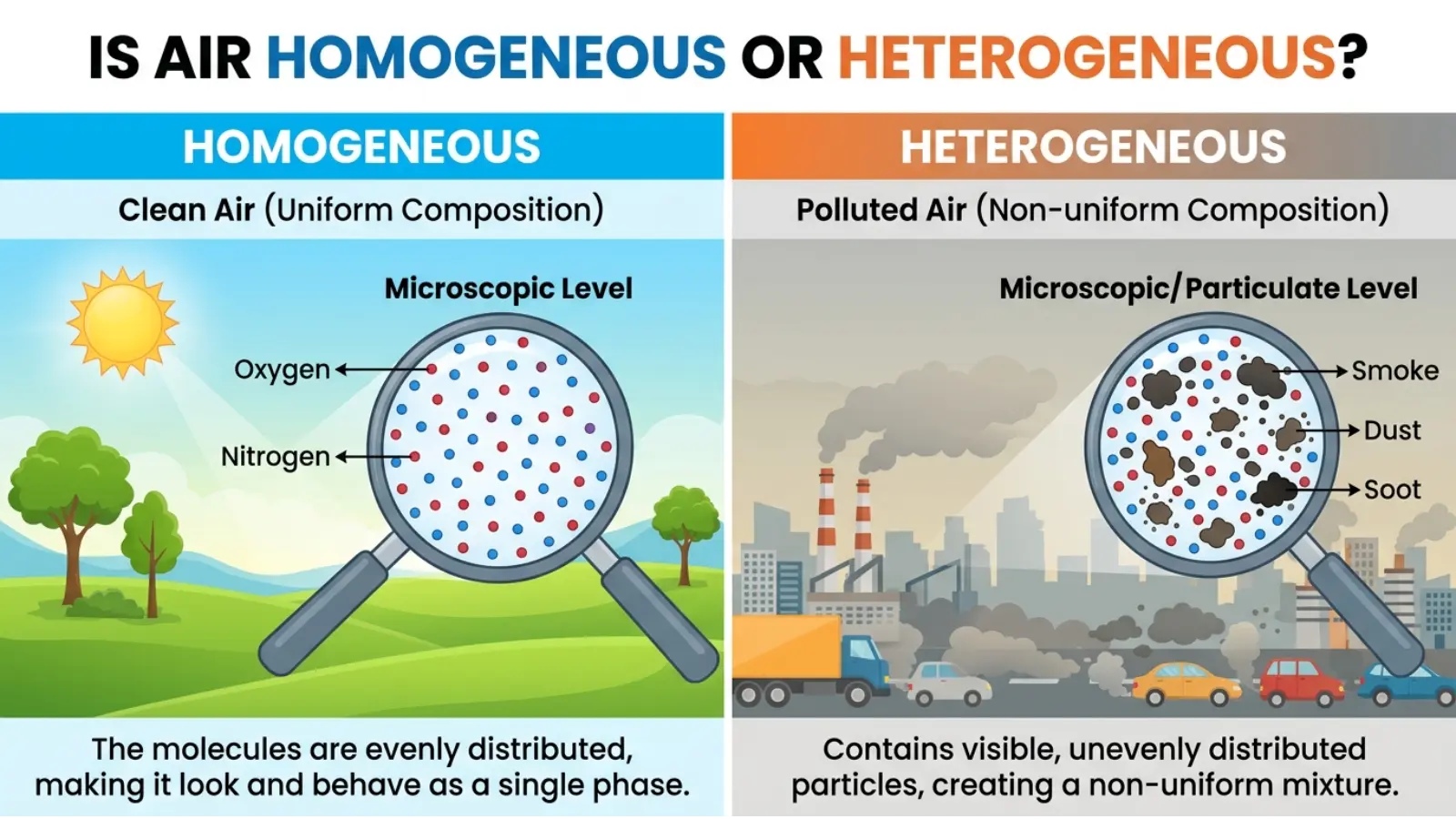
The answer depends on how evenly these gases are mixed. In clean, ordinary air, the gases are generally distributed evenly, making air a homogeneous mixture. However, air containing smoke, dust, fog, or other particles may be heterogeneous because its composition is not uniform.
Understanding this difference is useful for students studying chemistry, physics, and environmental science. It can also help you understand everyday examples, such as polluted air, foggy mornings, and the air inside a room.
Is Air Homogeneous or Heterogeneous? – Quick Answer
Air is generally a homogeneous mixture because its different gases are evenly mixed under normal conditions.
A homogeneous mixture has the same general composition throughout. You cannot easily see its separate components with your eyes.
Air is not a pure substance because it contains several gases. Its main components are nitrogen and oxygen, along with smaller amounts of argon, carbon dioxide, and other gases.
Examples:
- Clean air: A homogeneous mixture of gases under ordinary conditions.
- Air mixed with smoke: Usually a heterogeneous mixture because it contains suspended particles.
- Air with dust: Can be heterogeneous when dust particles are unevenly distributed.
Simple rule: Air with evenly mixed gases is homogeneous. Air containing unevenly distributed particles can be heterogeneous.

The Origin of the Terms Homogeneous and Heterogeneous
The words homogeneous and heterogeneous come from Greek roots.
- Homogeneous: Means having the same kind or a uniform nature.
- Heterogeneous: Means having different kinds or a non-uniform nature.
Scientists use these terms to describe mixtures based on how evenly their components are distributed.
Air became a common example in science lessons because it contains several gases that usually mix evenly. This makes it useful for explaining the difference between a pure substance and a mixture.
Today, these terms are widely used in chemistry, biology, environmental science, and school textbooks.
British English vs American English Usage
The scientific meaning of homogeneous and heterogeneous is the same in British and American English. There is no difference in the basic classification of air.
| Feature | British English | American English | Notes |
|---|---|---|---|
| Homogeneous | Homogeneous | Homogeneous | Same spelling |
| Heterogeneous | Heterogeneous | Heterogeneous | Same spelling |
| Air classification | Generally homogeneous | Generally homogeneous | Same scientific meaning |
| Scientific use | Chemistry and science | Chemistry and science | No major difference |
Both British and American science textbooks teach that ordinary air is generally a homogeneous mixture of gases.
Which One Should You Use?
When answering the question “Is air homogeneous or heterogeneous?”, consider the type of air being discussed.
- For school exams: Write that ordinary air is a homogeneous mixture of gases.
- For chemistry lessons: Explain that the gases are generally evenly distributed.
- For environmental science: Mention that smoke, dust, and other suspended particles can make air heterogeneous.
- For everyday examples: Clean air is generally homogeneous, while smoky or dusty air may be heterogeneous.
- For advanced science: Remember that air composition can vary by location, altitude, humidity, and pollution level.
The most important point is that air is a mixture, not a pure chemical substance. Its classification depends on the uniformity of the sample being studied.
Common Mistakes About Air Being Homogeneous or Heterogeneous
Mistake 1: Thinking air is a pure substance
❌ Incorrect: Air is a pure substance because we cannot see its components.
✔ Correct: Air is a mixture of several gases, even though they are usually invisible.
Mistake 2: Assuming all mixtures are heterogeneous
❌ Incorrect: Air contains different gases, so it must be heterogeneous.
✔ Correct: A mixture can be homogeneous if its components are evenly distributed.
Mistake 3: Believing all air samples are homogeneous
❌ Incorrect: Every type of air is homogeneous.
✔ Correct: Ordinary clean air is generally homogeneous, but air containing unevenly distributed dust or smoke may be heterogeneous.
Mistake 4: Confusing air with oxygen
❌ Incorrect: Air and oxygen are the same thing.
✔ Correct: Oxygen is one component of air. Nitrogen makes up most of the air in Earth’s atmosphere.
Mistake 5: Thinking invisible substances cannot form mixtures
❌ Incorrect: If you cannot see separate parts, the substance must be pure.
✔ Correct: Many homogeneous mixtures, including air, contain different components that are not visible separately.
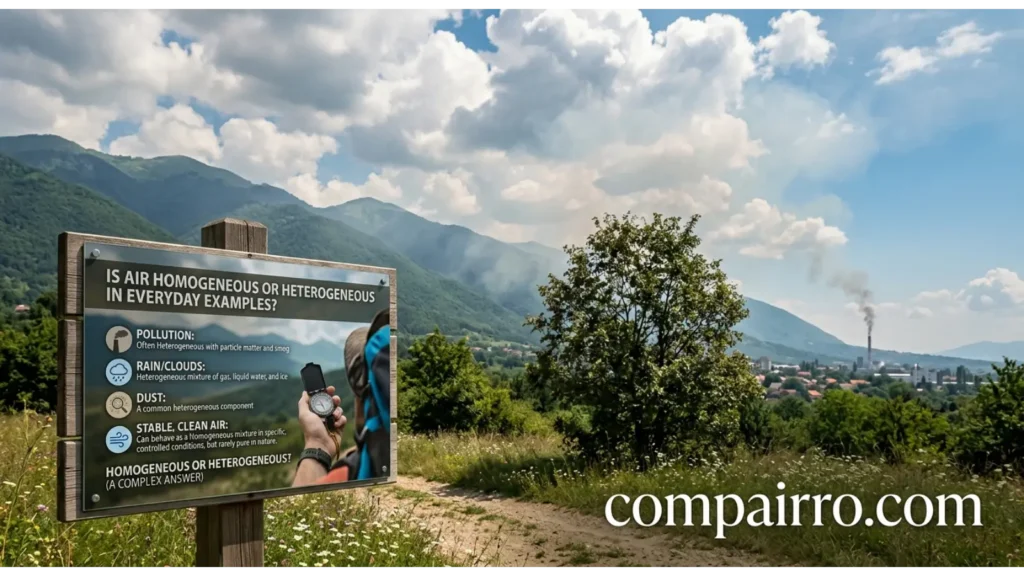
Is Air Homogeneous or Heterogeneous in Everyday Examples?
Air is all around us, but its composition can change depending on the environment.
1. At Work
In a clean office with normal ventilation, the gases in the air are generally evenly mixed.
However, construction dust, smoke, or airborne particles may create a non-uniform mixture.
2. At School
In a classroom, ordinary air is generally treated as homogeneous in basic chemistry.
If chalk dust or other particles are suspended in the air, the sample may become heterogeneous.
3. On Social Media
Science videos and educational posts often use air to explain mixtures. A simple experiment or animation may show nitrogen and oxygen as different particles mixed together.
Remember that a drawing of different gas particles does not automatically mean the mixture is heterogeneous. What matters is whether the components are uniformly distributed.
4. In Daily Life
Here are some familiar examples:
- Clean outdoor air: Generally homogeneous.
- Smoky air near a fire: Heterogeneous because it contains smoke particles.
- Dusty air in a room: May be heterogeneous.
- Foggy air: Often heterogeneous because tiny liquid water droplets are suspended in air.
- Air containing only evenly mixed gases: Homogeneous.
These examples show why the conditions of an air sample matter.
Is Air Homogeneous or Heterogeneous? – Google Trends and Usage Data
Students and curious readers may search for “is air homogeneous or heterogeneous” when preparing for exams or trying to understand basic chemistry.
This keyword is an educational search query. People usually want a direct answer, a simple explanation, and examples they can remember.
Common reasons people search for this topic include:
- Completing chemistry homework.
- Preparing for school or college exams.
- Learning the difference between mixtures.
- Understanding air pollution and atmospheric science.
- Finding examples of homogeneous and heterogeneous mixtures.
Students in the US, UK, India, Pakistan, Canada, and Australia may encounter this question in science lessons and online learning resources.
However, exact search popularity and country rankings should not be assumed without checking current Google Trends data. Search interest can change over time, especially during school examination periods.
For SEO purposes, related long-tail keywords include:
- Is air a homogeneous mixture?
- Why is air homogeneous?
- Is polluted air heterogeneous?
- Is air a pure substance or a mixture?
- Examples of homogeneous and heterogeneous mixtures.
These related phrases help explain the topic naturally without repeating the same keyword too often.
Comparison Table: Homogeneous Air vs Heterogeneous Air
| Feature | Homogeneous Air | Heterogeneous Air |
|---|---|---|
| Composition | Generally uniform | Not uniform throughout |
| Components | Gases evenly mixed | Gases and particles may be unevenly distributed |
| Appearance | Usually clear | May contain visible dust, smoke, or fog |
| Examples | Ordinary clean air | Smoky or dusty air |
| Mixture type | Homogeneous | Heterogeneous |
| Separation of components | Individual gases are not visible | Particles may sometimes be seen or filtered |
| Common setting | Clean indoor or outdoor environment | Polluted or particle-filled environment |
Important: Clear appearance alone does not prove that air is homogeneous. Scientists classify mixtures by their composition and distribution, not just by what the eye can see.
Air in Professional Life
Understanding the difference between homogeneous and heterogeneous mixtures is useful in several fields.
Environmental science: Scientists study air quality to measure gases, smoke, dust, and other pollutants.
Healthcare: Indoor air quality matters because airborne particles and droplets can affect health and the spread of some infections.
Engineering: Ventilation systems help move and mix air through buildings.
Industrial work: Factories may monitor dust and airborne chemicals to maintain safer working conditions.
In these fields, the exact composition of air matters more than simply calling it homogeneous or heterogeneous.
Air for Students or Beginners
Students sometimes struggle with this question because they learn that air contains many different gases. They may think that different components automatically make a mixture heterogeneous.
That is not correct. A mixture can contain different substances and still be homogeneous.
Use these tips to understand the concept:
- Learn the definitions: Homogeneous means uniform; heterogeneous means non-uniform.
- Remember the main gases: Air contains mostly nitrogen and oxygen.
- Focus on distribution: Ask whether the components are evenly mixed.
- Use everyday examples: Salt dissolved in water is homogeneous, while sand mixed with water is heterogeneous.
- Read the question carefully: If it asks about ordinary air, the expected answer is usually homogeneous.
For most school-level chemistry questions, you can confidently answer that air is a homogeneous mixture under normal conditions.
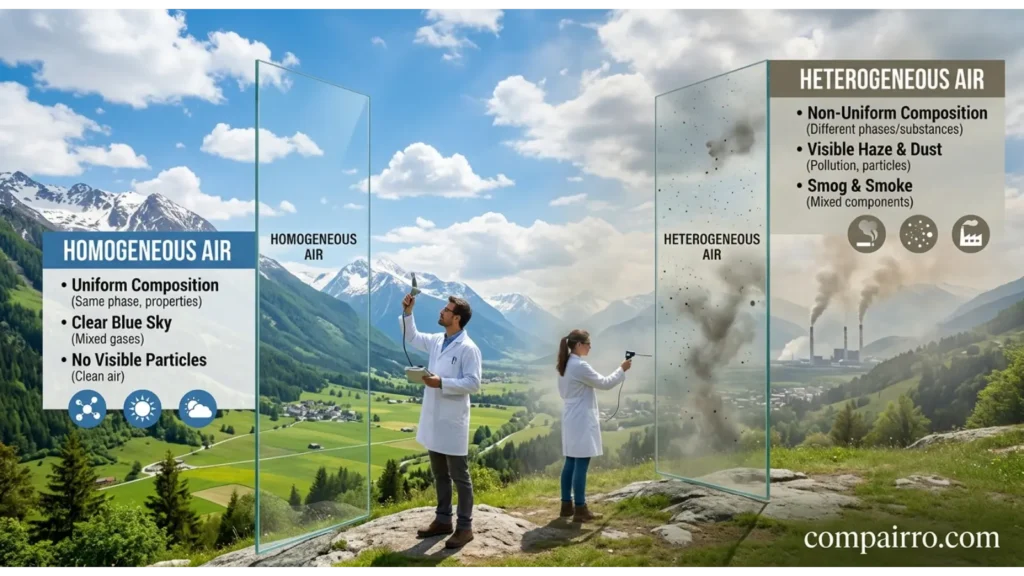
Signs or Characteristics Related to Homogeneous and Heterogeneous Air
The following characteristics help you tell the difference.
Characteristics of Homogeneous Air
- Its main gaseous components are generally evenly mixed.
- It appears uniform throughout a sample.
- You cannot see separate layers of nitrogen and oxygen.
- Its gaseous components form one uniform phase under ordinary conditions.
- It is the standard example used in basic chemistry lessons.
Characteristics of Heterogeneous Air
- It may contain suspended dust, smoke, or liquid droplets.
- Particles may be unevenly distributed.
- Some components may be visible under suitable conditions.
- Different parts of a sample may have different amounts of particles.
- Examples include smoky air and air containing fog droplets.
A mixture can look uniform and still contain multiple substances. Therefore, appearance is helpful but is not the only factor in classification.
Simple Trick to Remember Is Air Homogeneous or Heterogeneous
Here is an easy way to remember the answer:
- Homogeneous = evenly mixed
- Heterogeneous = unevenly mixed
Think of a glass of water with salt dissolved throughout it. The salt is spread evenly, so the mixture is homogeneous.
Now imagine water with sand in it. The sand does not dissolve and may settle at the bottom, so the mixture is heterogeneous.
Apply the same idea to air:
- Ordinary air with gases evenly mixed = homogeneous.
- Air with unevenly distributed smoke or dust particles = potentially heterogeneous.
Memory trick: If the mixture is uniform throughout, think homogeneous. If it has different regions or unevenly distributed components, think heterogeneous.
FAQs:
1. Is air homogeneous or heterogeneous?
Ordinary air is generally a homogeneous mixture because its gases are evenly mixed.
2. Why is air called a homogeneous mixture?
Scientists classify air as homogeneous because its main gaseous components generally distribute uniformly throughout a sample.
3. Is air a pure substance or a mixture?
Air is a mixture because it contains nitrogen, oxygen, argon, carbon dioxide, and other gases.
4. Can air be heterogeneous?
Yes. Air containing unevenly distributed dust, smoke, or fog droplets can be heterogeneous.
5. Is oxygen a homogeneous mixture?
No. Pure oxygen is an element, not a mixture. Air, by contrast, contains oxygen mixed with other gases.
6. Is polluted air homogeneous or heterogeneous?
Polluted air containing suspended particles, such as smoke or dust, is often heterogeneous. However, some gaseous pollutants can mix uniformly with air.
7. What is the best example of a homogeneous mixture?
Salt water is a common example because the water distributes the dissolved salt evenly throughout the mixture.
Ordinary air is another example.
Conclusion
So, is air homogeneous or heterogeneous? Ordinary air is generally a homogeneous mixture because its different gases are evenly distributed. It contains mostly nitrogen and oxygen, along with smaller amounts of other gases.
However, air containing suspended dust, smoke, or fog droplets may be heterogeneous because these particles can be unevenly distributed.
The key is to look at how the components are mixed. Air is not a pure substance, even when it looks completely clear.
Final memory rule: Homogeneous means evenly mixed, while heterogeneous means non-uniform. Remember this simple difference, and you will find it much easier to answer this question in chemistry class or an exam.

Sara Taylor is a passionate English content writer who specializes in word meanings, spelling comparisons, and modern slang explanations. She creates easy-to-understand articles that help readers avoid common English mistakes and improve their writing skills. Her content focuses on simple learning, real-life examples, and clear explanations for everyday readers.