Imagine you have a glass of water and a large bucket filled with the same type of water. The bucket contains much more water, but the density of the water stays the same. This simple example helps explain an important question in science: is density intensive or extensive?
Students often search for this question because the terms intensive property and extensive property can be confusing at first. Both describe physical properties of matter, but they behave differently when the amount of matter changes.
You may come across this topic in school science classes, chemistry lessons, physics, laboratory work, homework, exams, and online study materials. Understanding it can also make other topics, such as mass, volume, temperature, and concentration, much easier.
The main idea is simple: density does not depend on how much substance you have. Whether you have a small sample or a large sample of the same material, its density remains the same under the same conditions.
So, is density intensive or extensive? Density is an intensive property. It does not change simply because the amount of material changes.
In this guide, you’ll learn the meaning, examples, usage, differences, common mistakes, and simple explanations in easy English.
Is Density Intensive or Extensive – Quick Answer
👉 Density is an intensive property.
An intensive property does not depend on the amount of matter in a sample. Density describes how much mass is packed into a certain amount of volume.
The basic formula is:
Density = Mass ÷ Volume
For example:
- A small piece of pure gold has a certain density.
- A large piece of the same pure gold has the same density.
- A cup of water and a large tank of water have the same density if the temperature and conditions are the same.
Simple examples
Example 1:
A small bottle contains water. Its density is about 1 g/cm³ under common reference conditions.
Example 2:
A large container contains the same water. Its density does not become higher just because there is more water.
Example 3:
If you divide a sample of a pure substance into smaller pieces, its density stays the same.
Simple rule
👉 If changing the amount does not change the property, it is intensive.
Density stays the same when the amount of the substance changes, so density is intensive.

The Origin of Intensive and Extensive Properties
The terms intensive and extensive are used in thermodynamics, chemistry, and physical science to describe properties of matter.
An intensive property describes a characteristic that does not depend on the amount of material present.
Examples include:
- Density
- Temperature
- Pressure
- Color
- Melting point
- Boiling point
An extensive property, on the other hand, depends on the amount of matter.
Examples include:
- Mass
- Volume
- Total energy
- Length
- Number of particles
The idea became useful because scientists needed a simple way to describe how physical properties behave when the size of a sample changes.
Density became a common example of an intensive property because its value normally remains unchanged when a sample is divided or combined, assuming the material and conditions remain the same.
British English vs American English Usage
There is no important British English vs American English difference in the scientific use of the terms density, intensive property, and extensive property.
Students in both countries use the same scientific definitions.
| Feature | British English | American English | Notes |
|---|---|---|---|
| Density | Density | Density | Same meaning |
| Intensive property | Intensive property | Intensive property | Same scientific term |
| Extensive property | Extensive property | Extensive property | Same scientific term |
| Mass | Mass | Mass | Same meaning |
| Volume | Volume | Volume | Same meaning |
The spelling and scientific meaning remain the same in both forms of English.
Which One Should You Use?
When answering the question “Is density intensive or extensive?”, the correct term is intensive.
Use the following points to remember it:
- Say density is an intensive property.
- Density does not depend on the amount of substance.
- Use mass ÷ volume to calculate density.
- Do not call density an extensive property.
- Remember that mass and volume are extensive properties.
- In science assignments, explain that density remains constant for the same material under the same conditions.
Academic use
In school or college work, you can write:
“Density is an intensive property because it does not depend on the amount of matter present.”
This is a clear and simple answer for most basic science questions.
Common Mistakes With Is Density Intensive or Extensive
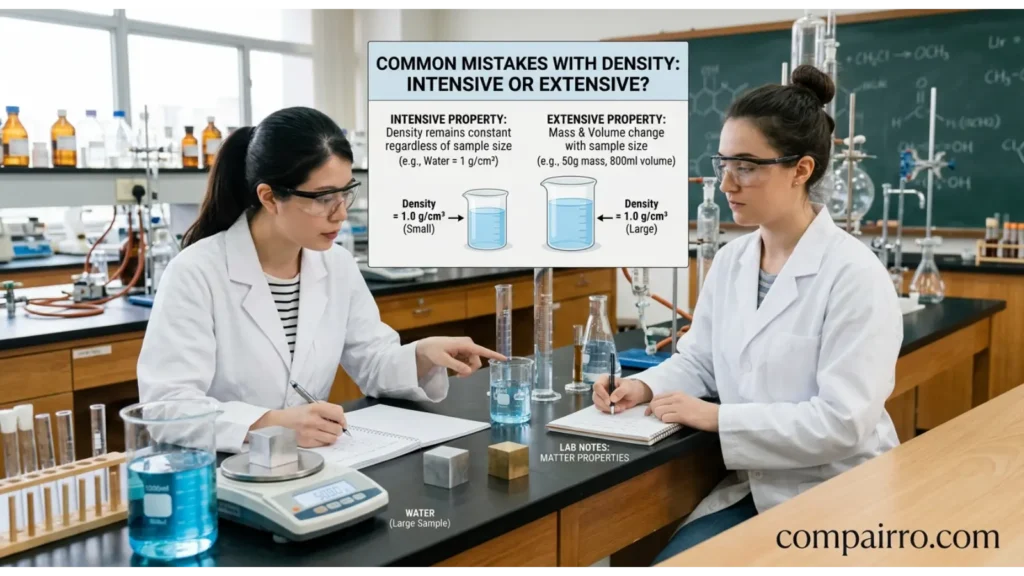
Mistake 1: Saying density is extensive
❌ Incorrect: Density is an extensive property because it uses mass and volume.
✔ Correct: Density is intensive. Although its formula uses mass and volume, the ratio of mass to volume does not depend on the total amount of material.
Mistake 2: Thinking more material means more density
❌ Incorrect: A larger amount of water must have a higher density.
✔ Correct: More water means more mass and more volume, but the density can remain the same.
Mistake 3: Confusing density with mass
❌ Incorrect: Density and mass are the same thing.
✔ Correct: Mass tells you how much matter is present, while density tells you how much mass exists in a given volume.
Mistake 4: Confusing density with volume
❌ Incorrect: Density increases whenever volume increases.
✔ Correct: For the same substance under the same conditions, increasing the amount increases both mass and volume proportionally, so density stays the same.
Mistake 5: Forgetting temperature
❌ Incorrect: Density can never change.
✔ Correct: Density is intensive, but its value can change when conditions such as temperature or pressure change, especially for gases.
Is Density Intensive or Extensive in Everyday Examples?
Understanding density becomes easier when you connect it to everyday situations.
Work
A laboratory worker may measure the mass and volume of a liquid to calculate its density.
For example:
Density = Mass ÷ Volume
The result can help identify or compare materials.
School
A student may perform an experiment using water, oil, or another liquid.
If the sample is divided into two parts, the density of each part can remain the same under the same conditions.
Social Media and Online Learning
Science videos often explain density using objects that float or sink in water.
These examples help students understand that density is a property of a material, not simply a measure of how large an object is.
Daily Life
Think about a small piece of wood and a large piece of the same type of wood. Their masses and volumes are different, but their density can be the same.
Text Messages
This topic is not normally used in texting or casual conversation. It is mainly a science and education term.
Is Density Intensive or Extensive – Google Trends & Usage Data
People commonly search “is density intensive or extensive” when studying chemistry, physics, thermodynamics, or basic properties of matter.
The question is especially useful for students who know the density formula but are unsure how density is classified.
Common reasons for searching include:
- Preparing for a science exam
- Completing homework
- Reviewing chemistry concepts
- Understanding intensive and extensive properties
- Checking whether density depends on mass or volume
- Looking for a simple definition
This type of educational search can appear among learners in countries such as the United States, United Kingdom, India, Pakistan, Canada, and Australia.
However, search interest can change over time and by location. Without live Google Trends data for the exact keyword and date range, specific rankings or search-volume claims should not be treated as confirmed.
The confusion is understandable because the density formula contains mass and volume, which are both related to the amount of matter. The important point is that density is their ratio.
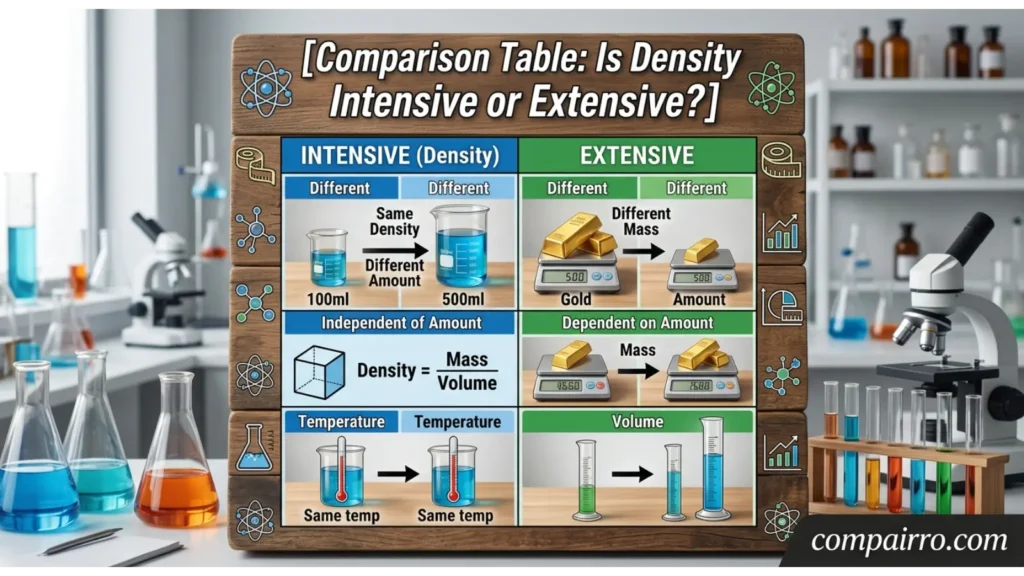
Comparison Table: Is Density Intensive or Extensive?
| Property | Type | Depends on Amount? | Example |
|---|---|---|---|
| Density | Intensive | No | Mass per unit volume |
| Mass | Extensive | Yes | Total amount of matter |
| Volume | Extensive | Yes | Space occupied |
| Temperature | Intensive | No | How hot or cold something is |
| Pressure | Intensive | No | Force per unit area |
| Color | Intensive | No | Appearance of a substance |
| Total energy | Extensive | Yes | Total energy in a system |
A useful comparison is mass versus density.
Suppose you have one kilogram of a material and then increase the amount to two kilograms. The mass has doubled. However, if the material remains the same and conditions remain constant, its density does not simply double.
That is why density belongs to the intensive category.
Is Density Intensive or Extensive in Professional Life?
Density is important in many professional fields.
Chemistry
Chemists use density to identify and compare substances and to perform calculations involving mass and volume.
Physics
Density helps explain why some objects float while others sink.
Engineering
Engineers may use density when working with materials, fluids, fuels, and structural designs.
Medicine and Biology
Density measurements can also be useful in areas such as tissue studies, body composition research, and laboratory work.
Manufacturing
Industries may use density measurements as part of material testing and quality control.
In each case, understanding whether density is intensive helps professionals use measurements correctly.
Is Density Intensive or Extensive for Students or Beginners?
Students often struggle with this topic because the formula contains two quantities that can change.
The easiest approach is to focus on what happens when the amount of material changes.
Imagine you have 100 mL of water. Now imagine you have 200 mL of the same water under the same conditions.
The second sample has more mass and more volume. However, the ratio between mass and volume remains the same.
Easy learning tips
- Memorize: Density = Mass ÷ Volume.
- Remember that density is intensive.
- Compare density with mass.
- Ask whether the property changes when the amount changes.
- Use real-life examples such as water, oil, and metals.
- Practice questions involving mass, volume, and density.
A simple exam answer is:
“Density is an intensive property because it does not depend on the amount of matter in a sample.”
Signs or Characteristics Related to Density
Here are the main characteristics that help identify density as an intensive property:
- It is an intensive property.
- It does not depend on sample size.
- It is calculated using mass and volume.
- It describes mass per unit volume.
- Different substances can have different densities.
- The same substance generally has the same density under the same conditions.
- Temperature can affect density.
- Pressure can strongly affect the density of gases.
- Density can help explain floating and sinking.
- Density is commonly measured in units such as g/cm³ or kg/m³.
These characteristics make density different from properties such as mass and total volume.
Simple Trick to Remember Is Density Intensive or Extensive
Here is an easy memory trick:
Density = Intensive
Mass = Extensive
Volume = Extensive
Think of it this way:
“Density describes the material, not how much material you have.”
For example, imagine cutting a block of pure material into several smaller pieces. Each piece may have less mass and less volume, but its density can remain the same.
Another easy rule is:
Amount changes → extensive property may change.
Amount changes → intensive property stays the same.
So when you see the question “Is density intensive or extensive?”, think:
👉 Density = same material characteristic = Intensive.
FAQs:
1. Is density an intensive or extensive property?
Density is an intensive property because it does not depend on the amount of matter in a sample.
2. Why is density considered intensive?
Density is considered intensive because changing the amount of a substance does not normally change its density under the same conditions.
3. Is mass intensive or extensive?
Mass is an extensive property because it depends on the amount of matter present.
4. Is volume intensive or extensive?
Volume is an extensive property because the total volume changes when the amount of material changes.
5. Is density affected by mass?
Density is calculated from mass and volume, but adding more of the same substance does not automatically increase its density because both mass and volume increase together.
6. Can density change?
Yes. Density can change when conditions or the material change. Temperature can affect density, and pressure can have a major effect on gases.
7. What is the easiest way to remember density?
Remember: Density is intensive because it describes how much mass is packed into a given volume, not the total amount of material.
Conclusion
So, is density intensive or extensive? The answer is simple: density is an intensive property.
Density does not depend on how much of a substance you have. A small sample and a larger sample of the same material can have the same density when they are under the same conditions.
The formula is:
Density = Mass ÷ Volume
Remember the key difference: mass and volume are extensive properties, while density is intensive.
Think of it this way: the amount can change, but the density of the same material can stay the same. That simple idea makes this topic much easier to remember.

Sara Taylor is a passionate English content writer who specializes in word meanings, spelling comparisons, and modern slang explanations. She creates easy-to-understand articles that help readers avoid common English mistakes and improve their writing skills. Her content focuses on simple learning, real-life examples, and clear explanations for everyday readers.