Is Exocytosis Active or Passive is a common biology question among students learning about cell transport. Exocytosis is an important process that helps cells remove substances from inside the cell. But is exocytosis active or passive? This article explains how exocytosis works, why it requires energy, and how it differs from passive transport.
If you are studying biology, you may wonder, “Is exocytosis active or passive?” The confusion is understandable because cells use several different transport methods. Some transport processes do not need energy, while others require the cell to use energy.
Exocytosis is commonly discussed in school and college biology, especially when learning about the cell membrane, vesicles, and active transport. You may see the term in textbooks, class notes, online lessons, quizzes, and exam questions.
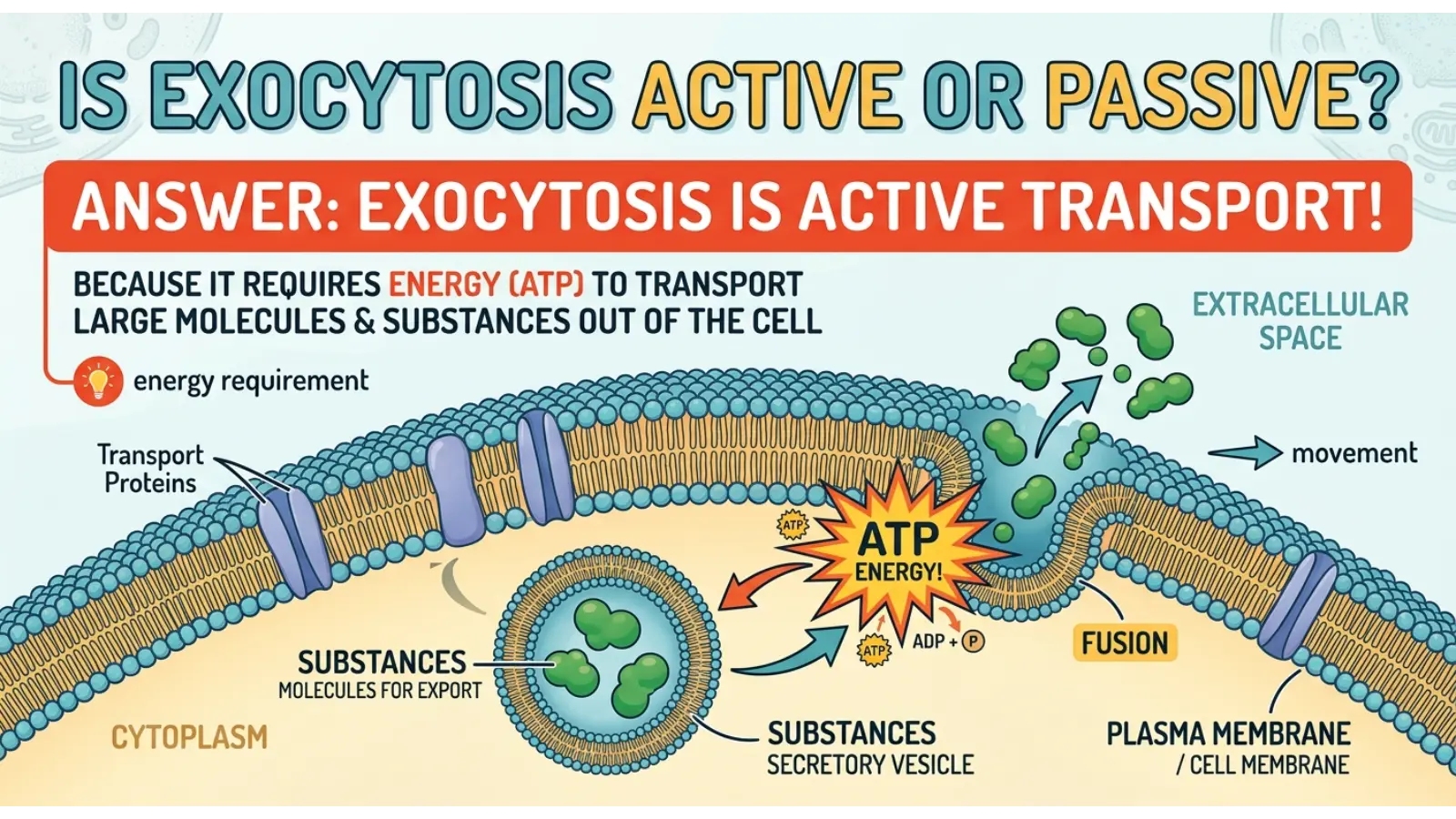
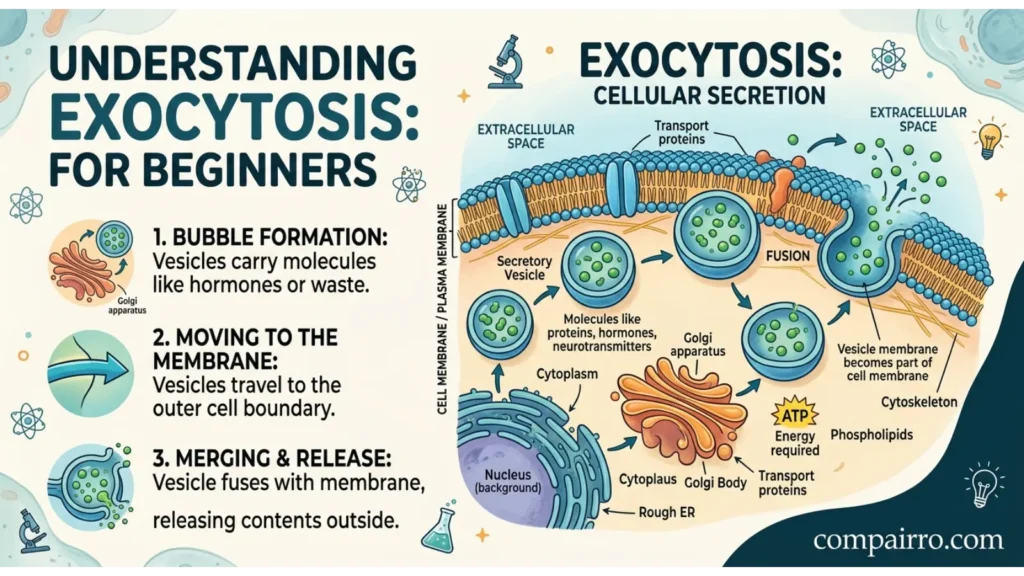
The key idea is simple: exocytosis is an active transport process because it requires energy from the cell. During exocytosis, a vesicle inside the cell moves toward the cell membrane, joins with it, and releases its contents outside the cell.
Understanding this process makes other topics, such as endocytosis and membrane transport, much easier to learn.
In this guide, you’ll learn the meaning, examples, usage, differences, common mistakes, and simple explanations in easy English.
Is Exocytosis Active or Passive – Quick Answer
👉 Exocytosis = Active transport
Exocytosis is an active transport process because the cell uses energy, mainly from ATP, to move materials out of the cell using vesicles.
Simple definition
Exocytosis is the process in which a cell releases substances outside the cell by a vesicle joining with the cell membrane.
Examples
- A cell releases hormones using exocytosis.
- Nerve cells release neurotransmitters into a space between cells.
- Some cells release enzymes outside the cell.
Simple rule:
👉 Exocytosis needs energy, so it is active transport.
Think of it as the cell spending energy to send something out.
The Origin of Exocytosis
The word exocytosis comes from scientific terms based on Greek roots.
- Exo means “outside.”
- Cyto refers to “cell.”
- -osis is commonly used in biological terms to describe a process.
So, the basic idea behind the word is a cellular process involving movement to the outside.
Scientists use the term to describe how cells package substances inside small membrane-covered structures called vesicles and release those substances outside the cell.
Exocytosis became an important part of cell biology as scientists learned more about how cells communicate, release chemicals, and move materials across their membranes.
British English vs American English Usage
There is no meaningful British-American spelling difference for the scientific term exocytosis. It is written the same way in both forms of English.
| Feature | British English | American English | Notes |
|---|---|---|---|
| Spelling | Exocytosis | Exocytosis | Same spelling |
| Meaning | Cellular transport process | Cellular transport process | Same meaning |
| Scientific use | Common | Common | Used in biology |
| Pronunciation | Similar | Similar | Minor accent differences may occur |
Whether you study biology in the UK, US, Pakistan, India, Canada, or Australia, exocytosis has the same basic meaning.
Which One Should You Use?
If you are answering the question “Is exocytosis active or passive?”, use active transport.
Remember these points:
- Exocytosis is active.
- It requires cellular energy.
- It uses vesicles.
- It moves materials from inside the cell to outside.
- The vesicle fuses with the cell membrane.
- It is different from simple diffusion.
- It is different from osmosis.
For a school or exam answer, a simple sentence works well:
Exocytosis is an active transport process because it requires energy to release substances from a cell.
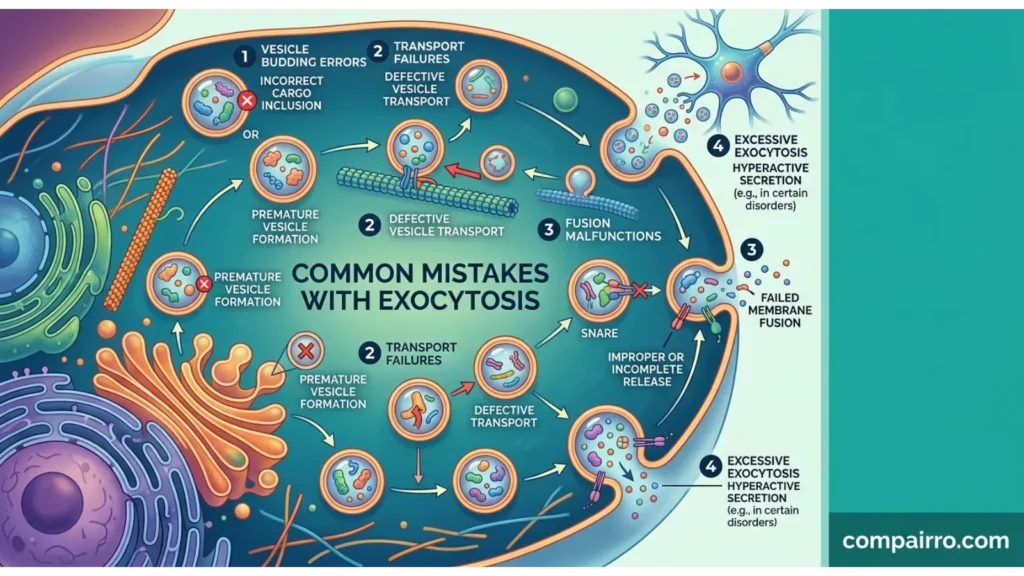
Common Mistakes With Exocytosis
Mistake 1: Calling exocytosis passive
❌ Exocytosis is passive transport because substances leave the cell.
✔ Exocytosis is active transport because the cell uses energy and vesicles to release substances.
Mistake 2: Thinking all movement out of a cell is passive
❌ Anything moving out of a cell is passive.
✔ Not all outward movement is passive. Exocytosis is an active process.
Mistake 3: Confusing exocytosis with diffusion
❌ Exocytosis is another type of diffusion.
✔ Diffusion is movement down a concentration gradient without cellular energy. Exocytosis uses vesicles and energy.
Mistake 4: Forgetting the vesicle
❌ The substance simply passes through the cell membrane during exocytosis.
✔ In exocytosis, the substance is packaged inside a vesicle. The vesicle moves to and fuses with the cell membrane.
Mistake 5: Confusing exocytosis with endocytosis
❌ Endocytosis sends materials out of the cell.
✔ Endocytosis brings materials into the cell, while exocytosis releases materials outside the cell.
Exocytosis in Everyday Examples
Although exocytosis happens at the microscopic level, it performs important jobs in the body.
Work
In professional science and medical settings, exocytosis helps explain how cells release important substances.
For example, scientists study exocytosis when examining hormone release, nerve signaling, and secretion by different cells.
School
A biology student might write:
“Exocytosis is an active transport process in which vesicles fuse with the cell membrane and release their contents outside the cell.”
This is a useful definition for tests and assignments.
Social Media
You might see biology videos explaining exocytosis with animations of a small vesicle moving toward a cell membrane and releasing its contents.
These animations are useful because the real process is microscopic and cannot normally be seen directly.
Daily Life
You cannot normally see exocytosis happening in everyday life. However, your cells use this process constantly for important functions.
For example, cells can use exocytosis to release chemical signals.
Text Messages
Exocytosis is not normally used as texting slang. If someone uses the word in a message, they are most likely talking about biology or cell science.

Exocytosis – Google Trends & Usage Data
People who search “is exocytosis active or passive” are usually looking for a quick biology explanation.
The question often appears when students are studying:
- Cell transport
- Active and passive transport
- Cell membranes
- Vesicles
- Endocytosis and exocytosis
- Biology exam questions
- Homework and assignments
Search interest can come from students in many English-speaking and English-learning countries.
In the US and UK, the term commonly appears in school and university biology material. In India and Pakistan, students may also search the question while preparing for biology tests and entrance exams.
Students in Canada and Australia may encounter the same concept in biology and life-science courses.
Because the question is often searched as a direct question, clear definitions and short answers are especially useful for beginners.
Important: Google Trends interest can change over time and differs by country. A general search query should not be treated as an exact measure of how many students use the term.
Comparison Table: Exocytosis
| Feature | Exocytosis |
|---|---|
| Transport type | Active transport |
| Direction | Inside → outside |
| Uses energy? | Yes |
| Main structure | Vesicle |
| Uses cell membrane? | Yes |
| Main action | Releases substances |
| Concentration gradient | Not the main requirement |
| Example | Hormone or neurotransmitter release |
Exocytosis vs Endocytosis
| Feature | Exocytosis | Endocytosis |
|---|---|---|
| Direction | Out of the cell | Into the cell |
| Energy | Required | Required |
| Vesicles | Used | Used |
| Main purpose | Release materials | Take in materials |
| Cell membrane | Vesicle fuses with it | Membrane surrounds material |
Active vs Passive Transport
| Feature | Active Transport | Passive Transport |
|---|---|---|
| Energy | Usually required | Not required |
| Exocytosis | Yes | No |
| Diffusion | No | Yes |
| Osmosis | No | Yes |
| Vesicles | Used in exocytosis/endocytosis | Usually not used |
Exocytosis in Professional Life
Exocytosis is important in many areas of biology and medicine.
Scientists use knowledge of exocytosis to understand how cells communicate and release substances. It is especially important when studying:
- Nerve cells
- Hormone-producing cells
- Digestive processes
- Cell communication
- Secretion
- Drug and disease research
For example, nerve cells can release neurotransmitters through exocytosis. These chemicals help transmit signals between nerve cells or from nerve cells to other cells.
Understanding exocytosis can therefore help students build a foundation for subjects such as medicine, biology, biotechnology, and neuroscience.
Exocytosis for Students or Beginners
Many beginners struggle with exocytosis because there are several transport terms that sound similar.
The easiest way to learn it is to focus on direction + energy + vesicles.
Easy learning tips
- Exo = outside
- Exocytosis moves substances out.
- It requires energy.
- It uses a vesicle.
- The vesicle joins the cell membrane.
- The vesicle releases its contents outside.
A useful comparison is:
Endocytosis = in
Exocytosis = out
If your teacher asks whether exocytosis is active or passive, remember that it requires energy, so the answer is active.
Signs or Characteristics Related to Exocytosis
Because exocytosis is a cellular process, its main characteristics are features of how the process works.
- Energy is required: The cell uses energy for the process.
- Vesicles are involved: Materials are carried in membrane-bound vesicles.
- Materials move outside: The contents are released outside the cell.
- Membrane fusion occurs: The vesicle joins with the cell membrane.
- Cell secretion: It allows cells to release useful substances.
- Cell communication: It can help cells send chemical signals.
- Waste removal: Some unwanted materials can be released from cells.
- Controlled process: Cells regulate when and how substances are released.
Simple Trick to Remember Exocytosis
Here is an easy memory trick:
👉 EXO = EXIT
Exocytosis means materials exit the cell.
👉 ENDO = ENTER
Endocytosis means materials enter the cell.
Think of it this way:
Imagine your cell is a house.
- Exocytosis = taking a package out of the house.
- Endocytosis = bringing a package into the house.
Both processes require cellular energy and use membrane vesicles.
FAQs:
1. Is exocytosis active or passive?
Exocytosis is active transport. It requires energy from the cell to release substances through vesicles.
2. Why is exocytosis considered active transport?
It is considered active because the cell uses energy to move and fuse a vesicle with the cell membrane.
3. Does exocytosis require ATP?
Yes. Exocytosis requires cellular energy, with ATP supporting many steps involved in vesicle transport and release.
4. Does exocytosis move substances into or out of the cell?
Exocytosis moves substances out of the cell.
5. Is endocytosis active or passive?
Endocytosis is also an active transport process because it requires cellular energy to bring materials into the cell.
6. What is an example of exocytosis?
The release of neurotransmitters from nerve cells is one example. Cells can also use exocytosis to release hormones and enzymes.
7. What is the easiest way to remember exocytosis?
Remember “EXO = EXIT.” Exocytosis helps materials exit the cell.
Conclusion
So, is exocytosis active or passive? The answer is clear: exocytosis is an active transport process.
The cell uses energy to move vesicles toward the cell membrane. The vesicles then fuse with the membrane and release their contents outside the cell.
The easiest memory rule is:
👉 EXO = EXIT = OUT = ACTIVE
Do not confuse it with diffusion or osmosis, which are passive transport processes. Also remember that endocytosis brings materials in, while exocytosis sends materials out.
Once you remember the direction, energy requirement, and role of vesicles, exocytosis becomes much easier to understand.

Sara Taylor is a passionate English content writer who specializes in word meanings, spelling comparisons, and modern slang explanations. She creates easy-to-understand articles that help readers avoid common English mistakes and improve their writing skills. Her content focuses on simple learning, real-life examples, and clear explanations for everyday readers.