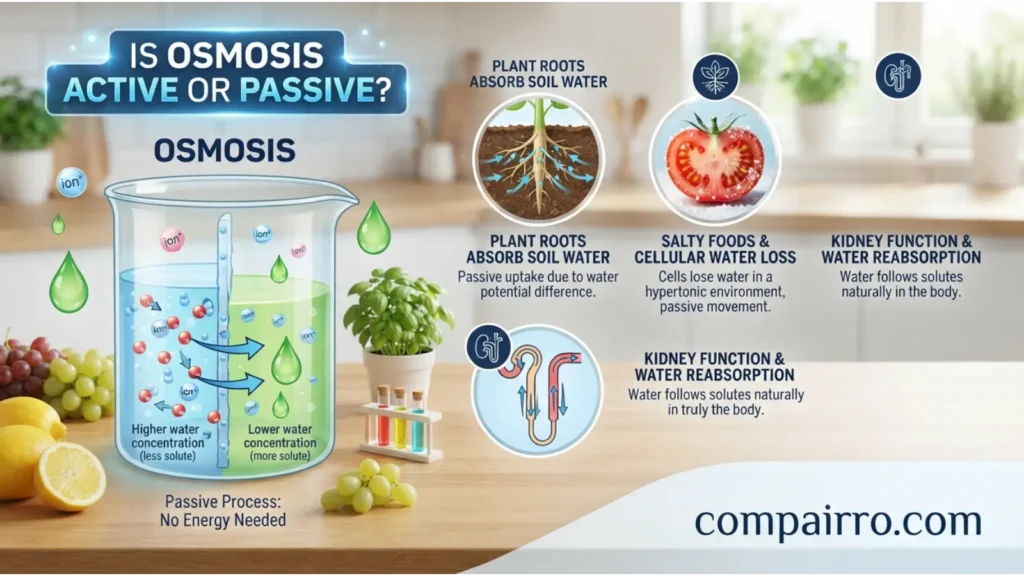
Is osmosis active or passive? This is a common biology question that students ask when learning about cell transport. Osmosis is the movement of water across a selectively permeable membrane. It occurs naturally without requiring the cell to use energy.
Many students search “is osmosis active or passive” because they are confused about if osmosis needs cellular energy. The words “active” and “passive” can be confusing when you first learn about cell transport. However, the basic idea is quite simple.
Osmosis is a common topic in biology and science classes. You may see it in school lessons, homework, exams, textbooks, online searches, and science discussions. It is also connected to important ideas such as cell membranes, water movement, concentration, diffusion, and homeostasis.
The main question is whether cells need ATP or another form of energy for osmosis. The answer is no. Osmosis is a form of passive transport, which means it does not require the cell to spend energy to move water across a selectively permeable membrane.
Understanding this difference is important because active and passive transport work in different ways. Once you understand the direction of water movement and the role of energy, osmosis becomes much easier to remember.
In this guide, you’ll learn the meaning, examples, usage, differences, common mistakes, and simple explanations in easy English.
Is Osmosis Active or Passive – Quick Answer
👉 Osmosis is passive transport.
Osmosis is the movement of water molecules through a selectively permeable membrane from an area with a higher water concentration to an area with a lower water concentration.
The cell does not use ATP energy to make osmosis happen.
Simple definition
Osmosis = passive movement of water across a selectively permeable membrane.
Examples
1: Water moves into a plant cell when the conditions outside the cell favor water entry.
2: A raisin placed in water can take in water and become swollen.
3: Water can move across the cell membrane depending on the concentration of dissolved substances on each side.
Simple rule
👉 Osmosis = water + membrane + no cellular energy
If water moves across a membrane without the cell using energy, you are looking at passive transport.
The Origin of Osmosis
The word osmosis comes from the Greek word ōsmos, which is related to the idea of pushing or moving.
Scientists developed the concept of osmosis through studies of water movement and membranes. As biology and chemistry developed, scientists learned more about how substances move across cell membranes.
Today, osmosis is one of the basic concepts taught in biology. It helps explain how plant cells absorb water, how cells maintain their water balance, and how different solutions affect cells.
The term is mainly used in science and education rather than everyday conversation.
British English vs American English Usage
There is no important British-versus-American difference in the meaning or spelling of osmosis.
Students in both British and American English use the same scientific term. The explanation of osmosis is also essentially the same in biology textbooks.
| Feature | British English | American English | Notes |
|---|---|---|---|
| Spelling | Osmosis | Osmosis | Same spelling |
| Meaning | Movement of water across a selectively permeable membrane | Same | Same scientific concept |
| Science use | Common | Common | Used in biology |
| Passive transport | Same concept | Same concept | No ATP is directly required |
| School use | Common | Common | Often taught in cell biology |
So, whether you study in Pakistan, the UK, the US, Canada, Australia, or another country, osmosis has the same basic meaning.
Which One Should You Use?
For this topic, you are not choosing between two spellings or words. You are identifying the correct type of cellular transport.
Use passive transport when explaining osmosis because:
- Osmosis does not directly require ATP.
- Water moves down its water potential gradient.
- A selectively permeable membrane is involved.
- The movement happens because of differences in water and solute concentration.
- The cell does not have to actively pump water across the membrane.
Academic use
In school or college biology, you can write:
Osmosis is a type of passive transport in which water moves across a selectively permeable membrane.
This is a clear and simple answer for most basic biology questions.
Common Mistakes With Is Osmosis Active or Passive
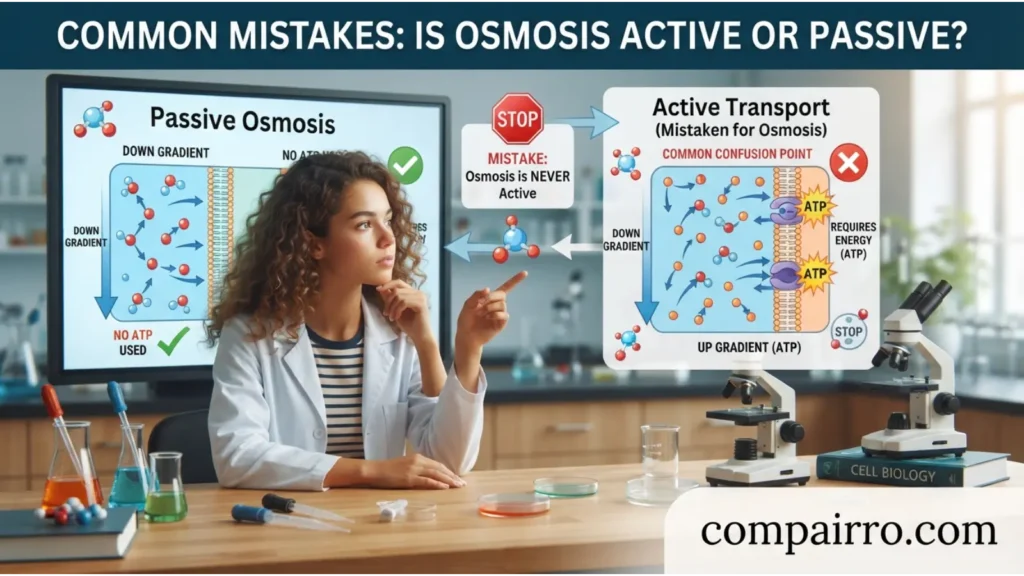
Mistake 1: Saying osmosis is active transport
❌ Incorrect: Osmosis is active because water moves into the cell.
✔ Correct: Osmosis is passive because the movement of water does not directly require cellular energy.
The fact that water moves does not automatically make a process active.
Mistake 2: Thinking all cell movement needs energy
❌ Incorrect: Every substance moving through a cell membrane needs ATP.
✔ Correct: Some substances move through membranes without direct energy use. These processes are forms of passive transport.
Mistake 3: Forgetting the membrane
❌ Incorrect: Osmosis is simply water moving from one place to another.
✔ Correct: Osmosis specifically involves water moving across a selectively permeable membrane.
Mistake 4: Confusing osmosis with active transport
❌ Incorrect: A protein pump moving substances is the same as osmosis.
✔ Correct: Active transport uses cellular energy to move substances, while osmosis is passive water movement.
Mistake 5: Thinking “passive” means water cannot move
❌ Incorrect: Passive means nothing moves.
✔ Correct: Passive means the movement does not require the cell to directly spend energy.
Is Osmosis Active or Passive in Everyday Examples?
Work
Osmosis is not usually something you discuss in normal workplace conversations. However, it can appear in laboratory, medical, food, agricultural, or research settings.
For example:
A laboratory worker studies how water moves across a cell membrane.
School
This is where the question “is osmosis active or passive?” is most common.
A student may see a question such as:
Is osmosis an active or passive process?
A simple answer is:
Osmosis is a passive process because it does not require ATP.
Social Media
Osmosis is sometimes discussed in educational videos, study posts, science quizzes, and biology content.
A common short explanation may be:
Osmosis = passive movement of water.
Daily Life
You can observe effects related to osmosis in things such as raisins, plant tissues, and foods placed in different solutions.
For example, dried fruits can change size when water enters their tissues.
Is Osmosis Active or Passive – Google Trends & Usage Data
People commonly search “is osmosis active or passive” when preparing for biology classes, tests, assignments, or exams.
The question is especially useful for beginners because osmosis, diffusion, active transport, and facilitated diffusion are often taught together.
The exact popularity of this search can change over time and may rise around school and university exam periods. Search interest can also vary by country and education system.
The keyword may be searched in:
- US: Students often search for quick biology explanations and homework help.
- UK: Biology students may encounter osmosis in school science and exam preparation.
- India: The topic is common in school and competitive-exam biology study.
- Pakistan: Students may search it while preparing biology lessons, tests, and exams.
- Canada: Osmosis is commonly covered in biology education.
- Australia: Students may study it as part of cell biology and biological sciences.
Rather than assuming one country has permanently higher interest, it is better to check the current Google Trends data for a specific date range and location.
The search itself shows a common beginner question: Does osmosis need energy?
The short answer remains no—osmosis is passive transport.
Comparison Table: Is Osmosis Active or Passive?
| Feature | Osmosis | Active Transport |
|---|---|---|
| Main substance | Water | Solutes or other substances |
| Energy directly required | No | Yes |
| Transport type | Passive | Active |
| Membrane involved | Selectively permeable membrane | Usually a cell membrane |
| ATP required | No | Yes |
| Main driving force | Water potential/concentration differences | Cellular energy |
| Example | Water crossing a membrane | Ion pump moving ions |
| Direction | Down water potential gradient | Can move against a concentration gradient |
Osmosis vs Diffusion
Osmosis is also related to diffusion, but they are not exactly the same.
Diffusion is the movement of particles from an area of higher concentration to an area of lower concentration.
Osmosis specifically describes the movement of water across a selectively permeable membrane.
Is Osmosis Active or Passive in Professional Life?
Osmosis is important in several scientific and professional fields.
Medicine and healthcare
Understanding osmosis helps explain how cells respond to different fluid conditions. Healthcare professionals learn about fluid balance, cells, and solutions as part of their education.
Agriculture
Plants depend on water movement. Osmosis helps explain how plant cells take in and maintain water.
Food science
Osmosis can affect food preservation and the movement of water in food tissues.
Laboratory science
Scientists can use controlled solutions to study how cells respond when the surrounding concentration changes.
So, while you may not hear the word “osmosis” in every workplace, it has important applications in science-related fields.
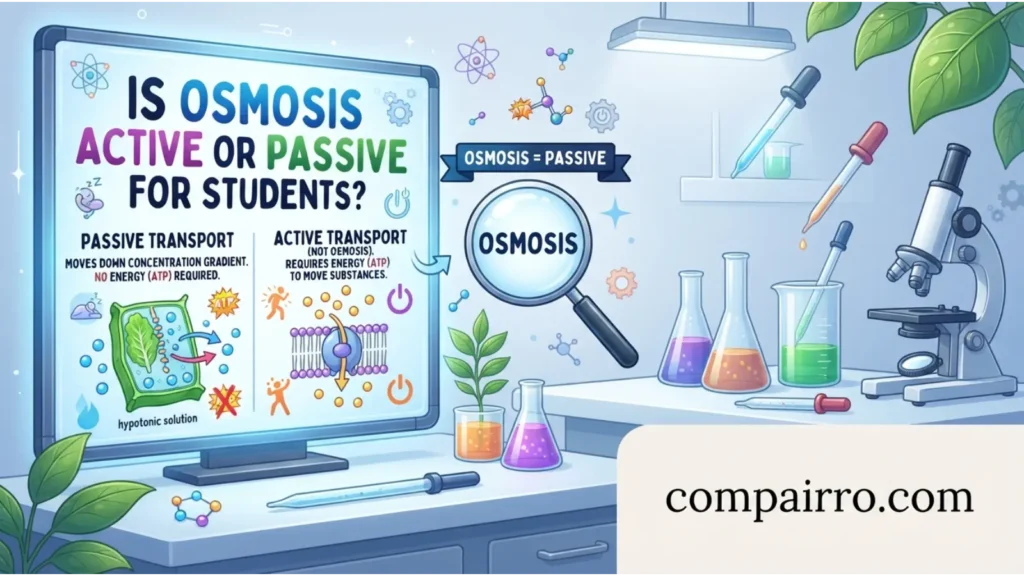
Is Osmosis Active or Passive for Students or Beginners?
Beginners often struggle because several transport processes sound similar.
You may need to learn:
- Osmosis
- Diffusion
- Facilitated diffusion
- Active transport
- Endocytosis
- Exocytosis
The easiest way to start is to focus on energy.
Ask yourself:
Does the cell directly use energy to move the substance?
If the answer is no, the process may be passive.
For osmosis, the answer is:
No, osmosis does not directly use ATP.
Easy learning tips
- Remember that osmosis deals with water.
- Remember that it involves a selectively permeable membrane.
- Remember that it is passive.
- Do not confuse passive movement with “no movement.”
- Compare osmosis with active transport when studying for exams.
Signs or Characteristics Related to Is Osmosis Active or Passive
Here are the main characteristics of osmosis:
- It involves water molecules.
- A selectively permeable membrane is involved.
- It is a form of passive transport.
- It does not directly require ATP.
- Water movement depends on differences in water potential.
- Dissolved substances influence the direction of water movement.
- Osmosis helps cells maintain water balance.
- It occurs in both plant and animal cells.
- It is an important process in biology.
- It can cause cells to gain or lose water.
In plant cells
Water entering plant cells can help maintain pressure inside the cells.
In animal cells
Changes in the surrounding solution can cause animal cells to gain or lose water.
Simple Trick to Remember Is Osmosis Active or Passive
Here is an easy memory trick:
👉 Osmosis = Water + No ATP = Passive
Think of the letter O in osmosis as standing for:
O = Only water movement
And remember:
Passive = No direct energy
Think of it this way:
Imagine water naturally moving through an open path because of a difference between two sides. The cell does not have to spend ATP to push every water molecule.
That is why osmosis is called passive transport.
A quick exam memory line is:
“Osmosis moves water passively.”
FAQs:
1. Is osmosis active or passive?
Osmosis is passive transport because it does not directly require ATP energy from the cell.
2. Does osmosis require energy?
No. Osmosis does not directly require cellular energy such as ATP.
3. What moves during osmosis?
Water molecules move during osmosis.
4. Does osmosis need a cell membrane?
Osmosis requires a selectively permeable membrane through which water can move.
5. Is osmosis the same as diffusion?
They are related but not identical. Diffusion refers to particle movement down a concentration gradient, while osmosis specifically refers to water movement across a selectively permeable membrane.
6. Is active transport the opposite of osmosis?
Not exactly. Osmosis is a passive process, while active transport uses cellular energy to move substances, often against their concentration gradient.
7. Why is osmosis important?
Osmosis helps cells control their water balance and is important in plants, animals, medicine, agriculture, and many biological processes.
Conclusion
So, is osmosis active or passive? The answer is clear: osmosis is a passive transport process.
It involves the movement of water across a selectively permeable membrane. The cell does not directly spend ATP to make osmosis happen.
The easiest rule to remember is:
👉 Osmosis = water movement + membrane + no ATP = passive transport.
Once you separate osmosis from active transport, the topic becomes much easier. Remember that osmosis focuses on water, while active transport involves energy use to move substances.
If you are preparing for a biology exam, memorize the simple line: “Osmosis is passive movement of water across a selectively permeable membrane.”

Sara Taylor is a passionate English content writer who specializes in word meanings, spelling comparisons, and modern slang explanations. She creates easy-to-understand articles that help readers avoid common English mistakes and improve their writing skills. Her content focuses on simple learning, real-life examples, and clear explanations for everyday readers.