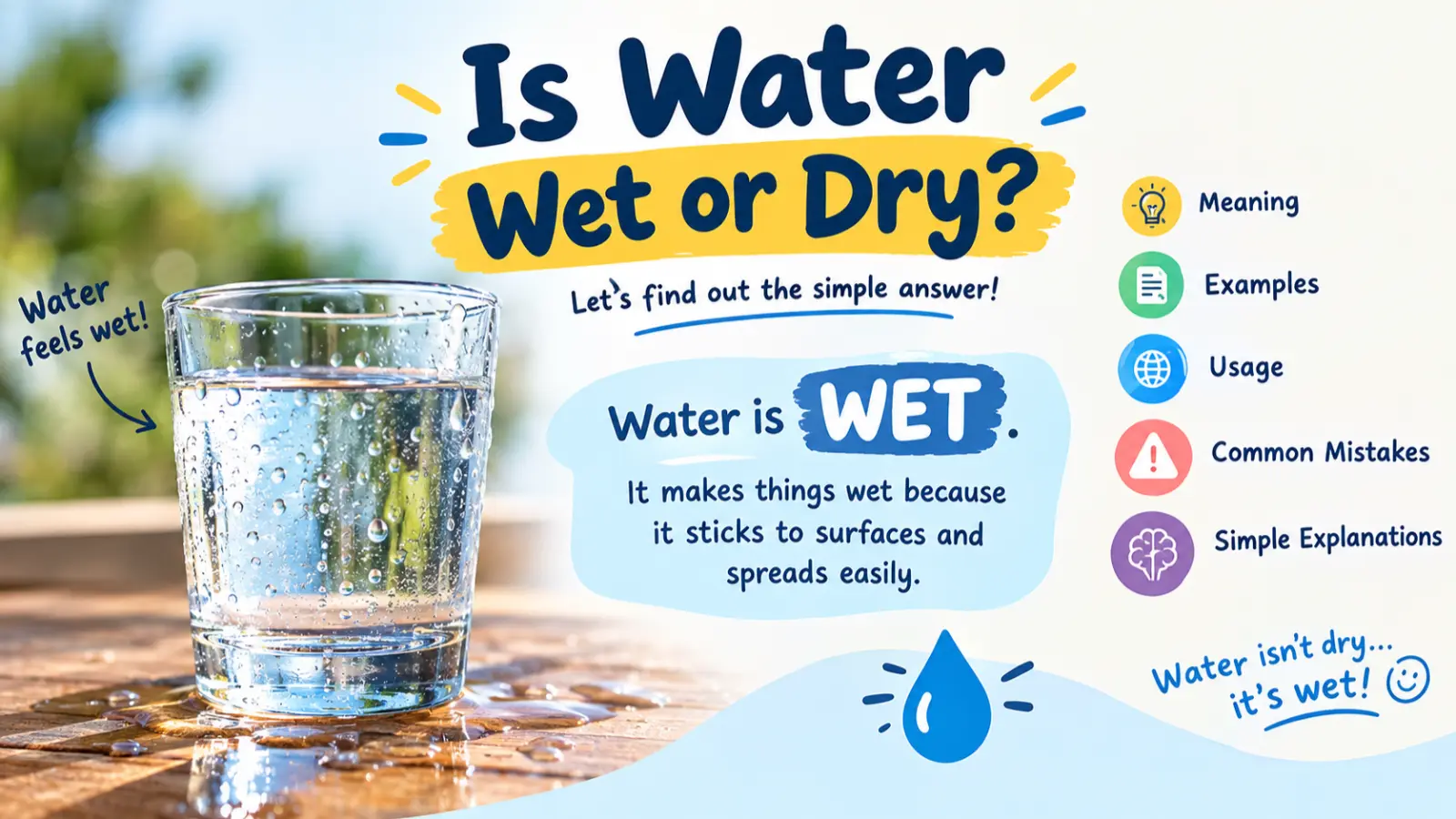
Think about a glass of water on your table. You can drink it, use it for cooking, and see it almost everywhere in daily life. But have you ever wondered what makes water behave differently from substances such as oil? This leads to a common science question: is water polar or nonpolar?
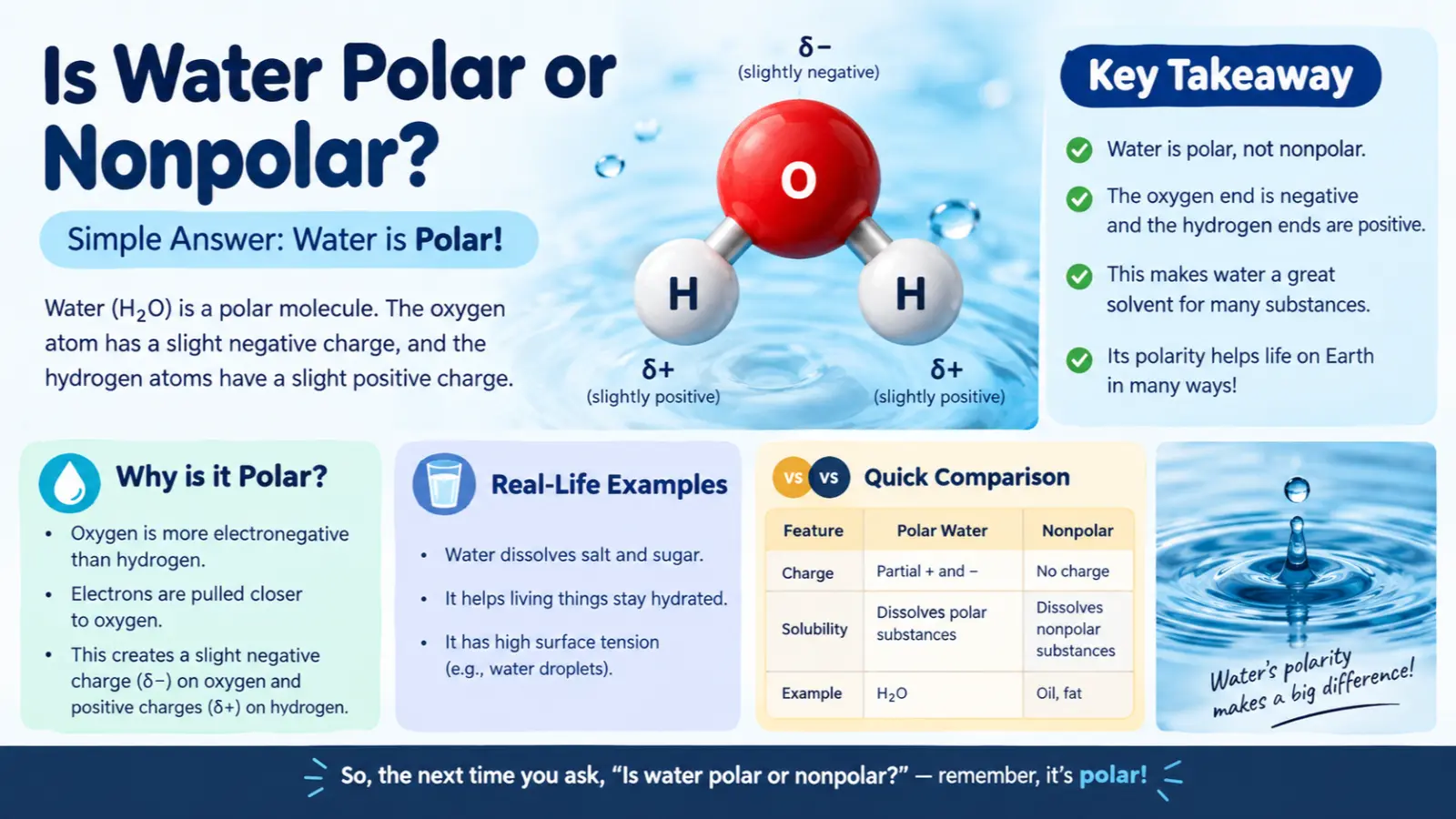
The answer is simple: water is a polar molecule. Its polarity helps explain many of its special properties, including why it dissolves salt and sugar, why water molecules attract each other, and why water behaves differently from nonpolar substances.
Students often search for is water polar or nonpolar when studying chemistry, molecular structure, chemical bonds, or solutions. The topic can seem confusing at first because water contains only hydrogen and oxygen. However, its molecular shape and the way electrons are shared make a big difference.
You may come across this question in school science lessons, college chemistry, laboratory work, online educational content, and everyday conversations about chemistry. Understanding water’s polarity also helps you understand why some substances mix with water while others do not.
The good news is that you do not need advanced chemistry knowledge to understand the answer. Once you know about electronegativity, bonds, and water’s bent shape, the idea becomes much easier.
In this guide, you’ll learn the meaning, examples, usage, differences, common mistakes, and simple explanations in easy English.
Is Water Polar or Nonpolar – Quick Answer
👉 Water is polar.
Water (H₂O) is a polar molecule because oxygen attracts the shared electrons more strongly than hydrogen. This creates a slightly negative side near oxygen and slightly positive sides near the hydrogen atoms.
Examples
Water + salt: Salt can dissolve well in water because water molecules interact with charged particles.
Water + sugar: Sugar dissolves because its molecules have parts that can interact with polar water molecules.
Water + oil: Water and oil usually do not mix because oil is mostly nonpolar.
Simple rule
👉 Water = Polar
A quick way to remember it is:
Oxygen pulls electrons → water gets uneven charges → water is polar.
The Origin of Water Polarity
Water’s polarity comes from its molecular structure. A water molecule contains two hydrogen atoms and one oxygen atom, giving it the chemical formula H₂O.
Oxygen has a stronger attraction for electrons than hydrogen. As a result, the electrons in the O–H bonds are not shared equally.
Oxygen gets a partial negative charge (δ−), while the hydrogen atoms get partial positive charges (δ+).
However, the unequal sharing of electrons is only part of the answer. Water also has a bent molecular shape.
Because of this bent shape, the small charges do not cancel each other out. The whole water molecule therefore has a net dipole, making it polar.
The concept of molecular polarity became important as scientists developed better ways to understand chemical bonds and molecular structures.
British English vs American English Usage
There is no British vs American spelling difference for the scientific terms used here. Scientists in both forms of English use polar molecule, nonpolar molecule, and water in the same way.
So, whether you are studying in the UK, US, Pakistan, India, Canada, or Australia, the scientific answer remains the same: water is polar.
Which One Should You Use?
If you are answering the question is water polar or nonpolar, use polar.
The term is appropriate in many situations:
School: Explain that water is a polar molecule.
Chemistry: Discuss its polar O–H bonds and bent shape.
Laboratory work: Use polarity to explain why substances dissolve or do not dissolve.
Academic writing: Say that water has a net molecular dipole.
Everyday explanation: Simply say that water has slightly positive and negative sides.
Online searches: Both “water polar” and “is water polar or nonpolar” are common ways to ask the same basic question.
A useful point is that polar does not mean that water has a full positive or negative charge. A water molecule is overall electrically neutral. Its charges are distributed unevenly.
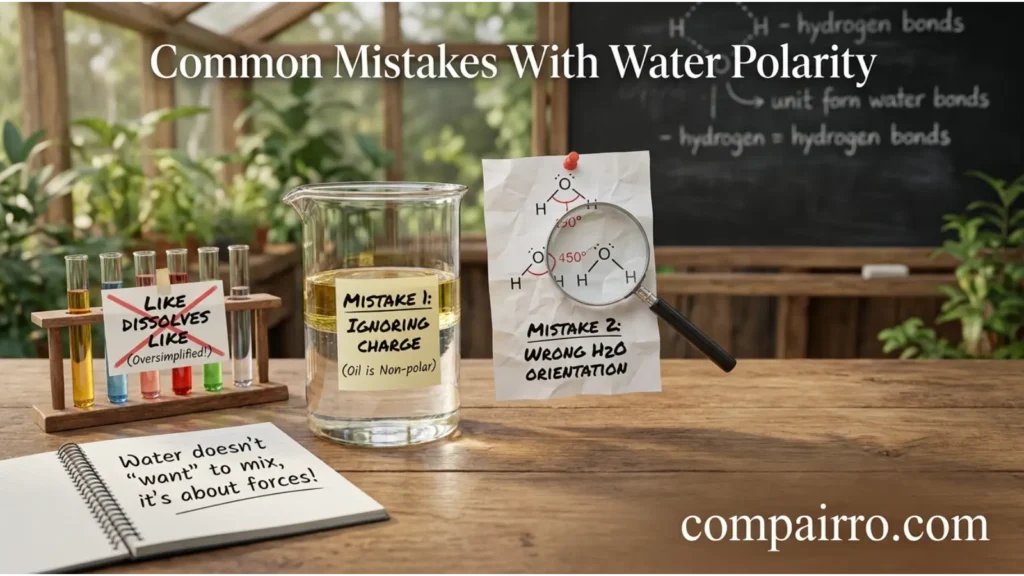
Common Mistakes With Water Polarity
Mistake 1: Thinking water is nonpolar because it is neutral
❌ Incorrect: “Water has no overall charge, so it must be nonpolar.”
✔ Correct: Water is neutral overall but has an uneven distribution of charge. That makes it polar.
Mistake 2: Looking only at the chemical formula
❌ Incorrect: “H₂O has three atoms, so its polarity cannot be determined.”
✔ Correct: You need to consider both the bonds and the molecule’s shape.
Mistake 3: Ignoring water’s bent shape
❌ Incorrect: “The two O–H bond polarities cancel each other.”
✔ Correct: Water has a bent shape, so the bond dipoles do not fully cancel.
Mistake 4: Saying oxygen has a full negative charge
❌ Incorrect: “The oxygen atom in water has a complete negative charge.”
✔ Correct: Oxygen has a partial negative charge, not a full negative charge.
Mistake 5: Assuming all polar substances mix perfectly
❌ Incorrect: “If two substances are polar, they must always mix in every situation.”
✔ Correct: Polarity helps predict interactions and solubility, but other molecular factors also matter.
Water in Everyday Examples
Water’s polarity affects many things you see every day.
Work
In laboratories and workplaces, water is commonly used as a solvent. Its polarity allows it to interact with many ionic and polar substances.
Example: “Water can dissolve many substances because it is polar.”
School
Students learn about water polarity when studying atoms, molecules, chemical bonds, and solutions.
Example: “Our science teacher explained why water is polar.”
Social Media
Science pages and educational videos often discuss water polarity when explaining chemistry in simple terms.
Example: “Why does oil float on water? Water’s polarity is part of the explanation.”
Daily Life
Water can dissolve substances such as table salt and many sugars. Its polarity also helps water molecules attract one another.
Example: “Salt dissolves in water because water molecules can interact with the ions in salt.”
Text Messages
This topic is not normally used in casual texting, but students may ask:
“Is H₂O polar or nonpolar?”
A simple answer is:
“H₂O is polar.”
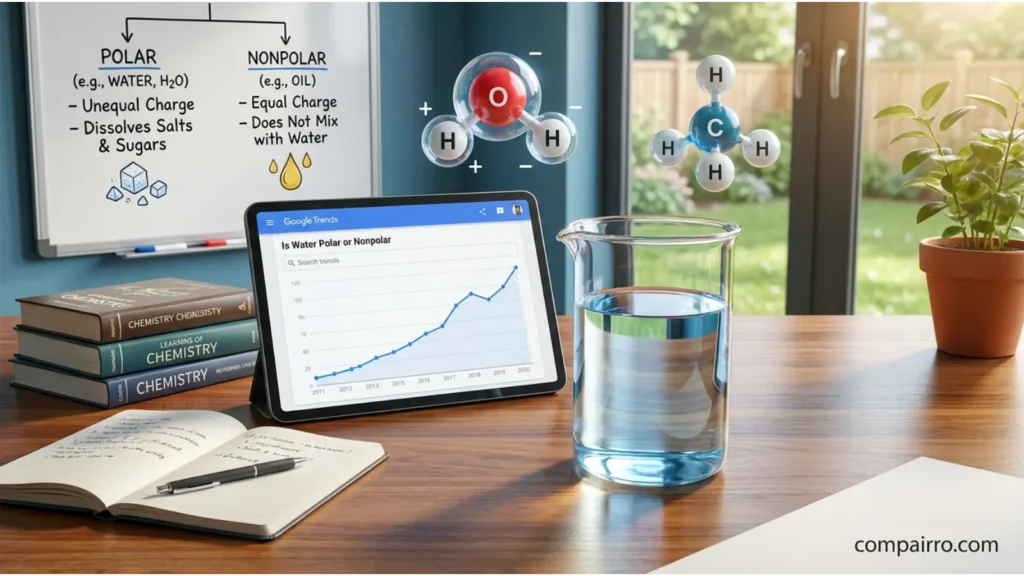
Is Water Polar or Nonpolar – Google Trends & Usage Data
The search is water polar or nonpolar is mainly an educational question. Students often use it when reviewing chemistry lessons, preparing for tests, completing homework, or trying to understand molecular polarity.
Search interest can increase around school and exam periods because students often look for quick explanations and examples.
People in the US, UK, India, Pakistan, Canada, and Australia may search this topic because polarity is taught in many school and college chemistry courses.
The wording can vary. For example, people may search:
Is water polar?
Is H₂O polar or nonpolar?
Why is water polar?
Why is H₂O a polar molecule?
Is water a polar solvent?
What makes water polar?
Is water polar or nonpolar and why?
The topic is also popular in educational videos, chemistry websites, online classrooms, and study platforms.
One important note: search interest changes over time, and a specific ranking among countries should not be assumed without current Google Trends data.
Comparison Table: Water Polarity
Feature
Water
Nonpolar Molecule
Water’s classification
Polar
Not applicable
Electron sharing
Unequal in O–H bonds
Often more even
Charge distribution
Uneven
More even
Molecular shape
Bent
Depends on molecule
Overall molecule
Neutral but polar
Usually neutral and nonpolar
Example
H₂O
O₂, many hydrocarbons
Interaction with ions
Strong
Usually weak
Mixing with oil
Does not mix well
Many nonpolar substances mix with oil
The key difference is charge distribution. Water has an uneven distribution of electrical charge, while a nonpolar molecule has no significant overall separation of positive and negative regions.
Water Polarity in Professional Life
Water’s polarity is important in many scientific and technical fields.
Chemistry
Chemists use water as a common solvent. Its polarity helps it interact with ions and many polar molecules.
Biology
Water is essential for living systems. Its chemical properties support many biological processes.
Medicine and Research
Water is widely used in laboratories for preparing solutions, cleaning equipment, and carrying out chemical processes.
Environmental Science
Scientists study how substances move through water, including pollutants and dissolved minerals.
Food Science
Water’s ability to dissolve and interact with different substances is important in cooking and food processing.
So, water’s polarity is not just a classroom fact. It helps explain real-world chemical behavior.
Water Polarity for Students or Beginners
Beginners often struggle because they hear two different ideas:
Water is neutral.
Water is polar.
Both statements can be true.
A water molecule has no overall electrical charge. However, its electrons are not spread evenly. Oxygen attracts electrons more strongly than hydrogen.
The molecule’s bent shape also matters. Because the molecule is bent, the positive and negative regions do not cancel completely.
Oxygen attracts electrons more strongly than hydrogen.
Water has a bent shape.
Oxygen becomes slightly negative.
Hydrogen becomes slightly positive.
Therefore, water is polar.
A useful exam answer is:
Water is polar because oxygen attracts electrons more strongly than hydrogen, and its bent shape causes the bond dipoles to remain uncanceled.
Characteristics Related to Water Polarity
Here are some important characteristics of polar water:
Uneven charge distribution: Water has slightly positive and negative regions.
Polar O–H bonds: Oxygen attracts shared electrons more strongly.
Bent shape: The molecule is not straight.
Hydrogen bonding: Water molecules can form strong attractions with one another.
Good solvent: Water dissolves many ionic and polar substances.
Surface tension: Water molecules strongly attract each other at the surface.
Cohesion: Water molecules tend to stick to other water molecules.
Adhesion: Water can also interact with other polar surfaces.
Interaction with ions: Polar water molecules can surround and stabilize ions in solution.
These features help explain why water behaves differently from many nonpolar liquids.
Simple Trick to Remember Water Polarity
Here is an easy memory trick:
👉 Water = O pulls + Bent shape = Polar
Think of it this way:
Oxygen pulls the electrons.
Because oxygen attracts the electrons more strongly, one side of the molecule becomes slightly negative. The hydrogen side becomes slightly positive.
Then remember:
Bent + Unequal = Polar
If a chemistry question asks, “Is water polar or nonpolar?”, think:
H₂O → bent shape → unequal charge → polar.
That simple chain can help you remember the answer during a test.
FAQs:
1. Is water polar or nonpolar?
Water is polar. Its oxygen atom attracts electrons more strongly than its hydrogen atoms, creating an uneven charge distribution.
2. Why is H₂O polar?
H₂O is polar because its O–H bonds share electrons unequally and the molecule has a bent shape.
3. Is water a polar solvent?
Yes. Water is a polar solvent and can dissolve many ionic and polar substances.
4. Is water electrically neutral?
Yes. A water molecule has no overall electrical charge, but its charge is distributed unevenly.
5. Is oil polar or nonpolar?
Most oils are largely nonpolar, which is why they do not mix well with water.
6. Does water polarity cause hydrogen bonding?
Yes. The partial positive hydrogen of one water molecule can attract the partial negative oxygen of another.
7. How can I remember that water is polar?
Remember: water has polar bonds + a bent shape = a polar molecule.
Conclusion
So, is water polar or nonpolar? Water is polar.
The main reason is that oxygen attracts the shared electrons more strongly than hydrogen. This creates partial negative and positive regions. Water’s bent shape prevents these regions from canceling each other.
This polarity helps explain many important properties of water. It allows water to interact with ions and many polar substances, supports hydrogen bonding, and makes water an excellent solvent for many materials.
The easiest memory rule is:
👉 Water = unequal charge + bent shape = polar.
Once you understand this simple idea, many questions about water, solubility, hydrogen bonding, and chemical interactions become much easier.
Sara Taylor is a passionate English content writer who specializes in word meanings, spelling comparisons, and modern slang explanations. She creates easy-to-understand articles that help readers avoid common English mistakes and improve their writing skills. Her content focuses on simple learning, real-life examples, and clear explanations for everyday readers.