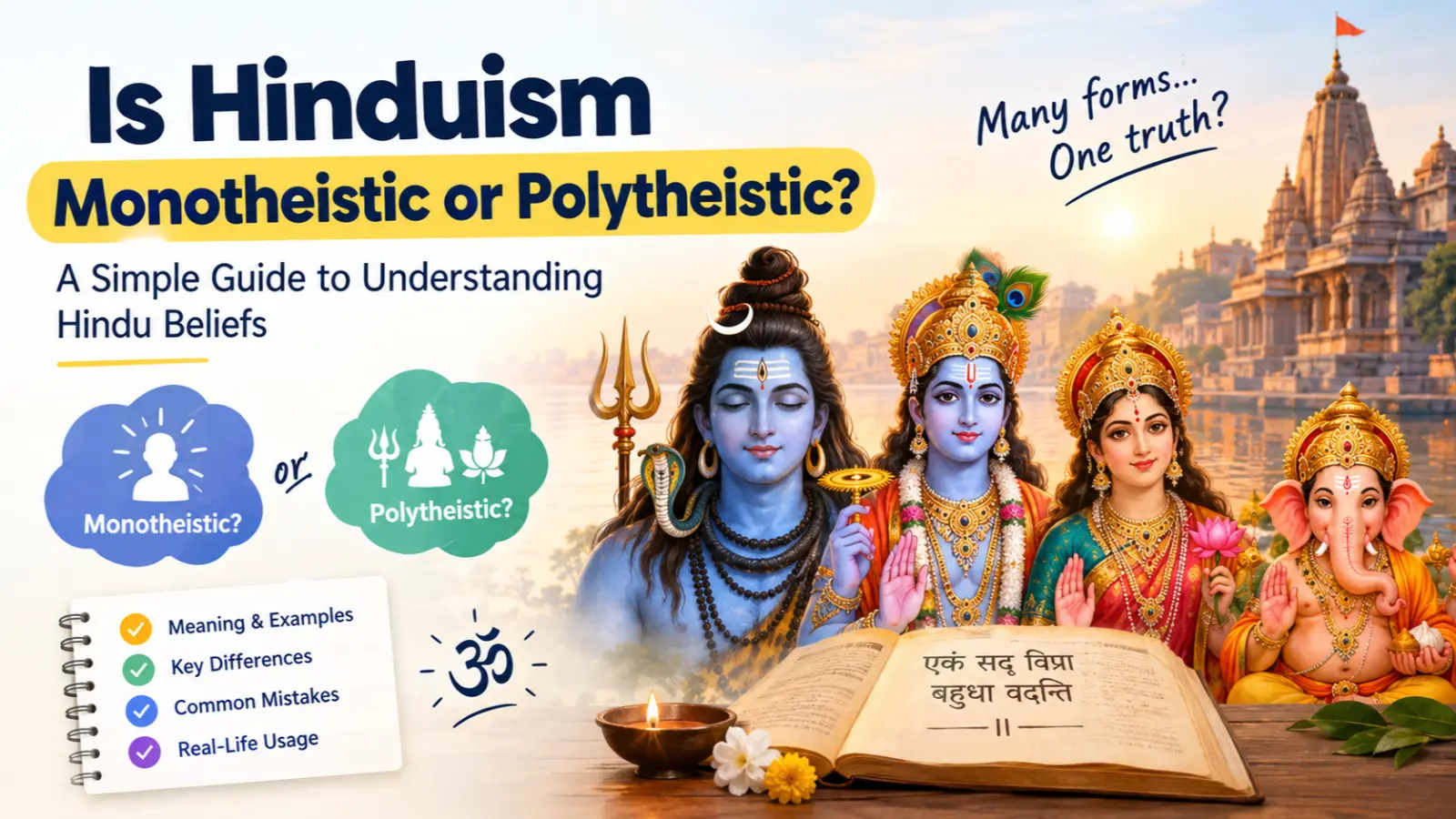
Imagine a student sitting in a classroom and hearing that Hinduism has many gods and goddesses. Later, the same student learns that some Hindu traditions describe one ultimate reality behind everything. Naturally, this can feel confusing. So, is Hinduism monotheistic or polytheistic?
The answer is not as simple as choosing only one word. Hinduism is a large and diverse religious tradition with many schools, beliefs, scriptures, and practices. Some Hindus worship one personal deity as supreme. Others worship different deities, while some focus on Brahman, the ultimate reality. Because of this variety, scholars often describe Hinduism as having monotheistic, polytheistic, monistic, henotheistic, and other forms of belief, depending on the tradition being discussed.
People commonly search this question for school assignments, religious studies, personal learning, online discussions, and general curiosity. It also appears in conversations and social media debates about how religions understand God or the divine.
Understanding this topic matters because simply calling Hinduism “polytheistic” can leave out important parts of Hindu thought. At the same time, saying that all Hindus believe in only one God would also be too broad.
In this guide, you’ll learn the meaning, examples, usage, differences, common mistakes, and simple explanations in easy English.
Is Hinduism Monotheistic or Polytheistic – Quick Answer
👉 Is Hinduism monotheistic or polytheistic? = Hinduism can include both monotheistic and polytheistic forms of worship, but its beliefs about the divine are much more diverse than either label suggests.
In simple terms, Hinduism has many traditions. Some worship one deity as the highest or supreme God, while others honor several deities. Many Hindu philosophies also speak about Brahman, the ultimate reality.
Examples
- A Vaishnava may worship Vishnu or one of his forms as supreme.
- A Shaiva may worship Shiva as the supreme deity.
- A Shakta may worship Devi or the Goddess as supreme.
- Some Hindu philosophies focus on Brahman, which is understood as the ultimate reality.
Simple rule:
👉 Hinduism is diverse, so one label does not fully describe every Hindu belief.
The Origin of Hinduism and Its Beliefs
Hinduism developed over a very long period in the Indian subcontinent. Unlike religions founded by one known historical founder, Hinduism grew from many traditions, texts, practices, and philosophical ideas.
Some of the oldest Hindu sacred texts are the Vedas. Later traditions also gave great importance to texts such as the Upanishads, Bhagavad Gita, Ramayana, and Mahabharata.
The idea of the divine developed in many different ways. The Vedic tradition includes many deities, while later Hindu philosophy often discusses deeper ideas about ultimate reality, the self, and the universe.
One important term is Brahman. In several Hindu philosophical traditions, Brahman refers to the ultimate or absolute reality. Brahman should not simply be treated as another god among many gods.
Over time, different Hindu traditions became especially devoted to particular deities, including Shiva, Vishnu, Devi, and their various forms.
British English vs American English Usage
There is no major British-versus-American difference in the terms “monotheistic” and “polytheistic.” Both varieties of English use the same spellings and meanings.
| Feature | British English | American English | Notes |
|---|---|---|---|
| Monotheistic | Monotheistic | Monotheistic | Same spelling |
| Polytheistic | Polytheistic | Polytheistic | Same spelling |
| Hinduism | Hinduism | Hinduism | Same spelling |
| Brahman | Brahman | Brahman | Same spelling |
| Hindu | Hindu | Hindu | Same spelling |
The main difference is not English usage. The important issue is understanding the different Hindu traditions and their beliefs.
Which One Should You Use?
If you are answering the question “Is Hinduism monotheistic or polytheistic?”, avoid giving an overly simple answer.
For school or academic writing, you can say:
- Hinduism is a diverse religious tradition.
- Some Hindu traditions focus on one supreme deity.
- Other traditions worship multiple deities.
- Some Hindu philosophies focus on Brahman as ultimate reality.
- Therefore, Hinduism cannot always be placed neatly into only one category.
For a short answer, this works well:
Hinduism includes diverse beliefs about the divine, including traditions centered on one supreme deity and traditions involving many deities.
This is more accurate than simply saying “Hinduism is polytheistic.”
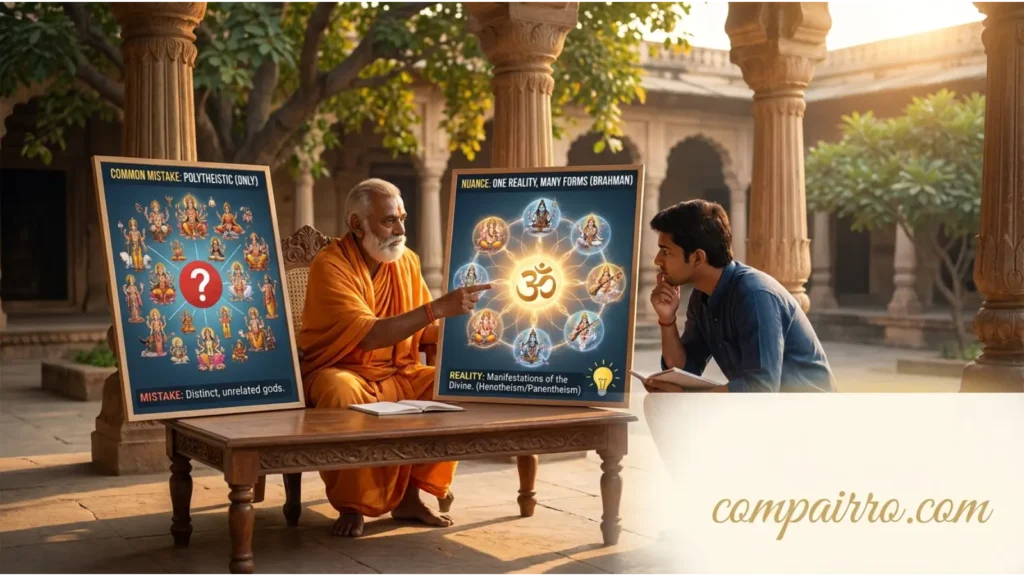
Common Mistakes With Is Hinduism Monotheistic or Polytheistic
Mistake 1: Saying every Hindu worships many gods
❌ Incorrect: Every Hindu believes that many separate gods are equally supreme.
✔ Correct: Hindu beliefs differ. Some traditions focus on one supreme deity, while others have different understandings of several deities.
Mistake 2: Saying all Hindus believe in exactly one God
❌ Incorrect: All Hindus follow exactly the same monotheistic belief.
✔ Correct: Hinduism contains many schools and traditions, so beliefs about God and ultimate reality vary.
Mistake 3: Confusing Brahman with Brahma
❌ Incorrect: Brahman is simply another name for the god Brahma.
✔ Correct: Brahman can mean ultimate reality in Hindu philosophy, while Brahma is a deity associated with creation in Hindu traditions.
Mistake 4: Assuming all Hindu gods are understood in the same way
❌ Incorrect: Every Hindu tradition understands Shiva, Vishnu, and Devi in exactly the same way.
✔ Correct: Different traditions give different roles and levels of importance to deities.
Mistake 5: Using “polytheistic” as the complete explanation
❌ Incorrect: Hinduism is only about worshipping many separate gods.
✔ Correct: Some Hindu traditions include many deities, but Hindu philosophy also contains ideas about one ultimate reality and different forms of the divine.
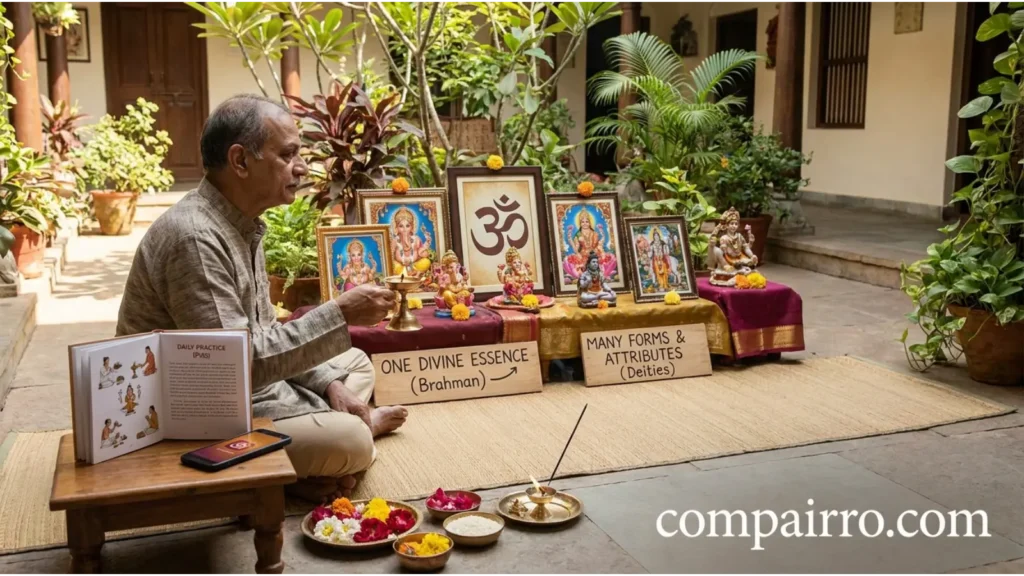
Is Hinduism Monotheistic or Polytheistic in Everyday Examples?
The question usually appears in educational and religious contexts rather than ordinary texting.
School
A student might write:
“Hinduism has many traditions, so it cannot be fully explained by calling it only monotheistic or polytheistic.”
Work
In professional or academic settings, respectful and neutral language is important when discussing religion.
Social Media
People may ask:
“Is Hinduism monotheistic or polytheistic?”
Online answers can sometimes be too simple. A better answer should mention Hinduism’s diversity.
Daily Life
A Hindu family may have a strong devotional focus on a particular deity. Another Hindu family may follow a different tradition or practice.
Text Messages
Someone might simply ask:
“Is Hinduism monotheistic?”
A short but accurate reply could be:
“It depends on the Hindu tradition. Hinduism includes several different views of the divine.”
Is Hinduism Monotheistic or Polytheistic – Google Trends & Usage Data
The search phrase “is Hinduism monotheistic or polytheistic” reflects a common educational question. People often search it because they want a quick way to understand Hindu beliefs compared with categories used to describe other religions.
Search interest can come from:
- Students researching religion
- Teachers and learners
- People studying world religions
- Religious comparison discussions
- Online questions and debates
- People learning about Hindu philosophy
The topic can appear in searches across the US, UK, India, Pakistan, Canada, and Australia.
However, search interest does not mean that one simple answer represents every Hindu tradition. A useful article should explain the different views instead of reducing the subject to a single label.
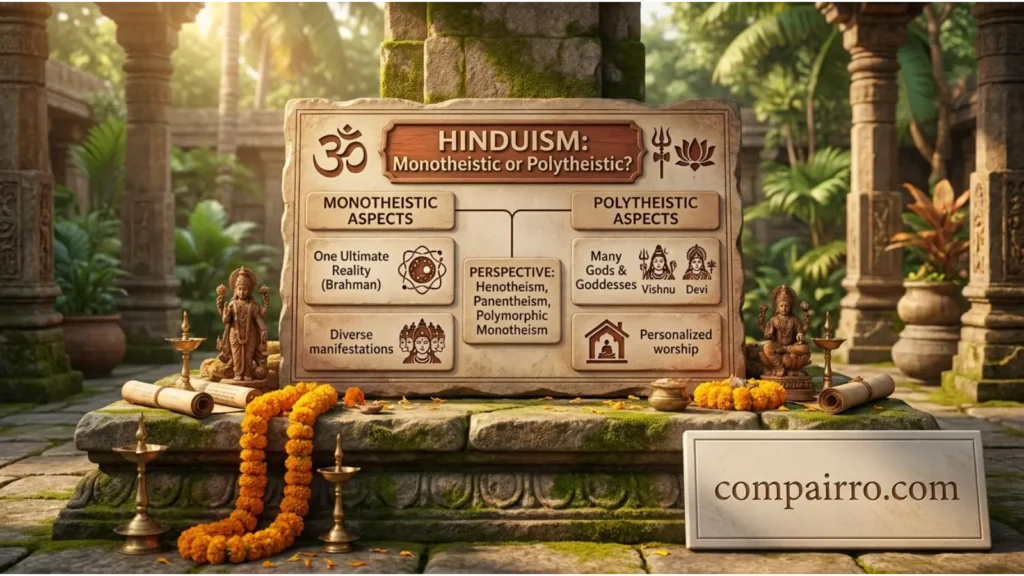
Comparison Table: Is Hinduism Monotheistic or Polytheistic?
| Hindu belief or tradition | Main focus | Simple explanation |
|---|---|---|
| Vaishnavism | Vishnu and his forms | Vishnu or a form of Vishnu may be understood as supreme |
| Shaivism | Shiva | Shiva may be understood as the supreme deity |
| Shaktism | Devi/Shakti | The Goddess is treated as supreme |
| Advaita Vedanta | Brahman | Focuses on ultimate reality beyond ordinary distinctions |
| Vedic traditions | Various deities | Multiple deities appear in Vedic texts and traditions |
| General Hinduism | Diverse beliefs | No single belief system represents all Hindus |
This table shows why the question does not have a one-word answer.
Is Hinduism Monotheistic or Polytheistic in Professional Life?
Religion is not normally a workplace category, but understanding the topic can be useful in education, journalism, research, teaching, and multicultural workplaces.
When discussing Hinduism professionally:
- Use neutral and respectful language.
- Avoid saying that every Hindu believes the same thing.
- Explain the specific tradition when possible.
- Distinguish Brahman from Brahma.
- Avoid reducing a large religion to one simple label.
For example, instead of saying:
“Hinduism has many gods.”
A more careful statement is:
“Hinduism includes traditions that worship multiple deities and traditions that understand one deity or ultimate reality as supreme.”
Is Hinduism Monotheistic or Polytheistic for Students or Beginners?
Beginners often struggle with this question because the words monotheism and polytheism are simple categories, while Hinduism contains many different philosophical and devotional traditions.
Easy learning tips
- Learn what monotheism means: belief in one God.
- Learn what polytheism means: belief in multiple gods.
- Learn what Brahman means in Hindu philosophy.
- Study major Hindu traditions separately.
- Remember that not every Hindu understands the divine in exactly the same way.
A good beginner approach is to think of Hinduism as a large family of traditions, rather than as one belief system with one simple answer.
Signs or Characteristics Related to Hinduism’s Views of the Divine
Because Hinduism is diverse, these are better understood as common characteristics, not rules that apply to every Hindu.
- Many deities: Hindu traditions include numerous gods and goddesses.
- Supreme deity: Some traditions treat one particular deity as supreme.
- Different forms: A deity may be understood through different names or forms.
- Brahman: Some philosophical traditions focus on ultimate reality.
- Devotion: Personal devotion, or bhakti, is important in many traditions.
- Different philosophies: Hindu schools have different views about God, the self, and reality.
- Diverse practices: Hindu worship and religious practice can vary greatly between communities.
Simple Trick to Remember Is Hinduism Monotheistic or Polytheistic
Think of it this way:
👉 Monotheism = one God
👉 Polytheism = many gods
👉 Hinduism = many traditions and different understandings of the divine
The easiest memory rule is:
Don’t force Hinduism into one box.
For example, one Hindu tradition may place Shiva at the center, another may place Vishnu at the center, and another may focus on Devi or Brahman.
So when someone asks, “Is Hinduism monotheistic or polytheistic?”, remember that the best answer explains the diversity within Hinduism.
FAQs:
1. Is Hinduism monotheistic or polytheistic?
Hinduism includes different beliefs. Some traditions focus on one supreme deity, while others include worship of multiple deities.
2. Do Hindus believe in one God?
Some Hindus understand one deity as supreme, while others have different views of the divine and ultimate reality.
3. Does Hinduism have many gods?
Yes. Hindu traditions include many gods and goddesses, although their roles and meanings differ between traditions.
4. What is Brahman in Hinduism?
Brahman is a term used in several Hindu philosophies for ultimate or absolute reality. It is different from Brahma, the deity.
5. Is Brahman a Hindu god?
Brahman is not simply a god among other gods. In many philosophical traditions, it refers to the ultimate reality behind existence.
6. Is Hinduism a polytheistic religion?
Calling Hinduism polytheistic can describe some of its practices, but it does not fully explain the many Hindu beliefs about the divine.
7. Why is Hinduism difficult to classify?
Hinduism developed through many traditions, scriptures, philosophies, and forms of worship. Therefore, its beliefs cannot always be placed into one simple category.
Conclusion
So, is Hinduism monotheistic or polytheistic? The most accurate answer is that Hinduism is a highly diverse religious tradition with different understandings of God, gods, and ultimate reality.
Some Hindu traditions focus on one supreme deity, such as Shiva, Vishnu, or Devi. Other traditions include worship of many deities. Some philosophical schools focus on Brahman, the ultimate reality.

Sara Taylor is a passionate English content writer who specializes in word meanings, spelling comparisons, and modern slang explanations. She creates easy-to-understand articles that help readers avoid common English mistakes and improve their writing skills. Her content focuses on simple learning, real-life examples, and clear explanations for everyday readers.