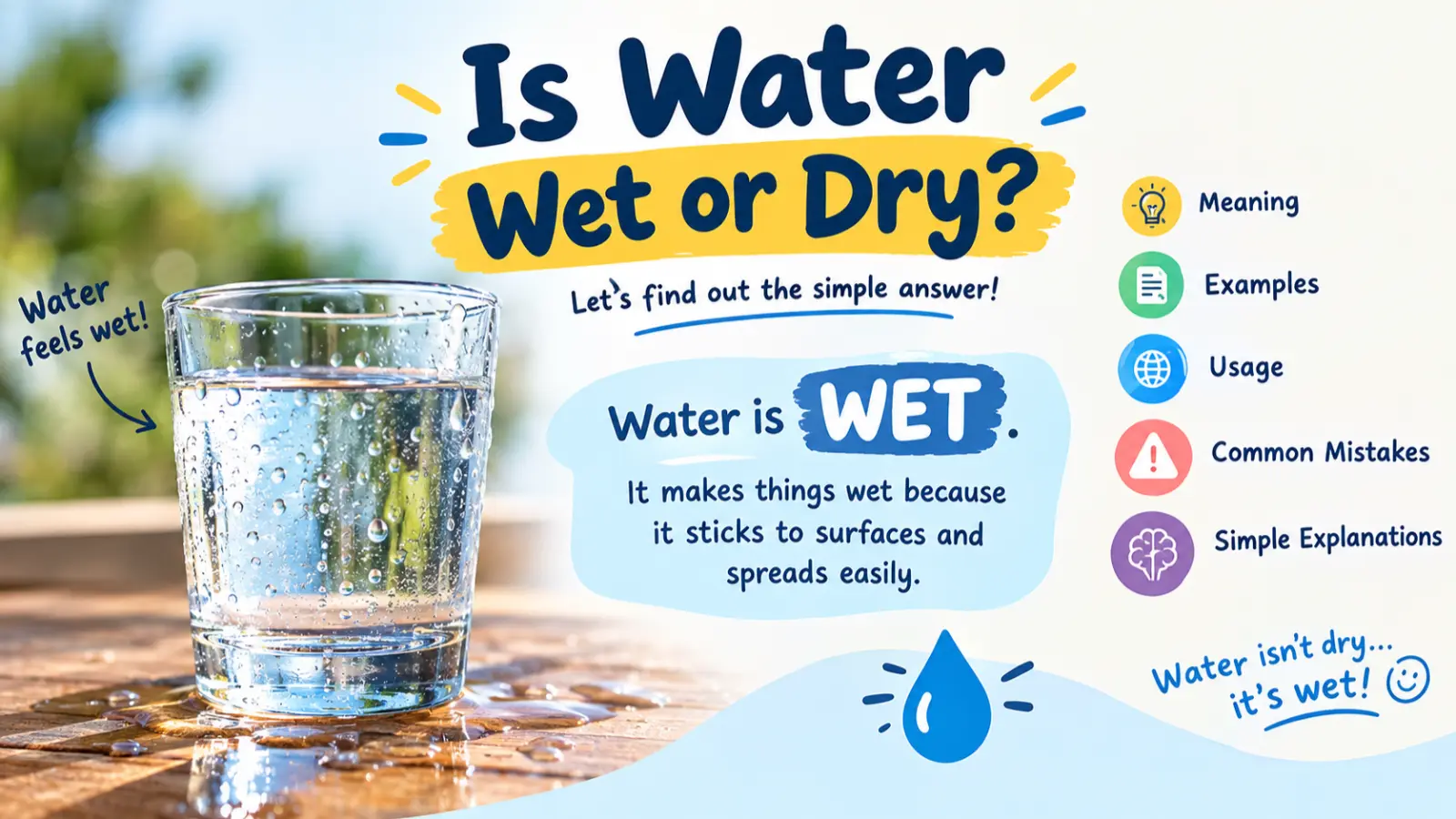
Have you ever wondered If water is wet or dry? This simple question may seem easy, but it can lead to a surprisingly interesting answer.
We usually say that water makes things wet, so it feels natural to call water itself “wet.” However, science gives us a more careful way to look at the question.
The confusion comes from the meaning of the word wet. In everyday English, wet usually describes something that has water or another liquid on its surface.
For example, a wet towel has water on it, and wet clothes contain water. Water itself is the liquid causing that condition.
You may see this question in school science discussions, online debates, social media posts, videos, and everyday conversations. People often ask it as a fun science question or use it to start a debate with friends.
In this guide, you’ll learn the meaning, examples, usage, differences, common mistakes, and simple explanations in easy English.
Is Water Wet or Dry – Quick Answer
👉 Water is generally not described as wet. Water makes other surfaces wet.
The word wet usually means that a surface has liquid on it. Therefore, a towel, table, floor, or shirt becomes wet when water covers its surface.
For example:
- The towel is wet. ✅
- The floor is wet. ✅
- Water made the towel wet. ✅
- Water is dry. ❌
However, there is another scientific view. Water molecules surround and interact with other water molecules, so some people consider water itself wet.
Simple rule
👉 Water is the liquid; wet describes what happens when a liquid covers or interacts with a surface.
The Origin of the Question “Is Water Wet or Dry?”
The exact origin of the question is difficult to identify. It is mainly a modern everyday-language and science debate rather than a scientific term with one known inventor.
The question became especially popular through internet discussions, social media, classroom debates, and videos. People began using it because the answer depends partly on how we define wet.
In ordinary English, “wet” describes something containing or covered with liquid. This makes it easier to say that water causes wetness rather than saying that water itself feels wet.
Science adds another layer. When water touches a surface, water molecules interact with that surface. This process is called wetting.
So, the question became popular because a simple word can have different meanings depending on the context.
British English vs American English Usage
There is no major British English vs American English difference in the meaning of wet or water.
Both varieties of English commonly use wet to describe something that has water or another liquid on it.
| Feature | British English | American English | Notes |
|---|---|---|---|
| Water | Water | Water | Same word |
| Wet | Wet | Wet | Same spelling |
| Wet towel | Common | Common | Same meaning |
| Wet floor | Common | Common | Same meaning |
| Water makes things wet | Common | Common | Same idea |
Therefore, whether you are writing in British or American English, the basic explanation remains the same.
Which One Should You Use?
If you are writing a school assignment or explaining the idea scientifically, it is better to say that water causes wetness.
You can use these simple points:
- Use wet for a surface or material covered with liquid.
- Use water for the liquid itself.
- In casual conversation, people often say, “Water is wet,” and others understand the meaning.
- In science discussions, explain what you mean by wet.
- For clear writing, “water makes things wet” is usually the easiest statement.
For example, a science student could write:
“Water is a liquid that can make other materials wet.”
This is clearer than simply saying:
“Water is wet.”
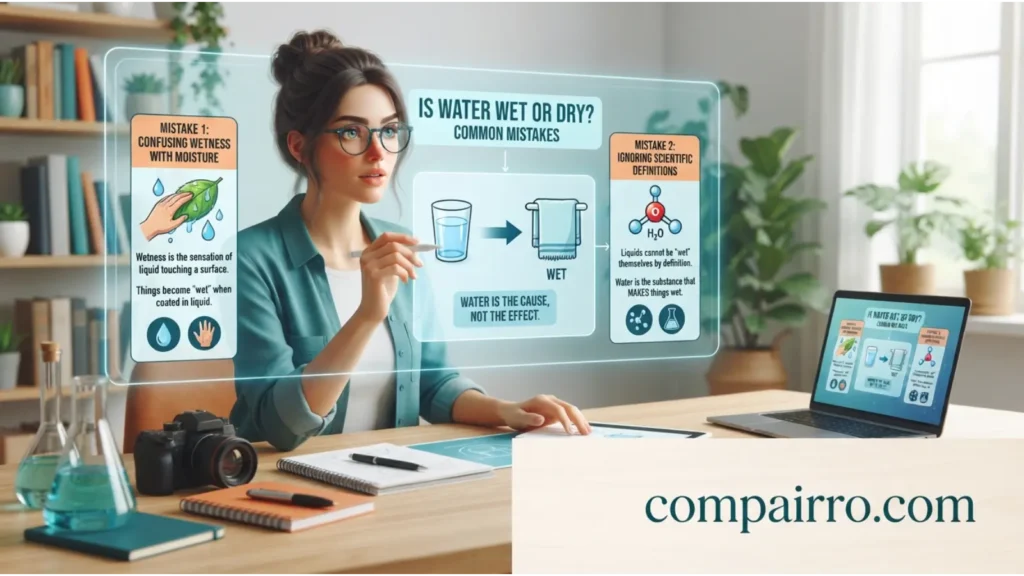
Common Mistakes With “Is Water Wet or Dry?”
Mistake 1
❌ Water is dry because it is not a solid.
✔ Dry does not simply mean “not solid.” Dry usually means that there is little or no liquid present on something.
Mistake 2
❌ Water does not automatically make everything wet just because it contains water.
✔ The word wet normally refers to the presence of liquid on or within a material. Context matters.
Mistake 3
❌ Wet and liquid mean exactly the same thing.
✔ They are different. Water is a liquid, while wet usually describes the condition of another material or surface.
Mistake 4
❌ People can never call water wet in any situation.
People commonly say, “the water is wet,” in casual conversation.
The debate mainly comes from how strictly we define the word wet.
Mistake 5
❌ Dry means the opposite physical state of liquid.
✔ Dry usually means free from or lacking noticeable liquid. It is not simply the opposite scientific state of “liquid.”
Is Water Wet or Dry in Everyday Examples?
The question becomes easier when you look at normal situations.
Work
Imagine someone spills water on a desk.
Water makes the desk wet by covering part of its surface.
The water itself is the liquid that caused the wet condition.
School
A student puts their hand under a tap.
Their hand becomes wet because water touches and remains on the skin.
The water is not the same thing as the wetness of the hand.
Social Media
People often use “Is water wet?” as a fun debate question online.
One person may say yes, while another says no. Both sides may use different definitions of “wet.”
Daily Life
Think about a swimming pool.
Your clothes become wet when they come into contact with water. The water causes the clothes to become wet.
Simple Example
👉 Rain → water → wet clothes
The rain provides water, and the clothes become wet.
Is Water Wet or Dry – Google Trends & Usage Data
“Is water wet or dry?” is mainly a curiosity-based search. People often search for it because they want a quick answer to a popular science debate.
Unlike terms such as “weather” or “water cycle,” this is not normally a practical daily search. Instead, interest can rise when the question becomes popular on social media, YouTube, classroom discussions, or online debates.
People in the US, UK, India, Pakistan, Canada, and Australia may all encounter this question because people widely share English-language science content and social media posts across these countries.
The exact search popularity can change over time. Therefore, it is better not to claim a fixed ranking or search volume without checking current Google Trends data.
Common reasons people search include:
- Curiosity about science
- School discussions
- Social media debates
- Funny questions
- Arguments with friends
- Interest in water science
- Understanding the meaning of “wet”
The question is especially interesting for beginners because the everyday meaning of a word does not always match a strict scientific definition.
Comparison Table: Is Water Wet or Dry?
| Idea | Meaning | Example |
|---|---|---|
| Water | A liquid | A glass contains water |
| Wet | Having or being covered with liquid | A wet towel |
| Dry | Having little or no liquid | A dry towel |
| Wetting | Liquid interacting with a surface | Water spreading over glass |
| Water on a surface | Can make the surface wet | Rain on a road |
The key difference is that water is a substance, while wetness describes a condition or interaction.
Is Water Wet or Dry in Professional Life?
This question is not normally important in most workplaces. However, the concepts of water, wet surfaces, and wetting are useful in many professional fields.
For example, workers in construction, cleaning, manufacturing, laboratories, and engineering may need to understand how water interacts with different materials.
In technical writing, clear terms are important. Instead of simply saying “water is wet,” a professional may explain how water contacts, spreads across, or interacts with a surface.
This removes confusion and makes the information more precise.
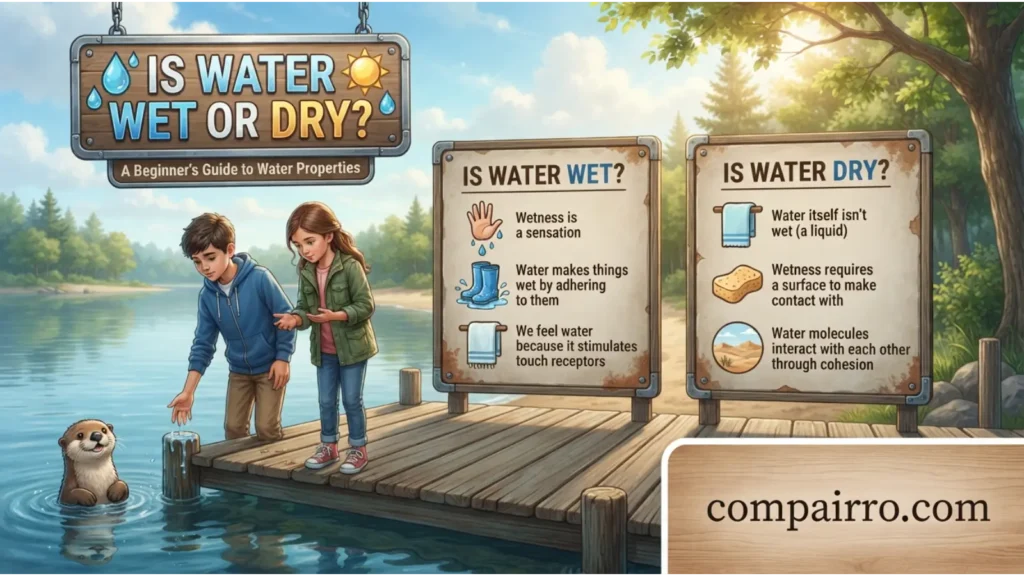
Is Water Wet or Dry for Students or Beginners?
Students often struggle with this question because the answer depends on the definition of wet.
The easiest way to understand it is to separate three ideas:
- Water is a liquid.
- Wet describes something affected by liquid.
- Water can make surfaces wet.
For example, put a dry cloth near water. After the water touches the cloth, the cloth becomes wet.
A useful learning tip is to focus on the surface. Ask:
“What has the water on it?”
If the answer is “the table,” then the table is wet.
This simple question can make the concept much easier for beginners.
Signs or Characteristics Related to “Is Water Wet or Dry?”
Instead of physical “signs,” focus on the main characteristics to understand this question better.
Water
- Water is a liquid.
- It can flow.
- It can spread across surfaces.
- It can make many materials wet.
- It can exist as solid ice or gaseous water vapor under different conditions.
Wetness
- Wetness is usually noticed on a surface or material.
- It happens when liquid contacts or remains on something.
- A wet object can become dry when the liquid leaves or evaporates.
- Different materials interact with water differently.
Dryness
- A dry surface has little or no noticeable liquid.
- Dry materials can become wet after contacting water.
- Dryness can change when water is added or removed.
Simple Trick to Remember “Is Water Wet or Dry?”
Here is an easy memory trick:
👉 Water = Liquid
👉 Wet = Condition
👉 Dry = Little or no liquid
Think of it this way:
Imagine a dry towel.
Add water → the towel becomes wet.
Remove the water → the towel becomes dry again.
So remember:
Water makes the towel wet.
This simple example is enough to understand the basic idea.
FAQs:
1. Is water wet or dry?
Water is a liquid. In everyday English, we usually use “wet” to describe something with liquid on it, so we more accurately describe water as the substance that makes things wet.
2. Can you say that water is wet?
Yes, people commonly say this in casual conversation. However, in a more precise explanation, it is clearer to say that water makes surfaces wet.
3. What does wet mean?
Wet usually means that something has water or another liquid on, in, or around it.
4. Is water the same as wetness?
No. Water is a substance and a liquid. Wetness describes a condition caused when a liquid interacts with a surface or material.
5. Why does water make things wet?
Water can stick to and spread across many surfaces because of interactions between water molecules and the material.
6. Is dry the opposite of wet?
In everyday language, yes. A surface with little or no liquid is usually called dry, while a surface with noticeable liquid is called wet.
7. Why do people debate whether water is wet?
The debate comes from different definitions of “wet.” Some people use wet only for materials covered by a liquid, while others use it more broadly for water itself.
Conclusion
So, is water wet or dry? The simplest answer is that water is a liquid, and it makes other things wet. A towel, floor, or shirt can be wet because water is present on or in the material.
In everyday conversation, saying “water is wet” is common and understandable. However, if you want to be more precise, especially in science, it is better to distinguish between water and wetness.
The most important point is that the answer depends on how the word wet is defined.
👉 Easy memory rule: Water is the liquid; wet describes the condition caused by liquid.
Once you understand that difference, the famous “is water wet or dry?” debate becomes much easier to understand.

Sara Taylor is a passionate English content writer who specializes in word meanings, spelling comparisons, and modern slang explanations. She creates easy-to-understand articles that help readers avoid common English mistakes and improve their writing skills. Her content focuses on simple learning, real-life examples, and clear explanations for everyday readers.