Imagine asking a simple question during a tarot reading: “Will this happen?” You draw The Hierophant and suddenly wonder if the card means yes, no, or something in between. This is a common question because tarot cards can have different meanings depending on the situation and the cards around them.
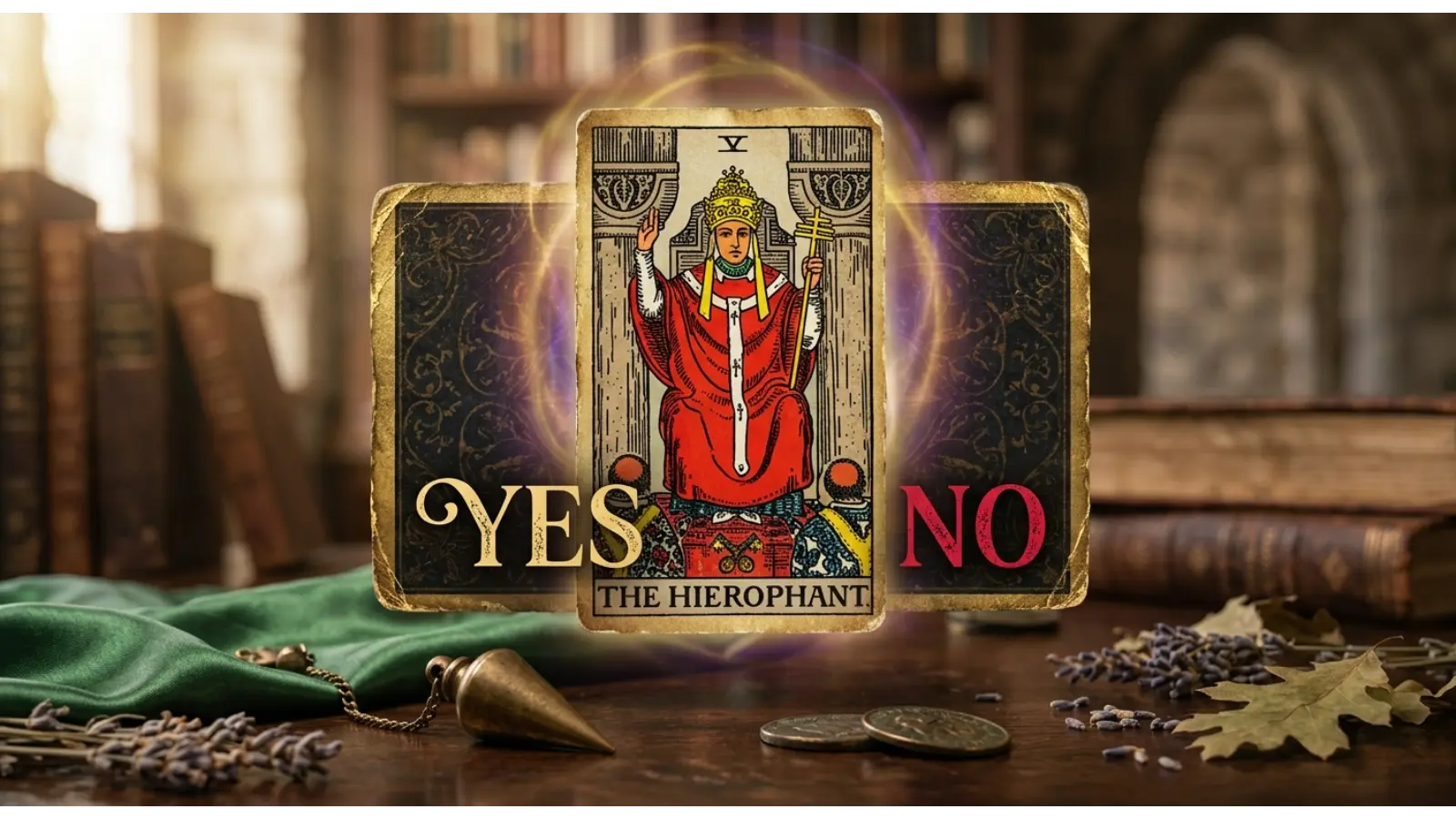
The Hierophant yes or no meaning is usually yes, especially when the question involves tradition, commitment, rules, learning, marriage, or doing things in an established way. However, it is not always a fast or exciting yes. The card often suggests that success comes by following a trusted path, respecting guidance, or being patient.
The Hierophant is often connected with teachers, mentors, institutions, traditions, religion, and shared beliefs. Because of this, its message can feel very different depending on whether you are asking about love, work, education, money, or a personal decision.
You may see this card discussed in tarot readings, social media posts, online searches, and spiritual conversations. Understanding its basic message can help you avoid taking a simple “yes” or “no” too literally.
In this guide, you’ll learn the meaning, examples, usage, differences, common mistakes, and simple explanations in easy English.
The Hierophant Yes or No – Quick Answer
👉 The Hierophant yes or no = Usually yes.
The Hierophant is generally a positive yes card when you are asking about commitment, tradition, education, marriage, guidance, or following an accepted path.
It can also mean that you should not rush. The answer may be yes, but you may need to follow rules, ask for advice, or take a traditional approach.
Examples:
- Will this relationship become serious? → Yes, especially if both people want commitment.
- Should I continue my studies? → Yes, particularly if structured learning will help you.
- Will this plan work? → Yes, if you follow the proper process.
Simple rule:
👉 The Hierophant = Yes, but follow the right path.
The Origin of The Hierophant
The Hierophant is the fifth card of the Major Arcana in traditional tarot. The word hierophant comes from ancient Greek and is connected with someone who reveals or teaches sacred knowledge.
In tarot, the card is commonly shown as a religious or spiritual teacher sitting between two followers. The image represents teaching, tradition, beliefs, rules, and organized knowledge.
The card has been part of tarot symbolism for centuries. Different tarot decks may use different names or images, but its main ideas often remain similar.
In modern tarot readings, The Hierophant is not limited to religion. It can represent schools, teachers, institutions, marriage, family traditions, professional systems, and other established structures.
British English vs American English Usage
There is no major British-versus-American difference in the meaning of The Hierophant. The word and tarot card are understood in much the same way in both forms of English.
| Feature | British English | American English | Notes |
|---|---|---|---|
| Spelling | Hierophant | Hierophant | Same spelling |
| Tarot meaning | Similar | Similar | Usually linked with tradition and guidance |
| Yes/no reading | Usually yes | Usually yes | Context can change the answer |
| Love meaning | Commitment/tradition | Commitment/tradition | Similar interpretation |
| Formal use | Tarot/spiritual discussions | Tarot/spiritual discussions | Not an everyday English word |
So, whether you are reading tarot in the UK, US, India, Pakistan, Canada, or Australia, the basic interpretation remains similar.
Which One Should You Use?
If you are asking whether The Hierophant represents yes or no, the best general answer is yes.
However, tarot is not a fixed mathematical system. The surrounding cards, your question, and the reading style can change the interpretation.
Use the card as a yes when:
- You are asking about commitment.
- You want to follow a proven method.
- A teacher or mentor can help.
- Rules or traditions are important.
- You are considering education or formal training.
- The situation involves marriage or a serious relationship.
- Patience and stability are valuable.
The Hierophant is usually less about quick action and more about doing things properly.
For a formal or important decision, tarot should be treated as a reflective tool rather than a guaranteed prediction.
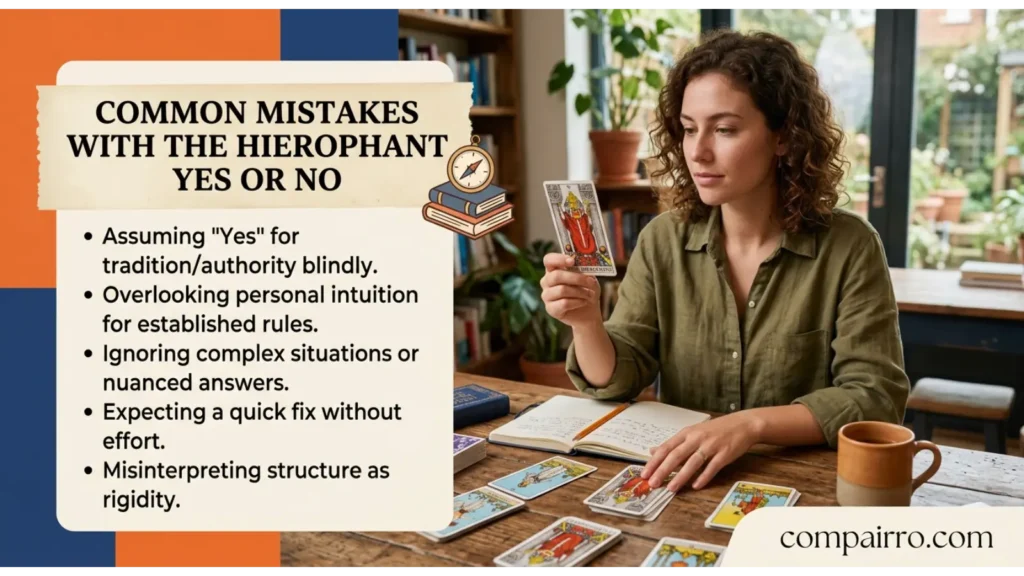
Common Mistakes With The Hierophant Yes or No
Mistake 1: Thinking The Hierophant always means an instant yes
❌ “The card says yes, so everything will happen immediately.”
✔ The Hierophant can indicate yes, but it often suggests patience, structure, and following the proper process.
Mistake 2: Thinking the card only represents religion
❌ “The Hierophant only means religion.”
✔ Religion is one possible meaning, but the card can also represent education, tradition, institutions, teachers, rules, and commitment.
Mistake 3: Ignoring the question
❌ Using exactly the same interpretation for love, career, and money.
✔ The meaning should fit the question. A yes about marriage may look different from a yes about school or work.
Mistake 4: Treating tarot as a guaranteed prediction
❌ “The Hierophant guarantees that this event will happen.”
✔ Tarot readings are interpretive. They can offer ideas for reflection, but they cannot guarantee future events.
Mistake 5: Ignoring surrounding cards
❌ Looking at The Hierophant alone every time.
✔ Other cards can add important details about the situation and possible challenges.

The Hierophant Yes or No in Everyday Examples
Work
If you ask, “Should I follow the normal process at work?” The Hierophant can be a strong yes.
It may suggest following workplace policies, learning from an experienced person, or respecting an established system.
School
For students, The Hierophant can be especially positive.
It may point toward teachers, structured courses, formal education, exams, and learning from someone with experience.
Example:
“I should ask my teacher for help.” → The Hierophant supports this approach.
Social Media
Tarot meanings are often discussed on TikTok, Instagram, YouTube, and other social platforms. People may search The Hierophant yes or no after seeing a tarot reading online.
Remember that short social media readings may not include enough context for a personal interpretation.
Daily Life
If you are unsure whether to follow advice from someone experienced, The Hierophant can suggest listening and learning before making a decision.
Text Messages
The Hierophant is not normally a texting abbreviation. If someone sends “The Hierophant” in a message, they are most likely talking about tarot, spirituality, or a tarot reading.
The Hierophant – Google Trends & Usage Data
People search for The Hierophant yes or no because they want a quick answer after pulling the card in a tarot reading.
Common searches include:
- The Hierophant yes or no love
- The Hierophant yes or no relationship
- The Hierophant yes or no career
- The Hierophant reversed yes or no
- What does The Hierophant mean in tarot?
- Is The Hierophant a yes or no card?
Interest can come from tarot beginners, spiritual communities, and people using online tarot resources.
Searches can appear in the US, UK, India, Pakistan, Canada, and Australia, as tarot content is available worldwide.
However, exact search popularity can change over time. Google Trends should be used for current numerical comparisons rather than assuming one country always has the highest interest.
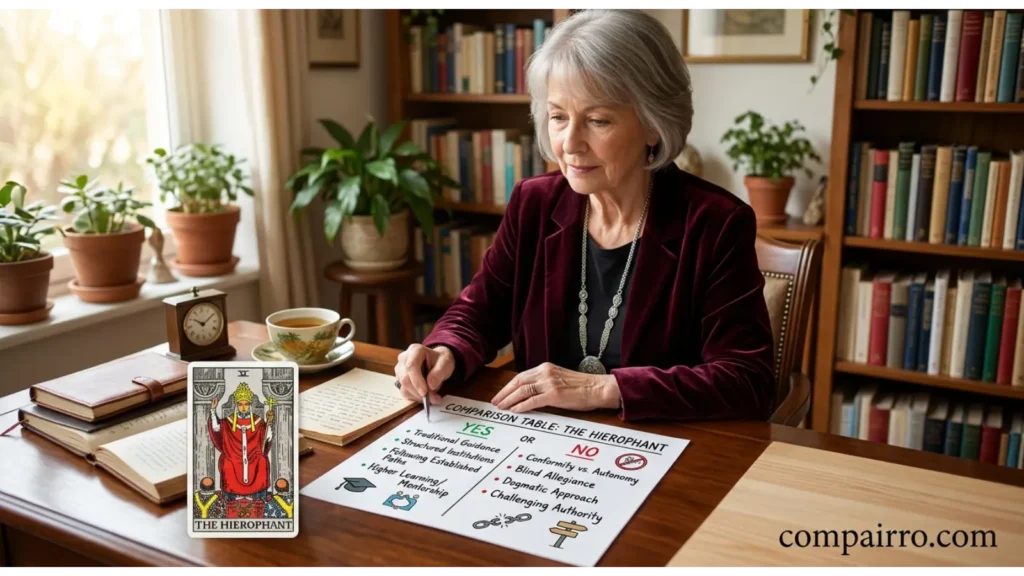
Comparison Table: The Hierophant Yes or No
| Situation | General Meaning | Yes or No |
|---|---|---|
| Love | Commitment and shared values | Usually Yes |
| Marriage | Tradition and formal commitment | Yes |
| Career | Structure and established systems | Usually Yes |
| Education | Learning and guidance | Yes |
| Money | Careful and traditional approach | Cautious Yes |
| Personal decision | Follow trusted guidance | Usually Yes |
| Quick change | May suggest patience | Not an instant yes |
| Rules or institutions | Respect the proper process | Yes |
The key idea is that The Hierophant usually supports stability, learning, commitment, and established paths.
The Hierophant in Professional Life
In professional life, The Hierophant can represent an organization, manager, teacher, mentor, professional standards, or established rules.
If you ask, “Should I follow the company process?” this card usually supports following the correct procedure.
It can also suggest:
- Learning from an experienced person
- Taking professional training
- Following workplace rules
- Joining a respected institution
- Building skills through formal education
- Using a proven method instead of taking unnecessary risks
The card does not always mean “do what everyone else does.” Instead, it can suggest understanding the system before trying to change it.
The Hierophant for Students or Beginners
Beginners may find The Hierophant confusing because its symbolism can look serious or old-fashioned.
The easiest way to understand it is to connect it with learning and guidance.
If you are studying something new, the card can encourage you to:
- Learn from a qualified teacher.
- Use reliable learning materials.
- Follow a clear study plan.
- Ask questions when confused.
- Learn the basics before taking advanced steps.
- Respect useful experience and knowledge.
For students, The Hierophant can be a reminder that you do not have to learn everything alone.
Signs or Characteristics Related to The Hierophant
When The Hierophant appears in a reading, its main characteristics may include:
- Tradition: Respect for established customs and beliefs.
- Guidance: Learning from a teacher, mentor, or experienced person.
- Commitment: Staying loyal to an important path or relationship.
- Structure: Following a clear system or process.
- Education: Gaining knowledge through formal or organized learning.
- Institutions: Schools, workplaces, religious groups, or other organizations.
- Shared values: Following beliefs or principles shared with others.
- Patience: Allowing a process to develop in its proper time.
These themes can help you understand why the card often receives a positive yes/no interpretation.
Simple Trick to Remember The Hierophant
👉 The Hierophant = Yes through tradition, guidance, and commitment.
Think of it this way:
Teacher → Learn
Rules → Follow
Commitment → Stay
Tradition → Respect
So when you see The Hierophant in a yes-or-no reading, remember:
👉 “Yes, but do it the right way.”
For example, if you ask whether you should learn a new skill, The Hierophant suggests finding a good teacher or structured course rather than trying to guess everything yourself.
FAQs:
1. Is The Hierophant a yes or no card?
The Hierophant is generally considered a yes card, especially for questions about commitment, education, tradition, and established paths.
2. What does The Hierophant mean in love?
In love, The Hierophant can suggest commitment, shared values, stability, and a serious relationship. It may also relate to marriage or traditional partnerships.
3. Is The Hierophant a yes for marriage?
Usually, yes. The card is strongly connected with formal commitment, tradition, and marriage. However, the surrounding cards and question matter.
4. What does The Hierophant mean for career?
It can indicate a structured career path, professional training, a mentor, or success through following established rules and systems.
5. What does The Hierophant reversed mean for yes or no?
A reversed Hierophant can be more uncertain. It may suggest questioning traditions, rejecting rules, or choosing your own path, so the answer may not be a clear yes.
6. Does The Hierophant mean commitment?
Yes. Commitment is one of its important themes, especially when the question involves relationships, marriage, beliefs, education, or long-term responsibilities.
7. Can The Hierophant predict the future?
Tarot can be used for reflection and interpretation, but it cannot guarantee future events. A reading should not be treated as certain proof of what will happen.
Conclusion
The Hierophant yes or no meaning is generally yes, but it is a special kind of yes. The card often says that the best result comes through patience, commitment, guidance, tradition, and following a proper process.
In love, it can point toward serious commitment. In education, it can suggest learning from teachers. Among career questions, it can represent institutions, professional standards, and structured progress.
The most important point is not to treat The Hierophant as an automatic promise. Your question, the surrounding cards, and your real-life situation all matter.
Easy memory rule:
👉 The Hierophant = Yes, but follow the right path.

Sara Taylor is a passionate English content writer who specializes in word meanings, spelling comparisons, and modern slang explanations. She creates easy-to-understand articles that help readers avoid common English mistakes and improve their writing skills. Her content focuses on simple learning, real-life examples, and clear explanations for everyday readers.