Meta Description: Discover js meaning in text, its full form, common uses, examples, tone, and differences from similar texting abbreviations. Learn how to use JS correctly.
js meaning in text can be confusing because the abbreviation may have different meanings depending on the conversation. If someone sends “js” in a text, social media comment, or chat, you may wonder if it has a special slang meaning or is simply a shortened phrase.
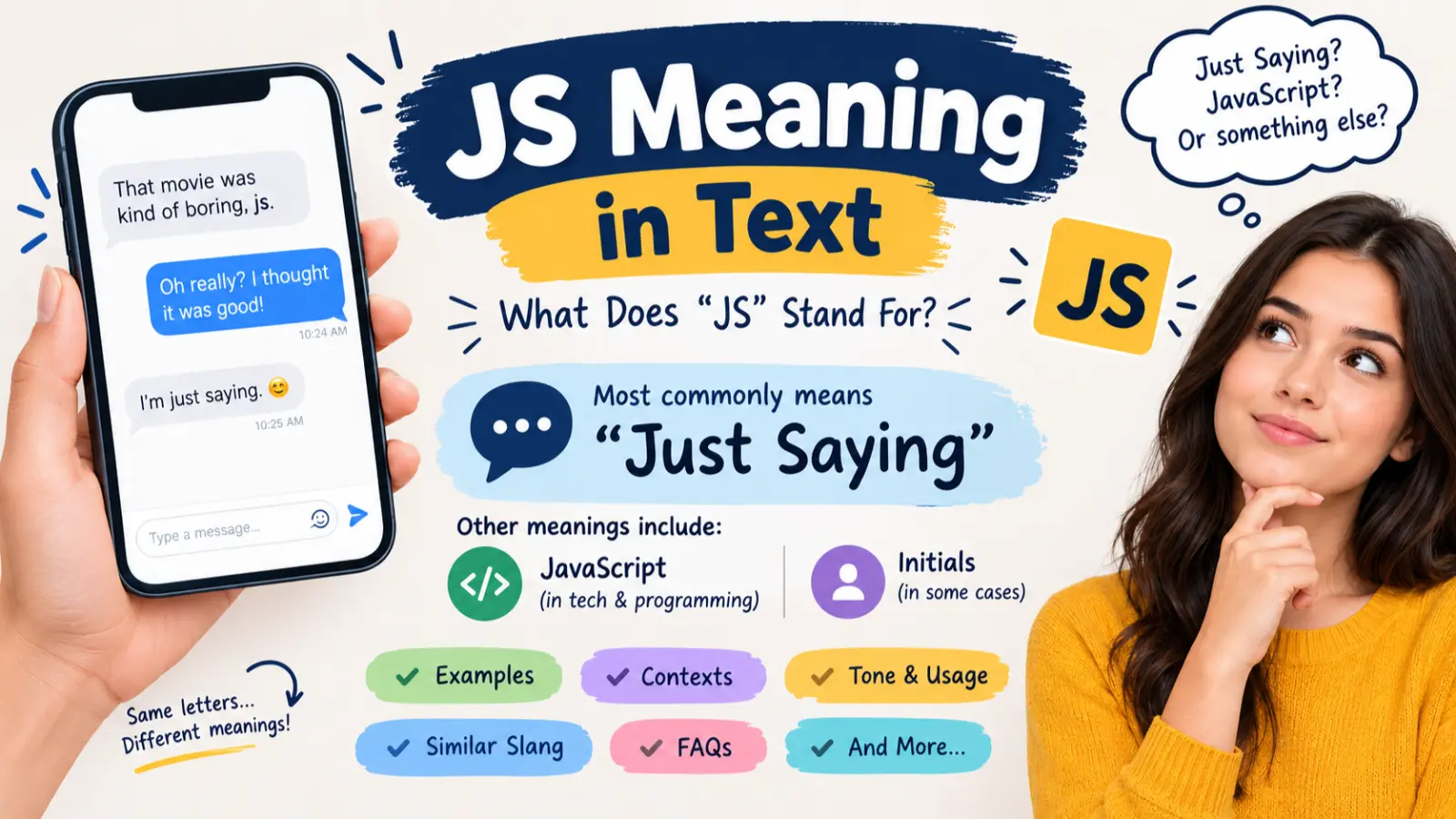
In casual texting, JS most commonly means “just saying.” People often use it after sharing an opinion, observation, or comment. For example, “That movie was kind of boring, js” means “That movie was kind of boring, just saying.”
However, JS can have other meanings, especially in technology, names, or specific communities. The surrounding words and conversation are important for understanding the intended meaning.
Quick Answer: In texting, JS usually means “just saying.” It is commonly used to add a casual comment or opinion without sounding too serious.
What Does JS Mean in Text?
The most common JS meaning in text is “just saying.”
It is an informal abbreviation used in messages, social media, comments, and online conversations. Someone may use it to make a statement while showing that they are simply giving their opinion.
JS Full Form
JS = Just Saying
For example:
“I think you should take a jacket, js.”
Here, “js” means “just saying.” The person is offering a suggestion without necessarily demanding that you follow it.
Another example is:
“That restaurant is expensive, js.”
The sender is expressing an opinion or observation in a casual way.
JS Meaning in Different Contexts
The meaning of JS depends heavily on context.
| Context | Possible Meaning |
|---|---|
| Texting | Just saying |
| Social media | Just saying |
| Casual chat | Just saying |
| Programming | JavaScript |
| Names/initials | Could represent someone’s initials |
| Specific communities | May have another local meaning |
When someone asks about JS meaning slang, “just saying” is usually the relevant interpretation if the conversation is informal.
JS in Texting
In texting, JS is often placed at the end of a sentence.
Example:
“You were a little late today, js.”
It can soften the statement and make it sound more like a personal observation.

Is JS Rude, Offensive, or Neutral?
JS is generally neutral, but its tone depends on the sentence and situation.
For example:
“You could try studying earlier, js.”
This may sound like friendly advice.
But:
“Nobody really liked your idea, js.”
This could sound critical or passive-aggressive depending on the relationship between the people.
So, the abbreviation itself is not normally offensive. The words surrounding JS determine how the message feels.
Where Is JS Commonly Used?
You may see JS in:
- Text messages
- Instagram comments and DMs
- TikTok comments
- Snapchat
- Discord
- Gaming chats
- Online forums
- Casual conversations
It is mainly an informal abbreviation, so it is better suited to casual communication than formal writing.
Real-Life Conversation Examples
Friendly Example
A: “Should I wear the blue shirt?”
B: “Yeah, it looks good on you, js.”
Here, JS adds a casual tone.
Casual Example
A: “I might order pizza tonight.”
B: “The place near your house is pretty good, js.”
The person is casually sharing an opinion.
Argumentative Example
A: “I think I was right about that.”
B: “You could have handled it better, js.”
Here, JS does not necessarily make the statement friendly. The overall sentence still sounds critical.

Emotional and Psychological Meaning of JS
There is no fixed emotional meaning attached to JS. However, people may use “just saying” to manage the tone of their message.
It can communicate:
- “This is only my opinion.”
- “I am giving you a suggestion.”
- “You don’t have to agree with me.”
- “I wanted to point this out.”
- “I’m not trying to make a big argument.”
Still, tone can change depending on the wording, punctuation, and relationship between the people chatting.
Origin and Background of JS
“Just saying” became increasingly common in informal spoken and online communication. As texting and social media developed, users began shortening common phrases to save time and make messages feel more casual.
JS is therefore best understood as a texting abbreviation rather than a completely separate slang word.
Its exact interpretation can vary by community, so context remains important.

JS vs Similar Texting Abbreviations
Several abbreviations can appear similar to JS but have different meanings.
| Abbreviation | Meaning | Common Use |
|---|---|---|
| JS | Just saying | Sharing an opinion |
| TBH | To be honest | Giving an honest opinion |
| IMO | In my opinion | Expressing a viewpoint |
| IMHO | In my humble opinion | Giving a personal opinion |
| FYI | For your information | Sharing information |
| BTW | By the way | Introducing another point |
For example:
“JS, I think you should wait.”
= “Just saying, I think you should wait.”
“TBH, I don’t like it.”
= “To be honest, I don’t like it.”
When Should You Use JS?
Use JS when you’re chatting casually with people who understand texting abbreviations.
It can work well when:
- Sharing a personal opinion
- Giving casual advice
- Making an observation
- Adding a small comment
- Keeping a conversation relaxed
For formal situations, write “just saying” instead.
For example, in an email to a teacher, employer, or business, a complete sentence is usually clearer and more appropriate.
Polite Alternatives to JS
If you want to sound more polite or professional, you can replace JS with:
- “Just a thought.”
- “In my opinion…”
- “I just wanted to mention…”
- “For what it’s worth…”
- “Just my opinion.”
- “I thought I’d point that out.”
These alternatives can make your meaning clearer, especially when tone could be misunderstood.
Why Do People Use JS?
People use texting abbreviations because they are quick, convenient, and familiar.
JS can also make a message feel less formal. Instead of writing:
“I am only expressing my personal opinion about this.”
Someone can simply write:
“JS.”
This makes digital communication faster and more conversational.
Impact of JS on Communication
JS is usually harmless, but abbreviations can sometimes create misunderstandings.
For example, someone might interpret:
“You should probably apologize, js.”
as friendly advice, while another person could read it as criticism.
The safest approach is to consider:
- Who are you talking to?
- What is the subject?
- Could your sentence sound sarcastic?
- Is the conversation serious?
- Would a complete phrase be clearer?
Is JS Safe for Social Media?
Yes, “JS” meaning “just saying” is generally safe for ordinary social media communication. It is not normally offensive or inappropriate by itself.
However, the sentence containing JS still matters. A harmless abbreviation can be used alongside rude, insulting, or inappropriate language, so always consider the complete message.
Common Misunderstandings About JS
1. JS Always Means “Just Saying”
Not necessarily. In programming and technology, JS commonly means JavaScript.
2. JS Is Always Friendly
Not always. Someone can use “js” in a sarcastic or argumentative message.
3. JS Is a Formal Abbreviation
It is primarily associated with casual communication. In professional writing, spelling out “just saying” is usually clearer.
4. JS Has Only One Meaning
The correct interpretation depends on the context.
Variations and Types of JS Usage
You may see JS written in several ways:
- JS
- js
- J/S
- just saying
- Just saying
Capitalization usually does not change the meaning in casual texting.
For example:
“JS, that’s not what I meant.”
and
“js, that’s not what I meant.”
generally communicate the same idea.
How to Respond When Someone Uses JS
Your response depends on what the person actually said.
If they are giving friendly advice, you can say:
“Yeah, I get what you mean.”
For they are sharing an opinion:
“Fair enough.”
If their message is unclear:
“What do you mean?”
You do not need to respond to “JS” separately. Focus on the main point of their message.
Regional and Cultural Usage
Texting abbreviations can vary between countries, age groups, platforms, and online communities.
Someone in one community may immediately understand JS as “just saying,” while another person may think of JavaScript.
This is especially important online because people from different countries communicate on the same platforms.
When the context is unclear, asking for clarification is better than assuming.
JS Meaning in Programming
There is an important second meaning of JS.
In technology, JS commonly stands for JavaScript, a programming language used to create interactive websites and applications.
For example:
- HTML structures a webpage.
- CSS controls its appearance.
- JavaScript adds behavior and interaction.
So if you see “JS” in a programming tutorial, developer forum, or coding conversation, it probably means JavaScript, not “just saying.”
Texting vs Programming
“JS, I don’t think that’s a good idea.”
Here, JS likely means just saying.
“I need to learn JS for web development.”
Here, JS means JavaScript.
The surrounding context makes the difference clear.
FAQs:
What does JS stand for in texting?
In texting, JS usually stands for “just saying.” It is used when someone shares an opinion, observation, or casual comment.
What does JS mean in slang?
JS meaning slang is commonly “just saying.” It is an informal abbreviation used in online chats and social media.
Is JS rude?
No. JS is generally neutral, but the complete sentence can make it sound friendly, serious, sarcastic, or critical.
What does JS mean on social media?
On social media, JS can mean “just saying” when used in a casual conversation. In technology-related posts, it can mean JavaScript.
What does JS mean from a girl or boy?
There is no special meaning based on whether the sender is a girl or boy. The meaning depends on the context of the message.
Is JS the same as “just saying”?
Yes. In casual texting, JS is commonly a shortened form of “just saying.”
Conclusion
The most common js meaning in text is “just saying.” People use it to share an opinion, suggestion, or observation in a casual way without making the statement sound overly formal.
JS is generally neutral and is common in texting, social media, gaming chats, and other informal conversations. However, context matters because JS can also mean JavaScript in technology and programming.
When you see JS in a message, look at the surrounding words and the topic of the conversation. Understanding the context will usually tell you whether the sender means “just saying” or something else.

Sara Taylor is a passionate English content writer who specializes in word meanings, spelling comparisons, and modern slang explanations. She creates easy-to-understand articles that help readers avoid common English mistakes and improve their writing skills. Her content focuses on simple learning, real-life examples, and clear explanations for everyday readers.