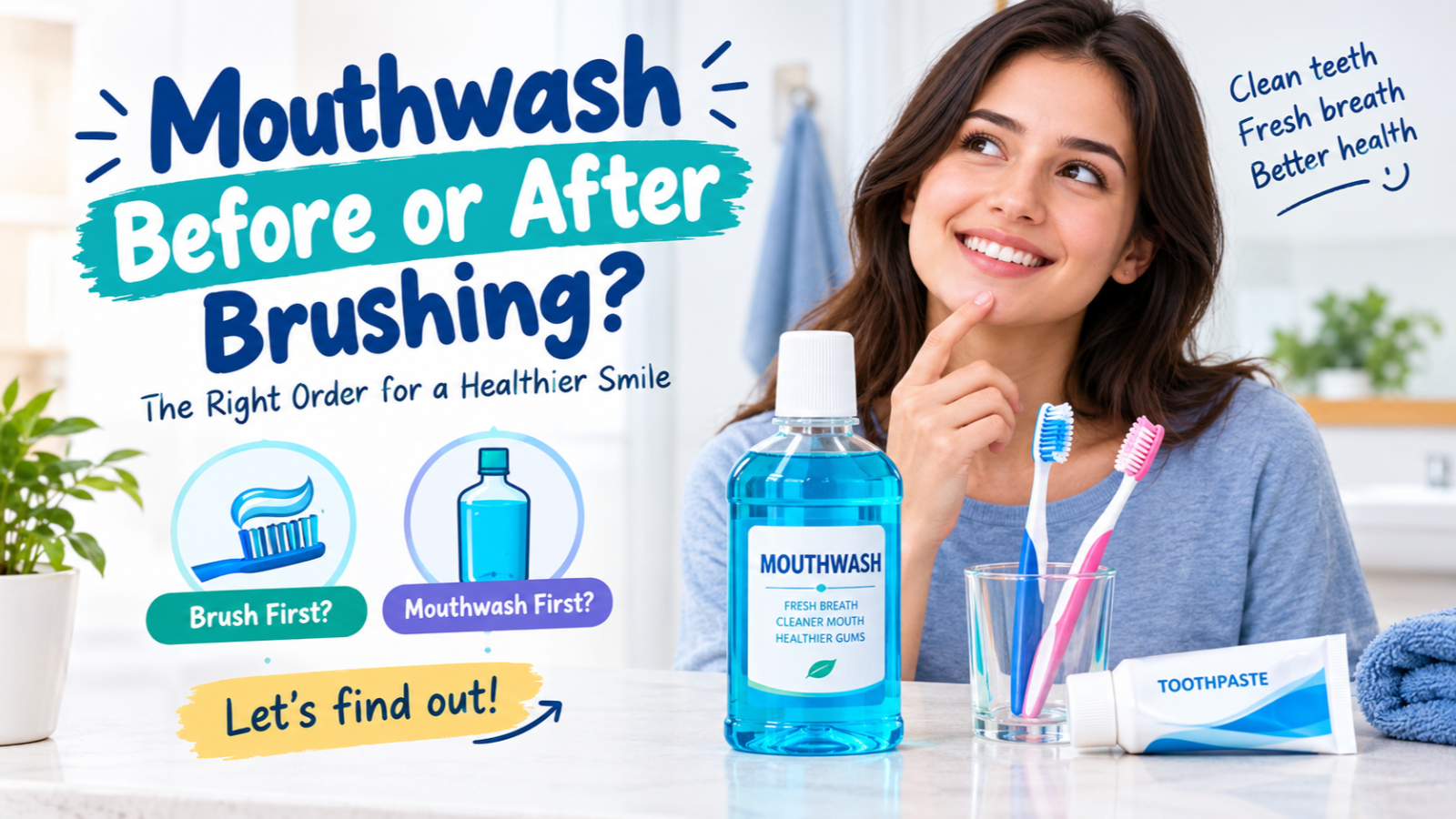
You brush your teeth twice a day, but then you may wonder what to do with mouthwash. Should you use mouthwash before or after brushing? It is a common question because many people use these products as part of the same oral-care routine.
The answer may seem simple, but the timing can matter. In particular, using a fluoride mouthwash right after brushing can wash away some of the fluoride left on your teeth from toothpaste. Fluoride is important because it helps protect teeth from decay.
That is why many dental health guidelines recommend not using mouthwash immediately after brushing. Instead, you can use mouthwash at another time of day, such as after lunch or between your usual brushing times. Always follow the instructions on the mouthwash label.
People often search for “mouthwash before or after brushing” because they want fresh breath, cleaner teeth, and better protection from cavities. You may also see this question in dental discussions, health websites, social media posts, and online searches.
The good news is that you do not need a complicated routine. Brush your teeth with fluoride toothpaste, spit out the toothpaste, and avoid rinsing your mouth with water immediately afterward. If you want to use mouthwash, using it at a separate time can be a simple choice.
In this guide, you’ll learn the meaning, examples, usage, differences, common mistakes, and simple explanations in easy English.
MOUTHWASH BEFORE OR AFTER BRUSHING – QUICK ANSWER
👉 Mouthwash before or after brushing? In general, it is better not to use mouthwash immediately after brushing, especially if your toothpaste contains fluoride. Use mouthwash at a different time of day when possible.
For example:
- Morning: Brush with fluoride toothpaste and spit. Do not rinse immediately.
- After lunch: Use mouthwash if you want to.
- Night: Brush again with fluoride toothpaste and spit.
Mouthwash can help freshen breath and may provide extra benefits depending on its ingredients. However, it does not replace brushing and cleaning between your teeth.
Simple rule:
👉 Brush first, but use mouthwash at a separate time.
Think of your toothpaste as leaving useful fluoride on your teeth. Using mouthwash immediately afterward may reduce the amount of fluoride that stays there.
If your dentist has given you a specific mouthwash routine, follow their advice instead.
THE ORIGIN OF MOUTHWASH BEFORE OR AFTER BRUSHING
Mouthwash itself has a long history. People have used different liquids to clean the mouth and freshen breath for centuries. Modern mouthwashes became more common as oral hygiene products developed.
The question of whether to use mouthwash before or after brushing became more important as fluoride toothpaste and fluoride mouthwash became widely used.
Today, the main concern is not the words “before” or “after.” Instead, it is about how the products work together.
Fluoride toothpaste is designed to leave fluoride on the teeth after brushing. Therefore, using another liquid immediately afterward may reduce this benefit.
This is why modern dental advice often focuses on keeping mouthwash separate from brushing rather than simply choosing one fixed order.

BRITISH ENGLISH VS AMERICAN ENGLISH USAGE
There is no important difference in the phrase “mouthwash before or after brushing” between British and American English.
The word mouthwash is commonly used in both forms of English. Dental advice may use slightly different wording, but the basic meaning stays the same.
| Feature | British English | American English | Notes |
|---|---|---|---|
| Mouthwash | Mouthwash | Mouthwash | Same word |
| Brushing | Brushing teeth | Brushing teeth | Same meaning |
| Fluoride toothpaste | Common | Common | Same oral-care term |
| Dental advice | Similar | Similar | Advice may vary by professional |
| Main question | Mouthwash before or after brushing? | Mouthwash before or after brushing? | Same meaning |
So, whether you are in the UK, US, Canada, Australia, India, or Pakistan, the phrase has the same basic meaning.
WHICH ONE SHOULD YOU USE?
The best routine depends on the type of mouthwash and your dental needs. However, a simple general routine is easy to follow.
- Brush your teeth twice a day with fluoride toothpaste.
- Spit out the toothpaste after brushing.
- Avoid rinsing your mouth with water immediately after brushing.
- Do not make mouthwash an immediate replacement for brushing.
- If you use fluoride mouthwash, consider using it at a different time from brushing.
- Follow the instructions printed on the mouthwash bottle.
- If your dentist prescribed a mouthwash, follow their instructions.
Should you use mouthwash before brushing?
You can use mouthwash before brushing, but it is not usually necessary to make this part of your routine. If you prefer using mouthwash before brushing, brush afterward as part of your normal oral-care routine.
Should you use mouthwash after brushing?
You generally should not use mouthwash immediately after brushing, particularly when you want to keep the fluoride from your toothpaste on your teeth.
A better option is to use mouthwash at another time of day.
What about after meals?
Using mouthwash after a meal can be convenient, depending on the product. However, it does not replace brushing and cleaning between your teeth.
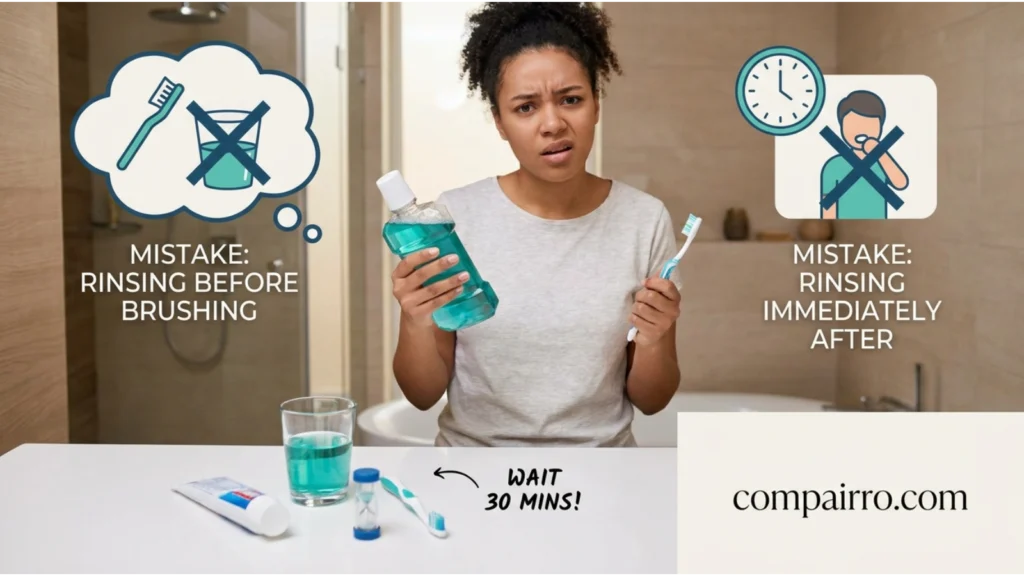
COMMON MISTAKES WITH MOUTHWASH BEFORE OR AFTER BRUSHING
Mistake 1: Using mouthwash immediately after brushing
❌ Incorrect: Brush with fluoride toothpaste and immediately rinse with mouthwash.
✔ Correct: Spit after brushing and, when possible, use mouthwash at a separate time.
Using mouthwash right after brushing may reduce the fluoride left behind by your toothpaste.
Mistake 2: Treating mouthwash as a replacement for brushing
❌ Incorrect: “I used mouthwash, so I do not need to brush.”
✔ Correct: Mouthwash is an extra oral-care product. It does not replace regular toothbrushing.
Brushing physically removes plaque from your teeth, while mouthwash works differently.
Mistake 3: Rinsing with lots of water after brushing
❌ Incorrect: Brush your teeth, rinse your mouth well with water, and then use mouthwash.
✔ Correct: Spit out excess toothpaste after brushing and avoid rinsing immediately if you can.
This helps keep more fluoride in contact with your teeth.
Mistake 4: Ignoring the mouthwash label
❌ Incorrect: Assume every mouthwash should be used in exactly the same way.
✔ Correct: Read the product instructions before using it.
Different mouthwashes can contain different active ingredients and may have different instructions.
Mistake 5: Swallowing mouthwash
❌ Incorrect: Treat mouthwash like a normal drink.
✔ Correct: Mouthwash is designed to be used in the mouth and then spat out.
Never intentionally swallow mouthwash.
Mistake 6: Using too much mouthwash
❌ Incorrect: More mouthwash must mean better results.
✔ Correct: Use the amount recommended on the product label.
More product does not automatically provide better oral care.
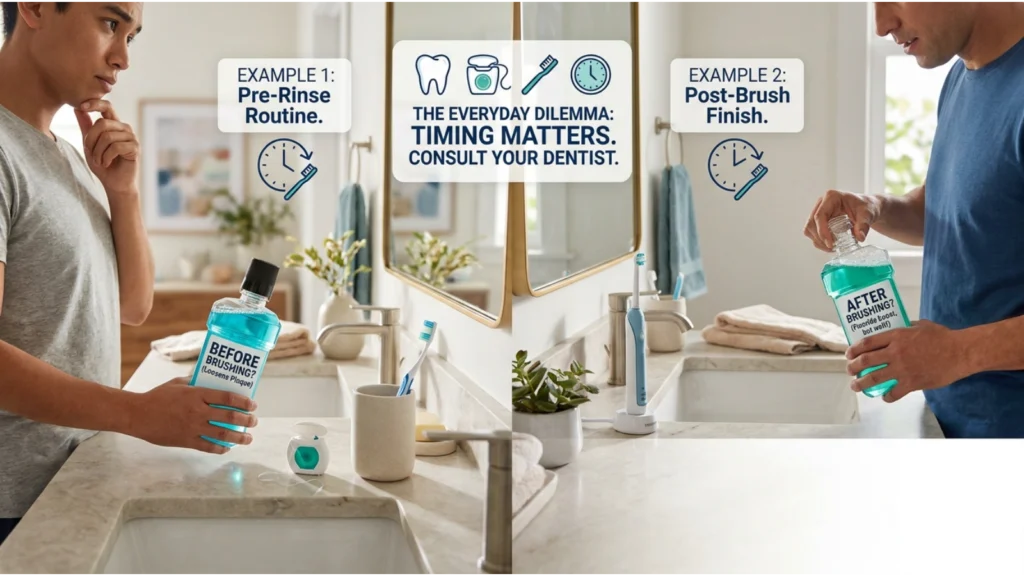
MOUTHWASH BEFORE OR AFTER BRUSHING IN EVERYDAY EXAMPLES
Work
You brush your teeth before going to work. Instead of using mouthwash immediately afterward, you could use an appropriate mouthwash later in the day if needed.
Example:
“I brush before work and use mouthwash after lunch.”
School
Students can keep their oral-care routine simple. Brushing twice daily is more important than trying to use many products.
Example:
“I brush my teeth before school and use mouthwash later if my dentist recommends it.”
Social Media
People often share different oral-care routines online. However, not every viral dental tip is reliable.
Example:
“I saw a video asking whether mouthwash should be used before or after brushing.”
Daily Life
A simple daily routine can include brushing in the morning and before bed, along with cleaning between the teeth.
Example:
“I use mouthwash at a separate time instead of right after brushing.”
Text Messages
The phrase can also appear in casual messages.
Example:
“Do u use mouthwash before or after brushing?”
The meaning is simply asking about the best timing for mouthwash.
MOUTHWASH BEFORE OR AFTER BRUSHING – GOOGLE TRENDS & USAGE DATA
The search phrase “mouthwash before or after brushing” reflects a common oral-care question. People often want to know the correct order because different products can have different purposes.
Search interest can come from people looking for:
- Better oral hygiene
- Fresh breath
- Cavity prevention
- Fluoride advice
- Dental routines
- Dentist recommendations
- Correct use of mouthwash
People in countries such as the US, UK, India, Pakistan, Canada, and Australia commonly search for dental-care information online.
The question also appears frequently in health blogs, dental websites, forums, videos, and social media discussions.
One reason for the confusion is that some people assume every oral-care product should be used one after another. However, the timing of fluoride toothpaste and mouthwash can matter.
Search trends can change over time, so exact search-volume numbers should be checked using a current keyword research or Google Trends tool rather than guessed.
COMPARISON TABLE: MOUTHWASH BEFORE OR AFTER BRUSHING
| Routine | Is it a good choice? | Main point |
|---|---|---|
| Brush, then immediately use mouthwash | Usually not preferred | May reduce fluoride left by toothpaste |
| Mouthwash, then brush | Possible | Brushing afterward can leave fluoride on teeth |
| Brush, then mouthwash later | Generally preferred | Keeps mouthwash separate from brushing |
| Brush only | Essential | Fluoride toothpaste provides important protection |
| Mouthwash instead of brushing | No | Mouthwash does not replace brushing |
| Mouthwash according to dentist’s advice | Yes | Best when tailored to your needs |
The key point is that separating mouthwash from cleaning is often better than using it immediately after cleaning.
MOUTHWASH BEFORE OR AFTER BRUSHING IN PROFESSIONAL LIFE
Oral hygiene matters in professional life because fresh breath and a clean mouth can help you feel more comfortable when talking with other people.
For example, someone may want to use mouthwash before a meeting, interview, or presentation.
However, timing still matters. If you have already brushed with fluoride toothpaste, you do not necessarily need to use mouthwash immediately afterward.
A simple approach is to brush in the morning and use mouthwash later if needed and appropriate for you.
If you have a dental condition or have been prescribed a special mouthwash, your dentist’s instructions should come first.
MOUTHWASH BEFORE OR AFTER BRUSHING FOR STUDENTS OR BEGINNERS
Beginners often struggle with this topic because there are many oral-care products on the market.
You may see toothpaste, mouthwash, dental floss, interdental brushes, tongue cleaners, and other products. It can feel confusing to know what comes first.
The easiest way to remember the basics is:
- Brush twice a day with fluoride toothpaste.
- Spit after brushing.
- Avoid rinsing immediately after brushing.
- Clean between your teeth regularly.
- Use mouthwash separately if you choose to use it.
- Follow the product label or your dentist’s advice.
Students should also avoid copying every dental routine they see on social media. A simple, consistent routine is usually easier to maintain.
SIGNS OR CHARACTERISTICS RELATED TO MOUTHWASH BEFORE OR AFTER BRUSHING
The important characteristics of a good oral-care routine include:
- Regular brushing: Brush your teeth twice each day.
- Fluoride use: Fluoride toothpaste helps protect against tooth decay.
- Proper timing: Avoid washing away toothpaste fluoride immediately with mouthwash.
- Between-teeth cleaning: Brushing alone does not clean every space between teeth.
- Correct mouthwash use: Follow the product directions.
- Fresh breath: Some mouthwashes can help control bad breath.
- Professional advice: Dental advice is especially important when you have specific oral-health problems.
- Consistency: A simple routine works better when you follow it regularly.
Remember that mouthwash is an additional product. It is not a magic solution for every dental problem.
SIMPLE TRICK TO REMEMBER MOUTHWASH BEFORE OR AFTER BRUSHING
Here is an easy memory trick:
👉 Brush = Protect with fluoride
👉 Mouthwash = Use separately
Think of it this way:
“Brush and spit. Do not wash away the fluoride right away.”
For example, if you brush your teeth at 8:00 AM, you do not have to use mouthwash at 8:01 AM. You can use an appropriate mouthwash later in the day if you want or need it.
At night, brush with fluoride toothpaste again and spit rather than immediately rinsing with mouthwash.
This simple rule can make your oral-care routine much easier.
FAQs:
1. Is it better to use mouthwash before or after brushing?
It is generally better not to use mouthwash immediately after cleaning. Using it at a separate time can help preserve the fluoride from your toothpaste.
2. Can I use mouthwash right after brushing?
You can, but it is usually not recommended, especially with fluoride toothpaste. Mouthwash may wash away some of the fluoride left by toothpaste.
3. Should I use mouthwash before brushing?
You can use mouthwash before Cleaning, but it is not essential. Brushing with fluoride toothpaste remains an important part of your routine.
4. How long should I wait to use mouthwash after brushing?
There is no single waiting time that applies to every product. A simple option is to use mouthwash at another time of day rather than immediately after cleaning.
5. Should I rinse my mouth after brushing?
It is generally better to spit out excess toothpaste and avoid rinsing immediately with water. This helps fluoride stay on your teeth longer.
6. Can mouthwash replace brushing?
No. Mouthwash does not replace cleaning or cleaning between your teeth. It should be viewed as an additional oral-care product.
7. What should I do if my dentist told me to use mouthwash after brushing?
Follow your dentist’s instructions. They may recommend a specific product or routine based on your dental needs.
CONCLUSION
So, mouthwash before or after brushing? The simplest answer is that you should generally avoid using mouthwash immediately after brushing, especially when you use fluoride toothpaste.
Instead, brush your teeth twice a day, spit out the toothpaste, and avoid rinsing immediately. If you use mouthwash, consider using it at a different time of day and follow the product instructions.
The main reason is simple: fluoride from toothpaste needs time to stay on your teeth and help protect them.

Sara Taylor is a passionate English content writer who specializes in word meanings, spelling comparisons, and modern slang explanations. She creates easy-to-understand articles that help readers avoid common English mistakes and improve their writing skills. Her content focuses on simple learning, real-life examples, and clear explanations for everyday readers.