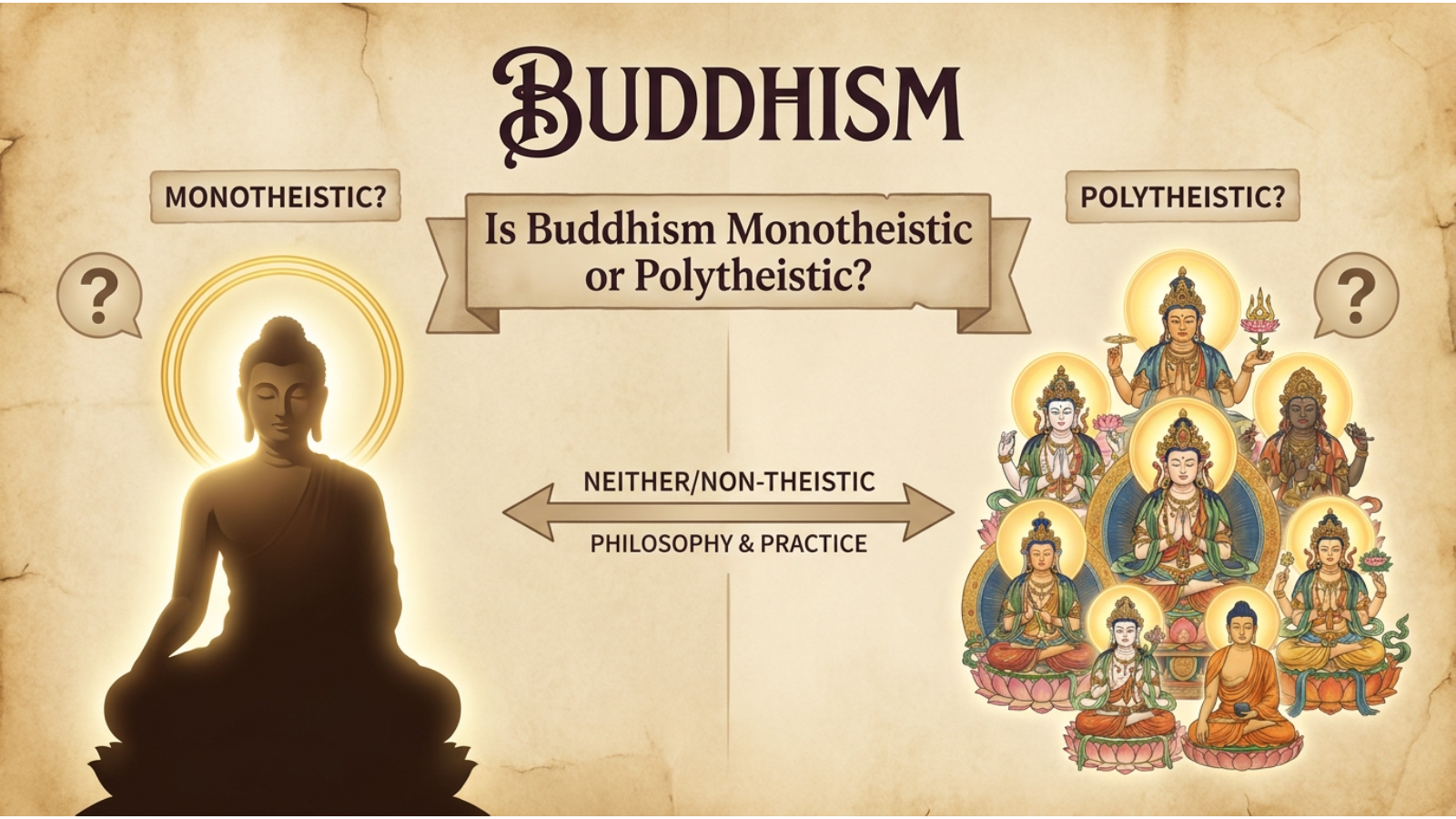
Imagine you are learning about the world’s major religions. You may already know that some religions believe in one God, while others believe in many gods. Then you come across Buddhism and wonder: is Buddhism monotheistic or polytheistic?
This is a common question because Buddhism has many different traditions, symbols, and stories. Some Buddhist traditions talk about heavenly beings, gods, and other spiritual figures. At the same time, the Buddha did not teach belief in one creator God as the center of Buddhism.
So, where does Buddhism fit?
The simple answer is that Buddhism is generally not classified as either monotheistic or polytheistic. It is usually described as a non-theistic religion. This means that belief in a creator God is not required for someone to follow Buddhist teachings.
However, Buddhism can be complex. Some Buddhist texts and traditions mention devas, which are powerful heavenly beings. These beings are not usually understood as an all-powerful creator God. They are also subject to the cycle of birth, death, and rebirth.
This topic often appears in school lessons, religious studies, online discussions, social media, and internet searches. Understanding the difference can help prevent common misunderstandings about Buddhism.
Is Buddhism Monotheistic or Polytheistic – Quick Answer
👉 Buddhism is generally neither monotheistic nor polytheistic. It is usually described as non-theistic.
Monotheistic means believing in one God who is usually understood as the supreme or creator God.
Polytheistic means believing in multiple gods as divine beings.
Buddhism does mention devas and other spiritual beings, but these beings are not normally treated as an eternal, all-powerful creator God.
Examples
- Buddhism does not require belief in one creator God.
- Some Buddhist traditions recognize many devas or heavenly beings.
- The Buddha taught a path based on understanding suffering, ethical living, meditation, and wisdom.
Simple rule
👉 Buddhism = non-theistic, not simply one-God or many-God religion.
The easiest way to remember it is: Buddhism focuses on the path to awakening rather than worship of a creator God.
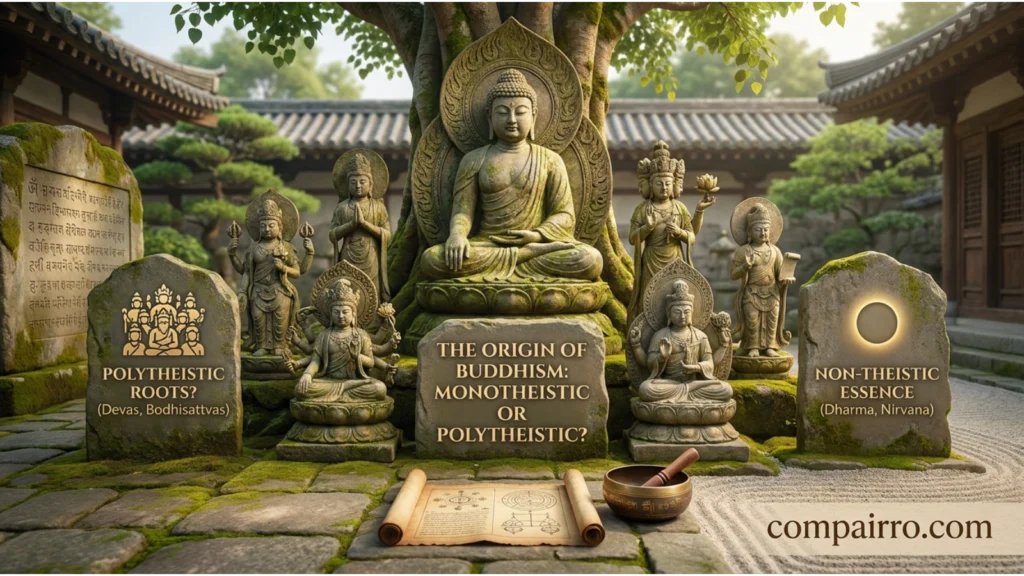
The Origin of Is Buddhism Monotheistic or Polytheistic
The question itself is a modern way of comparing religions. The terms monotheistic and polytheistic come from the study of religion and are often used to place religions into broad categories.
Buddhism began in ancient India with Siddhartha Gautama, who became known as the Buddha. He taught in northern India around the fifth century BCE, although the exact dates of his life are debated.
The Buddha’s teachings focused on problems such as suffering, craving, ignorance, and the cycle of rebirth. His teachings also explained a path toward liberation, known as nirvana.
Buddhist teachings developed over many centuries. As Buddhism spread through Asia, different schools and traditions developed.
Today, major Buddhist traditions include Theravada, Mahayana, and Vajrayana. They can differ in beliefs, practices, rituals, and the way they understand spiritual beings.
This is one reason the question is Buddhism monotheistic or polytheistic does not have a simple one-word answer such as “one” or “many.”
British English vs American English Usage
There is no important British-versus-American spelling difference in the phrase is Buddhism monotheistic or polytheistic.
The religious terms are written the same way in both forms of English.
| Feature | British English | American English | Notes |
|---|---|---|---|
| Buddhism | Buddhism | Buddhism | Same spelling |
| Monotheistic | monotheistic | monotheistic | Same spelling |
| Polytheistic | polytheistic | polytheistic | Same spelling |
| Non-theistic | non-theistic | non-theistic | Same spelling |
| Religious studies | religious studies | religious studies | Same general usage |
Therefore, you can use these terms in American or British English without changing their spelling.
Which One Should You Use?
If you are writing about Buddhism, avoid saying that Buddhism is simply “a polytheistic religion” without explanation.
A more accurate description is:
- Use “non-theistic” when explaining Buddhism’s general approach to a creator God.
- Use “monotheistic” only when discussing a religion or belief system centered on one supreme God.
- Use “polytheistic” when discussing systems centered on multiple gods.
- Use “devas” when referring to heavenly or divine beings mentioned in Buddhist traditions.
- Use “Buddhist traditions” when you need to explain that beliefs and practices can vary.
For academic writing, a sentence such as “Buddhism is generally described as non-theistic rather than monotheistic or polytheistic” is a clear choice.
Remember that “non-theistic” does not mean that Buddhism has no spiritual ideas. It means that belief in a creator God is not the foundation of Buddhist practice.
Common Mistakes With Is Buddhism Monotheistic or Polytheistic
Mistake 1: Calling Buddhism purely polytheistic
❌ “Buddhism is polytheistic because Buddhists believe in many gods.”
✔ This is too simple. Buddhist traditions may include devas and other spiritual beings, but they are not normally presented as all-powerful creator gods.
Mistake 2: Saying Buddhists must believe in one God
❌ “All Buddhists worship one God.”
✔ Buddhism does not require belief in a single creator God. Buddhist practice centers on the Buddha’s teachings and the path toward awakening.
Mistake 3: Thinking the Buddha is a creator God
❌ “The Buddha created the universe.”
✔ The Buddha is understood as an awakened teacher, not as the creator God of the universe.
Mistake 4: Assuming every Buddhist tradition is exactly the same
❌ “Every Buddhist follows exactly the same beliefs about gods and spiritual beings.”
✔ Buddhism has many traditions. Their teachings and practices can differ.
Mistake 5: Thinking non-theistic means “nothing spiritual”
❌ “Non-theistic means Buddhism has no spiritual beliefs.”
✔ Non-theistic means that a creator God is not the central basis of the religion. Buddhist traditions can still include spiritual beings, realms, rituals, and other religious ideas.

Is Buddhism Monotheistic or Polytheistic in Everyday Examples?
The question is mainly used in education and religious discussions rather than everyday conversation. Here are some practical examples.
Work
A person preparing a presentation about world religions might write:
“Buddhism is generally described as a non-theistic religion.”
This is a clear and neutral way to explain the subject.
School
A student might ask:
“Is Buddhism monotheistic or polytheistic?”
A short answer would be:
“Buddhism is generally considered non-theistic, although Buddhist traditions may include beliefs about devas and other spiritual beings.”
Social Media
People may ask the question on social media because Buddhist statues, temples, and religious stories can look very different from other religions.
A good response should avoid making broad claims about every Buddhist tradition.
Daily Life
If someone is learning about Buddhism, they may hear about gods or heavenly beings and wonder whether that makes Buddhism polytheistic.
The key point is that the role of these beings is different from the role of a supreme creator God in monotheistic religions.
Text Messages
A simple text response could be:
“Buddhism is usually called non-theistic. It can include spiritual beings, but it doesn’t center on belief in a creator God.”
Is Buddhism Monotheistic or Polytheistic – Google Trends & Usage Data
People search is Buddhism monotheistic or polytheistic because Buddhism does not fit neatly into the simple “one God versus many gods” comparison that is often taught in introductory religious studies.
Search interest can also come from:
- Students doing religion homework
- People comparing world religions
- Religious studies classes
- People learning about Buddhist beliefs
- Online discussions about gods and spirituality
- People researching Buddhism before visiting Buddhist countries or temples
The exact popularity of this keyword can change over time and by country. Without a live Google Trends measurement, it would not be accurate to claim a specific search volume or ranking.
The question can be relevant to English-speaking audiences in the US, UK, Canada, and Australia, as well as English-speaking learners in India and Pakistan.
Searches may increase when students study world religions or when religious topics receive attention online.
One important point is that related searches can use different wording, such as:
- Is Buddhism a monotheistic religion?
- Is Buddhism polytheistic?
- Does Buddhism believe in God?
- Does Buddhism have gods?
- Do Buddhists believe in a creator God?
- What type of religion is Buddhism?
- Is Buddhism non-theistic?
These related questions show why a simple answer alone may not fully explain the topic.
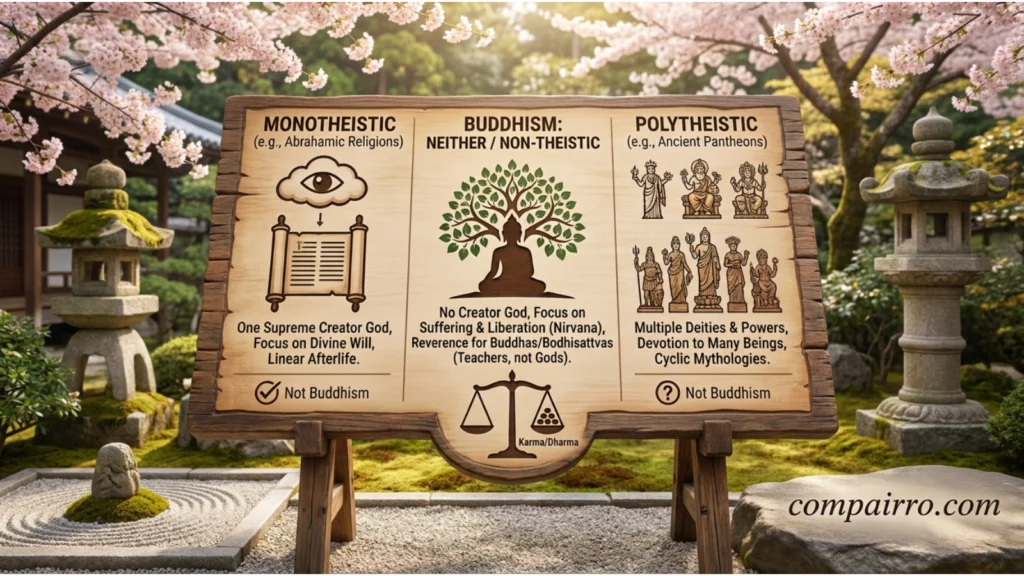
Comparison Table: Is Buddhism Monotheistic or Polytheistic?
| Feature | Monotheistic | Polytheistic | Buddhism |
|---|---|---|---|
| Main idea | One supreme God | Multiple gods | Generally non-theistic |
| Creator God | Usually central | May vary | Not central |
| Multiple spiritual beings | Not usually central | Often important | Present in some traditions |
| Buddha | Not applicable | Not applicable | Awakened teacher |
| Main focus | Relationship with God | Gods and religious traditions | Awakening and liberation |
| Karma | Varies by religion | Varies by tradition | Important Buddhist teaching |
| Rebirth | Varies | Varies | Important in traditional Buddhism |
| Nirvana | Not a general feature | Not a general feature | Central goal in Buddhist teaching |
| Religious diversity | Varies | Varies | Several major traditions |
This table shows why putting Buddhism into only the categories “monotheistic” or “polytheistic” can be misleading.
Is Buddhism Monotheistic or Polytheistic in Professional Life?
This topic can appear in professional settings such as education, research, journalism, publishing, and cultural studies.
Teachers and students should use neutral language when discussing Buddhist beliefs.
For example, instead of writing:
“Buddhists believe in many gods.”
A more careful statement is:
“Some Buddhist traditions recognize devas and other spiritual beings, but Buddhism is generally classified as non-theistic.”
This wording is useful because it recognizes Buddhist beliefs without treating every Buddhist tradition as identical.
Journalists, writers, and researchers should also avoid making broad claims about all Buddhists. Buddhism has developed across many countries and cultures, so practices can vary significantly.
Is Buddhism Monotheistic or Polytheistic for Students or Beginners?
Students often struggle with this question because school textbooks sometimes introduce religion using simple categories.
The first thing to remember is that not every religion fits perfectly into the categories of monotheism and polytheism.
Easy learning tips
1. Learn the word “non-theistic.”
It means a creator God is not the central foundation of the religion.
2. Remember the Buddha’s role.
The Buddha is generally understood as an awakened teacher, not a creator God.
3. Learn about devas.
Some Buddhist traditions include heavenly beings called devas. Their existence does not automatically make Buddhism the same as a typical polytheistic religion.
4. Do not treat all Buddhist traditions as identical.
Theravada, Mahayana, and Vajrayana traditions have different beliefs and practices.
5. Focus on the main teachings.
For beginners, learn about suffering, craving, the Noble Eightfold Path, karma, rebirth, and nirvana.
Signs or Characteristics Related to Is Buddhism Monotheistic or Polytheistic
When studying Buddhism, look for these important characteristics:
- Non-theistic focus: Buddhism does not center on worship of a creator God.
- The Buddha: He is viewed as an awakened teacher.
- Dharma: This refers broadly to the Buddha’s teachings and the way of practice.
- Karma: Actions have consequences that affect future experiences.
- Rebirth: Traditional Buddhist teachings include cycles of rebirth.
- Nirvana: It refers to liberation from the cycle of suffering and rebirth.
- Devas: Some Buddhist traditions recognize heavenly beings.
- Meditation: Meditation is an important practice in many Buddhist traditions.
- Ethical living: Buddhist teachings encourage actions that reduce harm and suffering.
- Different traditions: Buddhism has developed into many schools and cultural forms.
These characteristics help explain why Buddhism cannot always be described using only the labels “monotheistic” or “polytheistic.”
Simple Trick to Remember Is Buddhism Monotheistic or Polytheistic
Use this simple memory trick:
👉 Monotheistic = One supreme God
👉 Polytheistic = Many gods
👉 Buddhism = Non-theistic focus
Think of it this way:
Imagine three boxes:
1: One God
This represents monotheism.
Box 2: Many gods
This represents polytheism.
Box 3: Awakening and liberation
This helps you remember Buddhism’s main focus.
Buddhist traditions can include devas and other spiritual beings, but the central Buddhist path does not depend on belief in a creator God.
So remember:
👉 Buddhism → Awakening, not a creator God.
FAQs:
1. Is Buddhism monotheistic or polytheistic?
Buddhism is generally described as non-theistic, rather than simply monotheistic or polytheistic.
2. Does Buddhism believe in God?
Traditional Buddhism does not require belief in an all-powerful creator God. Its main teachings focus on suffering, its causes, and liberation.
3. Does Buddhism have gods?
Some Buddhist traditions recognize devas and other heavenly beings. However, these beings are not usually viewed as an eternal creator God.
4. Is Buddha a God?
The Buddha is generally understood as an awakened teacher, not as the creator God of the universe.
5. Why is Buddhism called non-theistic?
It is called non-theistic because belief in a creator God is not the central requirement of Buddhist teaching or practice.
6. Is Buddhism the same in every country?
No. Buddhism has different traditions and schools, including Theravada, Mahayana, and Vajrayana, with differences in beliefs and practices.
7. What type of religion is Buddhism?
Buddhism is commonly described as a non-theistic religion and philosophical-spiritual tradition focused on understanding suffering and reaching liberation.
Conclusion
So, is Buddhism monotheistic or polytheistic? The best simple answer is that Buddhism is generally neither. It is commonly described as non-theistic.
Buddhism does not make belief in one supreme creator God the center of its teachings. At the same time, some Buddhist traditions include devas and other spiritual beings. These details make the religion more complex than a simple “one God or many gods” label.
The Buddha’s teachings focus on understanding suffering, overcoming its causes, living ethically, developing wisdom, and following a path toward liberation.
The easiest memory rule is:
👉 Monotheistic = one God
👉 Polytheistic = many gods
👉 Buddhism = generally non-theistic
Understanding this difference makes it much easier to answer questions about Buddhist beliefs accurately and respectfully.

Sara Taylor is a passionate English content writer who specializes in word meanings, spelling comparisons, and modern slang explanations. She creates easy-to-understand articles that help readers avoid common English mistakes and improve their writing skills. Her content focuses on simple learning, real-life examples, and clear explanations for everyday readers.