tbf meaning in text is something many people search for when they see this abbreviation in a message, social media comment, or online conversation. If a friend texts you “TBF, you did a good job” or writes “TBF, that wasn’t your fault,” you might wonder what these three letters mean.
Texting abbreviations help people communicate quickly without typing long sentences. TBF is especially useful when someone wants to add a fair point, explain another side of a situation, or give a balanced opinion. You may see it on Instagram, TikTok, Snapchat, WhatsApp, and other messaging platforms.
Although TBF is usually easy to understand, its exact tone depends on the sentence and conversation. Learning its meaning will help you understand messages more clearly and use the abbreviation naturally.
Quick Answer:
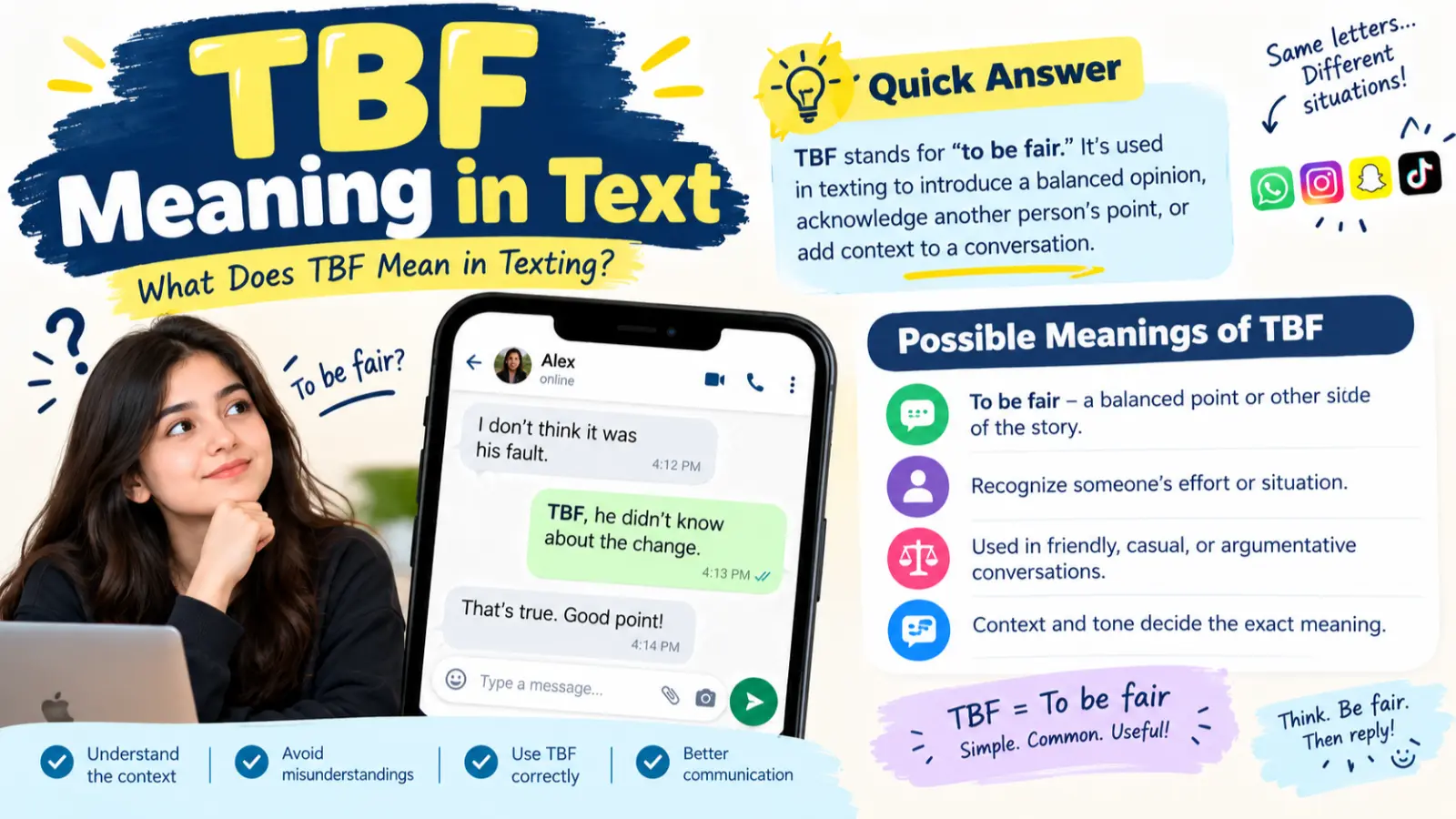
TBF stands for “to be fair.” People use it in texts to introduce a balanced opinion, acknowledge another person’s point, or explain a situation from a fair perspective.
What Does TBF Mean in Text?
The most common TBF meaning in text is “to be fair.” It is an informal abbreviation used when someone wants to recognize another side of a situation or make a reasonable point.
For example:
Friend 1: “He was late to the meeting again.”
Friend 2: “TBF, the traffic was terrible today.”
Here, TBF means “to be fair.” The second friend is adding information that may help explain why the person arrived late.
TBF does not always mean that someone disagrees with you. It can simply show that they want to consider all sides before making a judgment.

What Is the TBF Full Form?
The TBF full form in everyday texting is “to be fair.”
People commonly use it to:
- Give a balanced opinion.
- Recognize another person’s point of view.
- Explain why someone may have acted a certain way.
- Add information that others may have overlooked.
- Make a criticism sound less one-sided.
For example, “TBF, the food was good for the price” means that the speaker wants to give a fair assessment of the food.
Although TBF can have other meanings in specialized settings, “to be fair” is the standard interpretation in casual texting.
TBF Meaning in Different Contexts
1. TBF in Casual Text Messages
In everyday chats, TBF introduces a fair or reasonable point.
Example:
“I didn’t like the movie. TBF, the acting was excellent.”
The speaker did not enjoy the movie overall but still acknowledges something positive about it.
2. TBF on Social Media
On Instagram, TikTok, and other social platforms, TBF often appears in comments and discussions.
Example:
“TBF, she worked really hard to achieve that.”
This means the commenter wants people to consider the person’s effort before judging the result.
3. TBF in Friendships
Friends may use TBF to explain another person’s behavior or reduce a misunderstanding.
Example:
“TBF, he didn’t know you were waiting.”
The message suggests that the situation may have been a misunderstanding rather than intentional disrespect.
4. TBF in Arguments
During disagreements, TBF can help introduce another perspective.
Example:
“TBF, both of you made mistakes.”
The speaker is trying to acknowledge that responsibility may not belong to only one person.
5. TBF in Work or School Conversations
Although TBF is informal, people sometimes use it in casual workplace chats or student group messages.
For formal emails, however, writing “to be fair” in full is usually clearer and more professional.
Is TBF Rude, Offensive, or Neutral?
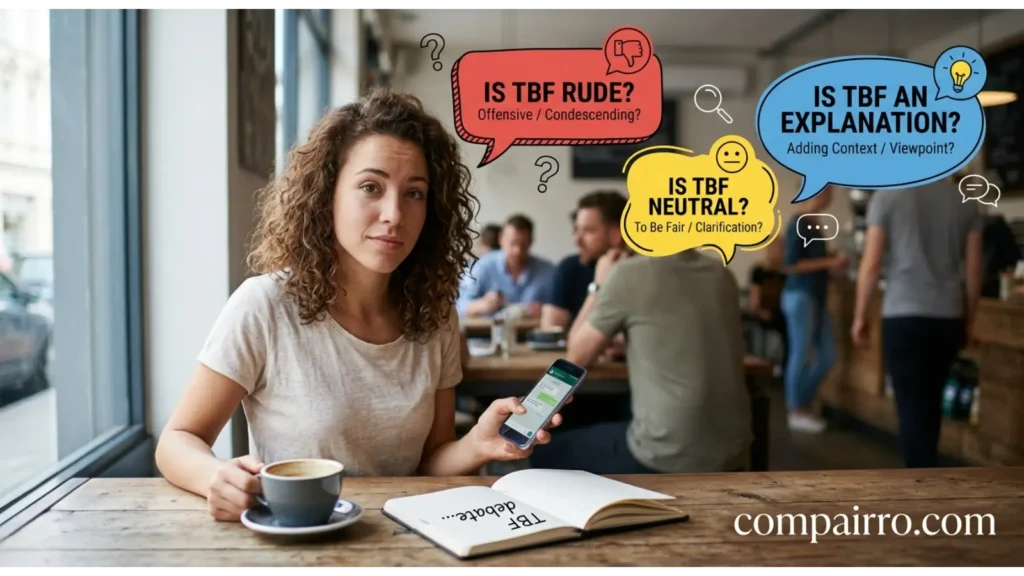
TBF is generally neutral and not offensive. It is a common abbreviation that helps people express a balanced opinion.
However, its tone can change depending on the context.
- Friendly: “TBF, you did really well.”
- Neutral: “TBF, we didn’t have enough time.”
- Defensive: “TBF, I wasn’t the only person responsible.”
- Argumentative: “TBF, you started the argument.”
In some situations, TBF can sound like an excuse or an attempt to defend someone. In others, it simply shows fairness. The surrounding words determine how the message is likely to be understood.
Real-Life Examples of TBF in Texting
Here are examples showing how people may use TBF in different conversations.
Friendly Example
Alex: “I think I did badly on the test.”
Sam: “TBF, the questions were difficult for everyone.”
Sam is trying to make Alex feel better by considering the difficulty of the test.
Casual Example
Friend 1: “That restaurant was expensive.”
Friend 2: “TBF, the portions were huge.”
The second friend adds a point that may help explain the price.
Supportive Example
Person A: “I feel bad that I couldn’t attend the event.”
Person B: “TBF, you had other important things to do.”
Here, TBF introduces a fair reason for the person’s absence.
Argumentative Example
Person A: “You never help with our group projects.”
Person B: “TBF, I completed most of the research last time.”
The second person uses TBF to defend their position and remind the other person of their contribution.
Social Media Example
“Everyone is criticizing the new update, but TBF, it fixed several important bugs.”
The writer acknowledges criticism while pointing out some benefits.
Emotional and Psychological Meaning of TBF
TBF does not represent one specific emotion. Instead, it shows how someone wants to present their point.
It may suggest:
- Fairness: The sender wants to consider both sides.
- Empathy: The sender understands another person’s situation.
- Honesty: The sender wants to acknowledge an important fact.
- Defensiveness: The sender wants to explain or justify an action.
- Balance: The sender sees both positive and negative aspects.
For example, “TBF, she tried her best” may show sympathy. However, “TBF, you made the same mistake” may sound defensive.
You should consider the full conversation instead of assuming the sender’s feelings from the abbreviation alone.
Origin and Background of TBF
TBF comes from the English phrase “to be fair.” The phrase has been used in everyday speech for a long time to introduce a reasonable point or acknowledge another perspective.
As texting and internet communication became more common, people began shortening familiar expressions to save time. TBF became a convenient way to communicate the same idea in fewer characters.
Today, it is widely understood in many English-language online conversations. Its popularity reflects a broader trend in digital communication: turning common phrases into short, easy-to-type abbreviations.

TBF vs. Similar Texting Abbreviations
TBF is sometimes confused with other abbreviations because they can appear in similar conversations. However, each has a different purpose.
| Abbreviation | Full Form | Meaning or Use |
|---|---|---|
| TBF | To be fair | Adds a balanced point |
| TBH | To be honest | Introduces an honest opinion |
| IMO | In my opinion | Shares a personal viewpoint |
| IMHO | In my humble opinion | Shares an opinion, often modestly |
| FR | For real | Shows agreement or emphasizes something |
| NGL | Not gonna lie | Introduces a candid statement |
| BTW | By the way | Adds another point or topic |
For example, “TBH, I didn’t like the movie” expresses an honest opinion. “TBF, the movie had excellent music” acknowledges a positive point, even if the overall opinion is negative.
When Should You Use TBF?
TBF works well in informal conversations when you want to make a fair point without writing a long explanation.
You can use it when:
- Explaining another person’s actions.
- Acknowledging someone’s effort.
- Giving a balanced review.
- Responding to criticism.
- Discussing different opinions.
- Adding context to a disagreement.
For example:
“TBF, everyone was given the same amount of time.”
This sentence adds a relevant point to a discussion about fairness.
When Should You Avoid Using TBF?
Although TBF is widely understood, it may not be suitable for every situation.
Avoid relying on the abbreviation when:
- Writing a formal business email.
- Preparing an academic assignment.
- Communicating with someone unfamiliar with internet slang.
- Discussing a sensitive issue where clarity matters.
- You need to explain a complicated situation carefully.
Instead of writing “TBF, the results were good,” you could write “To be fair, the results were good.”
The complete phrase is clearer and works in both formal and informal writing.
Polite Alternatives to TBF
If you want to express the same idea without using an abbreviation, try these alternatives:
- To be fair
- In fairness
- To give both sides a chance
- Considering the circumstances
- On the other hand
- It’s worth remembering that
- We should also consider
- From another perspective
For example:
“TBF, he was doing his best.”
You could write:
“Considering the circumstances, he was doing his best.”
Both sentences communicate a similar idea, but the second is more formal.
Why Do People Use TBF?
People use TBF because it makes conversations quicker and helps them add context without writing a long explanation.
Common reasons include:
- Saving time while typing.
- Showing fairness during disagreements.
- Recognizing another person’s perspective.
- Making an opinion more balanced.
- Explaining why a situation may not be entirely someone’s fault.
- Communicating naturally in online conversations.
TBF is particularly helpful when a discussion focuses on one side of an issue and someone wants to point out another relevant fact.
Is TBF Safe for Social Media?
Yes, TBF is generally safe for social media. It is not a swear word or an offensive expression.
You can use it in casual comments, messages, discussions, and posts. However, remember that written messages can sometimes sound more critical than intended.
For example, “TBF, you could have done better” might sound like constructive feedback or criticism, depending on the relationship and context.
If you want to avoid misunderstandings, explain your point politely and clearly.
Common Misunderstandings About TBF
Some people assume TBF means that the sender disagrees with them. That is not always true.
TBF simply introduces a fair point. The sender may agree with you overall while still recognizing an exception or another side of the situation.
Another misunderstanding is confusing TBF with TBH. Remember that TBF means “to be fair,” while TBH means “to be honest.”
Finally, TBF does not automatically mean that someone is making excuses. It may simply be an attempt to provide missing information or offer a more balanced view.
How to Respond When Someone Uses TBF
Your response depends on what the person says after TBF.
If you agree:
“They did work hard, TBF.”
You could reply: “Yes, that’s a good point.”
If they explain someone’s behavior:
“TBF, he didn’t know about the change.”
You could reply: “That’s true. It may have been a misunderstanding.”
If you disagree:
“TBF, I understand your point, but I see it differently.”
You can explain your own view respectfully without turning the discussion into an argument.
Regional and Cultural Usage of TBF
TBF is used in many English-language online communities, including conversations in the United Kingdom, the United States, Canada, Australia, and other countries.
The abbreviation is not limited to one region, although individual habits and levels of familiarity may differ.
In multilingual conversations, including chats where English is mixed with Urdu or other languages, people may use TBF alongside their everyday language.
For example: “TBF, uski baat bhi theek hai” means roughly, “To be fair, that person’s point is also valid.”
FAQs About TBF Meaning in Text
1. What does TBF mean in texting?
TBF means “to be fair.” People use it to introduce a balanced opinion, recognize another person’s perspective, or add context to a conversation.
2. What is the TBF full form in slang?
The standard texting full form is “to be fair.” It is commonly used in chats, comments, and informal online discussions.
3. Is TBF the same as TBH?
No. TBF means “to be fair,” while TBH means “to be honest.” TBF introduces a balanced point, whereas TBH introduces a candid opinion.
4. Is TBF rude?
No, TBF is generally neutral. However, the complete sentence can sound defensive, critical, or argumentative depending on the context.
5. What does TBF mean on Instagram?
On Instagram, TBF usually means “to be fair.” It may appear in comments or messages when someone wants to acknowledge another side of an issue.
6. Can I use TBF in formal writing?
It is better to write “to be fair” in formal writing. The full phrase is clearer and more appropriate for professional emails and academic work.
Conclusion
The tbf meaning in text is simple: TBF stands for “to be fair.” It is used in texting and online conversations to introduce a balanced opinion, acknowledge another perspective, or explain a situation more reasonably.
You may see TBF in friendly chats, social media comments, school group messages, and everyday discussions. Although it is generally neutral, its tone depends on the words that follow it.
Remember the difference between TBF and similar abbreviations such as TBH: TBF focuses on fairness, while TBH focuses on honesty. Use TBF when it helps you communicate a fair point, and write the complete phrase when clarity or professionalism matters most.

Sara Taylor is a passionate English content writer who specializes in word meanings, spelling comparisons, and modern slang explanations. She creates easy-to-understand articles that help readers avoid common English mistakes and improve their writing skills. Her content focuses on simple learning, real-life examples, and clear explanations for everyday readers.