Have you ever wanted to talk about a future plan but felt unsure whether to write “someday” or “some day”? You may see both forms in books, messages, social media posts, and everyday conversations. They look almost the same, but they are used in different ways.
This small difference can be confusing, especially for English learners. For example, you might write, “I will visit London someday,” or “I will finish it some day this week.” Both can be correct, but the meaning and grammar are slightly different.
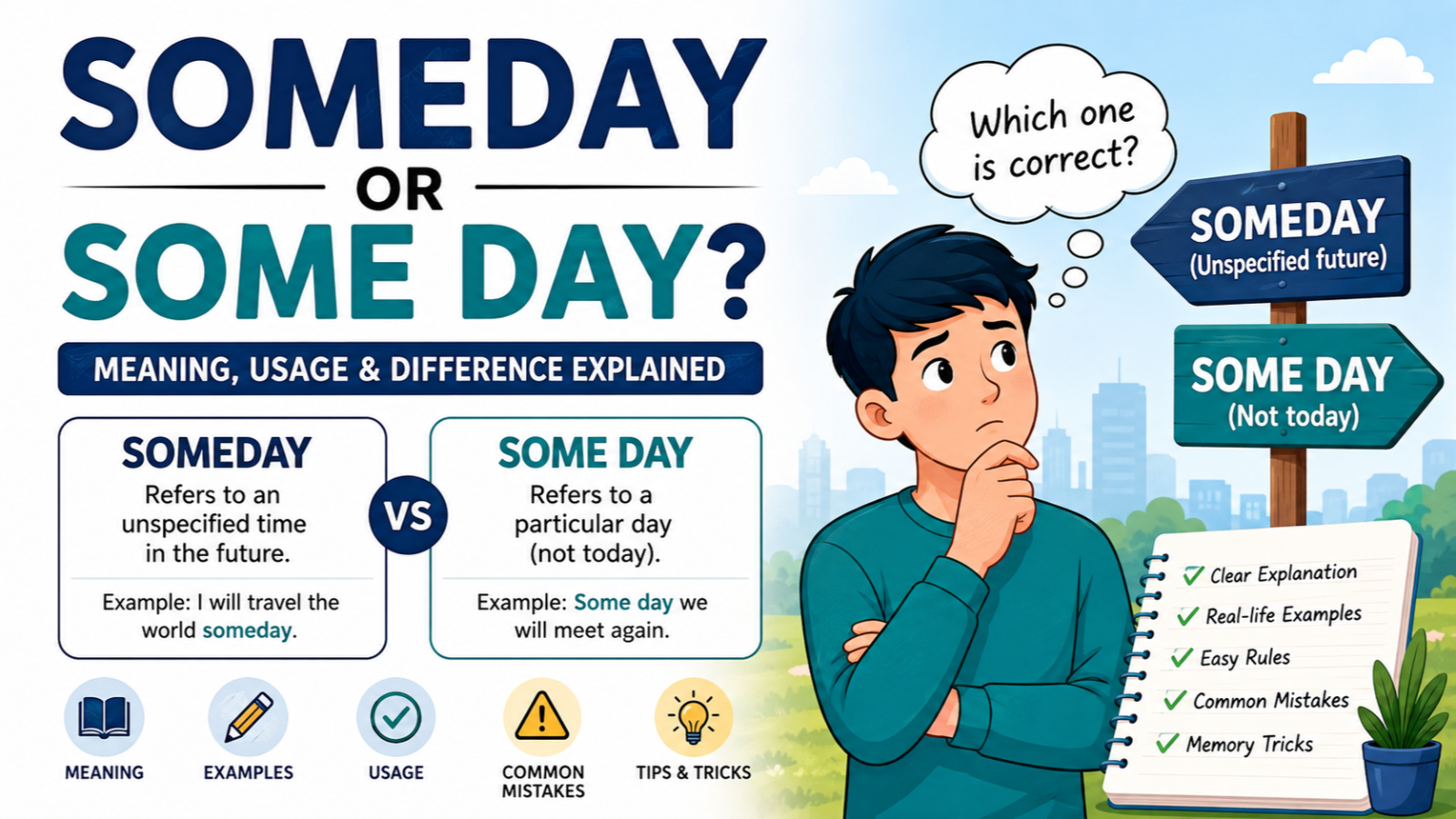
People often search for someday or some day because they want to know which form is correct. The answer depends on what you want to say. Someday usually means an unknown or unspecified time in the future. Some day usually refers to one particular day, even if that day is not named.
You can find these words in school writing, workplace messages, texting, social media captions, and normal conversations. Knowing the difference helps you sound clearer and avoid common grammar mistakes.
In this guide, you’ll learn the meaning, examples, usage, differences, common mistakes, and simple explanations in easy English.
Someday or Some Day – Quick Answer
👉 Someday = at an unknown or unspecified time in the future.
👉 Some day = one particular day or an unspecified day considered as a single day.
Examples
- I hope to travel to Japan someday. ✅
- Someday, I will learn to play the guitar. ✅
- We should meet some day next week. ✅
- I spent some day thinking about the problem. ❌
The last example is not natural English. If you mean an unspecified future time, use someday.
Simple rule
👉 Someday = sometime in the future
👉 Some day = a certain/particular day
A useful test is to ask yourself: Am I talking about the future in a general way, or am I talking about one day?

The Origin of Someday or Some Day
The word someday developed from the combination of some and day. In modern English, it is commonly used as an adverb meaning “at some unspecified time in the future.”
For example:
I want to visit Australia someday.
Here, the speaker does not give a specific date or day.
The two-word form, some day, keeps the normal meanings of the separate words. Some works as a determiner, while day is a noun.
For example:
We can choose some day in June.
Here, the phrase points to one day within a larger period.
Over time, someday became very common in everyday English, especially when people talk about hopes, dreams, plans, or things they want to do in the future.
Today, both forms are still used. The important thing is understanding their role in a sentence.

British English vs American English Usage
There is no major British-American spelling difference between someday and some day.
Both British and American English use someday when referring to an unspecified future time. Both also use some day when the words have their separate meanings.
| Feature | British English | American English | Notes |
|---|---|---|---|
| Someday | Used | Used | Means at an unspecified future time |
| Some day | Used | Used | Refers to one day |
| Spelling | Someday | Someday | No regional spelling change |
| Future dreams | Someday | Someday | Very common |
| Specific day | Some day | Some day | Used when “day” is a noun |
So, whether you are writing for readers in the UK, US, Canada, Australia, India, or Pakistan, the basic rule remains the same.
Which One Should You Use?
The correct choice depends on your meaning.
Use someday when:
- You mean at some time in the future.
- You are talking about a dream or hope.
- You do not know the exact date.
- You are making a general future statement.
- You are talking about something you want to do later.
Examples:
- I want to become a writer someday.
- We will meet again someday.
- She hopes to travel the world someday.
Use some day when:
- You mean one particular day.
- You are talking about a day within a specific period.
- The word day is being treated as a normal noun.
Examples:
- We should meet some day next month.
- On some day in the future, people may live on other planets.
- Choose some day that works for everyone.
Formal vs informal use
Someday is perfectly acceptable in both casual and formal English.
However, in formal writing, you may sometimes want to give a clearer time reference if the exact timing matters.
For example:
I hope to complete the project someday.
This is grammatically correct, but it does not tell the reader when.
For professional writing, a clearer sentence may be:
I hope to complete the project by the end of the year.

Common Mistakes With Someday or Some Day
Mistake 1: Using “some day” for a general future dream
❌ I want to own a house some day.
✔ I want to own a house someday.
When you mean “at an unknown time in the future,” someday is the better choice.
Mistake 2: Assuming “someday” always means one day
❌ We will choose someday next week.
✔ We will choose some day next week.
Here, you are talking about one day during next week. Therefore, some day is more appropriate.
Mistake 3: Thinking “someday” is incorrect
❌ Someday is not proper English.
✔ Someday is a standard English word.
It is widely used in both British and American English.
Mistake 4: Confusing “someday” with “some time”
❌ I will call you some day soon.
✔ I will call you someday soon.
However, if you are specifically talking about a single day, some day can be correct depending on the sentence.
Mistake 5: Writing the phrase without checking the meaning
❌ We need to meet someday next Tuesday.
✔ We need to meet some day next week.
If you have a specific time period in mind and mean one day within it, use the two-word form.

Someday or Some Day in Everyday Examples
Work
Someday:
I hope to start my own business someday.
This describes a future goal without a fixed date.
Some day:
We can arrange the meeting for some day next week.
This means one day during next week.
School
Someday:
I want to study at a famous university someday.
The student has a future dream but no exact date.
Some day:
We need to choose some day for the school event.
This means one day needs to be selected.
Social Media
You may often see someday in inspirational posts and captions:
Someday, all your hard work will pay off.
Another example:
I will visit this beautiful place someday. ❤️
Because these posts usually describe hopes or future dreams, the one-word form is very common.
Daily Life
I will clean my room someday.
This means the speaker plans to do it at an unspecified future time.
Let’s pick some day in December for the family trip.
This means one day in December should be selected.
Text Messages
In texting, someday is common:
We should hang out someday.
This means “at some point in the future.”
You can also write:
Let’s choose some day next week.
Here, you are thinking about one day within next week.
Someday or Some Day – Google Trends & Usage Data
People search someday or some day because the two forms sound almost identical. The confusion becomes stronger when English learners see both forms online.
Search interest for grammar questions like this can come from many English-speaking and English-learning countries, including the US, UK, India, Pakistan, Canada, and Australia.
The exact popularity of searches can change over time. Therefore, it is better to focus on the grammar rule rather than assume that one form is always more popular.
The one-word someday is especially common in:
- Inspirational quotes
- Songs and entertainment titles
- Social media captions
- Personal goals
- Conversations about dreams
- Future plans
Meanwhile, some day appears when writers want to describe one day as a noun phrase.
For beginners, the main confusion is simple: both forms sound the same when spoken. Writing makes the difference visible.
Comparison Table: Someday or Some Day
| Feature | Someday | Some day |
|---|---|---|
| Number of words | One | Two |
| Main meaning | At an unspecified future time | One particular/unspecified day |
| Grammar role | Adverb | Determiner + noun |
| Future dreams | Very common | Usually not preferred |
| Specific day | Usually no | Yes |
| Example | I will travel someday. | Choose some day in May. |
| Easy meaning | “At some time later” | “One day” |
Quick comparison
Someday:
I will visit Paris someday.
The exact day is unknown.
Some day:
We will visit Paris on some day in June.
The sentence focuses on one day within June.
Someday or Some Day in Professional Life
Both forms can appear in professional communication, but someday is usually used for long-term goals or hopes.
For example:
I hope to lead a team someday.
This means the person has a future career goal.
In professional planning, however, you should use exact dates when possible.
Instead of:
We will complete the project someday.
A better professional sentence is:
We will complete the project by Friday.
Likewise:
Let’s schedule the meeting for some day next week.
can be made clearer by choosing an exact day:
Let’s schedule the meeting for Tuesday.
So, someday works well for general future goals, while exact dates are better for important workplace plans.
Someday or Some Day for Students or Beginners
Students often struggle with this pair because the words have almost the same pronunciation.
The easiest way to learn them is to focus on meaning rather than spelling.
Easy learning tips
- Remember someday = sometime in the future.
- Remember some day = one day.
- Look at the words around the phrase.
- If you see a specific period such as “next week” or “in June,” check whether you mean one day in that period.
- Practice by writing your own sentences.
For example:
I want to travel abroad someday.
Then compare it with:
We can choose some day in July.
The first sentence expresses a dream. The second sentence identifies one day within a period.
Signs or Characteristics Related to Someday or Some Day
Characteristics of someday
- It is written as one word.
- It usually refers to the future.
- The exact time is unknown.
- It often appears with dreams and hopes.
- It works as an adverb.
Examples:
- someday soon
- someday in the future
- I hope to do it someday
Characteristics of some day
- It is written as two words.
- Day remains a noun.
- It can refer to one day.
- It can appear with a time period.
- It can be replaced by phrases such as “one day” in many contexts.
Example:
We need to select some day in April.
Common pattern
If you can naturally replace the word with “sometime”, At some point
is often the right choice.
I will visit you someday.
→ I will visit you sometime.
If you mean one particular day, some day may be better.
We will meet on some day in May.
Simple Trick to Remember Someday or Some Day
Here is an easy memory trick:
👉 Someday = sometime
👉 Some day = one day
Think of it this way:
If you are talking about a future dream with no exact date, use some at some point
day.
I want to become a successful writer someday.
If you are choosing or describing one day, use some day.
Let’s meet on some day next week.
Easy shortcut
No exact day → Someday
One day → Some day
This simple rule will help you choose the correct form in most everyday situations.
FAQs:
1. Is “someday” one word or two?
Someday is one word when it means “at some unspecified time in the future.”
2. Is “some day” also correct?
Yes. Some day is correct when day is being used as a noun to refer to one day.
3. What is the difference between someday and some day?
Someday means “at some time in the future,” while some day usually means “one day.”
4. Is “I will do it someday” correct?
Yes. It means you plan to do it at some unknown time in the future.
5. Should I write “someday” in formal writing?
Yes. Someday is grammatically correct in formal and informal English, although specific dates may be clearer in professional writing.
6. Can “some day” mean “someday”?
Sometimes the meanings can overlap, especially in older or more flexible usage. However, At some point
is the normal choice for the general idea of an unknown future time.
7. What is an easy way to remember someday vs some day?
Remember: someday = sometime, while some day = one day.
Conclusion
The difference between At some point
or some day is small but useful to understand. Someday is normally used when you mean an unknown or unspecified time in the future. Some day is used when you mean one particular or unspecified day.
For example, “I hope to travel someday” talks about a future dream. However, “Let’s choose some day in June” talks about one day within a specific period.
The easiest memory rule is:
👉 Someday = sometime in the future
👉 Some day = one day
Once you understand this simple difference, choosing between someday or some day becomes much easier in school, work, texting, social media, and everyday English.

Sara Taylor is a passionate English content writer who specializes in word meanings, spelling comparisons, and modern slang explanations. She creates easy-to-understand articles that help readers avoid common English mistakes and improve their writing skills. Her content focuses on simple learning, real-life examples, and clear explanations for everyday readers.