Imagine you are studying chemistry and your teacher suddenly asks, “Is NH3 polar or nonpolar?” You may know that NH3 is ammonia, but deciding whether it is polar can be confusing at first.
The good news is that the answer is simple once you understand its shape, bonds, and lone pair of electrons. NH3 is a common molecule, so this question often appears in school assignments, chemistry exams, quizzes, and online searches.
Many students search “NH3 polar or nonpolar” because they are unsure whether the N–H bonds cancel each other out. Some also confuse molecular shape with bond polarity. These are two different ideas, but they work together to determine the overall polarity of a molecule.
NH3 is also useful when learning about electronegativity, Lewis structures, molecular geometry, dipole moments, and intermolecular forces. Understanding it can make many other chemistry questions easier.
You may see NH3 discussed in school, college chemistry, laboratory lessons, textbooks, educational websites, and science videos. It is especially useful as a simple example of a polar covalent molecule.
In this guide, you’ll learn the meaning, examples, usage, differences, common mistakes, and simple explanations in easy English.
NH3 POLAR OR NONPOLAR – QUICK ANSWER
👉 NH3 = Polar molecule
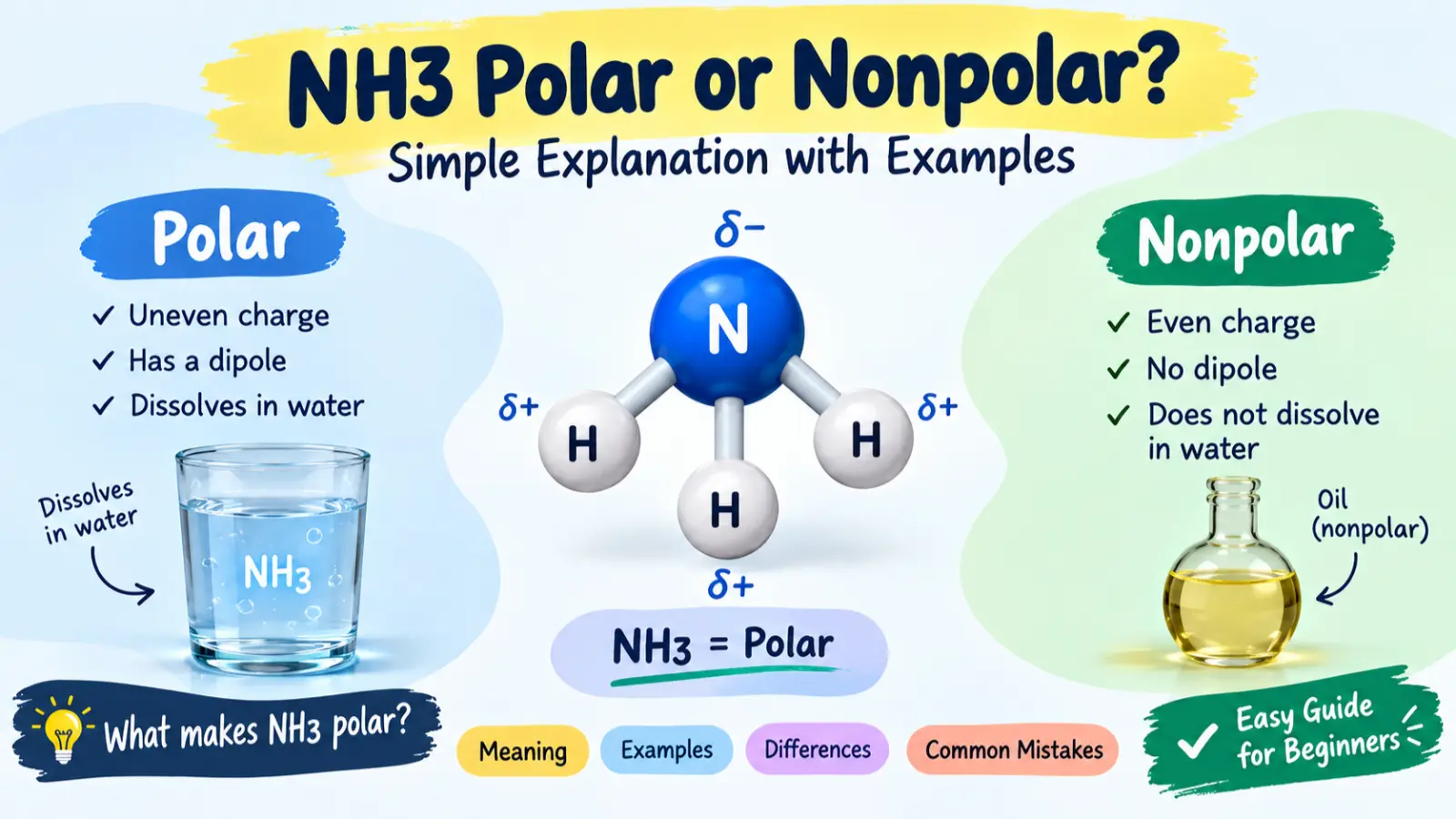
NH3, also called ammonia, is polar because it has:
- Polar N–H bonds
- A trigonal pyramidal shape
- One lone pair of electrons on nitrogen
- An uneven distribution of electrical charge
The nitrogen atom attracts the shared electrons more strongly than hydrogen does. Therefore, each N–H bond is polar.
However, the bonds do not cancel completely because NH3 is not a flat, symmetrical molecule. Its trigonal pyramidal shape creates an overall dipole.
Examples
NH3 is polar. ✅
H₂O is also polar. ✅
CO₂ is nonpolar. ✅
Simple rule:
👉 NH3 has polar bonds + an uneven shape = polar molecule.
A quick way to remember it is:
NH3 = pyramidal shape = polar.
THE ORIGIN OF NH3
NH3 is the chemical formula for ammonia. The formula contains one nitrogen atom and three hydrogen atoms.
The name “ammonia” has a long history. It is linked to an ancient Egyptian association with Ammon, where compounds related to ammonium salts were known.
Chemically, ammonia has been studied for centuries. Today, it is one of the most important nitrogen-containing compounds.
NH3 is widely used in chemistry, agriculture, industry, and laboratory work. It is also important because nitrogen is a key part of many biological and chemical processes.
The formula NH3 tells us exactly what the molecule contains:
- N = 1 nitrogen atom
- H = 3 hydrogen atoms
The arrangement of these atoms and the lone electron pair on nitrogen help give NH3 its polar nature.
BRITISH ENGLISH VS AMERICAN ENGLISH USAGE
There is no meaningful difference between British and American English when discussing NH3.
The chemical formula NH3 is written the same way worldwide. The chemical term ammonia is also spelled the same in both forms of English.
| Feature | British English | American English | Notes |
|---|---|---|---|
| Chemical formula | NH3 | NH3 | Same |
| Chemical name | Ammonia | Ammonia | Same |
| Polar | Polar | Polar | Same |
| Nonpolar | Nonpolar | Nonpolar | Same |
| Scientific usage | NH3 is polar | NH3 is polar | Same |
So, whether you study chemistry in the UK, US, Pakistan, India, Canada, or Australia, the answer remains the same:
👉 NH3 is polar.
WHICH ONE SHOULD YOU USE?
If your question is “Is NH3 polar or nonpolar?”, the correct answer is:
👉 NH3 is polar.
Use this explanation when you need to:
- Answer a chemistry exam question.
- Explain molecular polarity.
- Identify intermolecular forces.
- Study electronegativity.
- Understand molecular geometry.
- Compare NH3 with other molecules.
- Complete a chemistry assignment.
Why is NH3 polar?
The main reasons are:
- Nitrogen is more electronegative than hydrogen.
- The N–H bonds are polar.
- Nitrogen has one lone pair.
- The molecule has a trigonal pyramidal shape.
- The bond dipoles do not cancel completely.
For academic writing, you can write:
“NH3 is a polar molecule because its polar N–H bonds and trigonal pyramidal shape produce a net dipole moment.”
For a short exam answer, simply write:
“NH3 is polar because it has polar N–H bonds and an asymmetrical trigonal pyramidal shape.”
COMMON MISTAKES WITH NH3 POLAR OR NONPOLAR
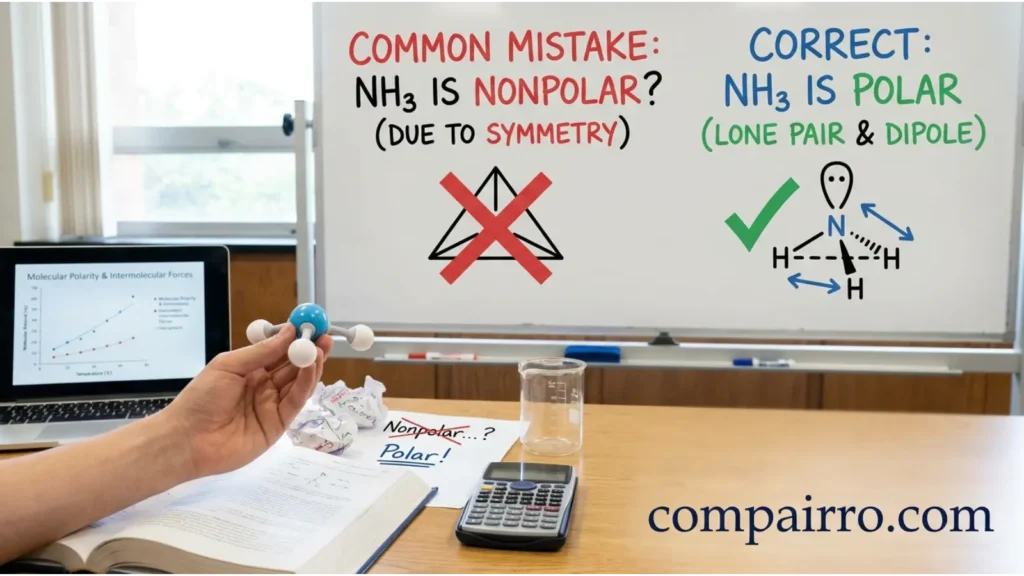
Mistake 1: Thinking NH3 is nonpolar because it has three similar H atoms
❌ Incorrect: “NH3 is nonpolar because all three hydrogen atoms are the same.”
✔ Correct: Having similar atoms does not automatically make a molecule nonpolar. The molecular shape also matters. NH3 has a trigonal pyramidal shape, so its bond dipoles do not cancel.
Mistake 2: Ignoring the lone pair
❌ Incorrect: “NH3 has three bonds, so its shape is flat.”
✔ Correct: Nitrogen has one lone pair. This lone pair affects the molecular shape and gives NH3 its trigonal pyramidal geometry.
Mistake 3: Looking only at individual bonds
❌ Incorrect: “N–H bonds are polar, so that is the only reason NH3 is polar.”
✔ Correct: Bond polarity is important, but the overall molecular shape determines whether the bond dipoles cancel.
Mistake 4: Confusing NH3 with CO2
❌ Incorrect: “NH3 is nonpolar like CO2.”
✔ Correct: CO2 is linear and symmetrical, so its bond dipoles cancel. NH3 is trigonal pyramidal, so its dipoles do not cancel completely.
Mistake 5: Saying NH3 is ionic
❌ Incorrect: “NH3 is an ionic molecule.”
✔ Correct: NH3 contains covalent N–H bonds. The electrons are shared, although they are shared unequally because nitrogen attracts them more strongly.

NH3 IN EVERYDAY EXAMPLES
NH3 is a chemistry concept, so you will not normally use “polar” and “nonpolar” in everyday conversation. However, NH3 appears in many real-life and educational situations.
Work
Chemists and laboratory workers may discuss NH3 when studying chemical reactions, gases, solutions, or industrial processes.
For example:
“The lab report explains why NH3 behaves as a polar molecule.”
School
Students often meet NH3 when learning about:
- Lewis structures
- Electronegativity
- Molecular geometry
- Bond polarity
- Dipole moments
- Intermolecular forces
Example:
“Our chemistry teacher asked whether NH3 is polar or nonpolar.”
Social Media
Science pages and educational accounts may use NH3 in short chemistry explanations.
Example:
“Quick chemistry fact: NH3 is polar because of its shape and lone pair.”
Daily Life
Ammonia is used in several industrial and household-related chemical products, although concentrated ammonia requires careful handling.
You may also encounter NH3 when learning about fertilizers and nitrogen chemistry.
Text Messages
If students are discussing homework, they might write:
“Is NH3 polar?”
A simple reply is:
“Yes, NH3 is polar.”
NH3 – GOOGLE TRENDS & USAGE DATA
People commonly search “NH3 polar or nonpolar” because polarity questions are a basic part of chemistry education.
Search interest is usually connected with schoolwork, homework, exam preparation, chemistry tutorials, and molecular geometry.
The query can also appear in searches such as:
- Is NH3 polar or nonpolar?
- Why is NH3 polar?
- Is ammonia polar?
- NH3 molecular geometry
- NH3 Lewis structure
- Does NH3 have a dipole?
- What is the shape of NH3?
Students in countries such as the US, UK, India, Pakistan, Canada, and Australia may encounter this topic because molecular polarity is taught in many chemistry courses.
Search activity can change around school and exam periods. However, exact Google Trends numbers should be checked directly in Google Trends because search interest changes over time and by location.
The main reason for the confusion is simple: students often know that NH3 contains three N–H bonds but forget to consider the lone pair and three-dimensional shape.
COMPARISON TABLE: NH3 POLAR OR NONPOLAR
The easiest way to understand NH3 is to compare it with other common molecules.
| Molecule | Shape | Polar Bonds? | Overall Polarity |
|---|---|---|---|
| NH3 | Trigonal pyramidal | Yes | Polar |
| H2O | Bent | Yes | Polar |
| CO2 | Linear | Yes | Nonpolar |
| CH4 | Tetrahedral | Slightly polar bonds | Nonpolar |
| BF3 | Trigonal planar | Yes | Nonpolar |
| CCl4 | Tetrahedral | Yes | Nonpolar |
The important point is that polar bonds do not always mean a molecule is polar.
The molecule’s shape determines whether the individual bond dipoles cancel.
For NH3, they do not cancel, so the molecule has an overall dipole.
NH3 IN PROFESSIONAL LIFE
NH3 is important in chemistry, agriculture, manufacturing, and laboratory science.
One major use of ammonia is in the production of fertilizers. Nitrogen from ammonia can help provide plants with an important nutrient.
NH3 is also used in industrial chemical processes. Because ammonia has important chemical properties, understanding its polarity helps students and professionals understand how it interacts with other substances.
In chemistry, NH3 is especially useful when studying:
- Hydrogen bonding
- Dipole-dipole interactions
- Solubility
- Acid-base chemistry
- Molecular structure
- Chemical reactions
Its polarity also helps explain why ammonia interacts strongly with certain polar substances.

NH3 FOR STUDENTS OR BEGINNERS
Many beginners struggle with NH3 polar or nonpolar because they try to memorize answers instead of checking the molecule step by step.
A better method is to follow a simple process.
Step 1: Draw the Lewis structure
Nitrogen is in the center and forms three bonds with hydrogen.
Nitrogen also has one lone pair.
Step 2: Find the shape
The electron arrangement around nitrogen is tetrahedral, but the molecular shape is called trigonal pyramidal because the lone pair is not counted as an atom when naming the molecular shape.
Step 3: Check the bonds
Nitrogen attracts electrons more strongly than hydrogen.
Therefore, the N–H bonds are polar.
Step 4: Check symmetry
NH3 is not perfectly symmetrical in a way that would cancel all the bond dipoles.
Step 5: Decide
The result is:
👉 NH3 = Polar
Easy learning tip
Do not ask only:
“Are the bonds polar?”
Also ask:
“What is the shape of the molecule?”
That second question often gives you the final answer.
SIGNS OR CHARACTERISTICS RELATED TO NH3
Instead of physical “signs,” we can look at the key chemical characteristics that show why NH3 is polar.
1. Polar N–H bonds
Nitrogen attracts shared electrons more strongly than hydrogen.
This creates partial charges within the N–H bonds.
2. Trigonal pyramidal shape
NH3 is not flat. Its three hydrogen atoms form a pyramidal arrangement around nitrogen.
3. One lone pair
Nitrogen has one lone pair of electrons.
This lone pair affects the shape of the molecule.
4. Net dipole moment
Because the bond dipoles do not completely cancel, NH3 has a net dipole moment.
5. Uneven charge distribution
The electrons are not spread evenly throughout NH3.
This uneven charge distribution is a key feature of a polar molecule.
6. Polar interactions
Because NH3 is polar, it can take part in strong interactions with other polar substances.
SIMPLE TRICK TO REMEMBER NH3 POLAR OR NONPOLAR
Here is an easy memory trick:
👉 NH3 = N has a lone pair → pyramidal shape → polar.
Think of NH3 as a small pyramid.
If the molecule has an uneven shape and polar bonds, the charges usually do not cancel completely.
Think of it this way:
NH3 → Lone pair → Pyramid → Polar
You can remember the four words:
Lone Pair → Pyramidal → No Cancellation → Polar
This is much easier than trying to memorize a long chemistry rule.
Another useful comparison is:
👉 NH3 = polar
👉 CO2 = nonpolar
Why?
NH3 has a pyramidal shape, while CO2 has a straight, symmetrical shape.
FAQs:
1. Is NH3 polar or nonpolar?
NH3 is polar. Its N–H bonds are polar, and its trigonal pyramidal shape prevents the bond dipoles from canceling.
2. Why is NH3 a polar molecule?
NH3 is polar because nitrogen attracts electrons more strongly than hydrogen, and the molecule has an uneven trigonal pyramidal shape.
3. What is the shape of NH3?
NH3 has a trigonal pyramidal molecular shape. Nitrogen has three bonded hydrogen atoms and one lone pair.
4. Does NH3 have a dipole moment?
Yes. NH3 has a net dipole moment because its bond dipoles do not cancel completely.
5. Is the N–H bond polar?
Yes. The N–H bond is polar because nitrogen is more electronegative than hydrogen.
6. Is NH3 more like CO2 or H2O in polarity?
NH3 is like H2O because both are polar molecules. CO2 is nonpolar because its linear shape allows its bond dipoles to cancel.
7. How can I quickly remember whether NH3 is polar?
Remember: NH3 has a lone pair and a pyramidal shape, so it is polar.
CONCLUSION
So, is NH3 polar or nonpolar? The clear answer is NH3 is polar.
The reason is not just the N–H bonds. NH3 has polar bonds, one lone pair on nitrogen, and a trigonal pyramidal shape. Because the bond dipoles do not cancel completely, NH3 has an overall dipole.
When solving polarity questions, always check three things:
- Are the bonds polar?
- What is the molecular shape?
- Do the bond dipoles cancel?
For NH3, the answer leads to:
👉 Polar bonds + pyramidal shape = polar molecule.
The easiest memory rule is:
NH3 → lone pair → pyramidal → polar.
Once you understand this pattern, questions about other molecules such as H2O, CO2, BF3, CH4, and CCl4 become much easier too.

Sara Taylor is a passionate English content writer who specializes in word meanings, spelling comparisons, and modern slang explanations. She creates easy-to-understand articles that help readers avoid common English mistakes and improve their writing skills. Her content focuses on simple learning, real-life examples, and clear explanations for everyday readers.