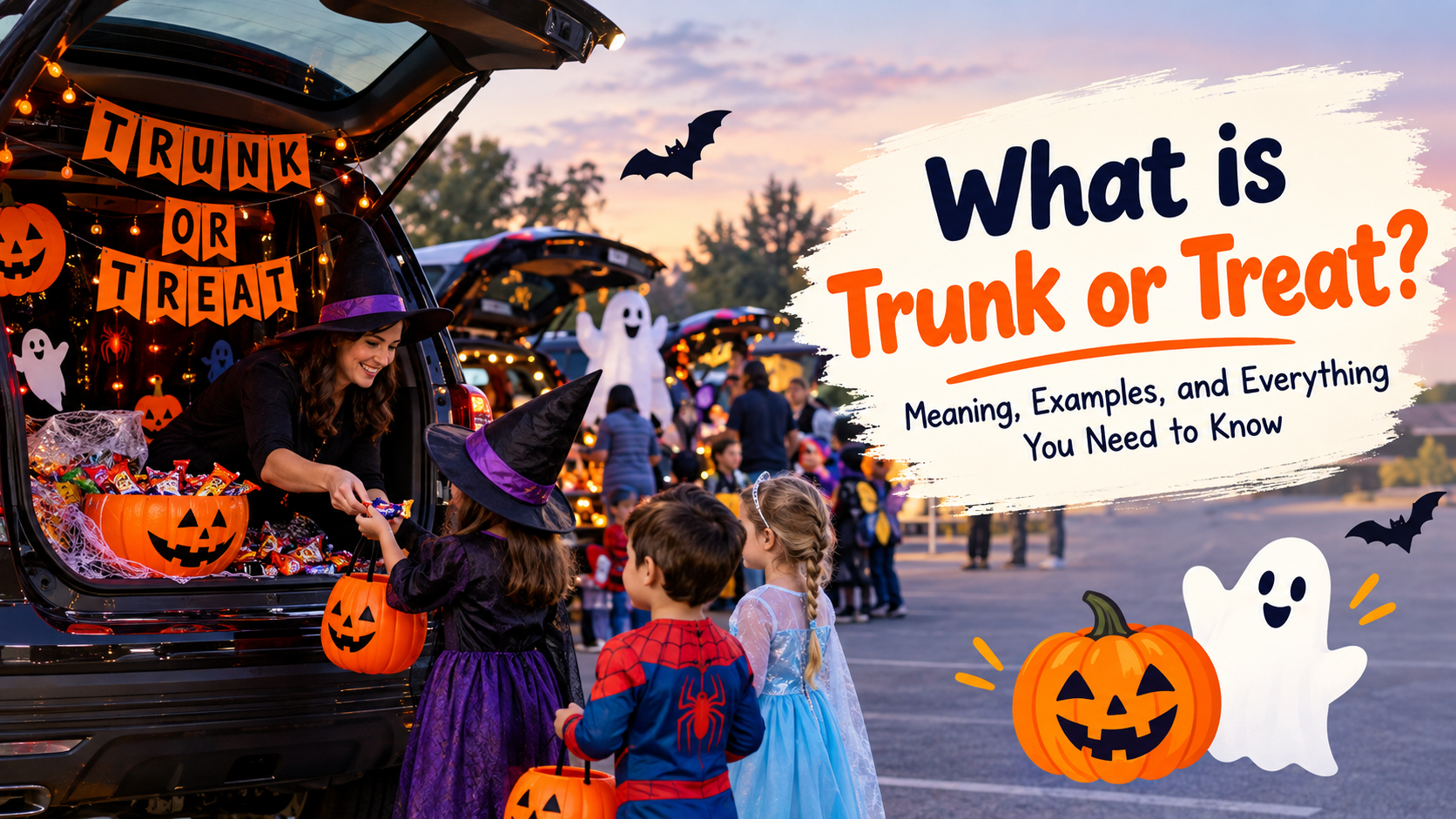
Halloween can be exciting for children, families, schools, and communities. But instead of walking from house to house for candy, some families join a special Halloween event where decorated cars are lined up in one place. Children walk from car to car and collect treats. This fun event is called trunk or treat.
If you have heard someone say “trunk or treat” and wondered what it means, you are not alone. The phrase may sound strange at first because a car trunk does not seem connected to Halloween. However, the idea is actually very simple.
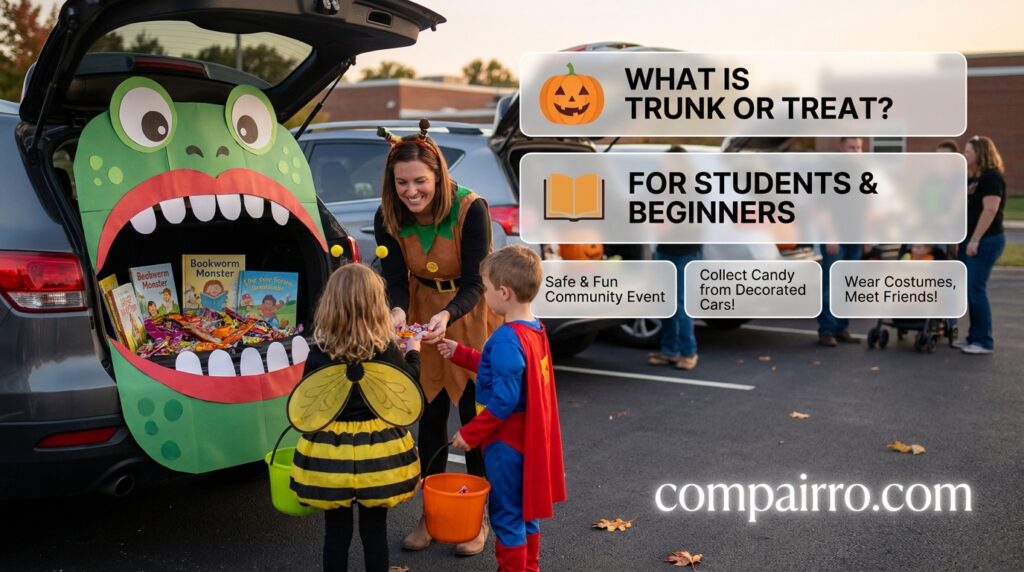
A trunk or treat event is usually held in a parking lot, school, church, community center, or other safe outdoor area. Adults decorate the trunks of their cars with Halloween themes, characters, colors, or simple decorations. Children then visit each car to receive candy or other small treats.
People often search for what is trunk or treat because they see the phrase on event posters, school notices, social media posts, or community calendars. The term is especially common in the United States, although similar events can be found in other places too.
Understanding the phrase is useful if you are reading a Halloween invitation, planning a family event, or simply learning modern English expressions. It also helps parents and children know what to expect before attending one.
In this guide, you’ll learn the meaning, examples, usage, differences, common mistakes, and simple explanations in easy English.
What Is Trunk or Treat? – Quick Answer
👉 Trunk or treat = a Halloween event where children collect candy by visiting decorated car trunks instead of going from house to house.
In a typical trunk or treat, several cars park together in a safe area. Their owners decorate their car trunks with fun Halloween themes. Children walk around and receive treats from the people standing near the cars.
Examples
- Our school is having a trunk or treat on Friday.
- The children wore costumes for the trunk or treat.
- We decorated our car trunk for the Halloween event.
Simple rule
👉 Think: “Halloween candy + decorated car trunks = trunk or treat.”
It is similar to traditional trick-or-treating, but the activity usually takes place in one organized location.
The Origin of Trunk or Treat
The exact beginning of trunk or treat is difficult to identify because communities began organizing similar events in different places and at different times.
The idea became popular in the United States as a community-based alternative to traditional trick-or-treating. Churches, schools, neighborhoods, and local groups have used these events to bring families together in a controlled setting.
The name comes from the two main parts of the activity:
- Trunk refers to the trunk of a car.
- Treat refers to the candy or small prizes given to children.
The phrase became more familiar through local events, community groups, school programs, and social media. Photos of creative decorated trunks also helped make the idea popular.
Today, trunk or treat events can range from very simple gatherings to large community celebrations with games, costumes, music, food, and contests.
British English vs American English Usage
Trunk or treat is mainly an American English expression. The word trunk is commonly used in American English for the storage area at the back of a car.
In British English, that part of a car is usually called the boot. However, “trunk or treat” remains the common name of the event because the phrase developed mainly in the United States.
| Feature | British English | American English | Notes |
|---|---|---|---|
| Car storage area | Boot | Trunk | Different words for the same part |
| Halloween event | Trunk or treat | Trunk or treat | The event name stays the same |
| Candy | Sweets | Candy | Common vocabulary difference |
| Halloween activity | Trick-or-treating | Trick-or-treating | Used in both varieties |
So, you may hear boot instead of trunk when describing a car in Britain, but the event itself is generally still called trunk or treat.
Which One Should You Use?
If you are talking about this specific Halloween event, trunk or treat is the standard phrase.
Use it when:
- Talking about an organized Halloween event.
- Writing a school or community announcement.
- Inviting families to a Halloween gathering.
- Discussing decorated cars and candy.
- Posting about a Halloween event on social media.
- Searching for local Halloween activities.
Formal vs. casual use
Trunk or treat is not a formal business term. It is a casual community and family expression.
For example:
- Casual: “Are you going to the trunk or treat tonight?”
- School: “Students are invited to our annual trunk or treat.”
- Community: “Join us for a family-friendly trunk or treat event.”
You can use the phrase in both speech and writing when the context is Halloween.
Common Mistakes With Trunk or Treat
Mistake 1: Thinking it means a car show
❌ “Trunk or treat is only a car exhibition.”
✔ Trunk or treat is mainly a Halloween activity where decorated cars are used as stations for giving treats.
Cars are an important part of the event, but the main purpose is usually Halloween fun and community participation.
Mistake 2: Thinking children visit normal houses
❌ “Children go from house to house during a trunk or treat.”
✔ Children usually walk from one decorated car to another at a planned location.
Traditional trick-or-treating normally involves visiting different homes.
Mistake 3: Assuming every trunk or treat is the same
❌ “Every trunk or treat has exactly the same activities.”
✔ Each event can be different.
Some events only offer candy, while others include games, food, music, prizes, costume contests, or other family activities.
Mistake 4: Thinking “trunk” means a suitcase
❌ “Trunk or treat means treating someone with a suitcase.”
✔ Here, trunk means the storage compartment at the back of a car.
The phrase gets its name from decorated car trunks.
Mistake 5: Confusing it with trick-or-treating
❌ “Trunk or treat and trick-or-treating are exactly the same.”
✔ They have a similar goal, but the setting is different.
Both can involve costumes and treats, but trunk or treat is usually organized in one location with decorated vehicles.
Trunk or Treat in Everyday Examples
Work
A workplace may organize a family Halloween event for employees.
Example:
“Our company is hosting a trunk or Offer for employees’ families.”
School
Schools sometimes use trunk or treat as a fun Halloween activity.
Example:
“The school announced a trunk or Reward for students and their families.”
Social Media
People often share photos of decorated cars and costumes online.
Example:
“Who has ideas for decorating a trunk or treat car?”
Daily Life
Families may attend a local event instead of traditional trick-or-treating.
Example:
“We’re taking the kids to a trunk or Reward this weekend.”
Text Messages
The phrase can be used casually in messages.
Example:
“Are you going to the trunk or treat tonight?”
Another example:
“Don’t forget the candy for the trunk or Reward!”
What Is Trunk or Treat? – Google Trends & Usage Data
Interest in what is trunk or Reward usually increases around Halloween because people see the phrase on event flyers, school calendars, community websites, and social media.
The term is especially connected with Halloween activities in the United States. Searches may rise during September and October as families and organizations begin planning Halloween events.
Interest can also come from people who are unfamiliar with the phrase. Someone may see “Trunk or Reward ” on a school notice and search for its meaning before attending.
The term is most strongly associated with the US, where the activity is widely known. It can also appear in searches from the UK, India, Pakistan, Canada, and Australia, especially among people interested in American Halloween traditions.
General usage pattern
- US: Strong connection with community Halloween events.
- UK: More likely to appear when discussing American Halloween traditions.
- India: May appear in content about Halloween events and celebrations.
- Pakistan: Mostly seen through social media, international content, and American cultural references.
- Canada: Used in some community and family Halloween events.
- Australia: May appear in Halloween-related community activities and American cultural content.
Because Google Trends values can change over time and by location, it is better to describe the keyword’s seasonal pattern rather than claim a fixed search volume without current data.
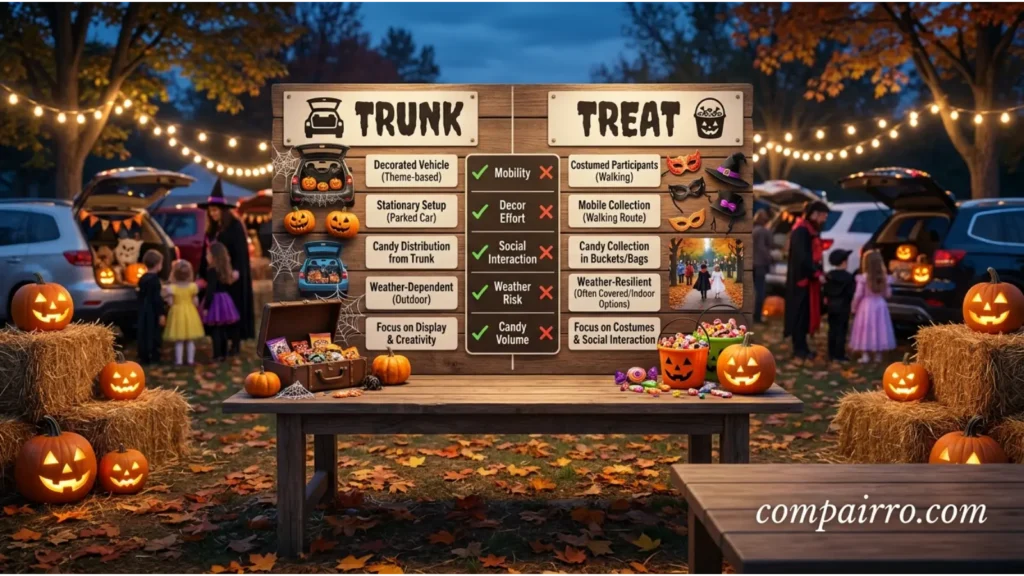
Comparison Table: Trunk or Treat
| Feature | Trunk or Treat | Traditional Trick-or-Treating |
|---|---|---|
| Main location | Parking lot or organized area | Neighborhood |
| Main activity | Visit decorated cars | Visit homes |
| Decorations | Car trunks | Houses and doors |
| Treats | Candy or small prizes | Candy or treats |
| Costumes | Common | Common |
| Organization | Usually planned in advance | Often informal |
| Community setting | Usually one gathering | Spread across a neighborhood |
| Main purpose | Halloween fun and community | Halloween fun and collecting treats |
Both activities can be enjoyable. The biggest difference is where children go to receive treats.

What Is Trunk or Treat in Professional Life?
Although trunk or treat is not a professional business term, workplaces can use it as a family-friendly community activity.
Companies, schools, hospitals, churches, and other organizations may organize these events for employees, families, students, or local communities.
For example, an employer might invite workers and their children to a Halloween event in the company parking lot.
A simple announcement could say:
“Employees and their families are invited to our annual trunk or treat event.”
In this setting, the phrase creates a friendly and informal feeling. It is not normally used in formal business reports or professional documents unless the document is specifically about the event.
What Is Trunk or Treat for Students or Beginners?
Students and English learners may find the phrase confusing because its literal meaning does not immediately explain the activity.
The easiest way to understand it is to break the phrase into two words:
Trunk + Treat
A trunk is the storage area at the back of a car in American English.
A treat is something nice that is given to someone, such as candy during Halloween.
Put the two ideas together, and you get an event where people decorate their car trunks and give treats to children.
Easy learning tips
- Remember that trunk = car in this phrase.
- Remember that treat = candy or small gift.
- Think about Halloween when you see the phrase.
- Do not confuse it with a normal car event.
- Remember that it is mainly an American Halloween expression.
Signs or Characteristics Related to Trunk or Treat
A typical trunk or treat may have several of these features:
- 🚗 Decorated cars: Participants decorate their vehicle trunks.
- 🎃 Halloween themes: Pumpkins, ghosts, superheroes, animals, and other themes may be used.
- 🍬 Candy: Children commonly receive candy or other small treats.
- 👻 Costumes: Children and adults may dress in Halloween costumes.
- 🅿️ Parking area: Cars are usually arranged in a parking lot or similar safe space.
- 👨👩👧 Families: The event often welcomes parents, children, and other family members.
- 🎮 Games: Some events include simple games and activities.
- 🏆 Contests: Some groups hold contests for the best-decorated trunk.
- 🎵 Entertainment: Larger events may include music or other entertainment.
- 🤝 Community: The event gives people a chance to meet and enjoy Halloween together.
Not every trunk or treat event includes all of these features. The exact activities depend on the organizers.
Simple Trick to Remember What Is Trunk or Treat
Here is an easy memory trick:
👉 Trunk = Car
👉 Treat = Candy
So:
Trunk + Treat = Halloween candy from decorated cars.
Think of it this way:
Imagine a parking lot filled with decorated cars. A child wearing a Halloween costume walks from car to car. At each car, someone gives the child a piece of candy.
That is the basic idea of trunk or treat.
You can also remember it like this:
Traditional trick-or-treat → Houses
Trunk or treat → Cars
This simple comparison makes the phrase much easier to remember.
FAQs:
1. What does trunk or treat mean?
Trunk or treat is a Halloween event where children visit decorated car trunks to receive candy or other small treats.
2. Why is it called trunk or treat?
It is called trunk or treat because people decorate their car trunks and give treats to children during the event.
3. Is trunk or treat the same as trick-or-treating?
They are similar, but not exactly the same. Traditional trick-or-treating usually involves visiting homes, while trunk or treat usually takes place around decorated cars in one location.
4. What happens at a trunk or treat?
Children usually wear costumes and walk from decorated car to decorated car to collect candy. Some events also have games, music, food, and contests.
5. Where does trunk or treat usually happen?
Trunk or treat events are commonly held in parking lots, schools, churches, community centers, or other organized outdoor areas.
6. Is trunk or treat an American tradition?
The phrase and the organized event are strongly associated with the United States. Similar Halloween gatherings can also take place in other countries.
7. What should I bring to a trunk or treat?
If you are attending as a guest, check the event rules first. Families may need costumes, while people decorating cars may bring decorations and treats if the organizers request them.
Conclusion
So, what is trunk or treat? It is a fun Halloween activity where children collect candy and other treats from decorated car trunks instead of visiting houses one by one.
The phrase is mainly associated with American English and American Halloween culture. It is commonly used by schools, churches, neighborhoods, workplaces, and community groups.

Sara Taylor is a passionate English content writer who specializes in word meanings, spelling comparisons, and modern slang explanations. She creates easy-to-understand articles that help readers avoid common English mistakes and improve their writing skills. Her content focuses on simple learning, real-life examples, and clear explanations for everyday readers.