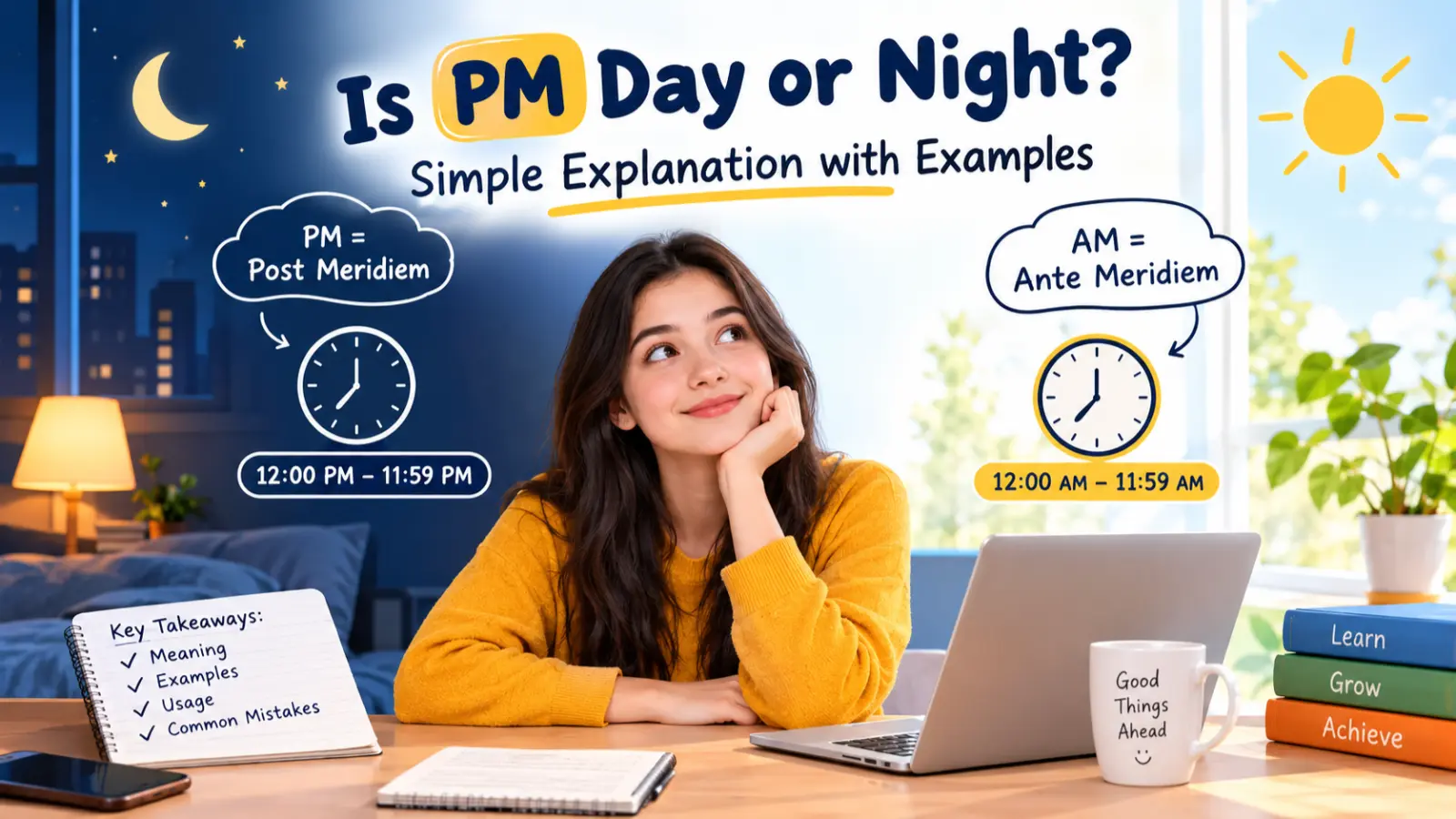
If you have ever looked at a digital clock and wondered, “Is PM day or night?”, you are not alone. AM and PM can be confusing, especially when you see times such as 12 PM, 1 PM, or 12 AM. The confusion becomes even greater when someone says, “Meet me at 8 PM,” and you need to quickly know if they mean evening or night.
The term PM appears everywhere. You can see it on phones, alarm clocks, school schedules, work timetables, appointment reminders, travel tickets, social media posts, and online forms. Understanding PM is useful in daily conversations because choosing the wrong time can easily lead to missed meetings or late arrivals.
In simple terms, PM refers to the time from noon until midnight. This includes the afternoon, evening, and part of the night. So, PM is not only “night.” For example, 2 PM is afternoon, 6 PM is evening, and 11 PM is night.
The most important part to remember is that 12 PM means noon, while 12 AM means midnight. Once you understand this rule, reading a 12-hour clock becomes much easier.
In this guide, you’ll learn the meaning, examples, usage, differences, common mistakes, and simple explanations in easy English.
Is PM Day or Night? – Quick Answer
👉 PM can mean afternoon, evening, or night. It starts at noon and ends at midnight.
PM stands for post meridiem, a Latin phrase meaning “after midday.”
For example:
- 1 PM = afternoon
- 4 PM = afternoon
- 7 PM = evening
- 10 PM = night
- 11:59 PM = just before midnight
What about 12 PM?
12 PM = noon.
What about 12 AM?
12 AM = midnight.
Simple rule:
👉 AM = midnight to before noon
👉 PM = noon to before midnight
So, PM is not always night. It covers the afternoon, evening, and night.
The Origin of PM
The abbreviation PM comes from the Latin words post meridiem, which mean “after midday.”
Likewise, AM comes from ante meridiem, meaning “before midday.”
The AM and PM system is connected to the 12-hour clock, which divides a full 24-hour day into two groups of 12 hours.
The system became common because it provides a simple way to tell whether a time is before or after noon. Today, AM and PM are widely used in countries such as the United States and Canada, while many other places often use the 24-hour clock.

British English vs American English Usage
There is no major difference between British and American English when using AM and PM. Both use these abbreviations to describe times in the 12-hour clock system.
| Feature | British English | American English | Notes |
|---|---|---|---|
| AM | Used | Used | Before noon |
| PM | Used | Used | After noon |
| 12 PM | Noon | Noon | Same meaning |
| 12 AM | Midnight | Midnight | Same meaning |
| 7 PM | Evening | Evening | Same time |
| 11 PM | Night | Night | Same time |
The main difference is that the 24-hour clock is more common in many British settings, especially for transport, schedules, and official information.
For example, 19:00 means 7:00 PM.
Which One Should You Use?
Use PM when you are talking about a time from noon through the evening and up to midnight.
For example:
- Use 2 PM for two o’clock in the afternoon.
- Use 6 PM for six o’clock in the evening.
- Use 9 PM for nine o’clock at night.
- Use 11 PM for late at night.
PM is useful for:
- Casual conversations
- Text messages
- School schedules
- Work meetings
- Appointments
- Social media posts
- Travel plans
For formal schedules, especially in international settings, the 24-hour clock can sometimes be clearer.
Common Mistakes With PM
Mistake 1: Thinking PM always means night
❌ “PM means nighttime.”
✔ PM covers the afternoon, evening, and night.
For example, 3 PM is afternoon, not night.
Mistake 2: Confusing 12 PM with midnight
❌ “12 PM means midnight.”
✔ 12 PM means noon.
Midnight is 12 AM.
Mistake 3: Confusing 12 AM with noon
❌ “12 AM means lunchtime.”
✔ 12 AM means midnight.
This is one of the most common time mistakes.
Mistake 4: Thinking 1 PM is before noon
❌ “1 PM comes before 12 PM.”
✔ 1 PM comes after 12 PM.
The order is:
11 AM → 12 PM → 1 PM → 2 PM
Mistake 5: Using PM after midnight
❌ 1 PM means one o’clock after midnight.
✔ 1 AM means one o’clock after midnight.
PM begins at noon.
PM in Everyday Examples
At Work
Your manager might say:
“The meeting starts at 3 PM.”
This means the meeting starts in the afternoon.
Another example:
“Please send the report before 7 PM.”
This means before seven o’clock in the evening.
At School
A school schedule may say:
“The sports event begins at 4 PM.”
That means it starts in the afternoon.
On Social Media
Someone might post:
“Live stream starts at 8 PM.”
This means the live stream starts at 8 o’clock in the evening.
In Daily Life
You might say:
“Let’s have dinner at 8 PM.”
This usually means 8 o’clock at night.
In Text Messages
A friend might text:
“I’ll call you at 9 PM.”
That means they plan to call at 9 o’clock at night.
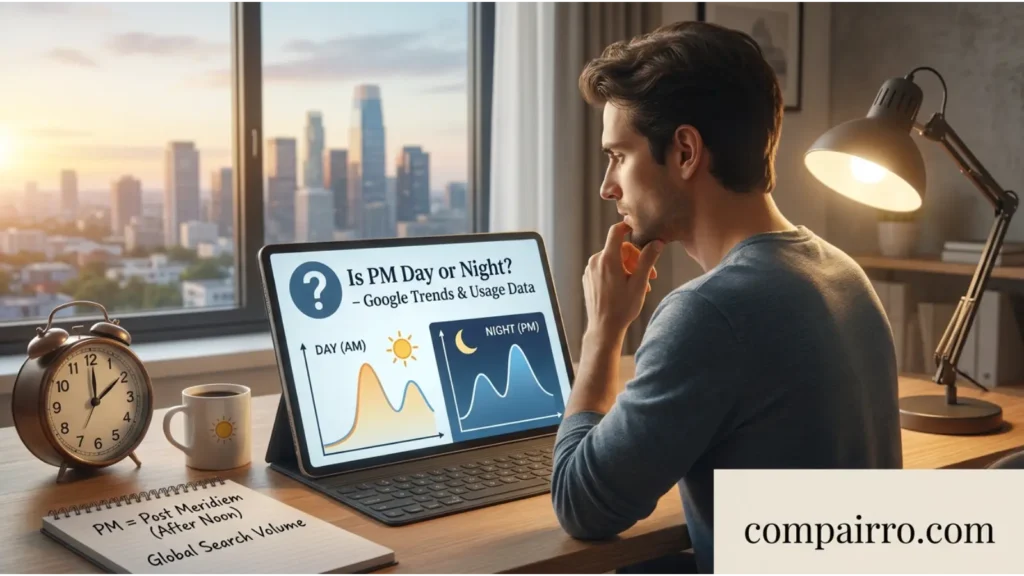
Is PM Day or Night? – Google Trends & Usage Data
People commonly search “is PM day or night” because the word PM does not describe only one part of the day.
The biggest confusion usually comes from times around 12 PM and 12 AM. People may also be learning the 12-hour clock or switching between AM/PM and the 24-hour system.
Search interest can come from many countries, including:
- US: AM and PM are common in everyday timekeeping.
- UK: Both systems are used, with the 24-hour clock common in many official schedules.
- India: AM and PM are widely used in everyday speech and digital clocks.
- Pakistan: AM and PM are commonly used in daily conversations, schools, offices, and phones.
- Canada: Both 12-hour and 24-hour time formats are used.
- Australia: Both systems are common, depending on the situation.
Searches often increase when people encounter confusing times such as 12 AM, 12 PM, 12 noon, and midnight.
Because people use phones and digital devices every day, understanding these abbreviations remains useful.
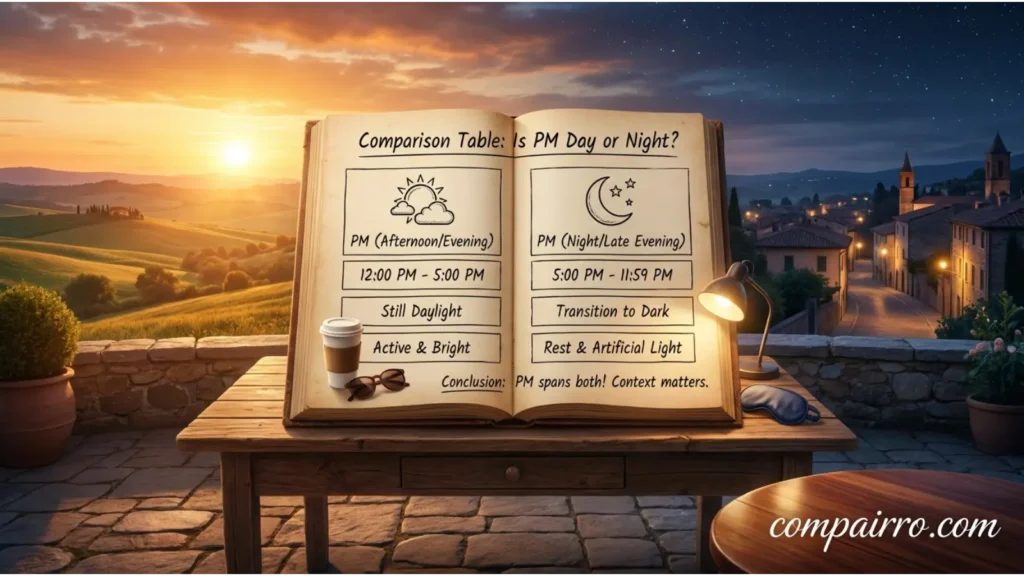
Comparison Table: Is PM Day or Night?
| Time | AM/PM | Part of Day | Meaning |
|---|---|---|---|
| 12:00 AM | AM | Midnight | Start of a new day |
| 1:00 AM | AM | Night | One hour after midnight |
| 6:00 AM | AM | Morning | Early morning |
| 11:00 AM | AM | Morning | Before noon |
| 12:00 PM | PM | Noon | Midday |
| 1:00 PM | PM | Afternoon | After noon |
| 4:00 PM | PM | Afternoon | Late afternoon |
| 6:00 PM | PM | Evening | Early evening |
| 8:00 PM | PM | Night | Evening/night |
| 11:00 PM | PM | Night | Late night |
| 11:59 PM | PM | Night | Almost midnight |
The exact time people consider “evening” or “night” can vary by culture and season. However, PM always technically means after noon and before midnight.
PM in Professional Life
Knowing AM and PM is important at work because time mistakes can cause missed meetings, late appointments, or scheduling problems.
For example:
- 9 AM meeting = morning meeting
- 1 PM lunch meeting = afternoon
- 5 PM deadline = late afternoon
- 8 PM event = evening/night
When communicating with people in different countries, it can help to write “12 noon” instead of “12 PM” and “12 midnight” instead of “12 AM” when there could be confusion.
For international schedules, the 24-hour format can also make times clearer.

PM for Students or Beginners
Students often struggle with AM and PM because the clock repeats the numbers from 1 to 12.
The easiest way to learn is to divide the day into two parts:
AM: Midnight → Morning → Before noon
PM: Noon → Afternoon → Evening → Night → Midnight
Remember that 12 is the special point.
- 12 AM = midnight
- 12 PM = noon
A simple practice method is to convert familiar times:
- Breakfast at 8 AM → morning
- Lunch at 1 PM → afternoon
- Dinner at 8 PM → night
After a little practice, AM and PM become easy to recognize.
Signs or Characteristics Related to PM
Here are the main features of PM:
- PM starts at 12:00 noon.
- PM continues through the afternoon.
- PM includes the evening.
- PM includes nighttime hours.
- PM ends at 11:59 PM.
- 12 PM means noon.
- 12 AM means midnight.
- 1 PM comes after noon.
- 11 PM is late at night.
- PM is used with the 12-hour clock.
The key point is that PM describes a 12-hour period after midday, not just nighttime.
Simple Trick to Remember PM
Here is an easy trick:
👉 AM = Before Noon
👉 PM = Past Noon
Think of PM as “Past Midday.”
For example:
11 AM → before noon
12 PM → noon
1 PM → past noon
Think of it this way:
Imagine the day as a simple line:
Midnight → Morning → Noon → Afternoon → Evening → Night → Midnight
AM is the time before noon.
PM is the time after noon.
So if you see 7 PM, you know it is after noon and normally evening/night.
FAQs:
1. Is PM day or night?
PM can be afternoon, evening, or night. It starts at noon and continues until midnight.
2. Is 12 PM noon or midnight?
12 PM is noon. It represents the middle of the day.
3. Is 12 AM day or night?
12 AM is midnight. It marks the beginning of a new calendar day.
4. Is 1 PM afternoon or night?
1 PM is afternoon. It is one hour after noon.
5. Is 6 PM day or night?
6 PM is usually considered evening. It is still PM.
6. Is 8 PM AM or PM?
8 PM is PM. It normally refers to the evening or nighttime.
7. Does PM mean after noon?
Yes. PM stands for post meridiem, which means “after midday” or “after noon.”
Conclusion
So, is PM day or night? The simple answer is that PM can be both afternoon and night, because it covers the entire period from noon until midnight.
For example, 2 PM is afternoon, 6 PM is evening, and 10 PM is night. The most important rule is to remember that 12 PM means noon and 12 AM means midnight.
Easy memory rule:
👉 AM = Before Noon
👉 PM = After Noon
Once you remember this, reading AM and PM becomes much easier in school, work, texting, appointments, and everyday life.

Sara Taylor is a passionate English content writer who specializes in word meanings, spelling comparisons, and modern slang explanations. She creates easy-to-understand articles that help readers avoid common English mistakes and improve their writing skills. Her content focuses on simple learning, real-life examples, and clear explanations for everyday readers.