Have you ever seen mushrooms growing in a garden, mold on old bread, or yeast used to make bread rise? These are all examples of fungi. However, have you ever wondered if fungi are unicellular or multicellular?
This is a common question for students who study biology. Some fungi are made of only one cell, while others contain many cells working together. That is why the answer is not simply one or the other.
Understanding whether fungi are unicellular or multicellular helps you learn how living things grow, reproduce, and survive. It is also useful when studying cells, microorganisms, plants, and animals in school.
You may come across this question in biology textbooks, classroom discussions, homework, online searches, and science exams. The topic can seem confusing at first because mushrooms and yeast look very different, even though both belong to the fungi kingdom.
The good news is that the concept is easy to understand once you learn the difference between unicellular and multicellular organisms. You will also discover why fungi are not classified as plants and how their cell structures help them survive.
In this guide, you’ll learn the meaning, examples, usage, differences, common mistakes, and simple explanations in easy English.
Is Fungi Unicellular or Multicellular? – Quick Answer
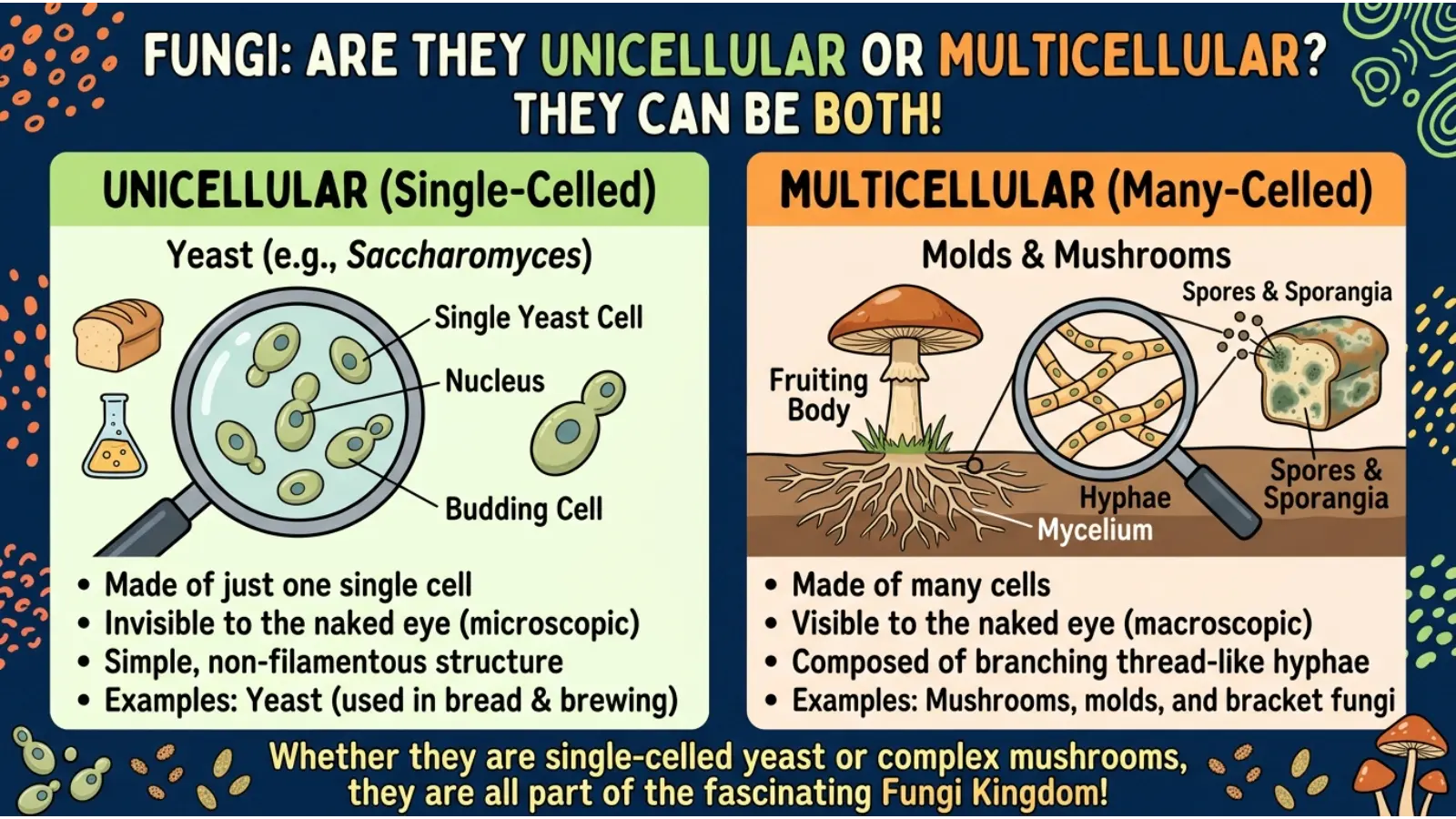
Fungi can be both unicellular and multicellular. Some fungi consist of a single cell, while others are made of many cells.
- Unicellular fungi: These fungi have only one cell. Yeast is a common example.
- Multicellular fungi: These fungi have many cells. Mushrooms and many molds are examples.
Examples of unicellular fungi
- Yeast used in baking.
- Some species of yeast found in nature.
Examples of multicellular fungi
- Mushrooms growing in forests.
- Bread mold.
- Many fungi growing on soil and decaying wood.
Simple rule: Yeast is usually unicellular, while mushrooms and most molds are multicellular.
The Origin of Fungi
The word fungus comes from Latin, where it referred to a mushroom. The plural form is fungi, which refers to more than one fungus or to the group as a whole.
Fungi are a separate group of living organisms called the kingdom Fungi. They are not plants, animals, or bacteria.
Scientists study fungi because they play important roles in nature. Many break down dead plants and animals, returning nutrients to the environment. Others help plants absorb nutrients, while some cause diseases.
Over time, scientists have learned that fungi have different forms. Some, such as yeast, consist of one cell. Others grow as networks of tiny threads called hyphae.
British English vs American English Usage
The scientific meaning of fungi is the same in British and American English. There is no major difference in how scientists describe unicellular and multicellular fungi.
| Feature | British English | American English | Notes |
|---|---|---|---|
| Singular form | Fungus | Fungus | One organism |
| Plural form | Fungi | Fungi | More than one fungus |
| Single-celled fungus | Yeast | Yeast | Usually unicellular |
| Many-celled fungus | Mushroom | Mushroom | Multicellular |
| Scientific term | Unicellular | Unicellular | One cell |
| Scientific term | Multicellular | Multicellular | Many cells |
In both countries, students learn that fungi include both unicellular and multicellular organisms.
Which One Should You Use?
When answering the question “Is fungi unicellular or multicellular?”, the correct response is both.
The answer depends on which type of fungus you are discussing.
- For biology exams: Write that fungi can be unicellular or multicellular.
- When discussing yeast: Explain that yeast is generally unicellular.
- When discussing mushrooms: Explain that mushrooms are multicellular.
- When discussing molds: Mention that most familiar molds are multicellular.
- In scientific writing: Use the terms unicellular and multicellular to describe the number of cells.
Remember that fungi are not all built in the same way. Their cell structure depends on the species.
Common Mistakes About Unicellular and Multicellular Fungi
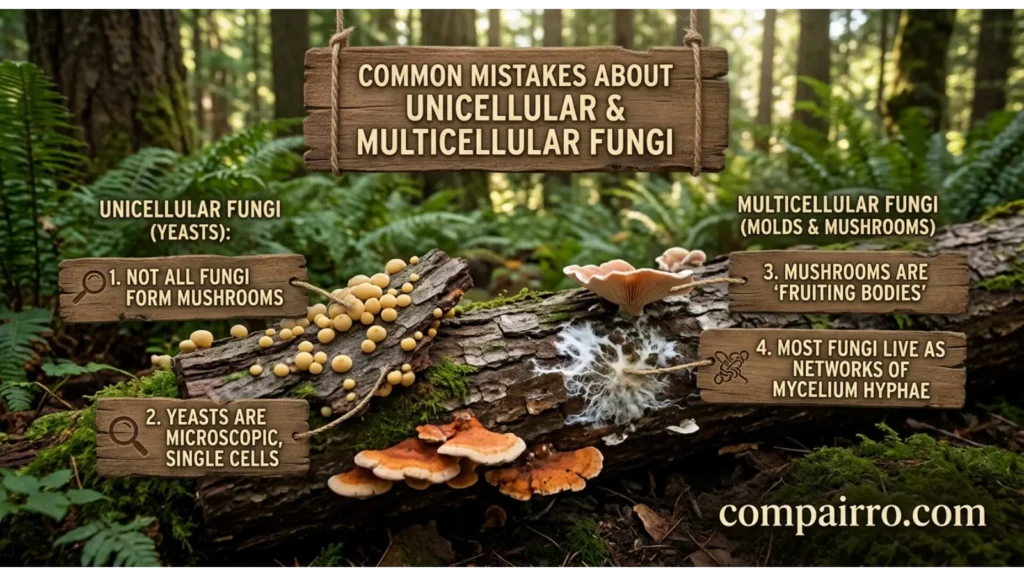
Students often make a few mistakes when learning about fungi. Here are four common ones and how to correct them.
Mistake 1: Saying all fungi are multicellular
❌ Incorrect: All fungi have many cells.
✔ Correct: Fungi can be unicellular or multicellular. Yeast is a common single-celled fungus.
Mistake 2: Calling yeast a bacterium
❌ Incorrect: Yeast is a type of bacteria.
✔ Correct: Yeast is a fungus. Unlike bacteria, yeast has a nucleus and other structures found in eukaryotic cells.
Mistake 3: Thinking mushrooms are single-celled
❌ Incorrect: A mushroom is made of only one cell.
✔ Correct: Mushrooms are multicellular. They develop from networks of fungal threads called hyphae.
Mistake 4: Believing fungi are plants
❌ Incorrect: Mushrooms belong to the plant kingdom.
✔ Correct: Fungi belong to their own kingdom. They do not make their own food through photosynthesis like green plants do.
Mistake 5: Thinking every mold looks the same
❌ Incorrect: All molds have the same structure.
✔ Correct: Different mold species can have different shapes, growth patterns, and reproductive structures. Many common molds are multicellular.
Fungi in Everyday Examples
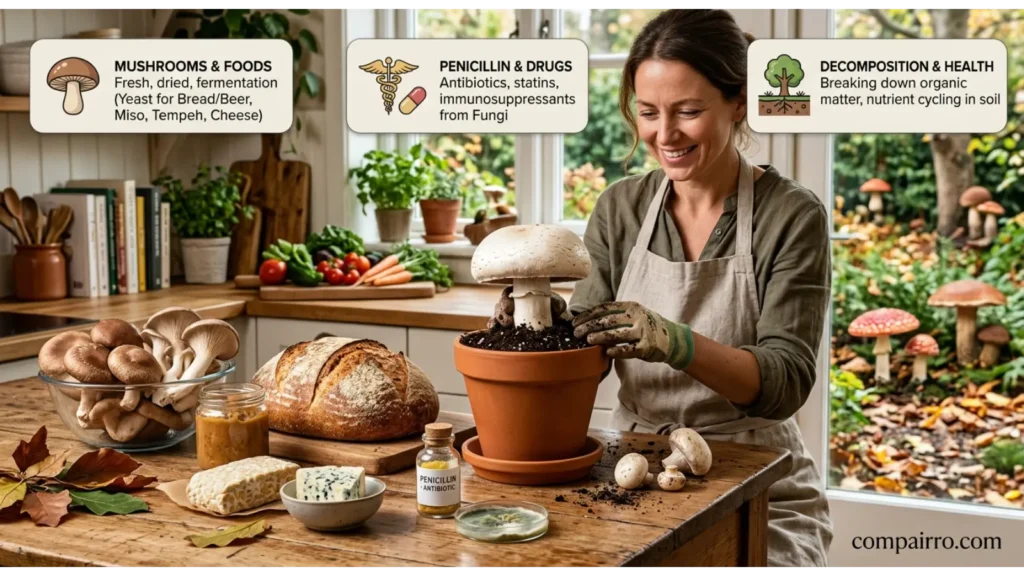
Fungi are part of everyday life, even when we do not notice them. Here are some examples that make the topic easier to understand.
1. At home
Yeast is used to make bread rise. It feeds on sugars and releases carbon dioxide, which helps create air pockets in the dough.
Bread mold is another example. It often grows as a network of tiny threads and is generally multicellular.
2. At school
Students often study mushrooms, yeast, and mold when learning about cells and living organisms.
For example, a teacher may ask students to identify a unicellular fungus. The expected answer is usually yeast.
3. In nature
Mushrooms can grow on soil, fallen trees, and dead leaves. Many fungi break down dead material and return nutrients to the soil.
This process supports plant growth and helps keep natural ecosystems working.
4. In food production
Fungi are useful in making certain foods. Yeast is used in bread production, while specific fungi are used to make some cheeses.
However, not every fungus is safe to eat. Some mushrooms are poisonous, so wild mushrooms should never be eaten unless their identity and safety have been confirmed by a qualified expert.
5. In medicine
Some fungi produce substances that have helped scientists develop medicines. For example, the antibiotic penicillin was discovered from a mold belonging to the genus Penicillium.
These examples show that fungi can have important effects on health, food, and the environment.
Is Fungi Unicellular or Multicellular? – Google Trends and Usage Data
People search for this question because they want a clear answer for biology lessons, homework, quizzes, and exams.
Common related searches include:
- Is fungi unicellular or multicellular?
- Are all fungi multicellular?
- Is yeast unicellular or multicellular?
- Is mushroom unicellular or multicellular?
- What are examples of unicellular fungi?
- What is the difference between yeast and mold?
Students in the United States, United Kingdom, India, Pakistan, Canada, and Australia may encounter these questions in school science courses.
However, without current Google Trends data, it would not be accurate to rank these countries or claim that searches are increasing or decreasing. Search interest can change over time.
The main source of confusion is that people often see mushrooms and assume that all fungi have the same structure. Learning about yeast makes it clear that fungi can exist in different forms.
Comparison Table: Unicellular vs Multicellular Fungi
The easiest way to understand fungi is to compare organisms with one cell to those with many cells.
| Feature | Unicellular Fungi | Multicellular Fungi |
|---|---|---|
| Number of cells | One cell | Many cells |
| Common example | Yeast | Mushroom |
| Body structure | Single cell | Often made of hyphae |
| Growth | A single cell grows and divides or reproduces | Cells grow as part of a larger structure |
| Reproduction | May occur by budding or other methods | May produce spores or reproduce in other ways |
| Visibility | Individual cells usually need a microscope | Some structures, such as mushrooms, are visible |
| Main role | Can help make bread and other foods | Can decompose dead material and form other useful relationships |
Important: These are general patterns. Different fungi reproduce and grow in different ways.

Fungi in Professional Life
Fungi are important in several fields, including food production, medicine, agriculture, and scientific research.
Here are some practical examples:
- Food industry: Yeast is used in bread-making and fermentation.
- Medicine: Scientists study fungi to find useful compounds and develop treatments.
- Agriculture: Some fungi help plants absorb nutrients from the soil.
- Environmental science: Decomposer fungi break down dead organic matter.
- Research laboratories: Scientists study fungal cells to understand growth, reproduction, and disease.
Knowing whether a fungus is unicellular or multicellular can help researchers understand how it grows and how it interacts with its surroundings.
Fungi for Students or Beginners
If you are a beginner, you may find this topic confusing because the word fungi includes many different organisms.
The easiest approach is to learn a few examples first.
- Learn the basic terms. Unicellular means one cell, and multicellular means many cells.
- Remember yeast. Yeast is a common example of a unicellular fungus.
- Remember mushrooms. Mushrooms are multicellular.
- Learn about hyphae. These are tiny, thread-like structures that form much of the body of many fungi.
- Practice with examples. Try classifying yeast, mushrooms, and common bread molds.
For an exam, you can write:
“Fungi can be unicellular or multicellular. Yeast is an example of a unicellular fungus, while mushrooms and most common molds are examples of multicellular fungi.”
This answer is short, clear, and scientifically accurate.
Signs or Characteristics Related to Fungi
Fungi have several features that help scientists identify and study them.
- Cell type: Fungi are eukaryotes, meaning their cells contain a nucleus.
- Cell wall: Their cells have walls that commonly contain chitin.
- Nutrition: Fungi absorb nutrients from their surroundings rather than making food through photosynthesis.
- Reproduction: Many fungi produce spores, while yeast can reproduce by budding.
- Growth: Some fungi grow as single cells, while others form networks of hyphae.
- Habitat: Fungi can live in soil, water, on food, and on or inside other organisms.
- Environmental role: Many fungi break down dead material and recycle nutrients.
- Variety: Fungi include yeasts, molds, mushrooms, and many other species.
Not every fungus has exactly the same appearance or life cycle. These features describe the group in general.
Simple Trick to Remember Fungi
Here is an easy memory trick:
- Uni = one
- Multi = many
- Yeast = usually one cell
- Mushroom = many cells
Think of it this way: a yeast cell is a tiny living unit, while a mushroom is a larger structure built from many cells.
When you see the word unicellular, think of one cell. When you see multicellular, think of many cells working together.
This simple rule will help you answer most basic biology questions about fungal cell structure.
FAQs:
1. Is fungi unicellular or multicellular?
Fungi can be both unicellular and multicellular. Yeast is a common unicellular fungus, while mushrooms and many molds are multicellular.
2. Is yeast unicellular or multicellular?
Most familiar yeasts are unicellular fungi. They usually grow and reproduce as individual cells, often through budding.
3. Are all fungi multicellular?
No. Some fungi consist of a single cell, while others contain many cells. Yeast is a well-known exception to the idea that all fungi are multicellular.
4. Is a mushroom unicellular or multicellular?
A mushroom is multicellular. Its main body is connected to a network of fungal threads, and the mushroom itself is a reproductive structure.
5. Is bread mold unicellular or multicellular?
Most familiar bread molds are multicellular. They grow as networks of hyphae and can produce spores.
6. Why are fungi not classified as plants?
Fungi do not make their own food through photosynthesis. Instead, they absorb nutrients from organic material or from other organisms.
7. What is the main difference between unicellular and multicellular fungi?
Unicellular fungi have one cell, while multicellular fungi have many cells. This difference affects their structure and how they grow.
Conclusion
So, is fungi unicellular or multicellular? The answer is both. Fungi are a diverse group of organisms, and different species have different cell structures.
Yeast is a familiar example of a unicellular fungus. Mushrooms and most common molds are examples of multicellular fungi.
Fungi are important in everyday life because they help break down dead material, support ecosystems, and contribute to food production and medicine.
The easiest memory rule is simple: yeast = one cell, mushroom = many cells. Remember this difference, and you will have a strong starting point for understanding fungi in biology.

Sara Taylor is a passionate English content writer who specializes in word meanings, spelling comparisons, and modern slang explanations. She creates easy-to-understand articles that help readers avoid common English mistakes and improve their writing skills. Her content focuses on simple learning, real-life examples, and clear explanations for everyday readers.