Have you ever stopped while writing a sentence and wondered if to use is or are? You are not alone. Many English learners face this problem when speaking, writing messages, or completing school assignments.
For example, should you say “She is happy” or “She are happy”? What about “The students is ready” or “The students are ready”? These small mistakes can make your English sound incorrect, but the good news is that the rules are easy to learn.
The words is and are are forms of the verb “to be.” We use them to describe people, places, things, feelings, and situations. However, choosing the correct word depends on if the subject is singular or plural. The subject is the person or thing that a sentence talks about.
You will see these words everywhere, including school lessons, workplace emails, text messages, social media posts, and everyday conversations. Learning the difference between is or are can help you write more clearly and speak with greater confidence.
Although both words have similar meanings, they cannot always replace each other. For example, “My brother is here” is correct, while “My brother are here” is incorrect. On the other hand, “My friends are here” is correct.
In this guide, you’ll learn the meaning, examples, usage, differences, common mistakes, and simple explanations in easy English.
Is or Are – Quick Answer
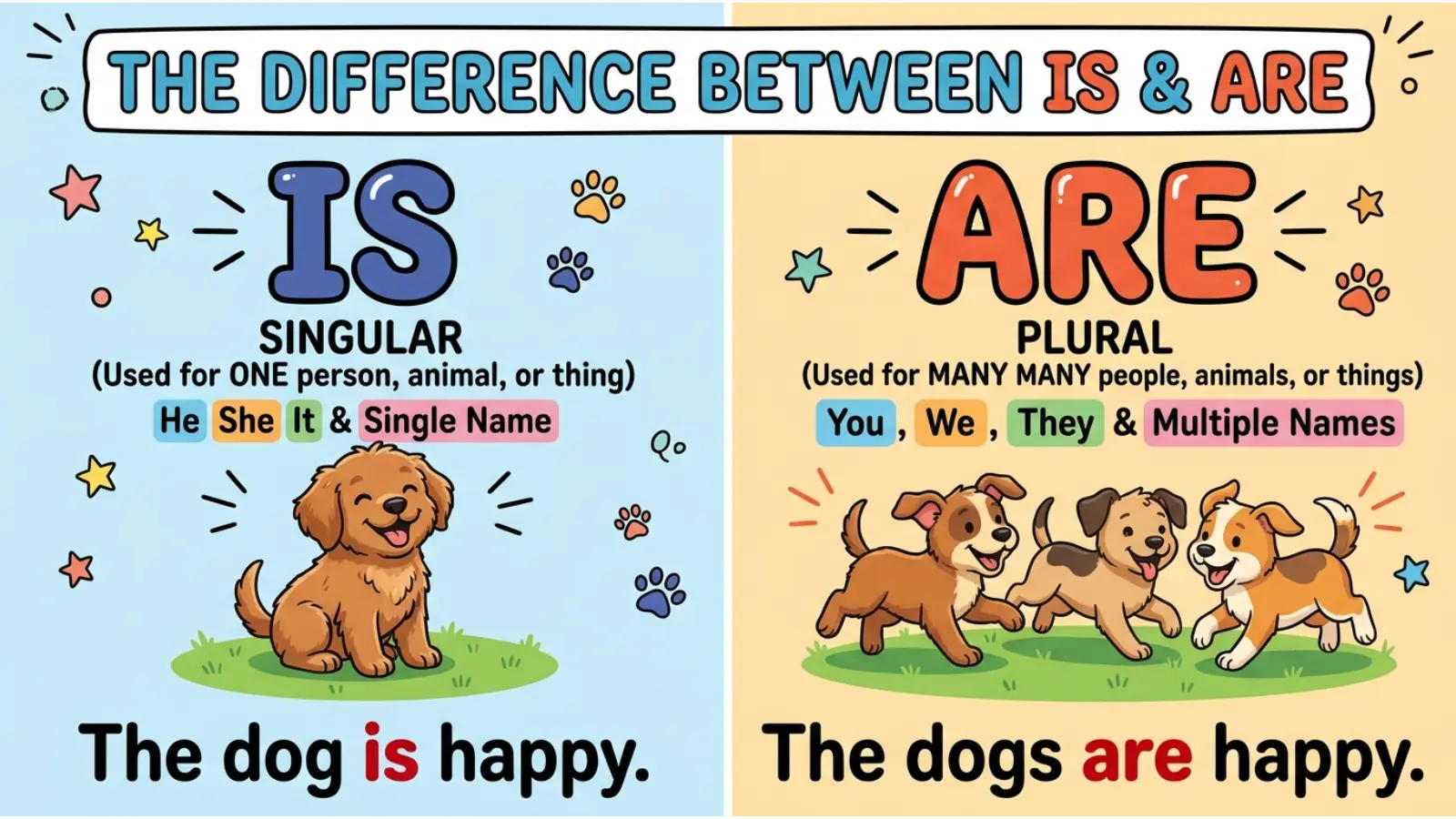
Is or are: Both are forms of the verb “to be,” but we use them with different subjects. Use is with singular subjects such as he, she, and it. Use are with plural subjects and with you.
Examples:
- She is my sister.
- They are my friends.
- You are very helpful.
Simple rule: Use is for most singular subjects and are for plural subjects. Remember that you always takes are, even when you are talking to one person.
The Origin of Is or Are
The words is and are come from the English verb to be. This verb has existed in English for many centuries and developed from older forms of the language.
Over time, English developed different forms of “to be” to match different subjects and sentence structures. Today, we use forms such as am, is, are, was, and were.
These words are common in modern English because they help us describe conditions, identities, locations, and actions in progress.
For example:
- He is a teacher.
- We are at home.
- They are learning English.
People use these forms in conversations, books, schoolwork, emails, and online communication. Their use is part of everyday English grammar rather than a social media trend.
British English vs American English Usage
The basic rules for is and are are the same in British English and American English. Both varieties use these words according to the subject and sentence structure.
| Feature | British English | American English | Notes |
|---|---|---|---|
| Singular subject | She is ready. | She is ready. | Same rule |
| Plural subject | They are ready. | They are ready. | Same rule |
| The word “you” | You are right. | You are right. | Used for one or more people |
| Collective nouns | The team is winning. | The team is winning. | Collective noun rules can vary by context |
| Questions | Is he here? | Is he here? | Same word order |
| Negative sentences | They are not busy. | They are not busy. | Same rule |
One small difference can appear with collective nouns such as team, family, or government. British English sometimes uses a plural verb when focusing on the members, while American English more often treats the group as one unit.
For example, “The team is playing well” is common in both varieties. The main rules for ordinary singular and plural subjects do not change.
Which One Should You Use?
Choosing between is and are becomes easier when you identify the subject first.
Use “Is” With Singular Subjects
Use is when the subject refers to one person, place, thing, or idea.
Examples:
- He is my brother.
- She is a good student.
- The cat is sleeping.
- My phone is new.
- The weather is nice.
You can also use is with singular names and uncountable nouns.
Examples:
- Ahmed is at school.
- Water is important.
- The information is useful.
Use “Are” With Plural Subjects
Use are when the subject refers to more than one person or thing.
Examples:
- The boys are playing.
- My friends are helpful.
- The books are on the table.
- These apples are fresh.
- The children are happy.
Remember the Special Rule for “You”
Even when you speak to one person, use are with you.
Correct examples:
- You are kind.
- You are my best friend.
- You are doing well.
Do not write “You is kind” in standard English.
Use “Are” With “We” and “They”
The pronouns we and they take are.
- We are ready.
- They are busy.
- We are learning grammar.
- They are watching a movie.
Formal vs Informal Usage
The same basic grammar rules apply in formal and informal English.
- Formal: The documents are ready for review.
- Informal: Your friends are here.
- Formal: The manager is available.
- Informal: He is online.
In casual speech and texting, people sometimes shorten these forms. For example, “She’s happy” means “She is happy,” while “They’re happy” means “They are happy.”
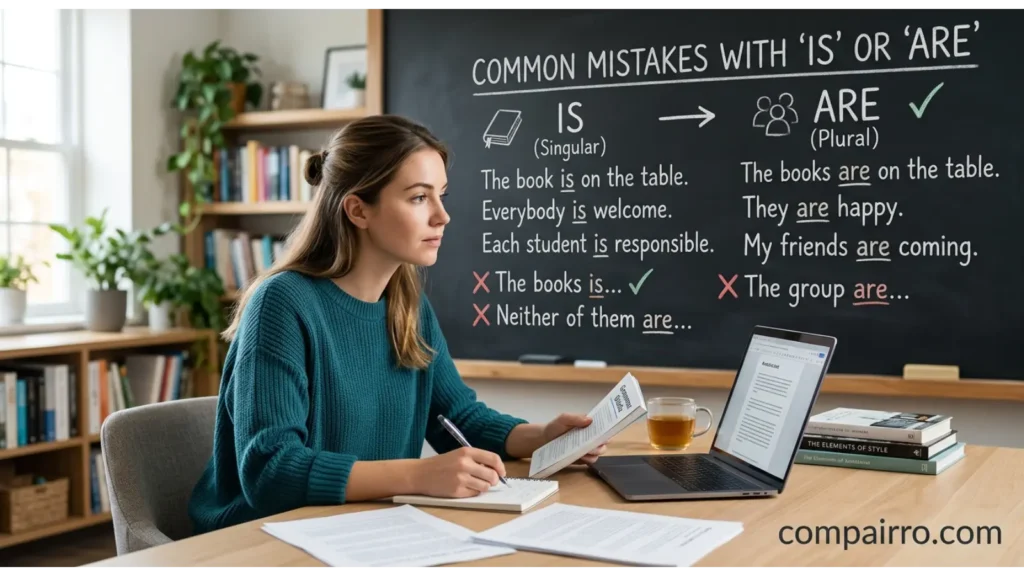
Common Mistakes With Is or Are
Here are five common mistakes that English learners should avoid.
Mistake 1: Using “Is” With a Plural Subject
❌ The students is ready.
✔ The students are ready.
Why? “Students” refers to more than one person, so we use are.
Mistake 2: Using “Are” With a Singular Subject
❌ My brother are at home.
✔ My brother is at home.
Why? “My brother” refers to one person, so is is correct.
Mistake 3: Using “Is” With “You”
❌ You is very helpful.
✔ You are very helpful.
Why? The pronoun you takes are, whether it refers to one person or several people.
Mistake 4: Ignoring the Main Subject
❌ The box of toys are heavy.
✔ The box of toys is heavy.
Why? The main subject is “box,” which is singular. The plural word “toys” does not change the verb.
Mistake 5: Using the Wrong Verb in a Question
❌ Are your sister at school?
✔ Is your sister at school?
Why? “Your sister” is singular, so the question must begin with is.
Is or Are in Everyday Examples
The best way to learn grammar is to use it in everyday situations. Here are practical examples for different parts of life.
At Work
- The manager is in a meeting.
- The employees are working.
- The report is complete.
- The files are ready.
At School
- The teacher is in the classroom.
- The students are studying.
- My homework is finished.
- The books are on the desk.
On Social Media
- This video is funny.
- These pictures are beautiful.
- My followers are amazing.
- The post is popular.
In Daily Life
- My mother is cooking.
- The children are playing.
- The food is delicious.
- The shops are open.
In Text Messages
- “Are you free today?”
- “Is your brother home?”
- “We are coming soon.”
- “The tickets are ready.”
These examples show that the correct choice depends on the subject, not on whether the sentence is formal or casual.
Is or Are – Google Trends and Usage Data
People search for “is or are” because they want quick answers to common English grammar questions. Many learners understand the meaning of both words but struggle to choose the correct one when writing a sentence.
Common reasons for searching this topic include:
- Checking grammar before submitting school assignments.
- Improving English speaking and writing skills.
- Learning subject-verb agreement.
- Correcting sentences in emails and messages.
- Understanding English grammar rules for exams.
English learners in the United States, United Kingdom, India, Pakistan, Canada, and Australia may search for this topic. It is especially useful for students and people learning English as an additional language.
However, the exact search popularity of this keyword can change over time. Without checking live Google Trends data, it would not be accurate to claim which country searches for it the most or whether its popularity is increasing.
The topic is useful throughout the year because is and are are basic parts of English grammar. People may also search for longer questions, such as “Should I use is or are in this sentence?” or “Is it or are they?”

Comparison Table: Is or Are
Use this table to compare the two words quickly.
| Feature | Is | Are |
|---|---|---|
| Main use | Most singular subjects | Plural subjects |
| Common pronouns | He, she, it | You, we, they |
| One person | Ahmed is here. | You are here. |
| More than one | The child is happy. | The children are happy. |
| Singular object | The phone is new. | Not correct for “the phone” |
| Plural objects | Not correct for “the phones” | The phones are new. |
| Negative form | Is not / isn’t | Are not / aren’t |
| Question | Is she ready? | Are they ready? |
Important: These are present-tense forms. In the past tense, is usually changes to was, while are usually changes to were. The correct form also depends on the subject.
Is or Are in Professional Life
Using is and are correctly is important in professional communication. A small grammar mistake may make an email or report harder to read.
For example:
- “The meeting is scheduled for Monday.”
- “The meeting notes are attached.”
- “The customer is waiting for a reply.”
- “The customers are waiting for a reply.”
When writing workplace emails, reports, or business messages, identify the subject before choosing the verb. This simple habit helps you write clear and professional English.
For example, in “The list of tasks is ready,” the subject is “list,” not “tasks.” Therefore, is is correct.
Is or Are for Students or Beginners
Students often find this topic confusing because a sentence can contain both singular and plural nouns. The key is to identify the main subject.
Follow these simple steps:
- Find the subject of the sentence.
- Decide whether it is singular or plural.
- Choose the correct form of the verb.
- Read the sentence again to check whether it sounds right.
For example:
“The bag of books ___ on the floor.”
The main subject is “bag,” which is singular. Therefore, the correct answer is is.
“The books ___ on the floor.”
Here, “books” is plural, so the correct answer is are.
You can improve your skills by reading simple English stories, writing short sentences, and practicing grammar questions every day.

Signs or Characteristics Related to Is or Are
The following features can help you recognize the correct form.
- Singular subjects: Names of one person, one animal, or one thing usually take is.
- Plural subjects: Subjects referring to multiple people or things usually take are.
- Pronoun patterns: He, she, and it take is. We and they take are.
- The word “you”: It always takes are in standard present-tense English.
- Uncountable nouns: Words such as water, information, and advice usually take is.
- Questions: The verb often comes before the subject, as in “Is she ready?” or “Are they ready?”
- Negative sentences: Use is not or are not to make a sentence negative.
Remember that these are general rules. Some sentence structures, such as questions with compound subjects or sentences beginning with “there,” need extra attention.
Simple Trick to Remember Is or Are
Here is an easy memory trick:
- He, she, it = is
- We, they, you = are
Think of it this way: if the subject names one person or thing, is is usually the right choice. If it names more than one, are is usually correct.
For example:
- The dog is hungry.
- The dogs are hungry.
- She is happy.
- They are happy.
Now try this quick practice:
- My friends ___ outside.
- The baby ___ asleep.
- You ___ a good student.
Answers: are, is, are.
Practice a few sentences every day, and the difference will become easier to remember.
FAQs:
1. What is the difference between is and are?
Is is used with most singular subjects, while are is used with plural subjects and the pronoun you.
2. Should I use is or are with “you”?
Use are. For example, “You are right” is correct, even when speaking to one person.
3. Is it correct to say “They is”?
No. In standard English, say “They are” because they takes are.
4. Should I use is or are with two names?
Use are when two names form a compound subject. For example, “Ali and Ahmed are friends.”
5. Do British and American English use is and are differently?
The basic rules are the same. Some collective nouns may be treated differently depending on the variety of English and the meaning.
6. Should I use is or are with uncountable nouns?
Use is with most uncountable nouns. For example, “The information is helpful” and “The water is cold.”
7. How can I learn is or are quickly?
Learn the common pronoun patterns, identify the main subject, and practice simple sentences. Daily practice helps you remember the rules.
Conclusion
Understanding is or are is an important step toward better English grammar. Both words belong to the verb “to be,” but the correct choice depends on the subject of your sentence.
Use is with most singular subjects, such as he, she, and it. Use are with plural subjects, such as we and they, and always use are with you.
The most useful memory rule is simple: he, she, it = is; you, we, they = are. Once you learn this pattern and practice it in everyday sentences, choosing the correct word will become much easier.

Sara Taylor is a passionate English content writer who specializes in word meanings, spelling comparisons, and modern slang explanations. She creates easy-to-understand articles that help readers avoid common English mistakes and improve their writing skills. Her content focuses on simple learning, real-life examples, and clear explanations for everyday readers.