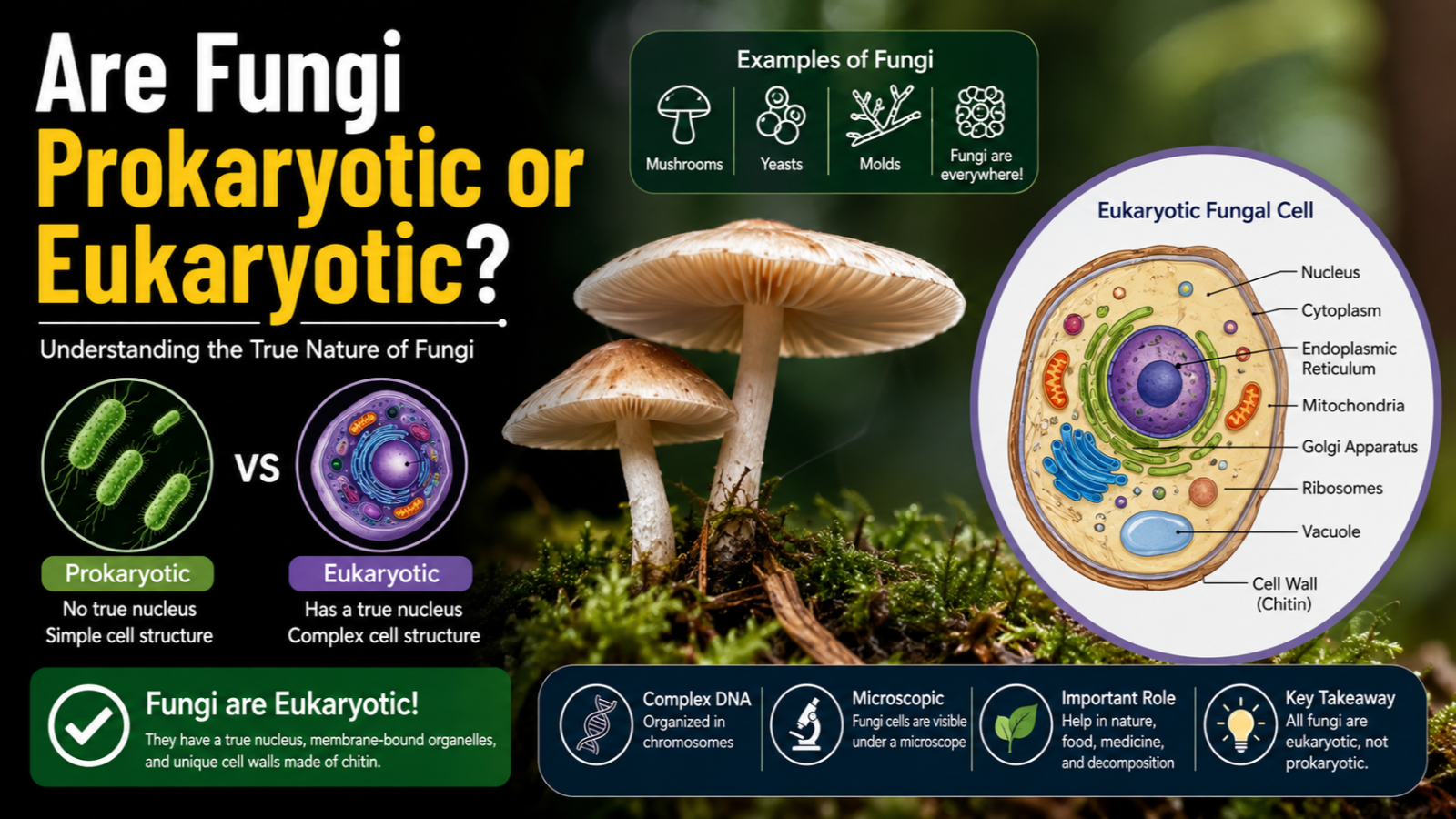
Are Fungi Prokaryotic or Eukaryotic is a common biology question for students learning about cell structure and classification. Fungi are eukaryotic organisms, meaning their cells contain a nucleus and other membrane bound organelles. This group includes familiar organisms such as mushrooms, yeasts, and molds.
One common question students ask is: are fungi prokaryotic or eukaryotic? This question often appears in biology classes, school exams, quizzes, textbooks, and online searches.
The simple answer is that fungi are eukaryotic organisms. This means their cells have a true nucleus surrounded by a membrane. Their cells also contain other membrane-bound structures called organelles.
People sometimes get confused because fungi can be very small. For example, yeast is a single-celled fungus. However, being small or single-celled does not make an organism prokaryotic.
Understanding whether fungi are prokaryotic or eukaryotic is important because it helps you understand how fungal cells work. It also makes it easier to compare fungi with bacteria, plants, animals, and other living organisms.
You may see this topic in school, college, university biology, laboratory studies, medical science, and internet searches. Once you understand the basic difference between prokaryotic and eukaryotic cells, the answer becomes easy to remember.
In this guide, you’ll learn the meaning, examples, usage, differences, common mistakes, and simple explanations in easy English.
ARE FUNGI PROKARYOTIC OR EUKARYOTIC – QUICK ANSWER
👉 Fungi are eukaryotic organisms.
A eukaryotic organism has cells with a true nucleus. The nucleus stores the cell’s DNA and is surrounded by a nuclear membrane.
Fungal cells also contain membrane-bound organelles, such as mitochondria and the endoplasmic reticulum.
Examples
- Mushrooms are eukaryotic fungi.
- Yeast is a single-celled eukaryotic fungus.
- Molds are also eukaryotic fungi.
Simple rule:
👉 Fungi = Eukaryotic
Think of it this way: fungal cells have a nucleus, so fungi are eukaryotic.
THE ORIGIN OF “ARE FUNGI PROKARYOTIC OR EUKARYOTIC?”
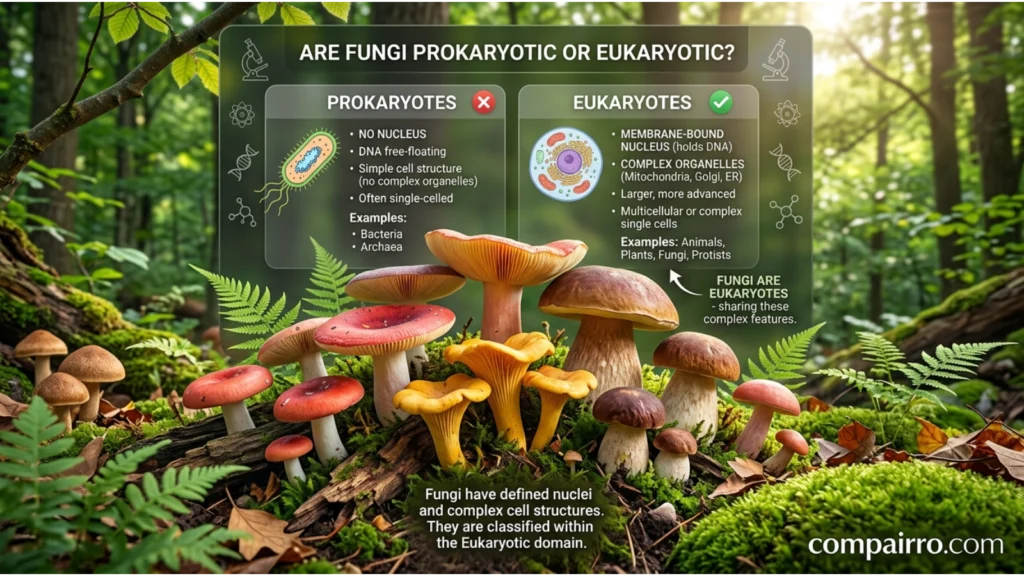
The question comes from the basic classification of living cells. Scientists commonly divide cells into two major types: prokaryotic cells and eukaryotic cells.
The word prokaryotic comes from Greek roots meaning roughly “before nucleus.” Prokaryotic cells do not have a membrane-bound nucleus.
The word eukaryotic comes from Greek roots meaning “true nucleus.” Eukaryotic cells have a nucleus surrounded by a membrane.
Fungi have been recognized as a separate major group of organisms because they have important features that differ from plants and animals. Modern biology places fungi in the domain Eukarya, along with animals, plants, and several other groups.
As biology became more detailed, scientists learned more about fungal cells. Their cell structure clearly showed that fungi belong to the eukaryotic group.
BRITISH ENGLISH VS AMERICAN ENGLISH USAGE
There is no British vs American English difference in the biological terms used here.
Both British and American English use prokaryotic, eukaryotic, fungi, and fungus in the same scientific sense.
| Feature | British English | American English | Notes |
|---|---|---|---|
| Fungi | Fungi | Fungi | Same |
| Fungus | Fungus | Fungus | Same |
| Prokaryotic | Prokaryotic | Prokaryotic | Same |
| Eukaryotic | Eukaryotic | Eukaryotic | Same |
| Scientific meaning | Same | Same | No major difference |
So, whether you are studying biology in the UK, US, Canada, Australia, India, or Pakistan, the scientific answer remains the same:
👉 Fungi are eukaryotic.
WHICH ONE SHOULD YOU USE?
If you are answering the question “Are fungi prokaryotic or eukaryotic?”, the correct answer is eukaryotic.
Keep these points in mind:
- Use eukaryotic when describing fungal cells.
- Use prokaryotic when describing organisms such as bacteria and archaea.
- In school or academic writing, you can say: “Fungi are eukaryotic organisms.”
- You can also explain that fungal cells contain a membrane-bound nucleus.
- Avoid saying that fungi are prokaryotic simply because some fungi are microscopic.
- Yeast is a good example of a single-celled eukaryotic organism.
For exams, a short answer is usually enough:
“Fungi are eukaryotic because their cells contain a true, membrane-bound nucleus and other membrane-bound organelles.”
COMMON MISTAKES WITH “ARE FUNGI PROKARYOTIC OR EUKARYOTIC?”
Mistake 1: Saying fungi are prokaryotic
❌ Fungi are prokaryotic organisms.
✔ Fungi are eukaryotic organisms.
Fungal cells contain a true nucleus, which is a key feature of eukaryotic cells.
Mistake 2: Thinking microscopic means prokaryotic
❌ Yeast is microscopic, so it must be prokaryotic.
✔ Yeast is microscopic but eukaryotic.
Size does not decide whether a cell is prokaryotic or eukaryotic.
Mistake 3: Confusing fungi with bacteria
❌ Fungi and bacteria have the same cell type.
✔ Fungi are eukaryotic, while bacteria are prokaryotic.
Their cell structures are different in important ways.
Mistake 4: Calling all single-celled organisms prokaryotic
❌ Every single-celled organism is prokaryotic.
✔ Some single-celled organisms are eukaryotic.
Yeast is a simple example. It is a single-celled fungus with a eukaryotic cell.
Mistake 5: Thinking fungi are plants
❌ Fungi are plants because they grow in soil.
✔ Fungi are a separate biological kingdom/group and are eukaryotic.
Although fungi and plants have some similarities, they are not the same type of organism.
ARE FUNGI PROKARYOTIC OR EUKARYOTIC?” IN EVERYDAY EXAMPLES
Work
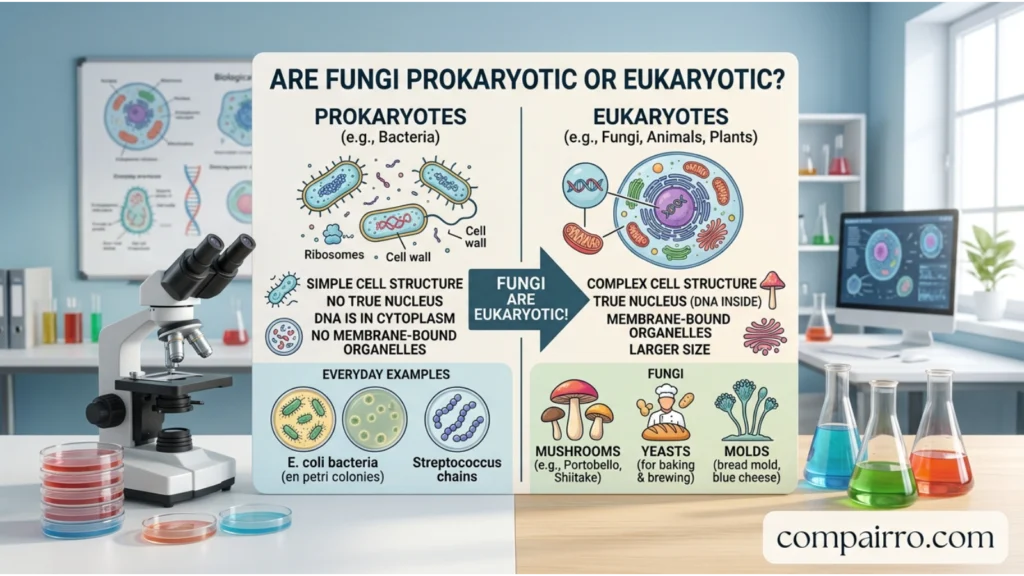
In a laboratory, a scientist may study fungal cells under a microscope. Knowing that fungi are eukaryotic helps the scientist understand their cell structure.
For example:
“The laboratory is studying the eukaryotic cells of a fungus.”
School
A biology teacher may ask:
“Are fungi prokaryotic or eukaryotic?”
A good answer is:
“Fungi are eukaryotic because they have cells with a true nucleus.”
Social Media
Science pages and educational accounts often share short biology questions such as:
“Are fungi prokaryotic or eukaryotic?”
These questions are popular because they test basic cell biology.
Daily Life
You may see fungi as mushrooms growing outdoors or mold growing on old food. Even though these organisms may look simple, their cells are eukaryotic.
Text Messages
In a study group, someone might ask:
“Are fungi prokaryotic?”
A quick reply could be:
“No. Fungi are eukaryotic because they have a true nucleus.”
ARE FUNGI PROKARYOTIC OR EUKARYOTIC?” – GOOGLE TRENDS & USAGE DATA
The question “are fungi prokaryotic or eukaryotic” is mainly an educational search. Students commonly search it when preparing for biology lessons, homework, tests, quizzes, or exams.
Search interest can change during school and exam periods. It can also increase when students are learning about cell structure, kingdoms of life, microorganisms, and biological classification.
The exact search volume and country rankings can change over time. Google Trends reports relative search interest rather than a fixed worldwide number, so exact rankings should be checked directly when current data is required.
The topic is relevant to English-speaking and English-learning students in many countries, including:
- United States: Common in school and college biology.
- United Kingdom: Used in biology courses and exam preparation.
- India: Frequently relevant to school and competitive biology studies.
- Pakistan: Useful for biology students preparing for school, college, and entrance exams.
- Canada: Common in science and biology education.
- Australia: Used in school and university biology topics.
The main reason for this search is simple: beginners often know that bacteria are prokaryotic but are unsure where fungi belong.
The answer is clear: fungi are eukaryotic.
COMPARISON TABLE: FUNGI
The easiest way to understand fungi is to compare them with prokaryotic organisms.
| Feature | Fungi | Bacteria |
|---|---|---|
| Cell type | Eukaryotic | Prokaryotic |
| True nucleus | Yes | No |
| DNA location | Inside the nucleus | Nucleoid region |
| Membrane-bound organelles | Present | Absent |
| Cell wall | Usually contains chitin | Usually contains peptidoglycan |
| Example | Mushroom, yeast, mold | E. coli, many other bacteria |
| Cell size | Generally larger | Generally smaller |
| Domain | Eukarya | Bacteria |
This table shows why fungi are classified as eukaryotic rather than prokaryotic.
FUNGI IN PROFESSIONAL LIFE
The fact that fungi are eukaryotic matters in many areas of science and research.
Medicine
Scientists study fungi because some fungi can cause infections, while others are useful in medicine and biotechnology.
Understanding their eukaryotic cells helps researchers study how fungal cells grow and respond to treatments.
Food Industry
Fungi are useful in food production. Yeast, for example, is used to help make bread and some fermented foods.
Biotechnology
Fungi can produce useful substances, enzymes, and other products used in different industries.
Agriculture
Fungi play important roles in soil and ecosystems. Some fungi help plants, while others can cause plant diseases.
Therefore, knowing fungal cell structure is more than an exam fact. It is also useful in real scientific work.

FUNGI FOR STUDENTS OR BEGINNERS
Students often struggle with this topic because the words prokaryotic and eukaryotic look complicated.
The easiest approach is to focus on one major difference: the nucleus.
Easy learning tips
- Remember that fungi have a true nucleus.
- A true nucleus means eukaryotic.
- Do not judge a cell by its size.
- Remember that yeast is eukaryotic even though it is single-celled.
- Compare fungi with bacteria to make the difference clear.
A simple exam sentence is:
Fungi are eukaryotic organisms because their cells contain a membrane-bound nucleus and membrane-bound organelles.
Learning this one sentence can help you answer many basic biology questions.
SIGNS OR CHARACTERISTICS RELATED TO FUNGI
Fungi have several features that help identify them as eukaryotic organisms.
Cell characteristics
- Fungal cells have a true nucleus.
- Their DNA is stored inside the nucleus.
- They contain membrane-bound organelles.
- Their cells have a cell membrane.
- Most fungi have cell walls containing chitin.
Biological characteristics
- Fungi are eukaryotic.
- They can be single-celled or multicellular.
- Yeast is a common single-celled fungus.
- Mushrooms are multicellular fungi.
- Many fungi obtain nutrients by absorbing them from their surroundings.
- Fungi do not make food through photosynthesis like plants.
Important pattern
The presence of a membrane-bound nucleus is one of the most important clues.
So when you see fungi, think:
👉 True nucleus → Eukaryotic
SIMPLE TRICK TO REMEMBER “ARE FUNGI PROKARYOTIC OR EUKARYOTIC?”
Here is a simple memory trick:
👉 Fungi = True nucleus = Eukaryotic
You can also remember:
👉 Fungi have a “full” cell structure.
This does not mean every part of the cell is full. It is simply a memory phrase to help you remember that fungal cells have a nucleus and membrane-bound organelles.
Think of it this way:
Imagine two rooms.
A eukaryotic cell has a separate room for its DNA—the nucleus.
A prokaryotic cell does not have that membrane-bound DNA room.
Fungal cells have the separate nucleus.
Therefore:
Fungi → Nucleus → Eukaryotic
FAQs:
1. Are fungi prokaryotic or eukaryotic?
Fungi are eukaryotic organisms. Their cells have a membrane-bound nucleus.
2. Why are fungi eukaryotic?
Fungi are eukaryotic because their cells contain a true nucleus and other membrane-bound organelles.
3. Is yeast prokaryotic or eukaryotic?
Yeast is eukaryotic. Although it is usually single-celled, its cell has a true nucleus.
4. Are mushrooms eukaryotic?
Yes. Mushrooms are fungi, and fungal cells are eukaryotic.
5. Are fungi similar to bacteria?
Both can include microscopic organisms, but their cells are different. Fungi are eukaryotic, while bacteria are prokaryotic.
6. Do fungi have a nucleus?
Yes. Fungal cells contain a membrane-bound nucleus that stores their genetic material.
7. Are all single-celled organisms prokaryotic?
No. Some single-celled organisms are eukaryotic. Yeast is a common example.
CONCLUSION
So, are fungi prokaryotic or eukaryotic? The answer is simple: fungi are eukaryotic organisms.
Their cells contain a true, membrane-bound nucleus and other membrane-bound organelles. This is one of the main differences between fungi and prokaryotic organisms such as bacteria.
Remember that being microscopic or single-celled does not automatically make an organism prokaryotic. Yeast is small and single-celled, but it is still eukaryotic.
The easiest memory rule is:
👉 Fungi → True nucleus → Eukaryotic
Once you remember this chain, the question “are fungi prokaryotic or eukaryotic?” becomes much easier to answer in class, homework, quizzes, and exams.

Sara Taylor is a passionate English content writer who specializes in word meanings, spelling comparisons, and modern slang explanations. She creates easy-to-understand articles that help readers avoid common English mistakes and improve their writing skills. Her content focuses on simple learning, real-life examples, and clear explanations for everyday readers.