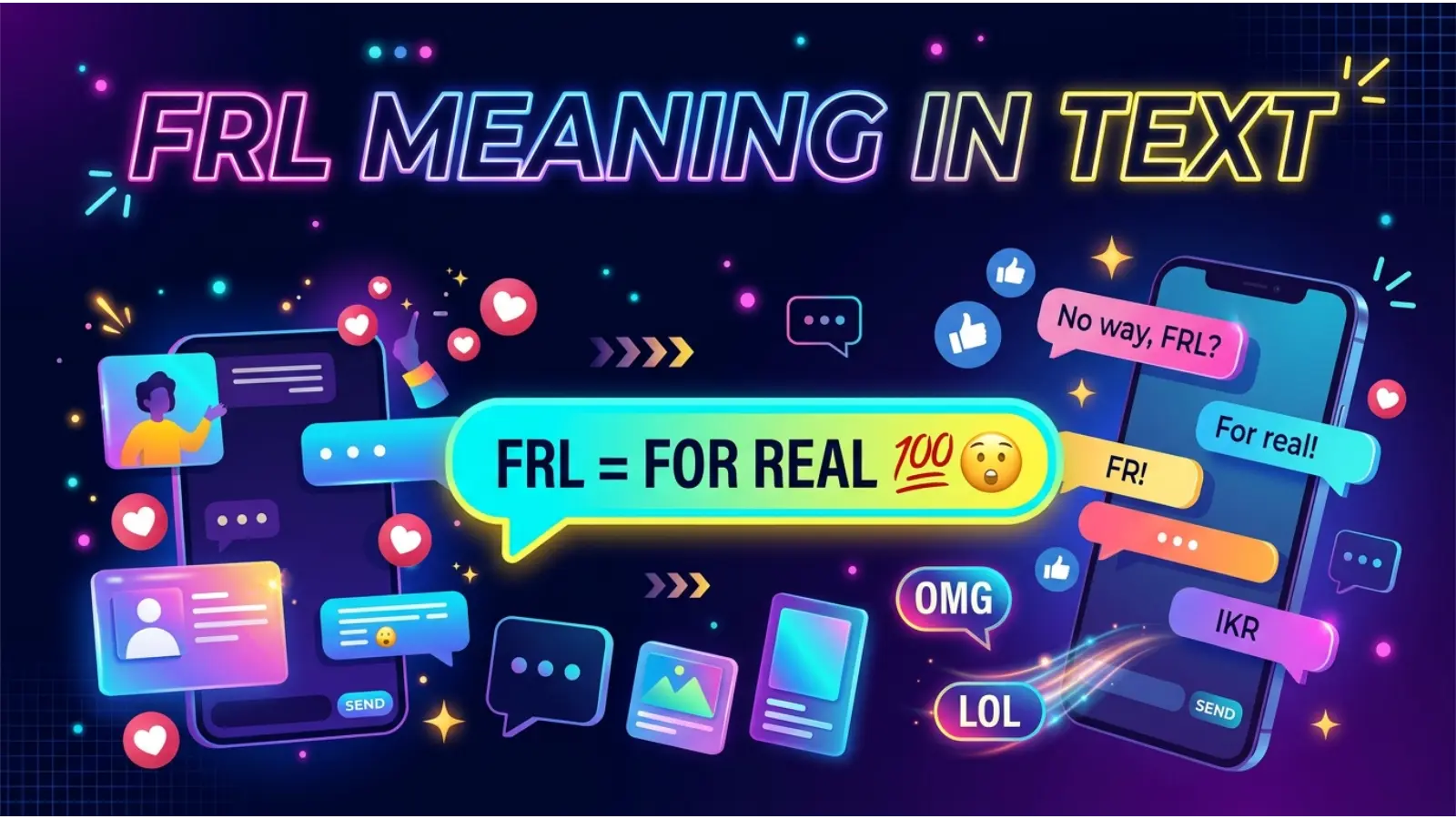
frl meaning in text is a common question for people who see this abbreviation in messages, social media comments, or online conversations. If someone sends you “frl,” you may wonder if they are agreeing with you, expressing a serious opinion, or simply reacting to something surprising. Internet slang can be confusing because people often shorten everyday phrases to make texting faster and easier.
FRL is commonly used as a short form of “for real.” People use it to show agreement, express honesty, emphasize a statement, or react to something they find surprising or relatable. For example, if your friend says, “This week has been exhausting,” you might reply, “frl,” meaning “for real” or “I agree.”
Quick Answer:
FRL means “for real” in texting and internet slang. It is used to express agreement, honesty, seriousness, or emphasis, depending on the conversation.
What Does FRL Mean in Text?
The most common meaning of FRL in text messages is “for real.” It is an informal abbreviation used in digital communication, especially when people want to express themselves quickly.
FRL can communicate several ideas, including:
- Agreement: You agree with what someone says.
- Honesty: You genuinely mean what you are saying.
- Emphasis: You want to make a statement sound stronger.
- Surprise: You are reacting to something unexpected.
- Relatability: You understand another person’s feelings or experience.
For example:
Friend: “That exam was so difficult.”
You: “FRL!”
Here, you are saying, “For real!” to show that you agree with your friend’s opinion.
What Is the FRL Full Form?
The FRL full form in texting is “for real.” It is a shortened version of a common English expression that people use in everyday conversations.
The expression can have slightly different meanings depending on the sentence.
For example:
- “FRL, I need some rest.” — You genuinely need rest.
- “That was amazing frl.” — You really enjoyed the experience.
- “FRL? Are you serious?” — You are expressing surprise or asking whether something is true.
- “FRL, I agree with you.” — You strongly agree with someone.
FRL is usually written in lowercase as “frl” or in uppercase as “FRL.” Both forms generally carry the same meaning in casual texting.
FRL Meaning in Different Contexts
1. FRL as a Sign of Agreement
People often use FRL when they strongly agree with another person’s statement.
Example:
Person A: “Good friends make life easier.”
Person B: “FRL.”
Meaning: “For real. I completely agree.”
2. FRL to Show Honesty
FRL can emphasize that someone genuinely means what they are saying.
Example:
“I frl appreciate everything you did for me.”
The person is emphasizing that their appreciation is sincere.
3. FRL to Express Surprise
Sometimes, FRL is used as a reaction when someone shares unexpected news.
Example:
Friend: “I finished the whole project in one day.”
You: “FRL? That’s impressive!”
Here, FRL expresses surprise and asks for confirmation.
4. FRL in Emotional Conversations
People may use FRL when discussing stress, happiness, disappointment, or other feelings.
Example:
Person A: “Sometimes, taking a break is more important than working nonstop.”
Person B: “FRL, everyone needs rest.”
In this case, FRL shows understanding and agreement.
Is FRL Rude, Offensive, or Neutral?
FRL is generally considered neutral and informal. Unlike some internet abbreviations, it does not contain profanity or an inherently offensive meaning.
However, the tone can change depending on how it is used.
- Friendly: “FRL, you’re a great friend.”
- Casual: “This food is good frl.”
- Surprised: “FRL? I didn’t know that!”
- Argumentative: “FRL? You weren’t even there.”
The last example may sound challenging or doubtful because of the question mark and the surrounding words.
FRL is suitable for most casual conversations, but writing the complete phrase “for real” may be better in formal emails, academic work, or professional communication.

Where Is FRL Commonly Used?
FRL is common in informal digital conversations where people use short expressions instead of complete sentences.
You may see it on:
- TikTok comments and captions
- Instagram posts and direct messages
- Snapchat conversations
- WhatsApp chats
- Discord servers
- Gaming chats
- Text messages
- Other social media platforms
For example, someone might comment “FRL 😂” under a funny video. This usually means they find the situation genuinely funny or relatable.
The precise meaning still depends on the conversation and the person using it.
Real-Life Examples of FRL in Texting
Here are examples showing how people use FRL in different situations.
Friendly Conversation
Friend: “You’re always there when I need help.”
You: “FRL, I appreciate you too.”
Meaning: You are sincerely expressing appreciation.
Casual Conversation
Person A: “This weekend went by so quickly.”
Person B: “FRL, I need another day off.”
Meaning: You agree and emphasize the feeling.
Funny Conversation
Friend: “I opened the fridge five times, hoping new food would appear.”
You: “FRL 😂”
Meaning: You find the situation relatable or funny.
Serious Conversation
Person A: “It’s important to believe in yourself.”
Person B: “FRL, confidence makes a difference.”
Meaning: You genuinely agree with the statement.
Argumentative Conversation
Person A: “You said you would finish the work yesterday.”
Person B: “FRL? I told you I needed more time.”
Meaning: The speaker is questioning or challenging the other person’s statement.
Social Media Example
Someone posts: “Sleep is the best part of the weekend.”
A comment saying “FRL” means the commenter strongly relates to or agrees with the statement.
Emotional and Psychological Meaning of FRL
FRL does not have one fixed emotional meaning. Instead, it helps people communicate how strongly they feel about something.
Depending on the context, it can suggest:
- Genuine agreement with another person
- Honesty about personal feelings
- Excitement about an experience
- Surprise at unexpected information
- A sense of connection with someone else’s experience
For instance, replying “FRL” to a friend who describes a stressful day can show that you understand their feelings.
However, the abbreviation alone cannot reliably reveal someone’s emotional state. The rest of the message and the wider conversation provide important clues.

Origin and Background of FRL
FRL developed as part of the wider use of abbreviations in online communication. People have long shortened common expressions to make messages quicker to type.
The phrase “for real” existed before modern texting became popular. As online messaging and social media grew, users began shortening it to forms such as FR and FRL.
There is no single confirmed date or person responsible for creating FRL. Its usage reflects the broader internet trend of turning familiar expressions into shorter forms.
FRL vs. Similar Texting Slang
FRL is closely related to other abbreviations used to express agreement, honesty, or emphasis.
| Slang | Full Form | Common Meaning |
|---|---|---|
| FRL | For real | Agreement or emphasis |
| FR | For real | Agreement or sincerity |
| TBH | To be honest | Giving an honest opinion |
| NGL | Not gonna lie | Sharing a candid thought |
| IMO | In my opinion | Expressing a personal view |
| IDK | I don’t know | Showing uncertainty |
| ISTG | I swear to God | Strong emphasis or frustration |
What Is the Difference Between FR and FRL?
FR and FRL can have the same meaning: “for real.” Both are used to express agreement, honesty, or emphasis.
FRL includes an extra letter, but that does not necessarily give it a different meaning. The choice between them often depends on personal typing habits or the online community.
When Should You Use FRL?
FRL works best in casual situations where the other person understands internet slang.
You can use it when:
- Agreeing with a friend’s opinion
- Reacting to a relatable social media post
- Emphasizing that you are being honest
- Responding to surprising news
- Chatting in a gaming group
- Sharing an informal reaction
For example:
“FRL, that was the best day of the year!”
This sounds natural in an informal conversation.
When Should You Avoid Using FRL?
Although FRL is not offensive, it may be too informal for certain situations.
Avoid using it in:
- Formal business emails
- Job applications
- Academic essays
- Official documents
- Professional messages where clarity is important
Instead of writing “FRL, I agree,” you could write “I completely agree” or “That is absolutely true.”
These alternatives sound more professional and are easier for readers unfamiliar with internet slang to understand.
Why Do People Use FRL?
People use FRL because it is short, convenient, and easy to recognize in casual online conversations.
Common reasons include:
- Saving time while typing
- Showing agreement quickly
- Emphasizing a genuine opinion
- Making messages sound natural
- Responding to relatable content
- Following common online communication habits
Like other abbreviations, FRL helps keep conversations moving without requiring long responses.
Is FRL Safe for Social Media?
Yes, FRL is generally suitable for social media because it does not inherently contain offensive language.
You can usually use it in comments, captions, direct messages, and casual conversations. However, consider your audience and the purpose of your post.
For professional pages, educational content, or formal announcements, writing “for real,” “genuinely,” or “I completely agree” may be clearer.
Remember that an abbreviation can be misunderstood when readers are unfamiliar with it. Clear wording is especially useful when discussing serious topics.
Common Misunderstandings About FRL
Several misunderstandings can occur when people encounter FRL for the first time.
1. Thinking FRL and FR always mean different things
Both abbreviations commonly mean “for real.” Their use can vary between people and online communities.
2. Assuming FRL always expresses agreement
FRL can also show sincerity, emphasis, or surprise. The sentence determines its exact function.
3. Thinking FRL is rude
FRL is generally neutral. It is an informal abbreviation rather than an inherently offensive expression.
4. Assuming every person understands it
Not everyone uses internet slang. If someone seems confused, writing the complete phrase can prevent misunderstandings.
Variations and Types of FRL Usage
FRL appears in several forms in online conversations:
- FRL: Uppercase form, often used for emphasis.
- frl: Lowercase form, common in casual messages.
- frl 😂: A humorous or relatable reaction.
- frl? A question that may express surprise or doubt.
- frl tho: An informal way to reinforce a statement, with “tho” meaning “though.”
These variations do not always have exactly the same tone. Emojis, punctuation, and surrounding words can change how a message sounds.
How to Respond When Someone Uses FRL
Your response depends on what the other person means.
If they are agreeing with you, you can continue the conversation naturally.
Example:
Them: “This month has been really busy.”
You: “FRL, I barely had any free time.”
If they use FRL to express surprise, you can explain the situation.
Them: “FRL? You got the highest score?”
You: “Yes, I was surprised too!”
If you cannot understand the abbreviation, simply ask, “What do you mean by FRL?” Asking for clarification is often better than guessing.
Regional and Cultural Usage
FRL is mainly associated with informal English-language internet communication. Its use can vary across countries, age groups, and online communities.
People who frequently use social media may recognize it quickly, while others may prefer the complete phrase “for real.”
The abbreviation can also appear alongside local expressions and other internet slang. Therefore, the surrounding conversation is often the best way to understand its intended meaning.
FAQs About FRL Meaning in Text
1. What does FRL mean in texting?
FRL means “for real.” It is commonly used to express agreement, sincerity, emphasis, or surprise in casual messages.
2. What does FRL stand for in slang?
FRL stands for “for real.” It is an informal abbreviation used in texting, social media, and online conversations.
3. Is FRL the same as FR?
Yes, FRL and FR commonly mean “for real.” Both can express agreement or sincerity, although individual usage may vary.
4. Is FRL rude or offensive?
No, FRL is generally neutral and informal. It does not inherently contain profanity, although the tone of a particular message may sound challenging or sarcastic.
5. What does FRL mean on TikTok?
On TikTok, FRL usually means “for real.” People may use it in comments to agree with a video, emphasize a reaction, or show that something feels relatable.
6. What should I reply when someone texts FRL?
You can agree by replying “FR,” “exactly,” or “I know, right?” If the person is asking a question with FRL, respond to what they want to confirm.
Conclusion
The frl meaning in text is simple: it commonly stands for “for real.” People use it to express agreement, honesty, surprise, and emphasis in everyday digital conversations.
FRL is popular in text messages, social media comments, gaming chats, and other informal settings. It is generally neutral, but its tone can change depending on punctuation and context.
If you want to communicate casually, FRL is a convenient abbreviation. For formal or professional situations, use clearer alternatives such as “seriously,” “exactly,” or “I completely agree.”
Ultimately, understanding FRL meaning slang comes down to reading the complete message rather than relying on the abbreviation alone.

Sara Taylor is a passionate English content writer who specializes in word meanings, spelling comparisons, and modern slang explanations. She creates easy-to-understand articles that help readers avoid common English mistakes and improve their writing skills. Her content focuses on simple learning, real-life examples, and clear explanations for everyday readers.