Have you ever looked at a cell diagram in your biology textbook and wondered whether cytoplasm belongs to prokaryotic cells or eukaryotic cells? You are not alone. Many students find this topic confusing, especially when learning about cell structures for the first time.
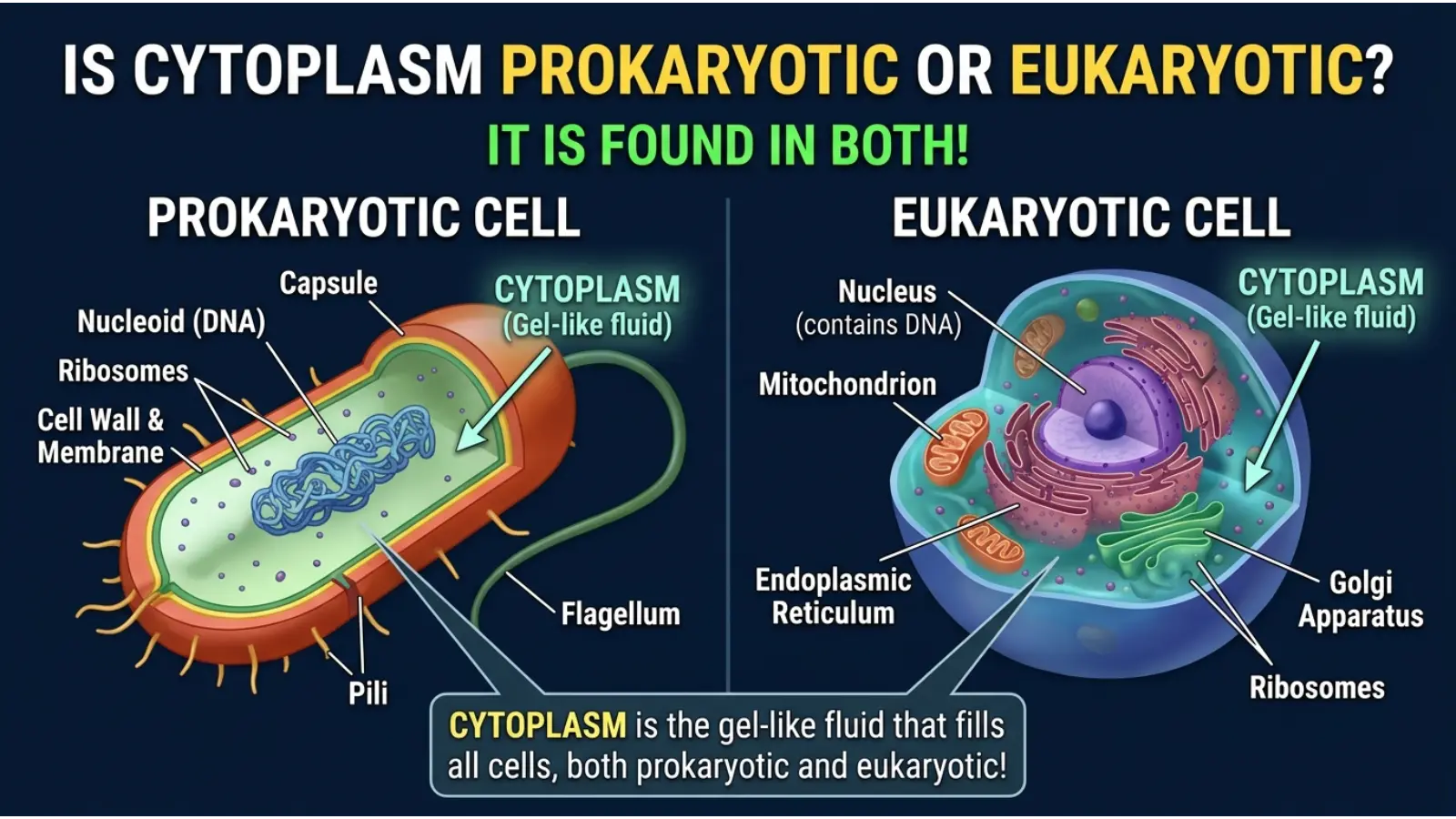
The good news is that the answer is simple. Cytoplasm is found in both prokaryotic and eukaryotic cells. It is the material inside a cell that surrounds its internal structures and helps many important cell activities take place.
You can learn about cytoplasm in school biology lessons, science books, laboratory activities, and online educational resources. However, students sometimes mix up cytoplasm with the cytosol, nucleus, or other parts of a cell. Understanding these differences makes biology much easier.
For example, bacteria are prokaryotes, but they still have cytoplasm. Plant and animal cells are eukaryotes, and they also contain cytoplasm. The main difference between these cell types is not whether they have cytoplasm. Instead, it is how their internal structures are organized.
Learning about cytoplasm is important because it helps you understand how cells work, how living things grow, and how different cell types compare. Once you know its basic role, you can answer many common biology questions with confidence.
In this guide, you’ll learn the meaning, examples, usage, differences, common mistakes, and simple explanations in easy English.
Cytoplasm Prokaryotic or Eukaryotic – Quick Answer
Cytoplasm is found in both prokaryotic and eukaryotic cells. It is the material inside the cell membrane that contains water, dissolved substances, and other cell components. It supports many chemical reactions and helps cells carry out their normal activities.
In simple words, cytoplasm is a basic part of both major types of cells.
Examples
- Prokaryotic cell: A bacterial cell contains cytoplasm but has no membrane-bound nucleus.
- Eukaryotic cell: An animal cell contains cytoplasm and a nucleus.
- Plant cell: A plant cell also contains cytoplasm, a nucleus, and other internal structures.
Simple rule: Cytoplasm = both prokaryotic and eukaryotic cells.
Remember that prokaryotic cells do not have a membrane-bound nucleus, while eukaryotic cells do.
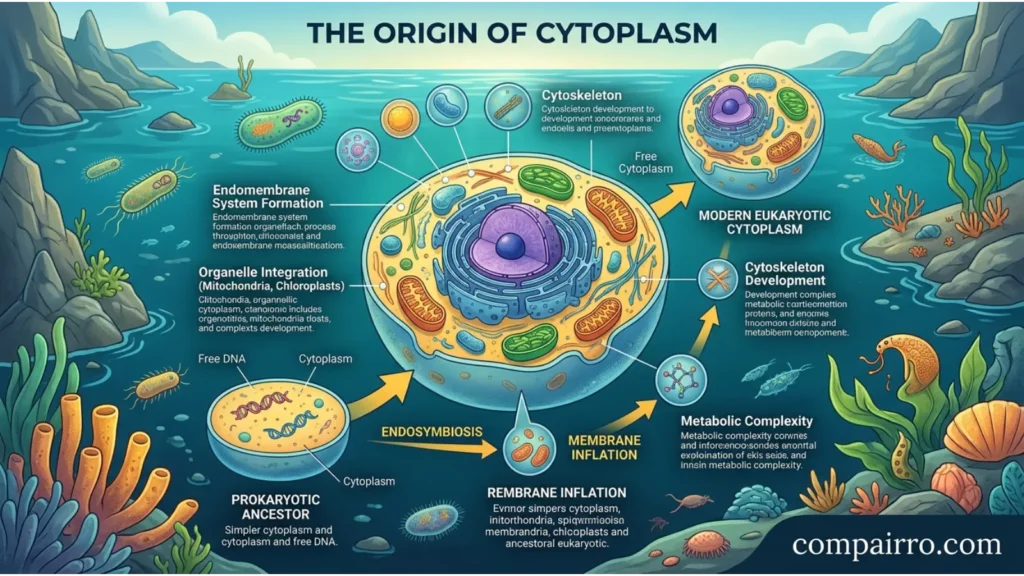
The Origin of Cytoplasm
The word cytoplasm comes from two Greek word parts. Cyto refers to a cell, while plasm refers to something formed or shaped.
The term describes the material that makes up much of the inside of a cell.
Scientists use the word cytoplasm to explain the area inside the cell membrane but outside the nucleus in a typical eukaryotic cell. In prokaryotic cells, which do not have a membrane-bound nucleus, the cytoplasm fills the inside of the cell membrane.
As cell biology developed, scientists learned more about the structures and chemical reactions found within cells. Today, cytoplasm is a basic concept in biology, microbiology, and other life sciences.
Unlike internet slang or social media terms, cytoplasm is a scientific word. Its meaning remains the same in textbooks, classrooms, and laboratories around the world.
British English vs American English Usage
There is no major difference between British and American English when using the word cytoplasm. Both forms of English use the same spelling and scientific meaning.
| Feature | British English | American English | Notes |
|---|---|---|---|
| Spelling | Cytoplasm | Cytoplasm | Same spelling |
| Pronunciation | Similar | Similar | Small accent differences may occur |
| Scientific meaning | Cell material | Cell material | Same meaning |
| School usage | Biology lessons | Biology lessons | Used in both |
| Related term | Cytosol | Cytosol | Same scientific term |
Students in Pakistan, India, the United Kingdom, the United States, Canada, and Australia can use the same definition.
Which One Should You Use?
If your question is whether cytoplasm is prokaryotic or eukaryotic, you do not need to choose only one. Both types of cells have cytoplasm.
Here is how to use the term correctly in different situations:
- In biology exams: Write that cytoplasm is present in both prokaryotic and eukaryotic cells.
- In school assignments: Explain that cytoplasm contains cell components and supports chemical reactions.
- In scientific writing: Describe cytoplasm according to the cell type being studied.
- When studying bacteria: Remember that bacteria have cytoplasm even though they lack a membrane-bound nucleus.
- When studying animal or plant cells: Explain that cytoplasm surrounds the organelles outside the nucleus.
For example, the sentence “Bacterial cells contain cytoplasm” is correct. The sentence “Only eukaryotic cells contain cytoplasm” is incorrect.
Common Mistakes With Cytoplasm
Students often make a few common mistakes when learning about cell structures. Understanding them can help you avoid losing marks in biology tests.
Mistake 1: Thinking cytoplasm is found only in eukaryotic cells
❌ Incorrect: Only animal and plant cells have cytoplasm.
✔ Correct: Both prokaryotic and eukaryotic cells contain cytoplasm.
Mistake 2: Confusing cytoplasm with the nucleus
❌ Incorrect: Cytoplasm is another name for the nucleus.
✔ Correct: The nucleus is a membrane-bound structure found in eukaryotic cells. Cytoplasm is the material inside the cell membrane and outside the nucleus.
Mistake 3: Thinking bacteria have no internal material
❌ Incorrect: Bacteria have no cytoplasm because they have no nucleus.
✔ Correct: Bacteria contain cytoplasm, even though they lack a membrane-bound nucleus.
Mistake 4: Treating cytoplasm and cytosol as exactly the same
❌ Incorrect: Cytoplasm and cytosol always mean the same thing.
✔ Correct: Cytosol is the fluid part of the cytoplasm. Cytoplasm generally includes the cytosol and the cell’s internal components outside the nucleus.
Mistake 5: Thinking cytoplasm has no important function
❌ Incorrect: Cytoplasm simply fills empty space inside a cell.
✔ Correct: Cytoplasm provides an environment for many chemical reactions and helps support the cell’s internal structures.
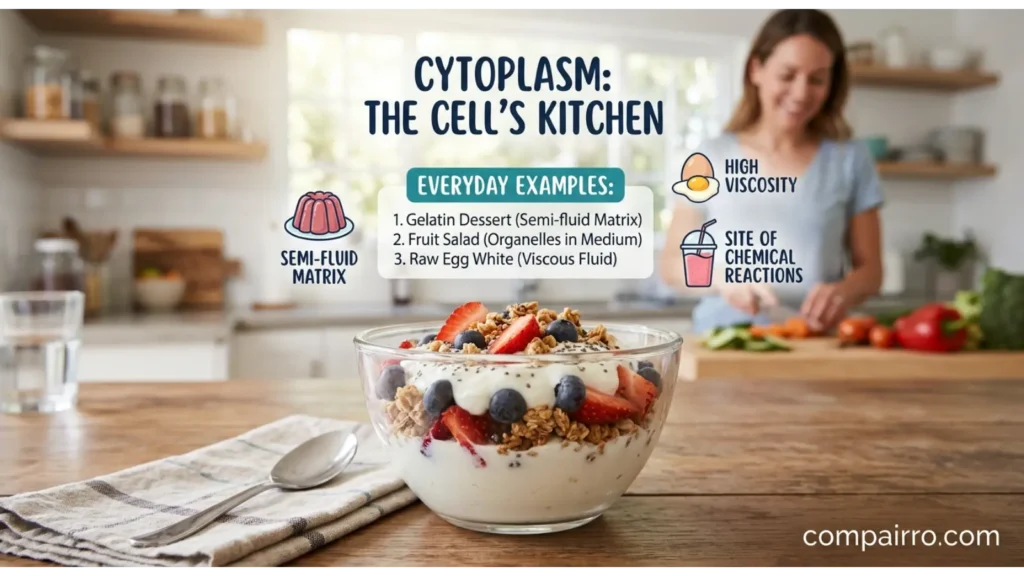
Cytoplasm in Everyday Examples
Cytoplasm is a scientific concept, so you may not use the word in everyday conversations. However, it appears frequently in schoolwork, science lessons, and discussions about living things.
At School
A biology teacher may ask, “Is cytoplasm prokaryotic or eukaryotic?”
A correct answer is: “Cytoplasm is present in both prokaryotic and eukaryotic cells.”
In a Science Laboratory
A student studying bacteria under a microscope may learn that the cells have cytoplasm, a cell membrane, and genetic material.
In Textbooks
A textbook may explain that animal cells contain cytoplasm, a nucleus, mitochondria, and other organelles.
In Online Learning
A student searching for “cytoplasm prokaryotic or eukaryotic” is likely looking for a quick answer about cell structure or help preparing for an exam.
In Daily Life
When you learn that your body is made of eukaryotic cells, you can connect the idea of cytoplasm to the basic structure of the cells that make up your tissues and organs.
Cytoplasm – Google Trends and Usage Data
People search for cytoplasm because it is a common biology topic. It often appears in lessons about cell structure, cell theory, microorganisms, and the differences between prokaryotic and eukaryotic cells.
Common reasons for searching include:
- Preparing for school biology exams.
- Completing homework and assignments.
- Learning the difference between prokaryotic and eukaryotic cells.
- Understanding the function of cytoplasm.
- Reviewing cell diagrams and biology notes.
Students in the United States, United Kingdom, India, Pakistan, Canada, and Australia may search for this topic as part of their science studies.
However, the exact search popularity of this keyword in each country cannot be confirmed without current Google Trends data. It would be inaccurate to claim that one country searches for it more than another without checking the available data.
The topic is mainly educational rather than a social media trend. Students often use question-based searches because they want a clear answer that is easy to remember.
Comparison Table: Cytoplasm in Prokaryotic and Eukaryotic Cells
The following table explains how cytoplasm is found in both cell types and how their internal structures differ.
| Feature | Prokaryotic Cells | Eukaryotic Cells |
|---|---|---|
| Cytoplasm present? | Yes | Yes |
| Membrane-bound nucleus | No | Yes |
| Membrane-bound organelles | Generally absent | Present |
| Examples | Bacteria and archaea | Plants, animals, fungi, and protists |
| Genetic material | Located in a region called the nucleoid | Mainly enclosed within the nucleus |
| Cell organization | Usually simpler | Usually more complex |
| Cytoplasm function | Supports cell reactions and components | Supports cell reactions and organelles |
The most important point is that cytoplasm is present in both cell types. Their major difference is the presence or absence of a membrane-bound nucleus and other membrane-bound organelles.

Cytoplasm in Professional Life
Cytoplasm is important in several scientific fields, including biology, medicine, microbiology, biotechnology, and laboratory research.
Scientists study cytoplasm to understand how cells function, how substances move inside cells, and how chemical reactions support life.
Here are some practical examples:
- Medicine: Researchers study cell structures to understand normal cell function and disease.
- Microbiology: Scientists examine bacteria and other microorganisms, including their internal cell contents.
- Biotechnology: Researchers study cells when developing biological products and laboratory methods.
- Education: Biology teachers use cytoplasm to explain basic cell structure.
- Scientific research: Scientists study processes that take place in the cytoplasm.
Although most people do not use this term in everyday workplace conversations, it is important for students and professionals who work with living cells.
Cytoplasm for Students or Beginners
Cytoplasm can seem confusing at first because cells contain many different parts. The easiest way to learn it is to compare the two major cell types.
Why Beginners Struggle
Students may remember that prokaryotic cells lack a nucleus and mistakenly assume they lack other internal cell components. Others may confuse cytoplasm with the cytosol or think that only animal cells contain it.
Easy Learning Tips
- Memorize that both cell types contain cytoplasm.
- Remember that prokaryotic cells lack a membrane-bound nucleus.
- Remember that eukaryotic cells have a membrane-bound nucleus.
- Practice labeling simple diagrams of bacterial, plant, and animal cells.
- Use a comparison table to review their features before an exam.
A useful exam answer is: “Cytoplasm is present in both prokaryotic and eukaryotic cells. It contains the cell’s internal material and supports many important chemical reactions.”
Signs or Characteristics Related to Cytoplasm
Cytoplasm has several important features that help cells work properly.
- Location: It is found inside the cell membrane.
- Composition: It contains water, dissolved substances, proteins, and other materials.
- Chemical reactions: Many cell reactions take place in the cytoplasm.
- Cell support: It helps support and organize internal cell components.
- Presence in prokaryotes: Bacteria and archaea contain cytoplasm.
- Presence in eukaryotes: Plant, animal, fungal, and protist cells contain cytoplasm.
- Connection with organelles: In eukaryotic cells, the cytoplasm surrounds organelles outside the nucleus.
Remember that cytoplasm is not simply empty space. It is an active part of the cell.
Simple Trick to Remember Cytoplasm
Here is an easy memory trick:
Cytoplasm = Common to both cell types.
Think of it this way: a bacterial cell and an animal cell are different, but both need cytoplasm to support their internal activities.
Remember these two facts:
- Prokaryotic = No membrane-bound nucleus.
- Eukaryotic = Membrane-bound nucleus present.
Both have cytoplasm.
For example, if an exam asks whether a bacterial cell contains cytoplasm, answer yes. If it asks whether an animal cell contains cytoplasm, answer yes again.
This simple rule can help you remember the correct answer without confusing cytoplasm with the nucleus.
FAQs:
1. Is cytoplasm prokaryotic or eukaryotic?
Cytoplasm is found in both prokaryotic and eukaryotic cells. It supports cell structures and many chemical reactions.
2. Do prokaryotic cells have cytoplasm?
Yes. Prokaryotic cells, including bacteria and archaea, contain cytoplasm even though they lack a membrane-bound nucleus.
3. Do eukaryotic cells have cytoplasm?
Yes. Eukaryotic cells, such as plant and animal cells, contain cytoplasm along with a nucleus and other internal structures.
4. What is the main function of cytoplasm?
Cytoplasm provides an environment for many chemical reactions and contains the cell’s internal components.
5. Is cytoplasm the same as cytosol?
No. Cytosol is the fluid part of the cytoplasm, while cytoplasm includes the cytosol and internal components outside the nucleus.
6. What is the difference between cytoplasm and the nucleus?
The nucleus is a membrane-bound structure that contains most of a eukaryotic cell’s genetic material. Cytoplasm is the material inside the cell membrane but outside the nucleus.
7. Why is cytoplasm important for cells?
Cytoplasm supports cell activities, contains important substances, and provides an environment where many chemical reactions take place.
Conclusion
So, is cytoplasm prokaryotic or eukaryotic? The answer is both. Cytoplasm is present in prokaryotic cells, such as bacteria, and eukaryotic cells, such as plant and animal cells.
Its main roles include supporting internal cell components and providing an environment for many chemical reactions. The key difference between prokaryotic and eukaryotic cells is that eukaryotic cells have a membrane-bound nucleus, while prokaryotic cells do not.
Final memory rule: Both cell types have cytoplasm, but only eukaryotic cells have a membrane-bound nucleus.

Sara Taylor is a passionate English content writer who specializes in word meanings, spelling comparisons, and modern slang explanations. She creates easy-to-understand articles that help readers avoid common English mistakes and improve their writing skills. Her content focuses on simple learning, real-life examples, and clear explanations for everyday readers.