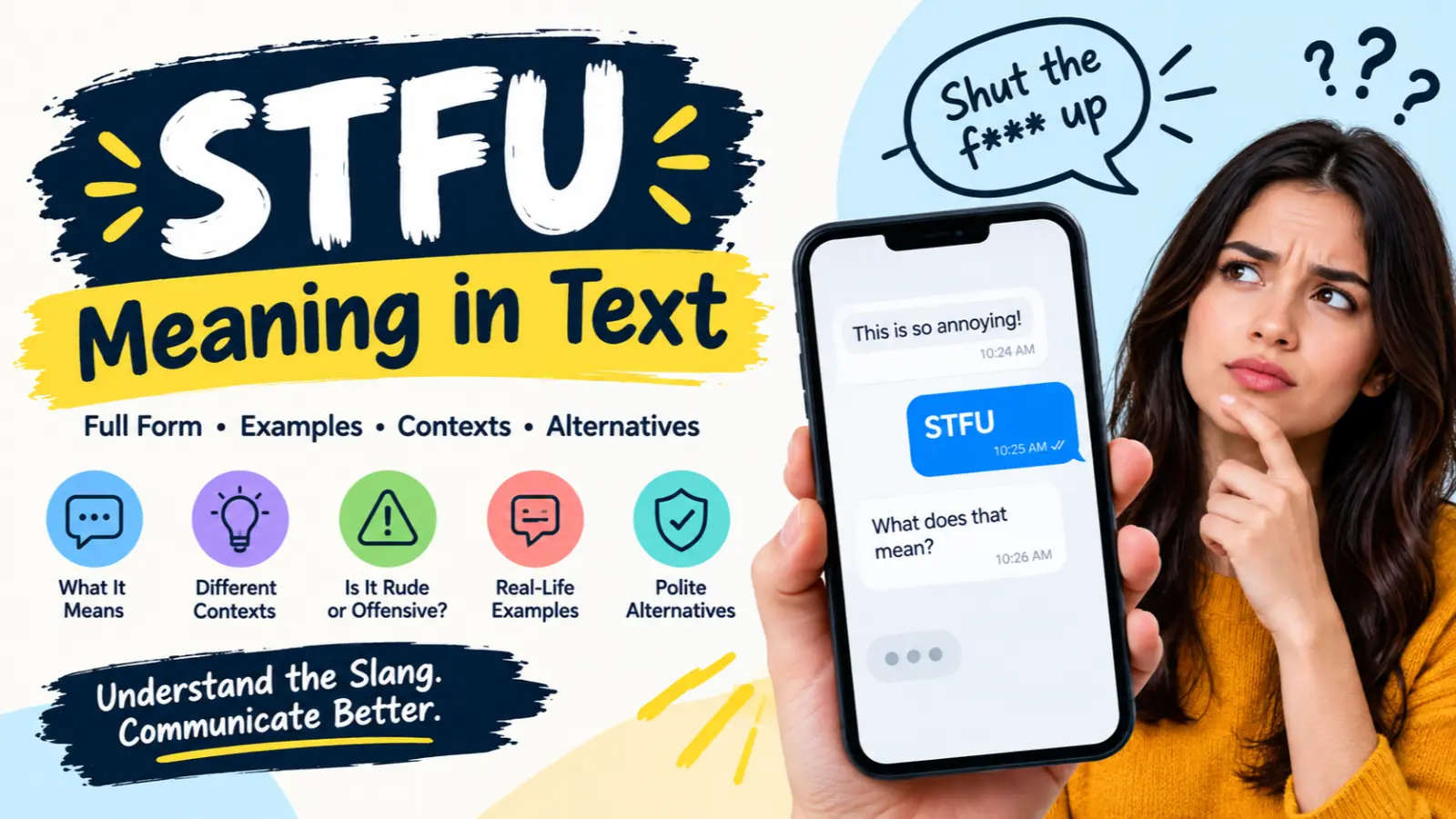
stfu meaning in text is a common search because people often see this abbreviation in texts, comments, chats, gaming, and social media and want to understand what it means. Like many internet slang terms, its meaning can change slightly depending on the conversation and the relationship between the people using it.
STFU is an abbreviation made from the first letters of a rude command. It is usually used when someone wants another person to stop talking. However, the tone can range from genuinely angry and disrespectful to joking between close friends.
Understanding the context is important before deciding how serious a message is. A phrase that friends use as a joke may sound extremely offensive when used with a stranger, teacher, parent, coworker, or someone you do not know well.
Quick Answer:
STFU is a vulgar abbreviation meaning “shut the f* up.”** It tells someone to stop talking and is generally considered rude or offensive, although friends may sometimes use it jokingly.
What Does STFU Mean in Text?
STFU is an internet and texting abbreviation for a profanity-based command telling someone to be quiet.
The phrase is usually stronger than simply saying “be quiet.” When someone writes STFU during an argument, they are normally showing irritation, anger, or frustration.
However, context matters. For example, friends might use the abbreviation jokingly after someone tells an unbelievable story. In that situation, the sender may not literally be angry.
STFU Full Form
The STFU full form contains a vulgar word, so it is generally considered profanity. It is best understood as an informal and aggressive way of telling someone to stop talking.
Because of its offensive nature, it is not suitable for most professional, school, or formal conversations.
Is STFU Rude, Offensive, or Neutral?
STFU is generally rude and offensive.
It is not normally considered a neutral abbreviation. Even when someone uses it as a joke, the wording can still sound harsh to the person receiving it.
The tone depends on several factors:
- Angry: It can be used to aggressively tell someone to stop talking.
- Joking: Close friends may use it while joking around.
- Frustrated: Someone may type it after becoming tired of an argument.
- Playful: Some online communities use it in an exaggerated or humorous way.
- Disrespectful: It can be insulting when directed at someone seriously.
If you are unsure how the other person will react, choosing a polite alternative is safer.

STFU Meaning in Different Contexts
The meaning can feel different depending on where you see it.
In Text Messages
In private messages, STFU often means that the sender wants the other person to stop talking. It may indicate annoyance or may be intended as a joke between friends.
On Social Media
You may see STFU in comments, replies, memes, or arguments. Online discussions can become heated quickly, so the abbreviation is often used aggressively.
In Gaming
Players sometimes use strong slang while joking or arguing during games. In this setting, STFU may be used as an angry response or playful trash talk.
Between Friends
Close friends may use the abbreviation without intending serious offense. Still, this depends on the friendship and the people involved.
During an Argument
During an argument, STFU is usually much more serious. It can communicate anger, disrespect, or a desire to end the conversation.

Real-Life Examples of STFU
Because STFU contains profanity, these examples focus on explaining the context rather than encouraging the phrase.
Friendly or Playful Example
Friend A: “I just ate three pizzas by myself.”
Friend B: “STFU 😂”
Here, the sender may be joking because the story sounds surprising or funny.
Casual Online Example
Person A: “This game is impossible.”
Person B: “STFU, you just need more practice.”
This sounds less friendly and could easily be interpreted as insulting.
Argumentative Example
Person A: “You never listen to anyone.”
Person B: “STFU.”
Here, the abbreviation is clearly being used aggressively.
Social Media Example
Someone may reply with STFU to a post they strongly disagree with. In this case, it can be seen as disrespectful rather than constructive communication.
Emotional and Psychological Meaning
STFU can communicate a strong emotional reaction, but the exact emotion depends on the context.
Someone may use it because they are:
- Angry
- Annoyed
- Frustrated
- Embarrassed
- Overwhelmed
- Joking with a friend
- Trying to end an argument
It is important not to assume someone’s exact emotional state from one abbreviation alone. The surrounding messages usually provide more information.
For example, STFU followed by laughing emojis may have a different tone from STFU written during a serious argument.

Origin and Background of STFU
STFU developed as an internet and texting abbreviation from the first letters of a common profane phrase. Like many early online abbreviations, it became useful because typing a few letters was faster than writing the complete expression.
Its popularity grew through online forums, instant messaging, gaming communities, social media, and text messaging.
Today, STFU is widely recognized by many internet users, but its meaning remains connected to profanity and an aggressive command.
When Should You Avoid Using STFU?
Because STFU is rude, it is better to avoid it in situations where respectful communication matters.
Avoid using it when talking to:
- Teachers
- Parents or elders
- Employers
- Customers
- Classmates you do not know well
- Professional contacts
- Strangers
- People who may not understand your humor
Even if you intend it as a joke, the other person may interpret it literally.
Polite Alternatives to STFU
If your goal is simply to ask someone to stop talking, there are many better choices.
| STFU-style message | More polite alternative |
|---|---|
| STFU | Please be quiet. |
| STFU | Could you please stop for a moment? |
| STFU | Let’s take a break from this conversation. |
| STFU | I’d rather not continue this discussion. |
| STFU | Please give me a moment. |
| STFU | Can we change the subject? |
These alternatives communicate your message without using profanity.
Why Do People Use STFU?
People use STFU because it is short, recognizable, and emotionally strong. Internet communication often favors abbreviations because they save time and can quickly express a reaction.
Some common reasons include:
- Anger: The person is genuinely upset.
- Humor: Friends are teasing each other.
- Frustration: Someone wants an argument or conversation to stop.
- Online culture: The sender regularly uses internet slang.
- Shock: Someone may use it jokingly after hearing surprising news.
- Impatience: The person does not want to continue listening.
The relationship between the people is important when interpreting the message.
Common Misunderstandings About STFU
One common mistake is assuming that every use of STFU is serious.
That is not always true. Close friends may use strong slang as part of their humor. On the other hand, assuming it is “just a joke” can also be a mistake. If the conversation is already tense, STFU may be intended as a genuine insult.
Another misunderstanding is thinking that STFU is a polite way to ask someone to stop talking. It is not. The abbreviation contains profanity and can easily offend people.
Variations and Related Slang
There are several expressions that can appear in similar online situations, although they do not all have exactly the same strength or meaning.
| Term | General meaning | Tone |
|---|---|---|
| STFU | Tells someone to stop talking | Very rude |
| Shut up | Tells someone to be quiet | Rude or playful |
| Be quiet | Requests silence | Neutral |
| Please stop | Requests that an action end | Polite |
| Zip it | Tells someone to stop talking | Informal/playful |
| Keep it down | Requests less noise | Usually neutral |
The important difference is tone. “Please stop” can be respectful, while STFU is much more aggressive.
How to Respond When Someone Uses STFU
Your response depends on the situation. If someone is clearly joking and you are comfortable with the humor, you might simply ignore it or respond casually.
If the message feels disrespectful, staying calm is usually better than escalating the argument.
You could say:
- “Please speak respectfully.”
- “I don’t appreciate that.”
- “If you disagree, we can discuss it calmly.”
- “Let’s leave the conversation here.”
- “I understand you’re upset, but there’s no need to be rude.”
If the person continues sending insulting messages, you can stop responding, mute the conversation, or use the platform’s available safety tools.
Regional and Cultural Usage
STFU is primarily associated with English-language internet culture, but it is recognized in many countries because social media and online communities are international.
Its interpretation can vary between groups. In some online communities, strong slang is common and may be treated casually. In more formal or culturally conservative settings, the same abbreviation may be considered highly disrespectful.
This is why knowing your audience matters. A phrase that seems funny in a private group chat may be inappropriate in a public comment or formal conversation.
Is STFU Safe for Social Media?
STFU is not dangerous by itself, but it is not a polite or universally appropriate expression for social media.
Using it publicly can lead to misunderstandings, arguments, or moderation problems depending on the platform and context.
If you want to disagree with someone online, respectful language is usually more effective. You can make your point without insulting the other person.
Remember that public posts and comments can also be seen by teachers, family members, employers, or other people outside your intended audience.
Comparison: STFU vs. Shut Up
Although both expressions tell someone to stop talking, STFU is generally stronger because it uses profanity.
“Shut up” can sometimes be playful among friends, while STFU is more strongly associated with internet slang and an aggressive tone.
Neither expression is ideal for formal communication. When respect matters, phrases such as “please be quiet” or “could we change the subject?” are better choices.
FAQs About STFU Meaning in Text
1. What does STFU mean in texting?
STFU is a vulgar abbreviation used to tell someone to stop talking or be quiet. It is generally considered rude or offensive.
2. Is STFU a bad word?
STFU contains profanity, so it is considered inappropriate in many formal or respectful situations.
3. Can STFU be used as a joke?
Yes. Close friends sometimes use it jokingly, especially in humorous conversations. However, the recipient may still find it offensive.
4. What does STFU mean from a friend?
It depends on the context. If your friend normally uses strong slang and includes laughing or playful language, it may be a joke. During an argument, it is more likely to express anger or frustration.
5. What is a polite alternative to STFU?
You can say “please be quiet,” “please stop,” “could you give me a moment?” or “let’s change the subject.”
6. Should I use STFU at school or work?
It is best to avoid STFU at school, work, or other formal settings because it contains profanity and can sound disrespectful.
Conclusion
The stfu meaning in text is a vulgar way of telling someone to stop talking or be quiet. The abbreviation is common in texting, social media, gaming, and online conversations, but it is generally considered rude and offensive.
Context makes a big difference. Friends may sometimes use it jokingly, while the same abbreviation during an argument can be a direct insult. Before using internet slang, consider who you are talking to and how your message could be understood.
If you want to communicate respectfully, alternatives such as “please be quiet,” “please stop,” or “let’s change the subject” are much safer choices. Understanding the tone behind slang helps you communicate clearly and avoid unnecessary misunderstandings.

Sara Taylor is a passionate English content writer who specializes in word meanings, spelling comparisons, and modern slang explanations. She creates easy-to-understand articles that help readers avoid common English mistakes and improve their writing skills. Her content focuses on simple learning, real-life examples, and clear explanations for everyday readers.