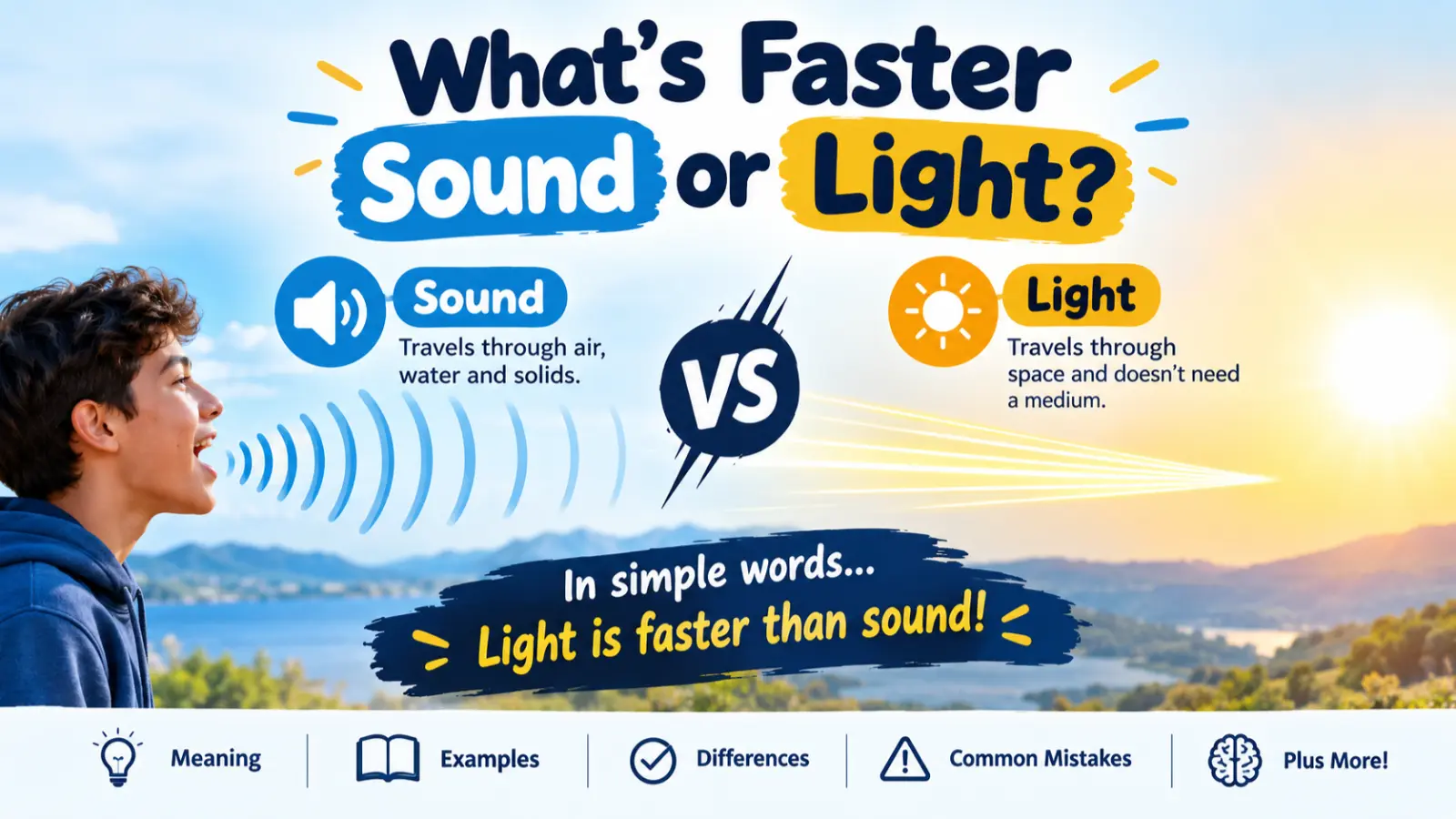
Have you ever watched a thunderstorm and noticed something interesting? You see a bright flash of lightning in the sky, but the sound of thunder reaches your ears a few seconds later. Why does this happen? Is light faster than sound, or is there another reason behind it?
The answer is simple: light is much faster than sound. Light travels so quickly that we often see an event before we hear the sound it creates. This happens during thunderstorms, fireworks, and other everyday events.
People search for “whats faster sound or light” because they want to understand this common science question. Students may come across it in school science lessons, while teachers may use it to explain speed and energy. People also discuss it in online videos, social media posts, and everyday conversations.
Although both light and sound help us understand the world, they travel in different ways. Light can travel through empty space, while sound needs a material such as air, water, or a solid object to move through. This is one of the main differences between them.
Understanding this topic makes basic physics easier to learn. It also helps explain why distant fireworks appear before their sound reaches us and why sunlight reaches Earth much sooner than any sound could travel through space.
In this guide, you’ll learn the meaning, examples, usage, differences, common mistakes, and simple explanations in easy English.
What’s Faster Sound or Light? – Quick Answer
Light is much faster than sound. In a vacuum, light travels at about 299,792 kilometers per second, while sound travels through air at approximately 343 meters per second at 20°C.
In simple words, light moves far faster than sound, which is why you usually see something happen before you hear its sound.
Examples:
- Lightning and thunder: You see the lightning flash before hearing the thunder.
- Fireworks: You see the colorful explosion before its sound reaches you.
- A distant drum: You may see someone hit a drum before hearing the beat if the distance is large enough.
Simple rule: Light reaches you first; sound usually follows.
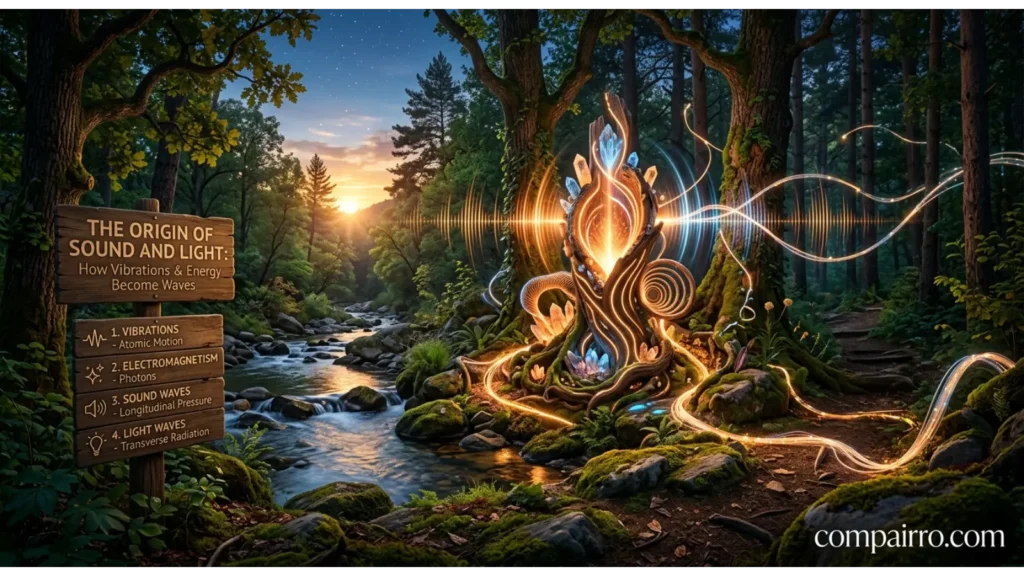
The Origin of Sound and Light
Light and sound have been studied for thousands of years. Early thinkers wondered how we see objects and hear voices, music, and other noises.
Over time, scientists developed ways to measure their speeds more accurately.
In the 1600s, astronomer Ole Rømer used observations of Jupiter’s moon Io to show that light takes time to travel. Later experiments helped scientists estimate the speed of light more accurately.
Sound speed was also studied through experiments involving echoes, musical instruments, and other sources of noise.
Today, scientists know that light is an electromagnetic wave, while sound is a mechanical wave. This difference helps explain why they travel at different speeds and why sound cannot move through a vacuum.
The question became popular in school science, educational books, online searches, and science videos because it connects a scientific fact with something people experience every day.
British English vs American English Usage
The phrase “whats faster sound or light” is an informal search query. In standard English, it is better written as “What’s faster, sound or light?”
British and American English use the same scientific facts and follow the same basic grammar rules for this question.
| Feature | British English | American English | Notes |
|---|---|---|---|
| Correct question | What’s faster, sound or light? | What’s faster, sound or light? | Same wording |
| Spelling | Speed, sound, light | Speed, sound, light | No spelling difference |
| Scientific answer | Light is faster | Light is faster | Same scientific fact |
| Informal search | Whats faster sound or light | Whats faster sound or light | Search queries may omit punctuation |
For schoolwork, use the complete question with an apostrophe and question mark. In an online search, people may leave out punctuation and still find the answer.
Which One Should You Use?
Sound and light are not words you choose instead of each other. They are different forms of energy that help us experience the world.
Here is how to understand their uses:
- Use light when discussing vision, sunlight, lasers, photographs, or how we see objects.
- Use sound when discussing speech, music, noise, echoes, or hearing.
- Use both when explaining events such as lightning, fireworks, and explosions.
- In science class, compare their speeds to understand how waves move.
- In everyday conversation, use the lightning-and-thunder example to explain why light arrives first.
The important point is that light and sound behave differently. Their speeds also depend on the material they travel through, especially in the case of sound.

Common Mistakes About What’s Faster: Sound or Light?
Mistake 1: Thinking sound and light travel at the same speed
❌ Sound and light move equally fast.
✔ Light travels much faster than sound in air. Their speeds are very different.
Mistake 2: Thinking sound cannot travel through anything except air
❌ Sound only travels through air.
✔ Sound can travel through gases, liquids, and solids. Its speed changes depending on the material.
Mistake 3: Thinking light always needs air to travel
❌ Light cannot travel without air.
✔ Light can travel through a vacuum, which is why sunlight reaches Earth through space.
Mistake 4: Thinking thunder happens after lightning
❌ Thunder begins only after the lightning flash ends.
✔ Lightning and thunder are connected to the same electrical event. Light reaches you first because it travels much faster than sound.
Mistake 5: Thinking sound is always slower in every possible situation
❌ Sound is slower than light under every condition without exception.
✔ Light in a vacuum travels at the universal speed limit for information. In materials such as glass or water, light slows down, and sound can sometimes travel faster than light does in that particular material. Sound still cannot travel faster than light in a vacuum.
What’s Faster Sound or Light? Everyday Examples
You can understand this scientific difference through familiar situations.
1. At Work
Imagine a worker using a machine that creates a bright flash and a loud noise at a distance.
The flash may reach an observer before the sound. This difference can matter when measuring events or designing systems that use light and sound signals.
2. At School
A teacher may clap their hands at the other end of a large school hall. Students see the movement almost immediately, while the sound takes a little longer to travel across the room.
For a short distance, the delay is tiny. However, it becomes easier to notice over longer distances.
3. On Social Media
Science videos often show lightning followed by thunder. They may also compare the speed of light with the speed of sound using animations.
These videos help students understand that seeing an event and hearing its sound are two different experiences.
4. In Daily Life
Imagine watching fireworks from far away. You see the bright colors first and hear the boom afterward.
The same principle applies to distant storms and other events that produce both light and sound.
5. During a Thunderstorm
When lightning flashes, count the seconds until you hear thunder. The longer the delay, the farther away the lightning occurred, approximately.
A rough estimate is that every three seconds between the flash and thunder represents about one kilometer of distance. This is only an estimate, not an exact measurement.
What’s Faster Sound or Light? – Google Trends and Usage Data
People search for “whats faster sound or light” to get a quick answer, understand a science lesson, or find a simple explanation for a question they have noticed in daily life.
Common reasons for searching include:
- School assignments: Students want a clear answer for physics or general science.
- Curiosity: People wonder why lightning appears before thunder is heard.
- Online learning: Short videos and educational posts make science questions popular.
- Exam preparation: Learners may need facts about waves, speed, and energy.
- General knowledge: People want to understand the difference between light and sound.
Search interest can come from the United States, United Kingdom, India, Pakistan, Canada, and Australia. However, the exact popularity and ranking of this keyword in these countries can change over time.
Without checking live Google Trends data, it would not be accurate to claim that a particular country has the highest search volume.
The topic remains useful for educational content because it answers a direct question and connects scientific facts with real-life examples.
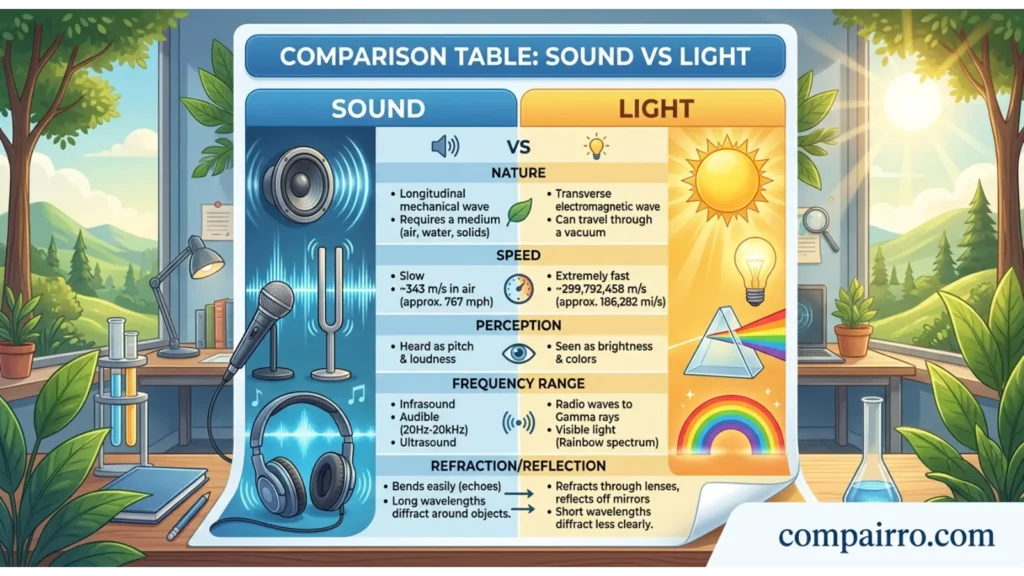
Comparison Table: Sound vs Light
| Feature | Sound | Light |
|---|---|---|
| Type of wave | Mechanical wave | Electromagnetic wave |
| Speed in air | About 343 m/s at 20°C | About 300 million m/s, approximately |
| Needs a medium? | Yes | No |
| Travels through a vacuum? | No | Yes |
| Detected by | Ears or microphones | Eyes or light sensors |
| Common example | Music or thunder | Sunlight or lightning |
| Main use | Hearing and communication | Vision and optical communication |
The speed values in this table are approximate. Sound speed depends on temperature and the material it travels through. Light travels at its maximum speed in a vacuum and slows down when passing through materials such as glass.
Sound and Light in Professional Life
Understanding the speed of sound and light is useful in several jobs and industries.
- Weather science: Meteorologists use the delay between lightning and thunder to estimate a storm’s distance.
- Medicine: Medical ultrasound uses sound waves to create images inside the body.
- Telecommunications: Fiber-optic systems use light to carry information over long distances.
- Photography: Cameras detect light to create images.
- Engineering: Engineers study sound and light when designing sensors, communication systems, and measuring tools.
These examples show that both forms of energy are important. Light is much faster in a vacuum, but sound is valuable for many tasks that light alone cannot perform.
What’s Faster Sound or Light? For Students and Beginners
Students sometimes find this topic confusing because both sound and light seem to reach us almost instantly.
However, their speeds are very different.
Here are a few easy learning tips:
- Remember the main numbers: Sound travels through air at about 343 meters per second, while light travels in a vacuum at about 300,000 kilometers per second.
- Think about lightning: You see the flash before hearing the thunder.
- Understand the medium: Sound needs matter to travel, but light can travel through empty space.
- Use comparisons: Imagine light as a fast runner and noise as a much slower runner.
- Practice with examples: Fireworks and distant storms make the idea easier to remember.
For a school answer, you can write: “Light travels much faster than noise. That is why we see lightning before we hear thunder.”
Signs or Characteristics Related to Sound and Light
The main characteristics of noise and light help explain how they differ.
Characteristics of Sound
- Sound is produced by vibrations.
- It travels through gases, liquids, and solids.
- It cannot travel through a vacuum.
- Its speed depends on the material and its conditions.
- It allows people to hear speech, music, and other noises.
Characteristics of Light
- Light is electromagnetic radiation.
- It can travel through empty space.
- It travels at about 299,792 kilometers per second in a vacuum.
- It allows people to see objects.
- It can reflect, bend, or be absorbed when it meets materials.
Common Patterns
- You usually see distant events before hearing their sounds.
- Greater distances make the delay easier to notice.
- Different materials affect the speeds of sound and light in different ways.
- Light and sound can both carry information, but they do so differently.
Simple Trick to Remember What’s Faster: Sound or Light
Here is an easy memory trick:
Light = Very fast
Sound = Slower through air
Think of it this way: When lightning flashes during a storm, your eyes receive the light almost instantly, but your ears must wait for the sound to travel through the air.
For example, if you see lightning and hear thunder five seconds later, the light has already reached you. The sound has taken more time to cover the distance.
Remember this simple sentence:
“See the flash first, hear the boom later.”
This phrase makes the difference easy to remember for school tests, general knowledge questions, and everyday conversations.
FAQs:
1. What’s faster, sound or light?
Light is much faster than sound. Light travels at about 299,792 kilometers per second in a vacuum, while sound travels through air at about 343 meters per second at 20°C.
2. How many times faster is light than sound?
In air, light travels roughly 874,000 times faster than sound, using the approximate speeds above.
3. Why do we see lightning before hearing thunder?
Light travels much faster than sound. The flash reaches your eyes before the sound waves reach your ears.
4. Can sound travel faster than light?
Sound cannot travel faster than light in a vacuum. However, sound can travel faster than light moving through certain materials, because light slows down in those materials.
5. Can light travel without air?
Yes. Light can travel through a vacuum, which is how sunlight crosses space to reach Earth.
6. Does sound travel faster in water or air?
Sound generally travels faster in water than in air. It also travels faster in many solids, depending on the material.
7. Is light the fastest thing in the universe?
Light in a vacuum travels at the speed limit for information and objects. This speed is approximately 299,792 kilometers per second.
Conclusion
So, what’s faster noise or light? Light is much faster than sound. It travels at about 299,792 kilometers per second in a vacuum, while sound moves through air at approximately 343 meters per second at 20°C.
This difference explains why you see lightning before hearing thunder and why fireworks appear before their sound reaches you.
Both sound and light are important in everyday life, science, communication, and technology. The main difference is how they travel and how quickly they reach us.
Final memory rule: You see the flash first because light travels much faster than sound.

Sara Taylor is a passionate English content writer who specializes in word meanings, spelling comparisons, and modern slang explanations. She creates easy-to-understand articles that help readers avoid common English mistakes and improve their writing skills. Her content focuses on simple learning, real-life examples, and clear explanations for everyday readers.