XeF4 Polar or Nonpolar is a trending chemistry question among students learning about molecular polarity and molecular geometry. Xenon tetrafluoride (XeF4) is a chemical compound that often causes confusion because it contains polar xenon-fluorine bonds. So, is XeF4 polar or nonpolar? The answer becomes clear when you understand its molecular shape and bond arrangement.
The question “XEF4 polar or nonpolar” is common among chemistry students who want to understand the shape and properties of xenon tetrafluoride. To answer it correctly, you need to know how its atoms are arranged and how its electrons are shared.
You may come across this topic in school chemistry lessons, college assignments, science textbooks, laboratory discussions, and online searches. It is also useful when learning about molecular geometry, electronegativity, and intermolecular forces.
One important point is that a molecule can contain polar bonds but still be nonpolar overall. Its final polarity depends on both the bond polarity and the shape of the molecule. This is why looking at the chemical formula alone is not always enough.
In this guide, you’ll learn the meaning, examples, usage, differences, common mistakes, and simple explanations in easy English.
XEF4 Polar or Nonpolar – Quick Answer
XeF₄ (xenon tetrafluoride) is a nonpolar molecule.
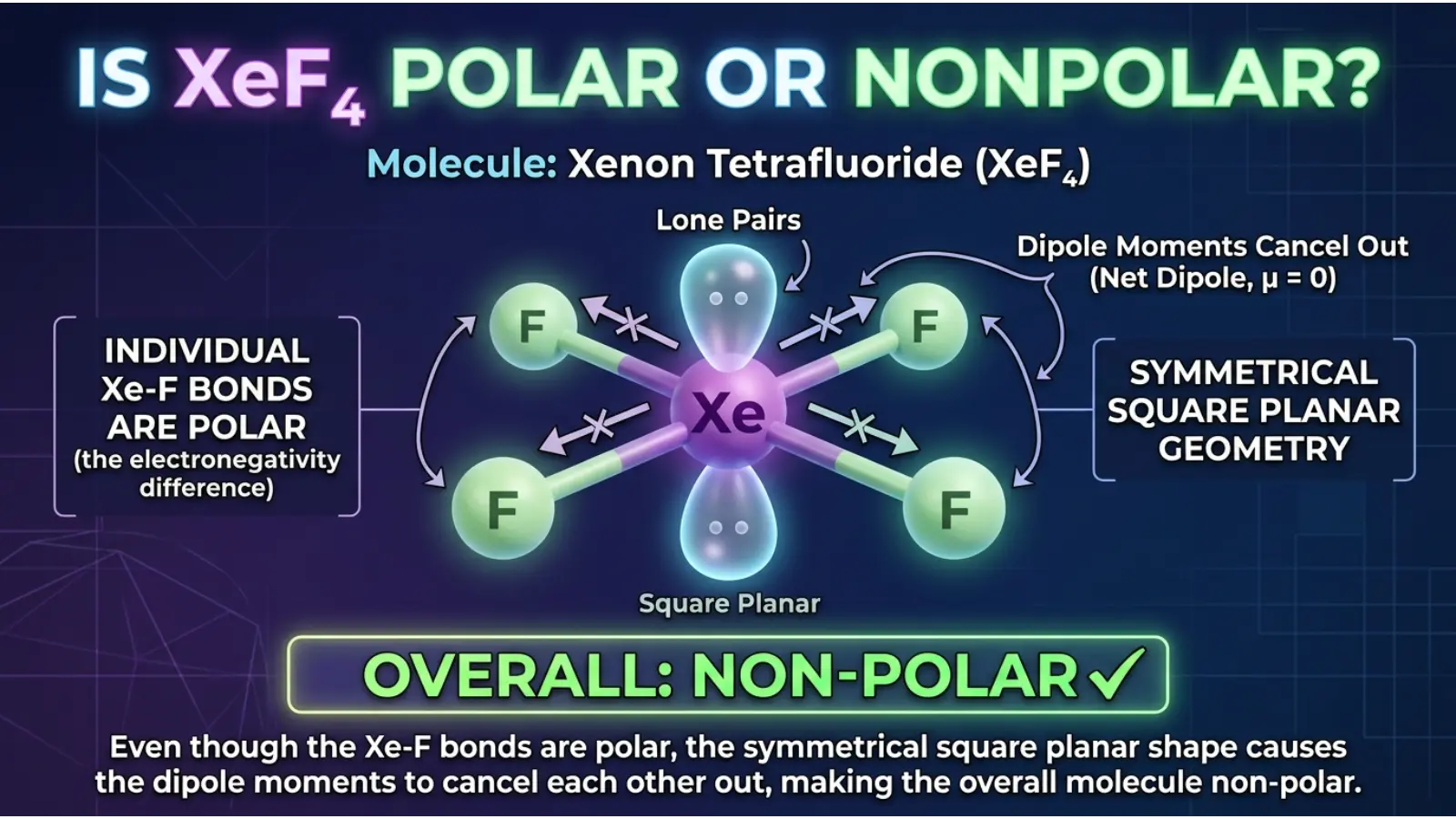
It contains polar xenon–fluorine (Xe–F) bonds, but its square planar shape causes the bond dipoles to cancel each other out. As a result, the molecule has no net dipole moment.
Here are three important facts:
- Chemical formula: XeF₄
- Molecular shape: Square planar
- Overall polarity: Nonpolar
Example: Imagine four people pulling equally in opposite directions. If the forces balance, there is no overall pull in one direction. In XeF₄, the bond dipoles balance in a similar way.
Simple rule: Polar bonds do not always make a polar molecule. The molecular shape also matters.
The Origin of XeF₄
XeF₄ stands for xenon tetrafluoride, a chemical compound made from one xenon atom and four fluorine atoms.
Scientists first prepared xenon compounds in 1962, when Neil Bartlett demonstrated that xenon could react with strong oxidizing agents. This discovery changed the common belief that noble gases could not form chemical compounds.
Xenon tetrafluoride was also prepared in 1962. It became an important example in chemistry because xenon, a noble gas, can form bonds with highly reactive fluorine atoms.
The name is easy to understand:
- Xe: The chemical symbol for xenon.
- F: The chemical symbol for fluorine.
- 4: Four fluorine atoms are present in each molecule.
- Tetrafluoride: A compound containing four fluorine atoms bonded to another element.
The modern understanding of XeF₄’s polarity comes from studying its electron arrangement, molecular geometry, and bond dipoles.
British English vs American English Usage
There is no difference between British and American English when describing the polarity of XeF₄. Both use the same chemical formula, molecular structure, and scientific explanation.
| Feature | British English | American English | Notes |
|---|---|---|---|
| Chemical name | Xenon tetrafluoride | Xenon tetrafluoride | Same spelling |
| Chemical formula | XeF₄ | XeF₄ | Identical |
| Molecular shape | Square planar | Square planar | Same geometry |
| Polarity | Nonpolar | Nonpolar | Same scientific result |
| Bond type | Polar covalent | Polar covalent | Same explanation |
Students in Pakistan, India, the UK, the US, Canada, and Australia can use the same explanation in their chemistry studies.
Which One Should You Use: Polar or Nonpolar?
When answering the question “XeF₄ polar or nonpolar,” choose nonpolar when describing the entire molecule.
However, it is important to separate bond polarity from molecular polarity.
- For individual Xe–F bonds: Describe them as polar covalent bonds.
- For the complete XeF₄ molecule: Describe it as nonpolar.
- For molecular geometry: Use square planar.
- For a school or college exam: Explain that the four bond dipoles cancel because of the molecule’s symmetrical arrangement.
XeF₄ has a central xenon atom surrounded by four fluorine atoms. It also has two lone pairs on xenon. These lone pairs occupy opposite positions in the arrangement of electron pairs, leaving the four fluorine atoms in one square plane.
This balanced structure is the main reason the molecule is nonpolar.
Common Mistakes With XeF₄ Polarity
Students often make a few mistakes when deciding whether XeF₄ is polar or nonpolar.
Mistake 1: Thinking Polar Bonds Always Make Polar Molecules
❌ Incorrect: XeF₄ must be polar because fluorine attracts electrons more strongly than xenon.
✔ Correct: The Xe–F bonds are polar, but their dipoles cancel because of the square planar geometry.
Mistake 2: Ignoring Molecular Shape
❌ Incorrect: The chemical formula alone tells us that XeF₄ is polar.
✔ Correct: Molecular shape is essential when determining the overall polarity of a molecule.
Mistake 3: Calling XeF₄ Tetrahedral
❌ Incorrect: XeF₄ has a tetrahedral molecular shape because it has four fluorine atoms.
✔ Correct: XeF₄ has a square planar molecular shape. Its electron-domain geometry is octahedral because xenon has four bonding pairs and two lone pairs.
Mistake 4: Forgetting the Lone Pairs
❌ Incorrect: Xenon has only four electron pairs around it.
✔ Correct: Xenon has four bonding pairs and two lone pairs, giving it six electron domains.
Mistake 5: Confusing Bond Polarity With Molecular Polarity
❌ Incorrect: Every molecule containing polar bonds is polar.
✔ Correct: A molecule may be nonpolar if its bond dipoles cancel due to its geometry.
XeF₄ in Everyday Examples
XeF₄ is mainly studied in chemistry rather than used in ordinary daily activities. However, simple examples can help you understand its polarity.
1. School
A student may be asked to determine whether XeF₄ is polar or nonpolar in a chemistry exam.
Example answer: XeF₄ is nonpolar because its square planar shape makes the four Xe–F bond dipoles cancel.
2. College Chemistry
Students studying molecular geometry can use XeF₄ to understand how lone pairs affect molecular shape.
Example: Six electron domains surround xenon, but only four fluorine atoms determine the square planar molecular shape.
3. Online Learning
Chemistry websites and educational videos often use XeF₄ to explain molecular symmetry and polarity.
Example search: “Why is XeF₄ nonpolar despite having polar bonds?”
4. Daily Life
You are unlikely to encounter XeF₄ in ordinary household activities. It is a reactive chemical used mainly in specialized scientific and chemical settings.
Nevertheless, its structure is a useful example for learning how molecules behave.
XeF₄ – Google Trends and Usage Data
People search for “XeF₄ polar or nonpolar” mainly to get a direct chemistry answer, prepare for exams, or understand molecular geometry.
Common reasons include:
- Learning the difference between polar bonds and polar molecules.
- Preparing for school or college chemistry tests.
- Understanding VSEPR theory and lone pairs.
- Checking whether square planar molecules are always nonpolar.
- Finding a simple explanation of xenon tetrafluoride.
Students in the US, UK, India, Pakistan, Canada, and Australia may search for this topic while studying chemistry.
However, exact search volumes and country rankings require current keyword research or Google Trends data. Without that data, it would be misleading to claim that one country has the highest search interest.
The topic is especially useful for educational content because it connects several important chemistry ideas: electronegativity, molecular geometry, electron pairs, symmetry, and dipole moments.

Comparison Table: XeF₄ Polar or Nonpolar?
The following table compares XeF₄ with other familiar molecules to show how molecular shape affects polarity.
| Molecule | Molecular Shape | Bond Polarity | Overall Polarity |
|---|---|---|---|
| XeF₄ | Square planar | Polar bonds | Nonpolar |
| H₂O | Bent | Polar bonds | Polar |
| CO₂ | Linear | Polar bonds | Nonpolar |
| NH₃ | Trigonal pyramidal | Polar bonds | Polar |
| BF₃ | Trigonal planar | Polar bonds | Nonpolar |
| CH₄ | Tetrahedral | Nearly nonpolar bonds | Nonpolar |
The key difference is symmetry. In XeF₄, CO₂, and BF₃, the bond dipoles cancel because of their molecular arrangements.
In water and ammonia, the molecular shapes do not allow the bond dipoles to cancel completely. Therefore, these molecules have a net dipole moment.
Remember that molecular shape alone is not enough. You must also consider whether the bonds have dipoles and how those dipoles are arranged.
XeF₄ in Professional Life
Understanding XeF₄ polarity is useful in several scientific fields.
- Chemistry education: Teachers use XeF₄ to explain molecular geometry and polarity.
- Chemical research: Scientists study xenon compounds to understand noble-gas chemistry.
- Materials and chemical science: Knowledge of molecular structure helps researchers understand chemical reactions and properties.
- Laboratory work: Understanding chemical properties is important when working with reactive compounds.
XeF₄ is not a common consumer product. It is a reactive chemical that requires appropriate laboratory safety procedures and professional handling.
For most students, its main value is educational: it demonstrates how a molecule with polar bonds can still be nonpolar overall.

XeF₄ for Students or Beginners
If you are learning this topic for the first time, focus on three basic ideas.
1. Understand electronegativity.
Electronegativity describes how strongly an atom attracts shared electrons. Fluorine attracts shared electrons more strongly than xenon, so each Xe–F bond is polar.
2. Learn the molecular shape.
XeF₄ has four bonding pairs and two lone pairs around the central xenon atom. According to VSEPR theory, its molecular shape is square planar.
3. Check whether the dipoles cancel.
The four Xe–F bond dipoles point toward the fluorine atoms. Because these atoms occupy four balanced positions in one plane, the dipoles cancel in opposite pairs.
A useful study method is to draw the molecule before deciding whether it is polar. This makes the role of symmetry much easier to see.
Signs or Characteristics Related to XeF₄ Polarity
XeF₄ has several important characteristics that help explain its nonpolar nature.
- Four Xe–F bonds: Xenon is bonded to four fluorine atoms.
- Two lone pairs: The central xenon atom has two lone pairs.
- Square planar shape: The four fluorine atoms lie in one plane around xenon.
- Polar covalent bonds: Fluorine attracts the shared electrons more strongly than xenon.
- Symmetrical arrangement: The four bond dipoles balance each other.
- Zero net dipole moment: The molecule has no overall molecular dipole.
- Nonpolar molecule: The complete molecule is classified as nonpolar.
These characteristics work together. The most important feature is not simply the presence of polar bonds but the way those bonds are arranged in space.
Simple Trick to Remember XeF₄ Polarity
Here is an easy memory trick:
Polar bonds + symmetrical shape = potentially nonpolar molecule.
For XeF₄:
- Four polar bonds.
- A square planar shape.
- Balanced bond dipoles.
- Zero net dipole moment.
- Overall nonpolar molecule.
Think of it this way: imagine four equal arrows pointing outward from the center of a square, one toward each corner. Each arrow has an opposite arrow that balances it. The total effect is zero.
This is similar to the cancellation of bond dipoles in XeF₄.
However, do not apply this rule without checking the actual structure. Some molecules have polar bonds arranged asymmetrically, so their dipoles do not cancel.
FAQs:
1. Is XeF₄ polar or nonpolar?
XeF₄ is nonpolar because its square planar shape causes the four Xe–F bond dipoles to cancel.
2. Why is XeF₄ nonpolar even though it has polar bonds?
Fluorine attracts electrons more strongly than xenon, making each Xe–F bond polar. However, the symmetrical arrangement cancels the bond dipoles.
3. What is the molecular shape of XeF₄?
XeF₄ has a square planar molecular shape. Its electron-domain geometry is octahedral because it has four bonding pairs and two lone pairs.
4. How many lone pairs are present in XeF₄?
The central xenon atom has two lone pairs of electrons.
5. What is the hybridization of XeF₄?
In the traditional school-level model, XeF₄ is commonly described as having \(sp^3d^2\) hybridization. This is a simplified bonding model rather than a complete modern description of its electronic structure.
6. Does XeF₄ have a dipole moment?
XeF₄ has a net molecular dipole moment of zero because its bond dipoles cancel due to its symmetrical square planar structure.
7. What is the difference between XeF₄ and H₂O polarity?
XeF₄ is nonpolar because its bond dipoles cancel. H₂O is polar because its bent shape prevents its O–H bond dipoles from canceling.
Conclusion
So, is XeF₄ polar or nonpolar? XeF₄ is a nonpolar molecule. Although its four Xe–F bonds are polar, its square planar shape makes the bond dipoles cancel, leaving a net dipole moment of zero.
To answer similar chemistry questions, remember to check both bond polarity and molecular geometry. Do not assume that a molecule is polar simply because it contains polar bonds.
Final memory rule: XeF₄ = polar bonds + square planar symmetry + zero net dipole moment = nonpolar molecule.

Sara Taylor is a passionate English content writer who specializes in word meanings, spelling comparisons, and modern slang explanations. She creates easy-to-understand articles that help readers avoid common English mistakes and improve their writing skills. Her content focuses on simple learning, real-life examples, and clear explanations for everyday readers.