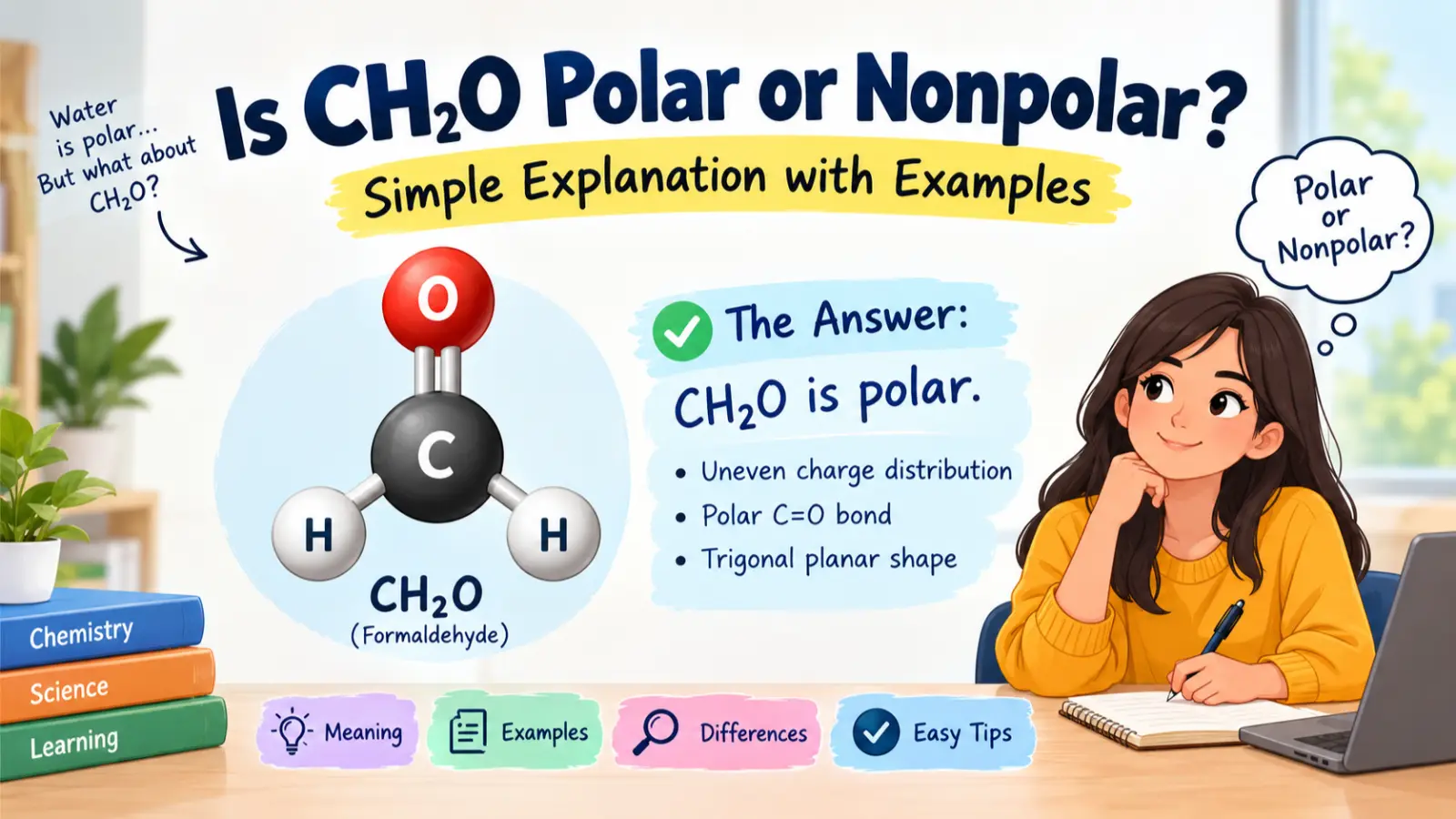
Is CH2O Polar or Nonpolar? This is a common chemistry question for students learning about molecular polarity, chemical bonds, and molecular geometry. CH2O, also known as formaldehyde, contains carbon, hydrogen, and oxygen atoms. Its molecular structure plays an important role in determining how electrical charges are distributed.
One common question students ask is, is CH2O polar or nonpolar? CH2O is the chemical formula for formaldehyde, a simple compound made of carbon, hydrogen, and oxygen. Students often see this question in chemistry homework, school exams, science textbooks, and online searches.
The confusion usually comes from the molecule’s shape and its chemical bonds. Some molecules contain polar bonds but are nonpolar overall because their bond dipoles cancel each other out. Other molecules have an uneven distribution of electrical charge, making them polar.
CH2O is an interesting example because its shape and bond arrangement help explain why the molecule has an overall dipole. Once you understand how the atoms are connected and how electrons are shared, the answer becomes much easier to remember.
Learning this concept can also help you answer similar questions about molecules such as H2O, CO2, and NH3. These examples show how molecular geometry affects polarity.
Is CH2O Polar or Nonpolar? – Quick Answer
CH2O is polar. CH2O, also known as formaldehyde or methanal, has an uneven distribution of electrical charge because oxygen attracts shared electrons more strongly than carbon and hydrogen.
Its molecular shape does not cancel the bond dipoles, so the molecule has a net dipole moment.
Simple definition
- Polar molecule: A molecule with an uneven distribution of electrical charge.
- Nonpolar molecule: A molecule with no overall permanent dipole moment.
- CH2O: A polar molecule with a strong carbon–oxygen bond dipole.
Examples
- CH2O: Polar because its bond dipoles do not cancel.
- H2O: Polar because its bent shape creates a net dipole.
- CO2: Nonpolar because its two equal C=O bond dipoles cancel in its linear shape.
Simple rule: A molecule is polar when its bond dipoles do not cancel each other out.

The Origin of CH2O
CH2O is the molecular formula of formaldehyde, also called methanal. It is the simplest aldehyde, a type of organic compound that contains a carbonyl group.
The formula contains:
- One carbon atom (C)
- Two hydrogen atoms (H)
- One oxygen atom (O)
Carbon forms a double bond with oxygen and single bonds with the two hydrogen atoms. This arrangement creates a molecule with a trigonal planar shape around the carbon atom.
Formaldehyde has been studied for many years in organic chemistry because it is a simple example of a compound containing a carbonyl group.
The name CH2O is commonly used in chemistry questions about molecular geometry, Lewis structures, bond polarity, and dipole moments.
British English vs American English Usage
The answer to whether CH2O is polar or nonpolar is the same in British and American English. The chemical formula and scientific explanation do not change between these varieties of English.
| Feature | British English | American English | Notes |
|---|---|---|---|
| Chemical formula | CH2O | CH2O | Same formula |
| Compound name | Formaldehyde | Formaldehyde | Same common name |
| Systematic name | Methanal | Methanal | Same chemical name |
| Molecular polarity | Polar | Polar | Same scientific result |
| Spelling | Molecule | Molecule | Same spelling |
Some chemistry terms may vary slightly in spelling between British and American English, but the polarity of CH2O remains unchanged worldwide.
Which One Should You Use: Polar or Nonpolar?
When answering the question “is CH2O polar or nonpolar?”, choose polar.
Here is how to explain the answer correctly in different situations:
- In school exams: Write that CH2O is polar because it has a net dipole moment.
- In chemistry homework: Explain that the C=O bond is strongly polar and its dipole is not canceled by the other bonds.
- When drawing a Lewis structure: Show carbon in the center, double-bonded to oxygen and single-bonded to two hydrogen atoms.
- When studying molecular geometry: Identify the shape around carbon as trigonal planar.
- When comparing molecules: Remember that molecular polarity depends on both bond polarity and molecular shape.
For a short-answer exam, you can write:
“CH2O is polar because the C=O bond is strongly polar, and the bond dipoles do not cancel due to the molecule’s arrangement.”
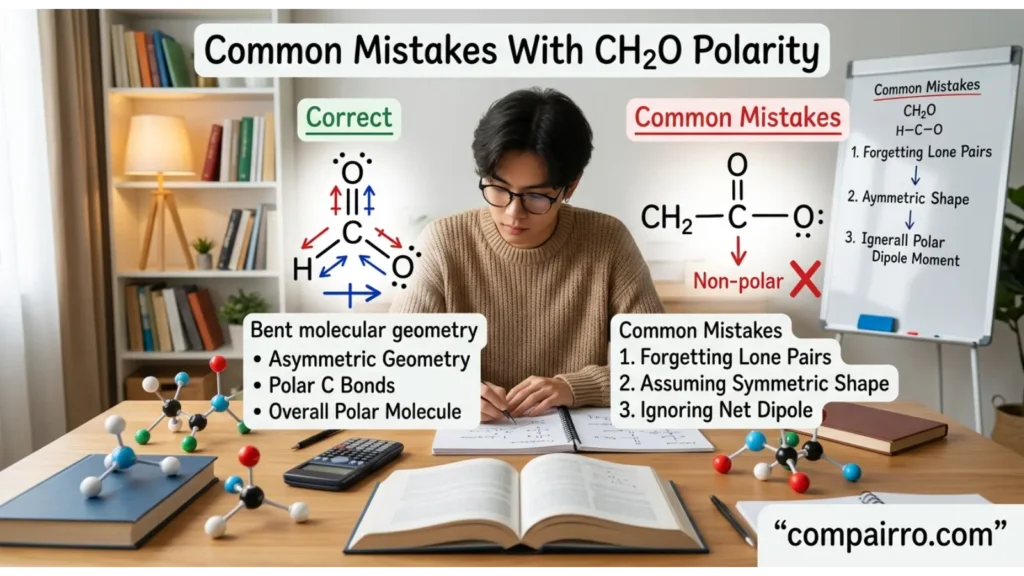
Common Mistakes With CH2O Polarity
Students often make a few mistakes when deciding whether CH2O is polar or nonpolar.
Mistake 1: Thinking all molecules with three atoms or more are polar
❌ Incorrect: Every molecule with several atoms is polar.
✔ Correct: Molecular polarity depends on bond polarity and molecular geometry. For example, CO2 has three atoms but is nonpolar.
Mistake 2: Thinking CH2O is nonpolar because it has a flat shape
❌ Incorrect: CH2O is flat, so it must be nonpolar.
✔ Correct: CH2O is trigonal planar around carbon, but its bond dipoles do not cancel. A flat molecule can still be polar.
Mistake 3: Ignoring the carbon–oxygen bond
❌ Incorrect: Carbon and oxygen share electrons equally.
✔ Correct: Oxygen is more electronegative than carbon, so it attracts the shared electrons more strongly. This makes the C=O bond polar.
Mistake 4: Checking only the individual bonds
❌ Incorrect: If a molecule has polar bonds, its overall polarity must always be polar.
✔ Correct: Some molecules have polar bonds that cancel because of their shape. You must consider the entire molecule.
Mistake 5: Confusing CH2O with CO2
❌ Incorrect: CH2O and CO2 are both nonpolar because both contain carbon and oxygen.
✔ Correct: CH2O is polar, while CO2 is nonpolar. Their different molecular arrangements lead to different overall dipole moments.
CH2O in Everyday Examples
CH2O polarity is mainly a chemistry concept, but learning it helps students understand how molecules behave in scientific and practical settings.
1. At school
A chemistry teacher may ask you to classify CH2O as polar or nonpolar. You can answer by identifying the polar C=O bond and explaining that its dipole is not canceled.
2. During homework
If you need to compare CH2O with CO2, draw both molecular structures. The difference in their arrangements helps explain why one is polar and the other is nonpolar.
3. In science textbooks
CH2O is often used to teach carbonyl chemistry, Lewis structures, molecular geometry, and electronegativity.
4. In laboratories
Formaldehyde is used in certain laboratory and industrial applications. However, it is hazardous and should only be handled with suitable professional safety measures.
5. In online chemistry lessons
Students often search for phrases such as “CH2O polarity,” “CH2O molecular geometry,” and “is formaldehyde polar?” These questions focus on the same basic idea: how the arrangement of atoms affects the distribution of charge.
CH2O – Google Trends and Usage Data
The keyword “is CH2O polar or nonpolar” is an educational search phrase. People usually search for it when studying chemistry or trying to understand a particular molecular structure.
Common reasons for searching include:
- Preparing for chemistry tests and exams.
- Completing school or college assignments.
- Learning about electronegativity and dipole moments.
- Comparing polar and nonpolar molecules.
- Checking molecular geometry or Lewis structures.
Students in the United States, United Kingdom, India, Pakistan, Canada, and Australia may encounter this question in chemistry courses.
However, exact search volumes and country rankings can change over time. Without current Google Trends data, it would not be accurate to claim that one of these countries has the highest search interest.
The topic is especially useful for beginners because it connects three important chemistry concepts: bond polarity, molecular geometry, and overall molecular polarity.
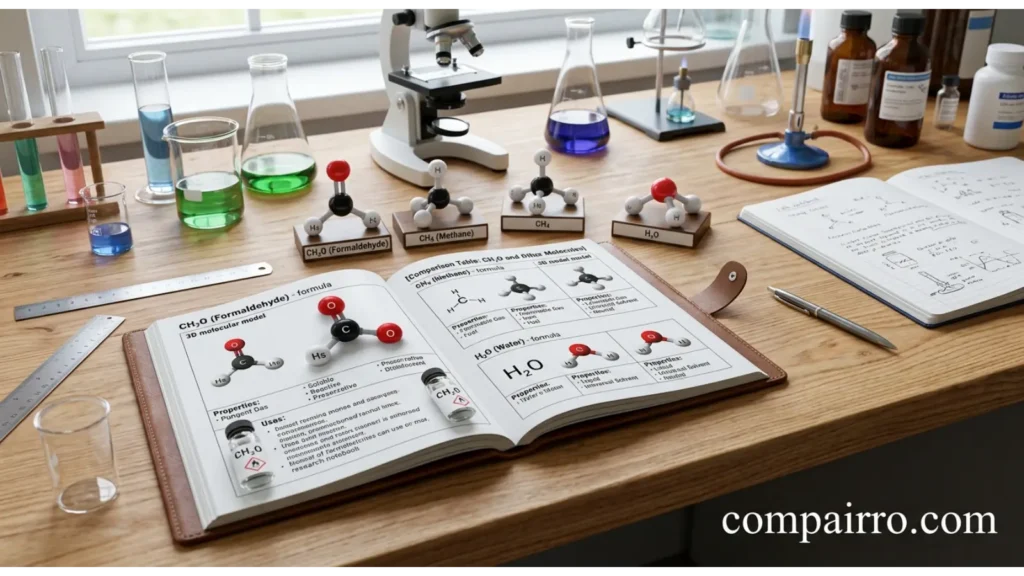
Comparison Table: CH2O and Other Molecules
Comparing CH2O with other common molecules makes the concept of polarity easier to understand.
| Molecule | Molecular shape | Polar or nonpolar? | Main reason |
|---|---|---|---|
| CH2O | Trigonal planar around carbon | Polar | Bond dipoles do not cancel |
| H2O | Bent | Polar | Uneven charge distribution |
| CO2 | Linear | Nonpolar | Equal bond dipoles cancel |
| NH3 | Trigonal pyramidal | Polar | Bond dipoles do not cancel |
| CH4 | Tetrahedral | Nonpolar | Symmetrical arrangement cancels bond dipoles |
| HCl | Diatomic | Polar | Chlorine attracts electrons more strongly |
The important lesson is that molecular polarity depends on more than the number of atoms. You must also consider how the atoms are arranged and how strongly they attract electrons.
CH2O in Professional Life
Understanding CH2O polarity is useful in chemistry, biology, environmental science, and laboratory work.
Formaldehyde is used in some industrial processes and in the production of certain materials. It is also used in controlled laboratory applications, including some specimen-preservation processes.
Knowing its molecular structure helps chemistry students understand how the carbonyl group behaves in organic reactions.
Polarity is also important when scientists study interactions between molecules, chemical reactions, and the behavior of substances in different environments.
Formaldehyde is hazardous, so practical handling requires proper training, ventilation, and safety controls. Its polarity alone does not determine its full health or environmental behavior.
CH2O for Students or Beginners
Students may find CH2O polarity confusing because they need to understand several concepts at the same time.
The easiest approach is to study them in this order:
- Learn electronegativity: Oxygen attracts shared electrons more strongly than carbon and hydrogen.
- Draw the Lewis structure: Place carbon in the center, attach two hydrogen atoms, and double-bond carbon to oxygen.
- Identify the molecular shape: The atoms around carbon form a trigonal planar arrangement.
- Check the bond dipoles: The C=O bond has a strong dipole, and the molecule’s bond dipoles do not cancel.
- State the answer: CH2O is polar.
Easy learning tips
- Practice drawing the Lewis structure instead of memorizing only the answer.
- Compare CH2O with symmetrical molecules such as CO2.
- Remember that molecular shape affects overall polarity.
- Use arrows to show the direction in which bond electrons are attracted.
These steps can help you answer many other molecular polarity questions, too.
Signs or Characteristics Related to CH2O Polarity
The following features help identify CH2O as a polar molecule.
- Polar carbon–oxygen bond: Oxygen attracts the shared electrons more strongly than carbon.
- Uneven charge distribution: The electrons are not distributed evenly throughout the molecule.
- Trigonal planar arrangement: The atoms around carbon lie approximately in one plane.
- Net dipole moment: The bond dipoles do not cancel completely.
- Carbonyl group: The C=O double bond is a key feature of formaldehyde.
- Overall polarity: The molecule has a permanent dipole moment.
These characteristics work together to explain why CH2O is polar rather than nonpolar.
Simple Trick to Remember CH2O Polarity
Here is a simple way to remember the answer:
CH2O = Polar
Think of it this way:
- Oxygen pulls electrons more strongly.
- The C=O bond creates a strong dipole.
- The molecule’s bond dipoles do not cancel.
- Therefore, CH2O is polar.
Now compare it with CO2:
- CO2 has two equal C=O bond dipoles.
- Its linear shape allows those dipoles to cancel.
- Therefore, CO2 is nonpolar.
Memory trick: If the bond dipoles cancel, the molecule is nonpolar. If they do not cancel, the molecule is polar.
Always check the molecule’s shape before deciding.
FAQs:
1. Is CH2O polar or nonpolar?
CH2O is polar because its bond dipoles do not cancel, leaving the molecule with a net dipole moment.
2. Why is CH2O a polar molecule?
Oxygen attracts electrons more strongly than carbon and hydrogen. The molecule’s arrangement creates an uneven distribution of electrical charge.
3. What is the molecular shape of CH2O?
CH2O has a trigonal planar arrangement around its central carbon atom. The atoms are approximately in the same plane.
4. Is the C=O bond in CH2O polar?
Yes. The carbon–oxygen double bond is polar because oxygen is more electronegative than carbon.
5. Does CH2O have a dipole moment?
Yes. CH2O has a net dipole moment because the individual bond dipoles do not cancel completely.
6. Why is CH2O polar but CO2 nonpolar?
CH2O has a bond arrangement that produces a net dipole. CO2 is linear and symmetrical, so its two equal C=O bond dipoles cancel.
7. Is formaldehyde the same as CH2O?
Yes. CH2O is the molecular formula of formaldehyde, whose systematic chemical name is methanal.
Conclusion
So, is CH2O polar or nonpolar? The answer is clear: CH2O is a polar molecule.
Its carbon–oxygen bond is strongly polar because oxygen attracts electrons more strongly than carbon. The arrangement of the atoms means the bond dipoles do not cancel, giving CH2O a net dipole moment.
Remember that molecular polarity depends on both bond polarity and molecular geometry. A molecule can contain polar bonds and still be nonpolar if those bond dipoles cancel, as they do in CO2.
Final memory rule: CH2O is polar because its bond dipoles do not cancel.

Sara Taylor is a passionate English content writer who specializes in word meanings, spelling comparisons, and modern slang explanations. She creates easy-to-understand articles that help readers avoid common English mistakes and improve their writing skills. Her content focuses on simple learning, real-life examples, and clear explanations for everyday readers.