Have you ever stopped while writing a sentence and wondered, “Should I use who or whom?” You are not alone. These two words look very similar, but they have different jobs in a sentence.
For example, you may hear someone say, “Who did you call?” You may also see the more formal version, “Whom did you call?” Both can be understood, but the grammar behind them is different.
People often search for who or whom because this grammar rule can be confusing. The problem becomes even harder because everyday English does not always follow the formal grammar rules taught in school.
You can see who or whom in school assignments, emails, books, workplace writing, interviews, social media posts, and everyday conversations. In casual speech, who is very common. However, whom still appears in formal writing and in certain fixed phrases.
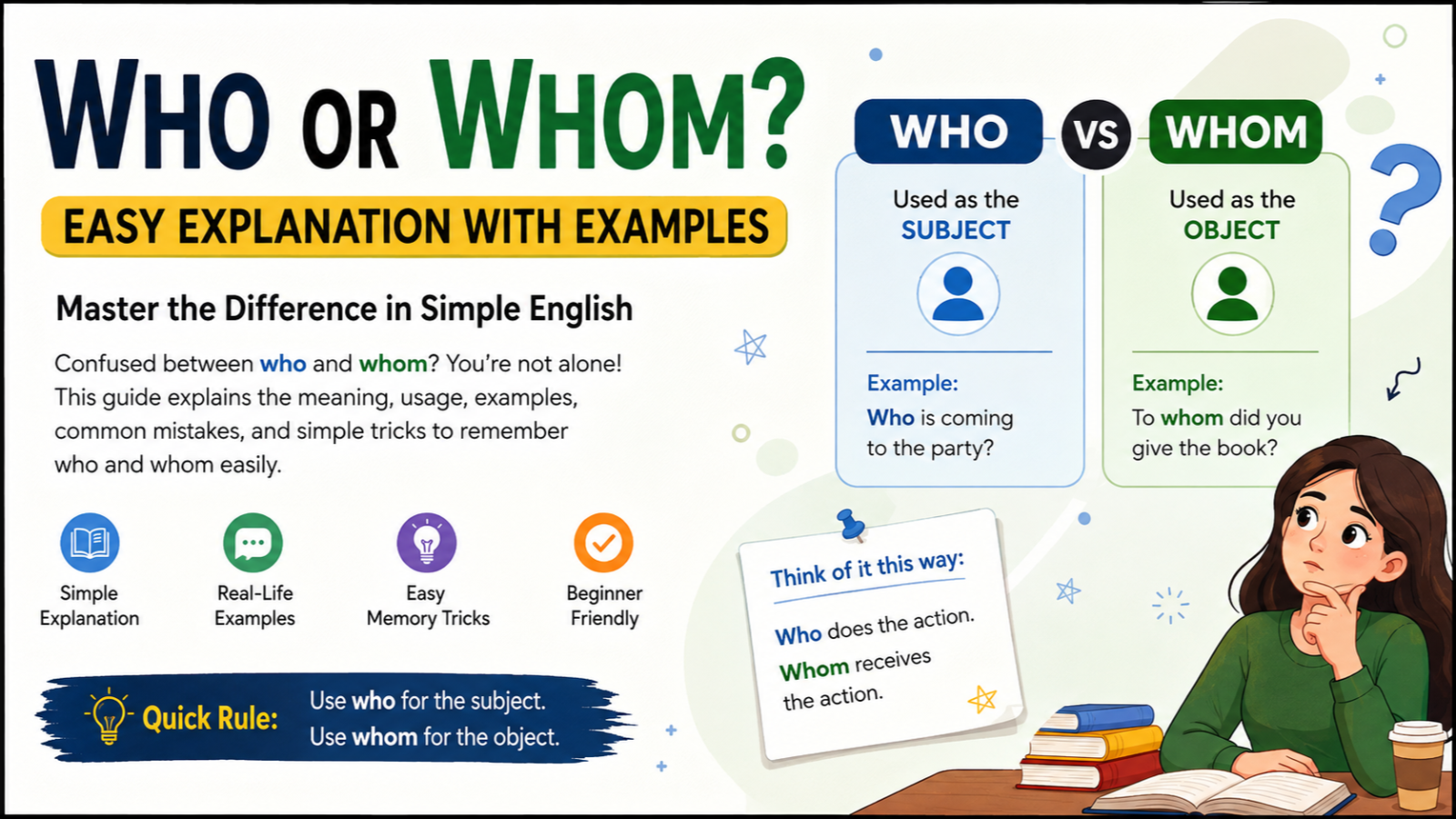
The easiest way to understand the difference is to look at the role of the word in the sentence. Who usually acts as the subject, while whom usually acts as the object.
Once you learn this simple rule, choosing between them becomes much easier.
In this guide, you’ll learn the meaning, examples, usage, differences, common mistakes, and simple explanations in easy English.
WHO OR WHOM – QUICK ANSWER
👉 Who = the person doing the action.
👉 Whom = the person receiving the action or affected by it.
Examples
Who called you?
Here, “who” is doing the calling.
Whom did you call?
Here, “whom” receives the action of calling.
Who is coming to the party?
“Who” is the subject because that person is coming.
Simple Rule
👉 Who = he/she/they
👉 Whom = him/her/them
Think about the answer.
If you can replace the word with he, she, or they, use who.
If you can replace it with him, her, or them, use whom.
For example:
Who did this? → He did this. ✅
Whom did you meet? → I met him. ✅

THE ORIGIN OF WHO OR WHOM
The words who and whom have a long history in English. They come from older forms of English and are related to the same basic question word.
Who developed from an older form used to ask about a person. Whom developed as the object form of the same word.
English once had more grammatical forms for nouns and pronouns. Over time, many of these forms became simpler.
Today, who is much more common in everyday English. Whom is still used, especially in formal writing and after certain prepositions.
For example:
To whom should I send the email?
This sounds formal. In everyday speech, many people would simply say:
Who should I send the email to?
Both are widely understood, but the first follows the traditional formal rule.
BRITISH ENGLISH VS AMERICAN ENGLISH USAGE
There is no major spelling difference between British and American English for who and whom. The main difference is often about how frequently whom is used.
In both varieties, who is common in normal conversation. Whom is more likely to appear in formal writing, official language, academic work, or carefully edited text.
| Feature | British English | American English | Notes |
|---|---|---|---|
| Who | Very common | Very common | Used in everyday English |
| Whom | Formal | Formal | More common in formal writing |
| Casual questions | Who is common | Who is common | Natural in conversation |
| After prepositions | Whom is possible | Whom is possible | More formal |
| Official writing | Whom may appear | Whom may appear | Depends on style |
| Everyday speech | Who is preferred | Who is preferred | Sounds natural |
So, whether you use British or American English, the basic grammar rule remains the same.
WHICH ONE SHOULD YOU USE?
Choosing who or whom depends on the role of the person in the sentence.
Use “who” when:
- The person is doing the action.
- You can replace the word with he, she, or they.
- You are speaking casually.
- You are asking about the subject of a sentence.
Example:
Who sent this message?
You can answer: She sent this message.
Use “whom” when:
- The person receives the action.
- You can replace the word with him, her, or them.
- You are writing formally.
- The word comes after a preposition in formal English.
Example:
Whom did you invite?
You can answer: I invited him.
In casual English
In everyday conversation, who often replaces whom.
For example:
Who did you talk to?
This is very natural.
The more formal version is:
Whom did you talk to?
For school, academic, or professional writing, knowing the traditional rule is still useful.

COMMON MISTAKES WITH WHO OR WHOM
Mistake 1: Using “whom” for every question
❌ Whom is coming to the meeting?
✔ Who is coming to the meeting?
The person is doing the action of coming, so who is correct.
Mistake 2: Using “who” when it is clearly an object
❌ Who did you invite to dinner?
✔ Whom did you invite to dinner?
In formal grammar, “whom” is the object of “invite.”
However, Who did you invite? is very common in everyday English.
Mistake 3: Forgetting the pronoun test
❌ I don’t know whom is responsible.
✔ I don’t know who is responsible.
You can say:
He is responsible.
Because “he” works, who is correct.
Mistake 4: Confusing prepositions
❌ To who should I give this form?
✔ To whom should I give this form?
In formal English, whom is used after “to.”
In casual English, however, people often say:
Who should I give this form to?
Mistake 5: Thinking “whom” is always better
❌ Whom is your best friend?
✔ Who is your best friend?
“Whom” is not a more intelligent version of “who.” It has a different grammatical role.

WHO OR WHOM IN EVERYDAY EXAMPLES
Work
Who is leading the project?
The person is doing the action, so use who.
Whom should I contact about the report?
This is a formal way to ask about the person you should contact.
In normal workplace conversation, you may also hear:
Who should I contact about the report?
School
Who wrote this essay?
The answer might be:
Ali wrote the essay.
So, who is correct.
A formal question could be:
Whom did the teacher choose for the competition?
The answer could be:
The teacher chose Sara.
Social Media
Social media posts usually favor simple, natural English.
For example:
Who is your favorite player?
This sounds natural.
You may also see:
Who did you meet today?
Although traditional grammar may prefer “whom” in the second sentence, who is very common online.
Daily Life
Who is at the door?
Who called me?
Whom did you see at the store?
The first two use who because the person is the subject. The last one uses whom in formal grammar because the person is the object.
Text Messages
Texting is usually informal, so who is much more common.
For example:
Who are you going with?
People rarely choose the very formal:
With whom are you going?
The second sentence is grammatically formal but can sound stiff in a casual text.
WHO OR WHOM – GOOGLE TRENDS & USAGE DATA
People search for who or whom mainly because the two words sound similar and often appear in similar sentences.
Another reason is that modern English does not always follow the traditional rule in casual conversation. This makes learners wonder whether “whom” is still correct.
Search interest for grammar questions can come from many English-speaking and English-learning countries, including the US, UK, India, Pakistan, Canada, and Australia.
Students in countries where English is taught as a second language may especially search questions such as:
- Who or whom?
- When should I use whom?
- Is whom still correct?
- Who vs whom examples
- Who or whom in a sentence
- Who or whom after a preposition
There is no need to treat whom as an old or useless word. It is still used in formal English. However, everyday English has moved strongly toward simpler constructions using who.
Because search trends change over time, exact Google Trends numbers should be checked directly in Google Trends for a specific date and country. The general usage pattern is clear: who is much more common in everyday English, while whom appears more often in formal contexts.
COMPARISON TABLE: WHO OR WHOM
| Feature | Who | Whom |
|---|---|---|
| Main role | Subject | Object |
| Basic meaning | Which person? | Which person? |
| Pronoun test | He/She/They | Him/Her/Them |
| Everyday use | Very common | Less common |
| Formal writing | Common | Common in certain structures |
| Casual speech | Preferred | Less common |
| Example | Who called you? | Whom did you call? |
| After a preposition | Less formal | Traditional formal choice |
| Easy memory | Doer | Receiver |
The biggest difference is not the meaning. Both words ask about a person.
The difference is their grammatical role.
WHO OR WHOM IN PROFESSIONAL LIFE
Knowing who or whom can help you write better emails, reports, applications, and formal documents.
In professional writing, whom is still useful when the sentence has a formal tone.
For example:
To whom it may concern
This is a well-known formal phrase used in letters and official documents.
Another example is:
Whom should we contact for further information?
However, modern professional communication often prefers simpler wording:
Who should we contact for more information?
The best choice depends on the style of the organization and the level of formality.
For most normal workplace messages, clear and natural English is more important than forcing the word whom into every sentence.
WHO OR WHOM FOR STUDENTS OR BEGINNERS
Students often struggle with who or whom because the words have almost the same basic meaning.
The easiest way to learn them is not to memorize long grammar rules. Instead, use the pronoun test.
Step 1: Find the action
Look at the sentence and ask who is doing the action.
Step 2: Try “he” or “him”
For example:
Who/Whom broke the window?
Try:
He broke the window.
“He” works, so use who.
Now try:
Who/Whom did you help?
Try:
I helped him.
“Him” works, so use whom in formal grammar.
Easy learning tips
- Learn who = he/she/they.
- Learn whom = him/her/them.
- Read formal examples.
- Notice how native speakers use “who” in casual speech.
- Do not assume “whom” is always more correct.
- Practice with short sentences first.
SIGNS OR CHARACTERISTICS RELATED TO WHO OR WHOM
Characteristics of “who”
- Usually works as the subject.
- Refers to a person or people.
- Is very common in conversation.
- Is common in questions.
- Is widely used in casual writing.
- Can appear in formal writing too.
Example:
Who wants some tea?
Characteristics of “whom”
- Usually works as the object.
- Refers to a person or people.
- Is more formal.
- Often appears after prepositions.
- Is common in formal phrases.
- May sound unusual in casual conversation.
Example:
Whom did you invite?
Common patterns
Who + verb
Who called?
Which helped you?
Who knows the answer?
Whom + subject + verb
Which did you call?
Whom did she invite?
Whom are they asking?
These patterns can make the difference easier to spot.
SIMPLE TRICK TO REMEMBER WHO OR WHOM
Here is the easiest memory trick:
👉 Who = He/She/They
👉 Whom = Him/Her/Them
Think of it this way:
Who = Doer
Whom = Receiver
For example:
Who called you?
Answer:
He called me.
So, use who.
Now:
Whom did you call?
Answer:
I called him.
So, use whom in formal grammar.
Think of it this way:
If he sounds right, choose who.
If him sounds right, choose whom.
This trick works for many common sentences.
FAQs:
1. What is the main difference between who and whom?
Who is normally the subject, while whom is normally the object of a verb or preposition.
2. Is “who did you call?” grammatically correct?
Yes. It is very common in modern English. In traditional formal grammar, “Whom did you call?” is preferred.
3. Is whom still used in English?
Yes. Whom is still used, especially in formal writing, official phrases, and after prepositions.
4. Which is more common, who or whom?
Who is much more common, especially in everyday conversation and informal writing.
5. Should I use who or whom in formal writing?
Use whom when it is the object and the formal style calls for it. However, clear modern writing often uses who in places where “whom” was traditionally expected.
6. How can I quickly remember who vs whom?
Use this test: who = he/she/they, while whom = him/her/them.
7. Is “to whom” correct?
Yes. “To whom” is grammatically correct and formal. For example: To whom should I send this letter?
CONCLUSION
Understanding who or whom does not have to be difficult. The key is to look at the role of the word in the sentence.
Who is generally used for the person doing the action. Whom is traditionally used for the person receiving the action or following a preposition.
The easiest memory rule is:
👉 Who = he, she, they
👉 Whom = him, her, them
For example, “Who called?” works because he called. Meanwhile, “Whom did you call?” works because you called him.
In everyday English, who is often preferred, even where traditional grammar would use whom. Still, knowing whom is useful for formal writing, academic work, and professional communication.
Once you practice the simple pronoun test, choosing between who or whom becomes much easier.

Sara Taylor is a passionate English content writer who specializes in word meanings, spelling comparisons, and modern slang explanations. She creates easy-to-understand articles that help readers avoid common English mistakes and improve their writing skills. Her content focuses on simple learning, real-life examples, and clear explanations for everyday readers.