
Have you ever looked in the toilet and wondered, “Should poop float or sink?” It may seem like a strange question, but many people notice this and become curious about what it means. Stool can sometimes float on the water, while at other times it sinks to the bottom.
In most cases, there is no need to worry about if poop floats or sinks. The main reason stool floats is often trapped gas. Your diet can also affect how your stool behaves. Foods that contain more fiber can change stool size, texture, and how easily it moves through water.
However, stool changes can sometimes give useful clues about digestion. For example, stool that floats often and looks greasy, oily, pale, or is difficult to flush may be worth discussing with a healthcare professional. One unusual bowel movement usually does not mean something is wrong.
People commonly search “should poop float or sink” because they see a change in the toilet and want a quick answer. This topic can come up during school health lessons, workplace conversations, social media discussions, texting, or simple internet searches. It is also common for people to compare their bowel movements with what they believe is “normal.”
Understanding the difference between a normal change and a lasting digestive problem can help you avoid unnecessary worry. It can also help you know when it may be a good idea to speak with a doctor.
In this guide, you’ll learn the meaning, examples, usage, differences, common mistakes, and simple explanations in easy English.
Should Poop Float or Sink – Quick Answer
👉 Should poop float or sink? = Both can be normal.
Healthy stool can float or sink. Floating stool is often caused by extra gas trapped inside the stool, while denser stool may sink.
Examples
- Poop that sinks: This can be completely normal.
- Poop that floats sometimes: This can also be normal, especially after eating certain foods.
- Poop that floats often and looks greasy: This may need medical attention if it continues.
Simple rule
👉 Occasional floating or sinking = usually not a problem.
👉 A lasting change with other symptoms = worth checking with a healthcare professional.
The position of stool in the toilet alone does not tell you whether you are healthy or unhealthy.
The Origin of “Should Poop Float or Sink?”
The question “should poop float or sink” is not a medical term. It is a simple everyday question people use when they notice how their stool behaves in toilet water.
The word “poop” is an informal English word for feces or stool. “Stool” is more common in medical and healthcare settings.
People have long used stool appearance as a basic way to notice changes in digestion. Modern health information has made questions about stool color, shape, texture, and floating more common online.
Search engines and social media have also made simple health questions easier to ask. As a result, phrases such as “why does my poop float?” and “should poop float or sink?” are common ways people look for basic digestive information.
British English vs American English Usage
There is no major British-versus-American difference in the basic question. People in both countries understand “should poop float or sink?”
The main difference is the level of formality. “Poop” is casual, while “stool” or “feces” is more suitable for medical writing.
| Feature | British English | American English | Notes |
|---|---|---|---|
| Poop | Common informal word | Common informal word | Casual |
| Stool | Common medical term | Common medical term | More formal |
| Feces | Formal/medical | Formal/medical | Used in healthcare |
| Floating stool | Same meaning | Same meaning | No major difference |
| Sinking stool | Same meaning | Same meaning | No major difference |
So, the health meaning is essentially the same in British and American English.
Which One Should You Use?
If you are simply asking about bowel movements, both floating and sinking stool can be normal.
There is no rule saying that healthy poop must always sink.
For everyday conversations:
- Use “poop” in casual conversations.
- Use “stool” when speaking with a doctor.
- Use “bowel movement” in more formal health discussions.
- Focus on other changes, such as color, texture, frequency, or unusual symptoms.
For example, you could ask a doctor:
“My stool has been floating for several days and looks oily. Should I be concerned?”
That gives more useful information than simply saying that your poop floats.
Common Mistakes With Should Poop Float or Sink
Mistake 1: Thinking floating poop is always unhealthy
❌ “My poop floated, so something must be wrong.”
✔ Floating stool can happen because of gas or changes in diet. An occasional floating bowel movement is usually not enough to show that there is a health problem.
Mistake 2: Thinking sinking poop is always healthier
❌ “Healthy poop must sink.”
✔ There is no simple rule that healthy stool must sink. Both floating and sinking can occur normally.
Mistake 3: Looking only at whether stool floats
❌ “It floats, so I don’t need to notice anything else.”
✔ Pay attention to other changes too. Persistent greasy stool, unusual color, diarrhea, pain, weight changes, or other symptoms may be more important.
Mistake 4: Assuming one unusual bowel movement means disease
❌ “My stool looked different once, so I have a digestive disease.”
✔ Stool can change because of food, hydration, fiber, and normal digestive changes. One unusual bowel movement does not usually provide enough information to diagnose a condition.
Mistake 5: Ignoring persistent changes
❌ “It has been floating for weeks, but I will ignore it.”
✔ If a change continues or happens with other concerning symptoms, speak with a healthcare professional.
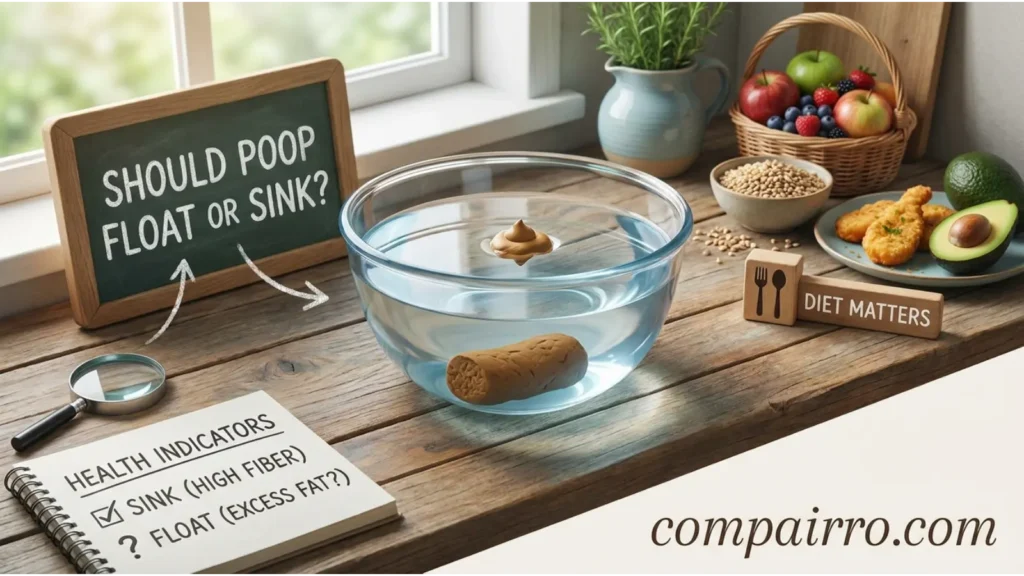
Should Poop Float or Sink in Everyday Examples?
Work
You might notice a change in your bowel movement during a busy workday.
Stress, changes in meals, less activity, or different eating habits can affect digestion. A single floating stool is not usually a reason to panic.
School
Students may learn about digestion and wonder why stool sometimes floats.
A simple explanation is that stool can contain different amounts of gas and other material, which can affect its density.
Social Media
People often ask questions such as:
- “Why does my poop float?”
- “Is floating poop normal?”
- “Should poop float or sink?”
- “Why does my stool look different?”
Online answers can be useful for general information, but social media should not be used to diagnose a health condition.
Daily Life
Your stool may change after eating more fiber-rich foods or after a change in your normal diet.
Hydration and eating habits can also affect bowel movements.
Text Messages
In a casual text, someone might write:
“Is it normal if your poop floats?”
A more formal version would be:
“Is floating stool normal?”
Both communicate the same basic question.
Should Poop Float or Sink – Google Trends & Usage Data
The question “should poop float or sink” is mainly a health-information search. People usually search it because they notice something different about their bowel movement and want a quick explanation.
Related searches often include questions about:
- Why poop floats
- Floating stool causes
- Is floating poop normal?
- Why does my stool sink?
- Greasy or oily stool
- Normal stool appearance
- Stool color and texture
Health questions like these can attract searches from many English-speaking and English-using countries.
People in the US, UK, India, Pakistan, Canada, and Australia may use slightly different terms, but the basic concern is similar: they want to know whether a change in stool is normal.
Search interest can also increase when health topics become popular on social media. However, search popularity does not mean that a particular symptom is dangerous or harmless.
For accurate health information, it is better to use trusted medical sources and talk with a healthcare professional when symptoms continue.
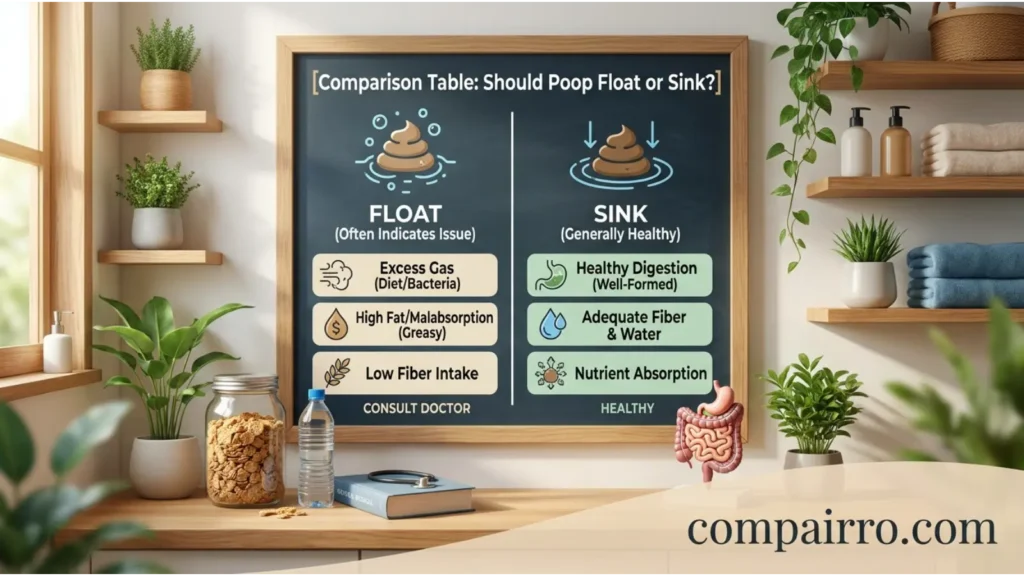
Comparison Table: Should Poop Float or Sink?
| Stool behavior | Possible reason | Usually concerning? |
|---|---|---|
| Sinks normally | Normal stool density | Usually no |
| Floats sometimes | Gas or diet changes | Usually no |
| Floats after certain foods | Dietary changes | Usually no |
| Floats and is hard to flush | May contain more fat or gas | Worth monitoring |
| Floats and looks oily/greasy | May suggest excess fat in stool | Can need medical advice |
| Persistent floating with other symptoms | Possible digestive issue | Speak with a healthcare professional |
| Major lasting stool change | Several possible causes | Should be assessed if persistent |
The key point is that floating versus sinking alone is not a reliable health test.

Should Poop Float or Sink in Professional Life?
In a medical setting, healthcare professionals usually use terms such as stool, bowel movement, or feces instead of “poop.”
If you notice a lasting change, try to describe it clearly.
Useful details include:
- How long the change has lasted
- Whether the stool floats every time or only sometimes
- Whether it looks oily or greasy
- Any change in stool color
- Changes in bowel frequency
- Diarrhea or constipation
- Abdominal pain
- Other new symptoms
This information can help a healthcare professional understand the situation better.
Should Poop Float or Sink for Students or Beginners?
Beginners often struggle with this topic because they expect a single answer: float or sink.
The truth is more simple. Stool does not have to behave exactly the same way every time.
Easy learning tips
- Remember that both can be normal.
- Do not judge health from floating alone.
- Think about recent diet changes.
- Notice whether the change keeps happening.
- Look for other symptoms.
- Ask a healthcare professional if you are concerned.
A good beginner lesson is to focus on patterns, not one bowel movement.
Signs or Characteristics Related to Should Poop Float or Sink
When thinking about stool changes, consider these characteristics:
- Occasional floating: Often not a concern by itself.
- Occasional sinking: Normal for many people.
- Gas: Extra gas can make stool float.
- Diet changes: New foods can change bowel movements.
- Greasy appearance: Persistent oily stool may need medical attention.
- Unusual color: A lasting or concerning color change should be discussed with a healthcare professional.
- Persistent diarrhea: Ongoing diarrhea should be evaluated.
- Abdominal pain: Pain together with stool changes deserves attention.
- Unexplained weight loss: This should be discussed with a healthcare professional.
- Long-lasting changes: A change that does not return to your normal pattern may need evaluation.
These signs do not diagnose a disease on their own. A healthcare professional can look at the complete picture.
Simple Trick to Remember Should Poop Float or Sink
Here is an easy memory trick:
Float sometimes = often normal
👉 Sink sometimes = often normal
👉 Float + persistent unusual changes = check it
Think of it this way:
“Position alone does not tell the whole story.”
For example, if your stool floats once after a change in your diet, there may be no reason to worry.
But if it keeps floating and also appears greasy or you have other ongoing symptoms, it is better to get medical advice.
FAQs:
1. Should poop float or sink?
Both can be normal. Stool may float because of trapped gas or dietary factors, while denser stool may sink.
2. Is floating poop normal?
Occasional floating poop is often normal. However, persistent floating stool with a greasy appearance or other symptoms should be discussed with a healthcare professional.
3. Is sinking poop healthier than floating poop?
No. Healthy stool can float or sink, so its position alone does not show whether it is healthier.
4. Why does poop sometimes float?
Extra gas in the stool is a common reason. Diet and other digestive factors can also affect whether stool floats.
5. When should I worry about floating stool?
If floating stool continues or comes with greasy or oily stool, ongoing diarrhea, pain, unexplained weight loss, or other unusual symptoms, seek medical advice.
6. Can food make poop float?
Yes. Changes in diet can affect stool texture and gas, which may change whether it floats or sinks.
7. Does floating poop mean poor digestion?
Not necessarily. Floating stool can happen for harmless reasons. Persistent changes, especially with other symptoms, should be checked by a healthcare professional.
Conclusion
So, should poop float or sink? The simple answer is that either can be normal. Stool may float because of trapped gas, diet changes, or other harmless factors. Sinking stool is also common.
The most important thing is not to judge your health by if one bowel movement floats or sinks. Instead, pay attention to lasting changes in appearance, texture, frequency, and other symptoms.
If floating stool continues and looks greasy or oily, or if it happens with pain, ongoing diarrhea, unexplained weight loss, or other concerning changes, speak with a healthcare professional.
👉 Easy memory rule: Floating or sinking alone is usually not the main issue; persistent changes and other symptoms matter more.
Understanding your normal bowel pattern can help you notice meaningful changes without becoming worried about every small difference.