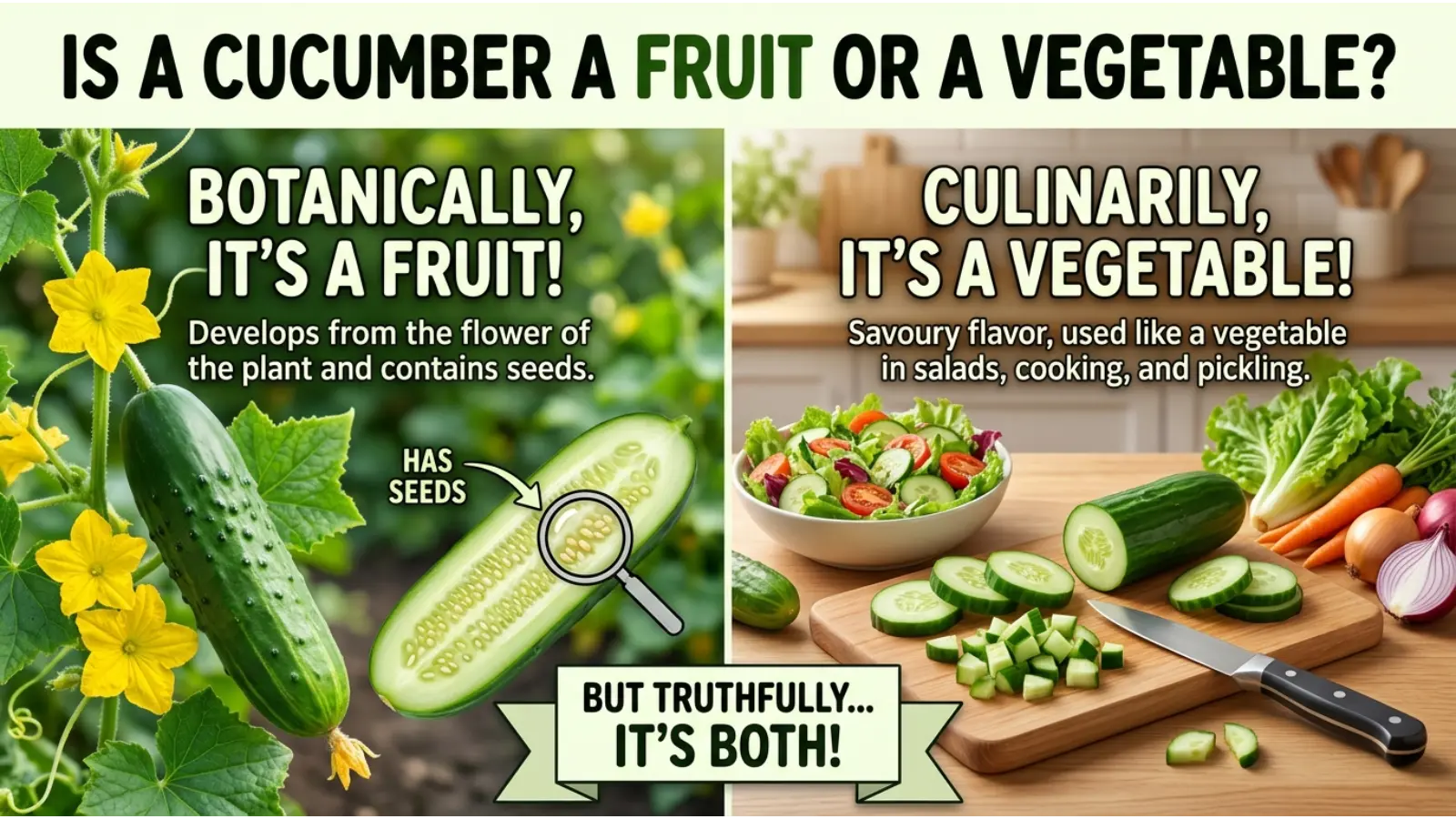
Cucumber a Fruit or Vegetable is a popular question for anyone curious about fruits, vegetables, and healthy eating. Cucumbers are commonly used in salads, sandwiches, and refreshing drinks, so most people consider them vegetables. However, their botanical classification may surprise you. So, is a cucumber a fruit or a vegetable? The answer depends on how you look at it.
The question “cucumber a fruit or vegetable” is common among students, teachers, gardeners, and people who want to understand everyday foods better. The confusion happens because fruits and vegetables can be classified in different ways. In science, the answer depends on how a plant grows and produces its food. In cooking, the answer often depends on taste and how the food is used.
You may come across this question in school science lessons, workplace conversations, food blogs, social media posts, or internet searches. Cucumbers are also popular in countries such as the United States, the United Kingdom, India, Pakistan, Canada, and Australia, where people use them in salads, sandwiches, and many other dishes.
Understanding the difference between a botanical fruit and a culinary vegetable helps you learn more about plants and food. It also explains why some foods, such as tomatoes and cucumbers, belong to one group in science but another in the kitchen.
In this guide, you’ll learn the meaning, examples, usage, differences, common mistakes, and simple explanations in easy English.
Cucumber a Fruit or Vegetable – Quick Answer
Cucumber is botanically a fruit but is commonly treated as a vegetable in cooking.
A botanical fruit develops from the flower of a plant and usually contains seeds. A cucumber grows from a flower and contains seeds inside, so it meets the scientific definition of a fruit.
However, cucumber has a mild, fresh taste and is usually served in salads, sandwiches, and savory meals. For this reason, people commonly call it a vegetable in everyday life.
Examples:
- Science: A cucumber is a fruit because it develops from a flower and contains seeds.
- Cooking: A cucumber is used as a vegetable in salads and sandwiches.
- Daily life: Buying cucumbers from the vegetable section of a grocery store is normal.
Simple rule: If you are talking about plant science, cucumber is a fruit. If you are talking about cooking, it is commonly treated as a vegetable.
The Origin of Cucumber
Cucumbers have been grown by people for thousands of years. They are believed to have originated in the Indian subcontinent, where they were cultivated long before they became common around the world.
The cucumber plant belongs to the gourd family, known as Cucurbitaceae. This family also includes pumpkins, melons, and squash.
Cucumbers spread to different regions through farming and trade. Today, they are grown in many countries and are used in a wide range of meals.
The confusion about whether cucumber is a fruit or vegetable comes from two different ways of classifying food:
- Botanical classification: Based on how a plant grows and produces its fruit.
- Culinary classification: Based on taste and how people prepare and eat the food.
Therefore, cucumber has two common descriptions, depending on the situation.
British English vs American English Usage
There is no major difference between British and American English when classifying cucumbers. In both varieties, cucumber is scientifically a fruit but is generally used as a vegetable in cooking.
The word is also spelled the same way in both countries.
| Feature | British English | American English | Notes |
|---|---|---|---|
| Spelling | Cucumber | Cucumber | Same spelling |
| Botanical classification | Fruit | Fruit | Based on plant science |
| Cooking classification | Vegetable | Vegetable | Common kitchen usage |
| Common dishes | Salads, sandwiches | Salads, sandwiches | Similar uses |
| Taste description | Mild and fresh | Mild and fresh | Generally the same |
In both countries, you can correctly call cucumber a vegetable when discussing food preparation. If you are answering a science question, however, fruit is the more accurate classification.
Which One Should You Use?
The correct term depends on what you are discussing. Both descriptions can make sense, but they are used in different contexts.
Use fruit when:
- You are studying plant biology.
- You are explaining how flowers develop into fruits.
- You are discussing the seeds inside a cucumber.
- You are answering a school science question about botanical classification.
Use vegetable when:
- You are talking about cooking or recipes.
- You are preparing a salad or sandwich.
- You are shopping for ingredients.
- You are discussing everyday eating habits.
For formal science writing, explain that cucumber is a botanical fruit. For recipes and everyday conversation, calling it a vegetable is perfectly normal.

Common Mistakes About Cucumber
Here are five common mistakes people make when discussing cucumber.
Mistake 1: Thinking Every Fruit Is Sweet
❌ Incorrect idea: All fruits must taste sweet.
✔ Correct explanation: Many fruits are not sweet. Cucumbers have a mild, fresh taste, but they are still botanical fruits.
Mistake 2: Believing Cooking Terms and Science Terms Are the Same
❌ Incorrect idea: If people cook it as a vegetable, it cannot be a fruit.
✔ Correct explanation: Culinary and botanical classifications use different rules. A food can be a fruit in science and a vegetable in cooking.
Mistake 3: Thinking Cucumbers Do Not Have Seeds
❌ Incorrect idea: Cucumbers are vegetables because they do not contain seeds.
✔ Correct explanation: Cucumbers contain seeds, usually in the soft center. These seeds are one clue that cucumber is a fruit.
Mistake 4: Assuming All Plant Parts Are Fruits
❌ Incorrect idea: Every part of a plant that people eat is a fruit.
✔ Correct explanation: People eat many different plant parts. For example, carrots are roots, lettuce leaves are leaves, and celery stalks are stems.
Mistake 5: Calling Cucumber a Fruit in Every Situation
❌ Incorrect idea: Calling cucumber a vegetable is always wrong.
✔ Correct explanation: In everyday cooking, cucumber is commonly treated as a vegetable. The term is suitable for normal food conversations.

Cucumber in Everyday Examples
Cucumber is used in many parts of daily life. These examples show how its classification changes with the situation.
At Work
A chef might say, “Please slice the cucumbers for the vegetable salad.”
This is correct because the chef is discussing food preparation rather than plant science.
At School
A science teacher might explain, “Cucumber is a fruit because it develops from the flower of the plant.”
This is correct in a botanical lesson.
On Social Media
Someone might post, “Did you know cucumber is actually a fruit?”
This is a common way to share an interesting science fact online.
In Daily Life
A person might say, “I bought cucumbers and carrots from the vegetable market.”
This is natural everyday language, even though cucumbers are botanically fruits.
In Text Messages
A friend might text, “Can you buy cucumber for our salad?”
There is no need to call it a botanical fruit in an ordinary message. The meaning is clear.
Cucumber – Google Trends and Usage Data
People search for “cucumber a fruit or vegetable” because the answer seems surprising. Many people learn that cucumbers are vegetables when growing up, so discovering their botanical classification creates curiosity.
Search interest can also grow when food facts become popular on social media or appear in school quizzes.
Here is how the topic may be relevant to different countries:
- United States: People may search for cucumber classification for schoolwork, cooking, and general knowledge.
- United Kingdom: The topic may interest gardeners, students, and people learning about food science.
- India: Cucumber is widely eaten in salads and traditional meals, making it a familiar example for science questions.
- Pakistan: People commonly eat cucumber with meals, especially in fresh salads, so the classification can be an interesting general-knowledge topic.
- Canada: Students and home cooks may look up the difference between botanical fruits and culinary vegetables.
- Australia: The question may appear in gardening, food education, and general science discussions.
These are possible reasons for searches, not a verified ranking of countries or measured search volumes.
To check actual search popularity, use Google Trends and compare phrases such as “is cucumber a fruit,” “cucumber fruit or vegetable,” and “fruits and vegetables.” Results can vary by country and time period.
Comparison Table: Cucumber as a Fruit vs Vegetable
The easiest way to understand the difference is to compare the scientific and cooking definitions.
| Feature | Cucumber as a Fruit | Cucumber as a Vegetable |
|---|---|---|
| Classification | Botanical | Culinary |
| Main reason | Develops from a flower | Used in savory meals |
| Seeds | Usually present | Not the main concern |
| Taste | Can be mild or not sweet | Often fresh and mild |
| Common use | Plant science lessons | Salads and sandwiches |
| Example sentence | Cucumber is a fruit botanically. | Add cucumber to the vegetable salad. |
The important point is that these descriptions do not conflict. They simply use different classification systems.
Cucumber in Professional Life
Cucumber classification can be useful in food science, agriculture, gardening, teaching, and nutrition education.
For example, a biology teacher may use cucumber to explain how flowers develop into fruits. A farmer may study cucumber plants to understand pollination, growing conditions, and seed production.
Chefs and food professionals usually focus on taste, texture, preparation, and how an ingredient fits into a dish. They commonly group cucumbers with vegetables because they are used in savory recipes.
Food writers can also use this topic to explain the difference between scientific terms and everyday language.

Cucumber for Students and Beginners
Students often find this question confusing because school lessons may teach that fruits are sweet and vegetables are not. However, sweetness is not the main rule used in botany.
To understand the topic, remember these simple facts:
- A flower can develop into a fruit after pollination and fertilization.
- A botanical fruit contains seeds or develops from the flower’s ovary, although some fruits may have very small or no mature seeds.
- Cucumbers grow from flowers and contain seeds.
- In cooking, the word vegetable is used more broadly for many savory plant foods.
Easy learning tip: Compare a cucumber with a carrot. A cucumber develops from a flower and is botanically a fruit. A carrot is a root that grows underground.
This comparison helps explain why the two foods are classified differently in science, even though both are often found in the vegetable section of a store.
Signs or Characteristics That Make Cucumber a Fruit
Several features help explain why cucumber belongs to the botanical fruit group.
- It develops from a flower: The cucumber grows from the flower of the cucumber plant.
- It contains seeds: The seeds are found inside the cucumber.
- It forms as the plant develops: After successful pollination and fertilization, the flower’s ovary develops into the fruit.
- It belongs to the gourd family: Cucumbers are related to pumpkins, melons, and squash.
- It has a protective outer skin: Its outer covering surrounds the softer inner flesh and seeds.
These features support its botanical classification. Its mild taste and common use in salads explain why people usually treat it as a vegetable in cooking.
Simple Trick to Remember Cucumber Classification
Here is an easy memory trick:
Botany = How a plant grows.
Cooking = How people use food.
Think of it this way:
Imagine looking at a cucumber plant in a garden. You see a flower, and later a cucumber develops from it. That tells you why cucumber is a botanical fruit.
Now imagine slicing the cucumber and adding it to a salad. You are using it as a vegetable in cooking.
You can also remember this simple phrase:
“From a flower, it’s a fruit; in a salad, it’s a vegetable.”
This is a helpful shortcut for remembering the difference. It is not a complete scientific definition, but it captures the main idea.
FAQs:
1. Is cucumber a fruit or vegetable?
Cucumber is botanically a fruit because it develops from a flower and contains seeds. In cooking, it is commonly treated as a vegetable.
2. Why is cucumber called a fruit?
A cucumber develops from the flower’s ovary and contains seeds. These are key features of a botanical fruit.
3. Why do people think cucumber is a vegetable?
People usually eat cucumber in salads, sandwiches, and savory dishes. Its culinary use makes it a vegetable in everyday language.
4. Is cucumber a fruit like a tomato?
Yes. Both cucumbers and tomatoes are botanical fruits because they develop from flowers and contain seeds. However, both are commonly treated as vegetables in cooking.
5. Is cucumber a vegetable in cooking?
Yes. Cucumber is commonly used as a vegetable in salads, sandwiches, and other savory meals.
6. Does cucumber contain seeds?
Yes. Most cucumbers contain seeds inside their central flesh, although seed size and development vary by variety.
7. Is cucumber a fruit or vegetable for school exams?
If the question is about botany, the expected answer is fruit. If it asks about common culinary use, vegetable may be appropriate. Follow the exact wording of the question.
Conclusion
So, is cucumber a fruit or vegetable? The answer depends on how you classify it.
In botany, cucumber is a fruit because it develops from a flower and contains seeds. In cooking, it is commonly treated as a vegetable because people use it in salads, sandwiches, and savory meals.
Neither description is automatically wrong. The important thing is to understand the difference between scientific classification and everyday food use.
Remember this easy rule: Cucumber is a fruit in botany and a vegetable in the kitchen.

Sara Taylor is a passionate English content writer who specializes in word meanings, spelling comparisons, and modern slang explanations. She creates easy-to-understand articles that help readers avoid common English mistakes and improve their writing skills. Her content focuses on simple learning, real-life examples, and clear explanations for everyday readers.