Many people get confused when writing words with “ei” or “ie.”
You may stop while typing words like receive, believe, piece, or their and wonder which spelling is correct.
This confusion happens to students, writers, office workers, and even native English speakers. You often see these spellings in school assignments, emails, social media posts, online searches, and daily conversations.
The problem is that English spelling does not always follow one clear rule. Some words use “ie,” while others use “ei.” That is why people search online for easy ways to remember the difference.
Learning the correct spelling matters because it improves your writing, helps you avoid mistakes, and makes your communication clearer. Whether you are writing an essay, sending a text, or posting online, correct spelling creates a better impression.
In this guide, you’ll learn the meaning, examples, usage, differences, common mistakes, and simple explanations in easy English.
Ei or Ie – Quick Answer
👉 “Ei” and “ie” are letter combinations used in English words.
The correct order depends on the word and spelling rule.
Common Examples
- Believe ✅
- Piece ✅
- Receive ✅
- Friend ✅
Easy Memory Rule
👉 “I before E, except after C”
This means:
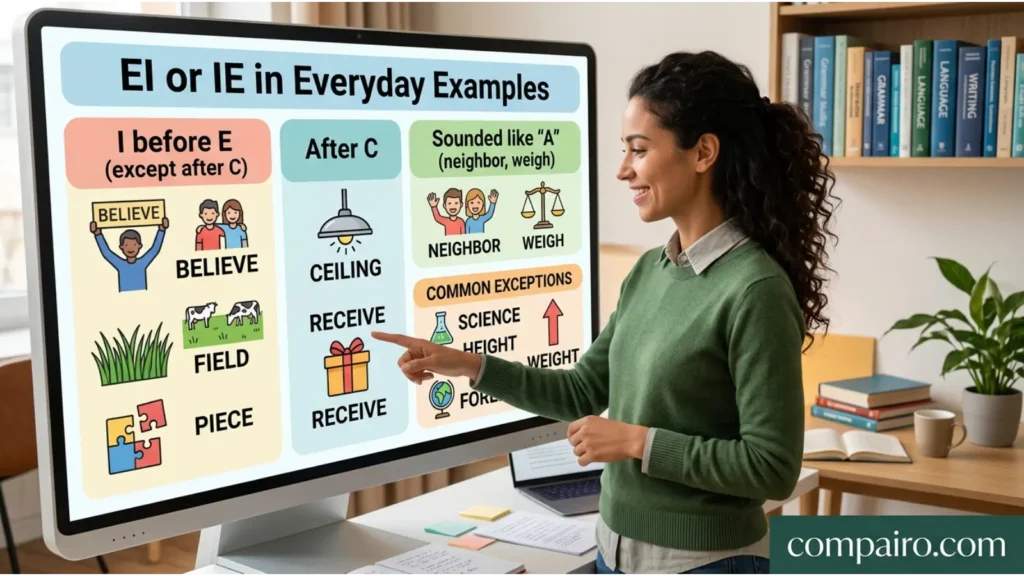
- Use ie → believe, field, chief
- Use ei after the letter c → receive, ceiling, deceive
But remember: English has many exceptions.
The Origin of Ei or Ie
The spelling patterns “ei” and “ie” come from old English, Germanic, and French language influences.
Over time, English borrowed words from many languages. Because of this, spelling rules became mixed and sometimes confusing.
The famous rule:
“I before E, except after C”
became popular in schools to help students remember common spellings. However, not all words follow this rule.
Today, people still search for “ei or ie” because spelling mistakes are common in texting, emails, schoolwork, and online writing.
British English vs American English Usage
For “ei” and “ie,” the spelling rules are mostly the same worldwide.
| Feature | British English | American English | Notes |
|---|---|---|---|
| Believe | Believe | Believe | Same spelling |
| Receive | Receive | Receive | Same spelling |
| Friend | Friend | Friend | Same spelling |
| Weird | Weird | Weird | Exception to rule |
👉 There is no major difference between British and American English for these spellings.
Which One Should You Use?
You should use the spelling that matches the correct English word.
Use “ie” in many common words:
- Believe
- Friend
- Piece
- Field
Use “ei” after “c”:
- Receive
- Ceiling
- Deceive
Important Tips
- In formal writing, always double-check spelling.
- In texting, people may ignore spelling rules, but correct spelling still looks better.
- In school and workplace writing, spelling matters a lot.
- Spellcheck tools can help, but learning the rule is useful.
Common Mistakes With Ei or Ie
Mistake 1
❌ Recieve
✔ Correct spelling: Receive
Because it comes after the letter “c.”
Mistake 2
❌ Beleive
✔ Correct spelling: Believe
Use “ie” here.
Mistake 3
❌ Freind
✔ Correct spelling: Friend
This is an exception to the rule.
Mistake 4
❌ Ceilding
✔ Correct spelling: Ceiling
Use “ei” after “c.”
Ei or Ie in Everyday Examples
Work
- “Please receive the attached file.”
- “I believe the meeting starts at 2 PM.”
School
- “The student got a small piece of cake.”
- “Our classroom has a high ceiling.”
Social Media
- “I can’t believe this trend!”
- “That meme feels weird.”
Daily Life
- “My friend called me yesterday.”
- “She bought a new field guide.”
Text Messages
- “Did you receive my text?”
- “I believe you’re right.”
Ei or Ie – Google Trends & Usage Data

People search for “ei or ie” because spelling confusion is very common.
Students often search before exams or homework. Adults also check spellings while writing emails, resumes, or online posts.
Popular Countries Searching This Topic
- United States
- United Kingdom
- India
- Pakistan
- Canada
- Australia
Why the Keyword Is Popular
- English spelling rules are confusing
- Many words break the standard rule
- Students want quick memory tricks
- Social media and texting increase spelling mistakes
The search trend stays popular every year because English learners around the world face the same problem.
Comparison Table: Ei or Ie
| Pattern | Example Words | Simple Rule | Common Confusion |
|---|---|---|---|
| ie | believe, field, piece | Usually “i” before “e” | People reverse letters |
| ei | receive, ceiling | Often after “c” | Easy to miss rule |
| Exceptions | weird, friend, foreign | Rule does not always work | Causes confusion |
Ei or Ie in Professional Life
Correct spelling is important in professional communication.
In workplaces, spelling mistakes can:
- Make emails look unprofessional
- Create confusion
- Affect school or job applications
Using the correct spelling helps people trust your writing more.
For example:
- “Please confirm you received the report.”
- “We believe this plan will work.”
Good spelling also helps content writers, bloggers, teachers, and students.
Ei or Ie for Students or Beginners
Many beginners struggle with “ei” and “ie” because English has many exceptions.
Common Learning Problems
- Forgetting the rule
- Mixing letters while typing fast
- Memorizing exception words
Easy Tips
- Learn common words first
- Practice writing daily
- Use spelling apps or flashcards
- Read more English books and articles
The more you see correct spelling, the easier it becomes to remember.
Signs or Characteristics Related to Ei or Ie
Common Features
- Both are vowel combinations
- Used in many English words
- Often sound similar
- Cause spelling confusion
Signs or Characteristics
- “ie” appears in many basic words
- “ei” often follows “c”
- Some words break the rule completely
Common Exception Words
- Weird
- Friend
- Foreign
- Science
Simple Trick to Remember Ei or Ie
👉 I before E, except after C
This is the easiest beginner rule.
Think of it this way:
- Believe → “i” comes first
- Receive → after “c,” use “ei”
But remember:
👉 English has exceptions like weird and friend.
A simple trick:
- If you see the letter c, check for ei
- Otherwise, many words use ie
FAQS:
Is “i before e except after c” always correct?
No. Many English words break this rule, like weird and friend.
Why is “receive” spelled with “ei”?
Because it comes after the letter “c.”
Is “believe” spelled with ie or ei?
The correct spelling is believe with “ie.”
Why do people confuse ei and ie?
The words often sound similar, so spelling becomes tricky.
Are British and American spellings different for ei or ie?
No. Most words use the same spelling worldwide.
What is the easiest way to remember ei or ie?
Use the rule: “I before E, except after C.”
Which words are exceptions to the rule?
Examples include weird, friend, and foreign.
Conclusion
Understanding “ei or ie” can make English spelling much easier. While the rule “I before E, except after C” helps in many cases, there are still important exceptions to remember.
The best way to improve is through reading, writing, and practice. Over time, correct spellings will start to feel natural.
👉 Final easy memory rule:
Use “ie” in most words, but use “ei” after “c.” Always watch for exceptions.

Sara Taylor is a passionate English content writer who specializes in word meanings, spelling comparisons, and modern slang explanations. She creates easy-to-understand articles that help readers avoid common English mistakes and improve their writing skills. Her content focuses on simple learning, real-life examples, and clear explanations for everyday readers.