Have you ever placed water in a freezer and watched it turn into ice? You may know that water freezes when it gets cold, but have you ever wondered what happens to its energy during this process? This is where the question “is freezing endothermic or exothermic” becomes important.
Freezing is a common physical change that happens in everyday life. Water turns into ice, juice becomes frozen popsicles, and liquid substances can become solids when their temperature drops enough. Although these changes may seem simple, they help explain an important idea in science: heat transfer.
Many students get confused between endothermic and exothermic processes. Both terms describe how heat moves during a physical or chemical change. An endothermic process absorbs heat from its surroundings, while an exothermic process releases heat into its surroundings.
Understanding this difference can help you answer science questions, complete homework, prepare for exams, and understand real-life events. You may come across this topic in school science lessons, chemistry textbooks, online learning platforms, and educational videos on social media.
The good news is that freezing is easy to understand once you know what happens to heat energy. You do not need advanced chemistry knowledge to learn the basic concept. A few simple examples can make everything clear.
In this guide, you’ll learn the meaning, examples, usage, differences, common mistakes, and simple explanations in easy English.
Is Freezing Endothermic or Exothermic? – Quick Answer
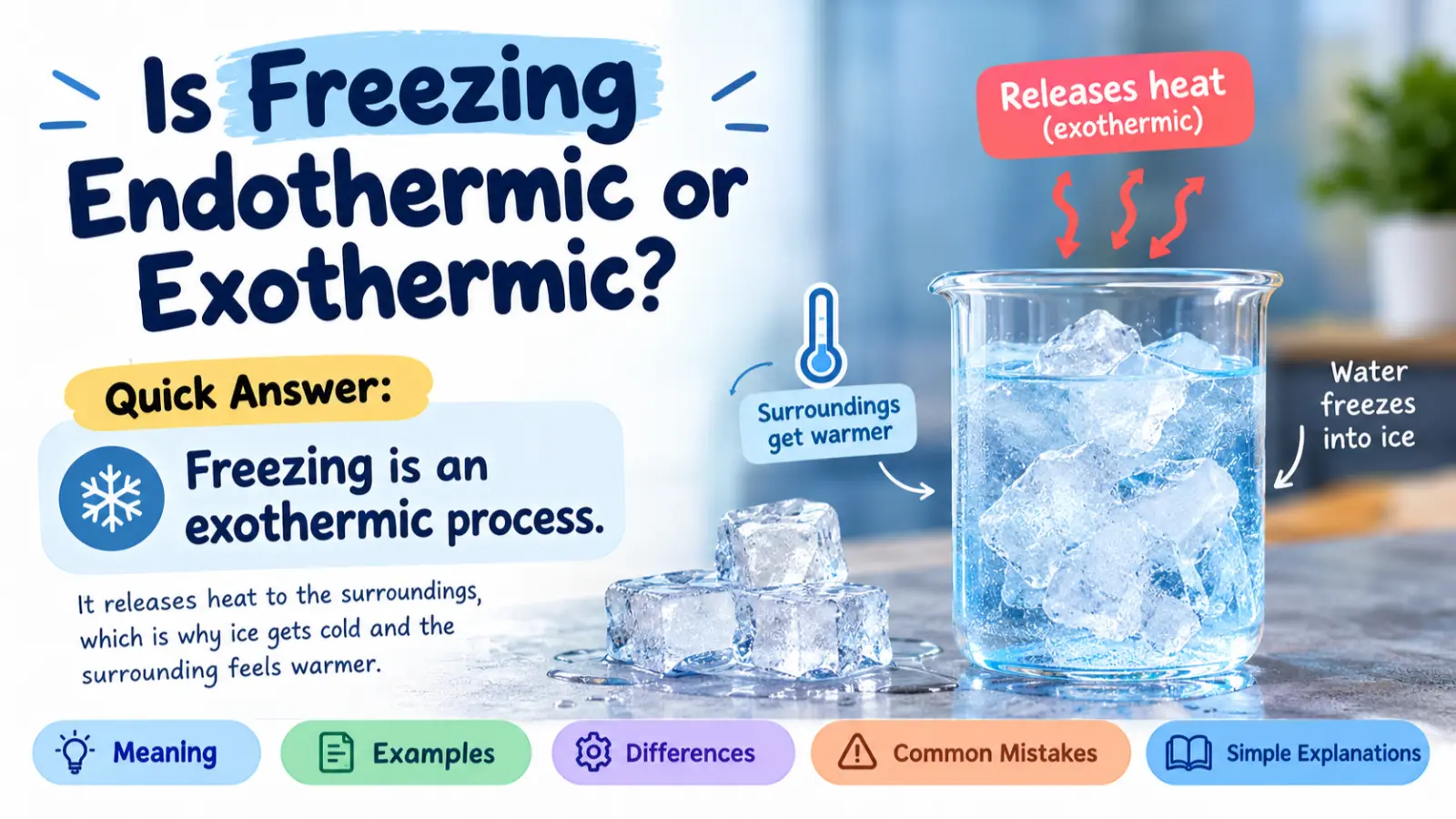
Freezing is an exothermic process because a substance releases heat energy into its surroundings as it changes from a liquid to a solid.
In simple words, freezing happens when a liquid loses energy and its particles become arranged in a more fixed structure.
For example:
- Water freezing: Liquid water releases heat as it becomes ice.
- Juice freezing: Liquid juice releases heat while turning into a frozen treat.
- Molten wax freezing: Liquid wax releases heat as it becomes solid.
Simple rule: Freezing releases heat, so it is exothermic.
Remember that the substance does not have to become warmer during freezing. Instead, it transfers heat to its surroundings while its own temperature usually stays constant during the phase change of a pure substance at a given pressure.
The Origin of Freezing and Its Scientific Background
Freezing is a natural process that people have observed for thousands of years. Early humans noticed that water could turn into ice when exposed to very cold conditions, long before scientists understood heat energy at the particle level.
The scientific explanation became clearer as researchers developed ideas about temperature, energy, and the states of matter.
The words endothermic and exothermic come from Greek word roots related to heat. The prefix “endo-” means inside, while “exo-” means outside. The word “thermic” relates to heat.
In science, these terms describe energy transfer:
- Endothermic: A process absorbs heat from its surroundings.
- Exothermic: A process releases heat into its surroundings.
Freezing belongs to the exothermic category because heat leaves the substance as its particles settle into a solid structure.
Today, this concept is widely taught in schools and explained through online science lessons, educational websites, and videos.
British English vs American English Usage
The scientific meaning of freezing is the same in British English and American English. Both use the terms freezing, endothermic, and exothermic in the same way.
There is no major difference in the scientific explanation between the two varieties of English.
| Feature | British English | American English | Notes |
|---|---|---|---|
| Main term | Freezing | Freezing | Same spelling |
| Scientific term | Exothermic | Exothermic | Same meaning |
| Opposite process | Melting | Melting | Same spelling |
| Common example | Water turns into ice | Water turns into ice | Same process |
| Temperature unit | Celsius is common | Fahrenheit is common | Both use Celsius in science |
For example, a British student and an American student can both write: “Freezing is an exothermic process because heat is released.”
The temperature scale used in an everyday example may differ, but the science remains the same.
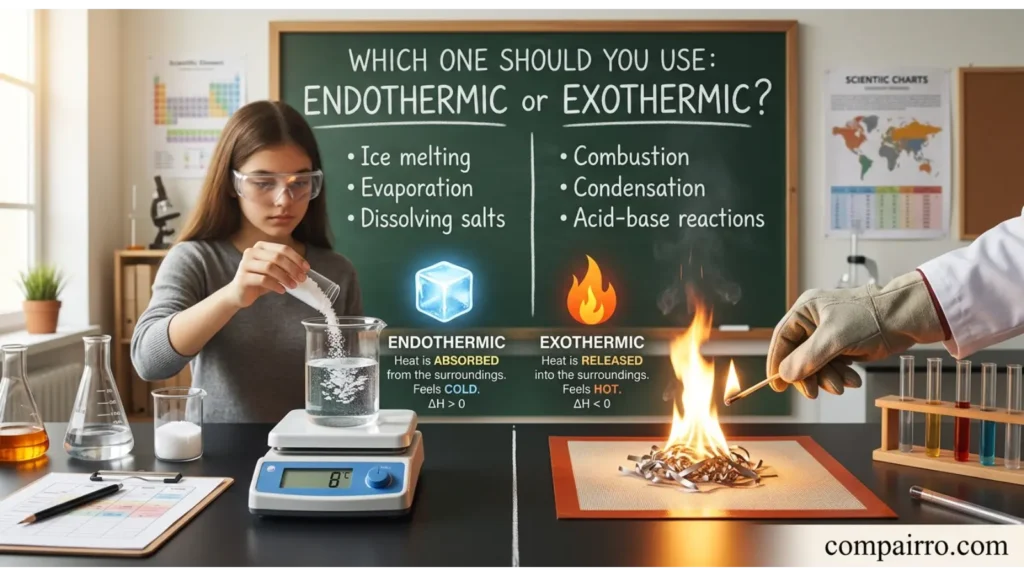
Which One Should You Use: Endothermic or Exothermic?
When answering the question “is freezing endothermic or exothermic,” you should use exothermic.
Here is when and how to use the term correctly:
- In school exams: Write that freezing is exothermic because heat is released.
- In chemistry homework: Explain that heat moves from the freezing substance to its surroundings.
- In everyday science: Use water turning into ice as a simple example.
- In scientific writing: Describe freezing as an exothermic phase change.
- When comparing processes: Remember that freezing releases heat, while melting absorbs heat.
Freezing is a physical change, not a chemical reaction. The substance keeps its chemical identity during the process. For example, liquid water and ice are both H₂O.
A useful exam answer is:
“Freezing is exothermic because a liquid releases latent heat to its surroundings when it changes into a solid.”
Common Mistakes About Freezing
Students sometimes confuse heat transfer with temperature. Here are five common mistakes and how to avoid them.
Mistake 1: Saying Freezing Is Endothermic
❌ Incorrect: Freezing is endothermic because the liquid becomes cold.
✔ Correct: Freezing is exothermic because the liquid releases heat to its surroundings.
A substance becoming cold does not mean it absorbs heat during the change.
Mistake 2: Thinking Heat and Temperature Are the Same
❌ Incorrect: The substance must become hotter if it releases heat.
✔ Correct: Heat is energy transferred between objects or systems, while temperature measures how hot or cold something is.
During freezing, a pure substance can release heat while remaining at the same temperature until the phase change is complete.
Mistake 3: Confusing Freezing With Melting
❌ Incorrect: Freezing and melting are both exothermic.
✔ Correct: Freezing is exothermic, while melting is endothermic under ordinary conditions.
Freezing releases heat; melting absorbs heat.
Mistake 4: Thinking Freezing Changes the Substance Into a New Chemical
❌ Incorrect: Water becomes a different chemical when it freezes.
✔ Correct: Water remains H₂O in both liquid and solid forms.
Freezing changes the physical state, not the chemical identity.
Mistake 5: Assuming Freezing Always Happens at 0°C
❌ Incorrect: Every liquid freezes at 0°C.
✔ Correct: Pure water freezes at approximately 0°C (32°F) under normal atmospheric pressure. Other substances have different freezing points, and dissolved substances can change water’s freezing point.
Freezing in Everyday Examples
Freezing is easy to understand when you connect it to things you see every day.
1. Work and Industry
In food factories, liquids are cooled to make frozen products. As the liquid changes into a solid, it releases heat that must be removed by the cooling system.
For example, ice cream production involves removing heat from the mixture so that it freezes.
2. School Science
A science teacher may place water in a freezer to demonstrate a change of state.
The water loses heat as it becomes ice. This makes freezing a useful example of an exothermic physical process.
3. Social Media and Online Learning
Educational videos often explain endothermic and exothermic processes with simple examples, such as ice cubes, melting chocolate, and boiling water.
If you see a video asking whether freezing is endothermic or exothermic, the correct answer is exothermic.
4. Daily Life
When water freezes in an ice tray, it releases heat into the surrounding environment. The freezer removes this energy to keep the water cold enough to become ice.
Similarly, liquid candle wax releases heat as it cools and solidifies.
5. Weather and Nature
When liquid water freezes on a cold surface, it releases heat to its surroundings. This heat transfer can affect the temperature of the nearby surface and air.
The amount of heat released depends on the amount of water and the conditions involved.
Is Freezing Endothermic or Exothermic? Google Trends and Usage Data
People search for “is freezing endothermic or exothermic” mainly because they want a quick, clear answer for science homework, chemistry exams, or general learning.
The question is especially useful for beginners who are learning the difference between heat absorption and heat release.
Search interest may come from students, teachers, parents, and people watching science lessons online.
The topic can be relevant to learners in several countries:
- United States: Students often study phase changes in middle school and high school science.
- United Kingdom: Chemistry lessons cover changes of state and energy transfer.
- India: Students may search for simple explanations to prepare for school examinations.
- Pakistan: Learners may use online resources to understand chemistry concepts and prepare for tests.
- Canada: Science courses teach freezing, melting, and other changes of state.
- Australia: Students learn about matter, temperature, and energy in science classes.
However, these examples do not establish which country has the highest search volume. Exact rankings and changes over time require current Google Trends data for the specific keyword and selected time period.
The topic also appears in educational videos and online quizzes because it is a common science question with a short answer and a clear explanation.
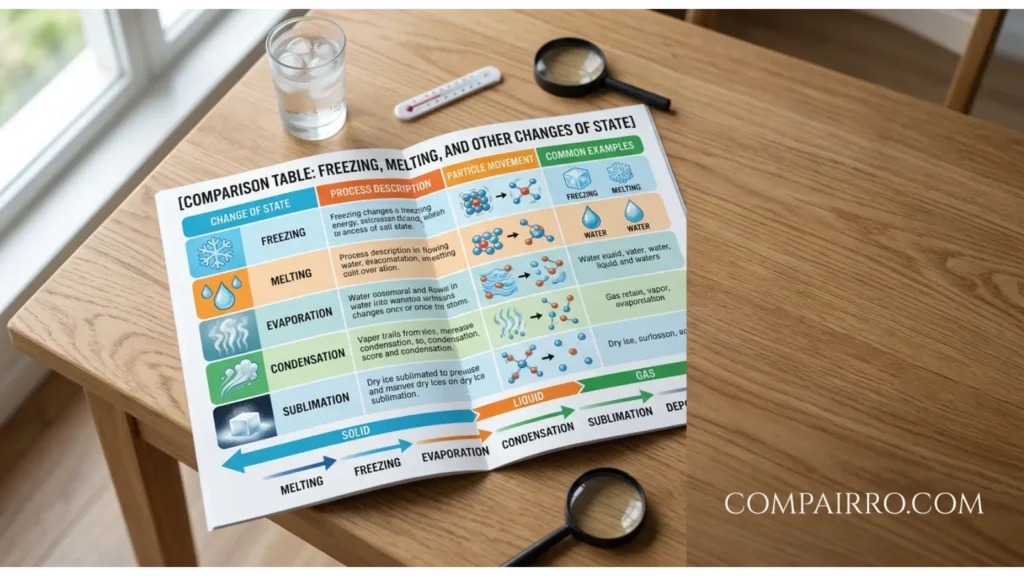
Comparison Table: Freezing, Melting, and Other Changes of State
Comparing different processes makes it easier to understand why freezing is exothermic.
| Process | Change of State | Heat Transfer | Type |
|---|---|---|---|
| Freezing | Liquid to solid | Heat released | Exothermic |
| Melting | Solid to liquid | Heat absorbed | Endothermic |
| Condensation | Gas to liquid | Heat released | Exothermic |
| Evaporation | Liquid to gas | Heat absorbed | Endothermic |
| Sublimation | Solid to gas | Heat absorbed | Endothermic |
| Deposition | Gas to solid | Heat released | Exothermic |
The main pattern is simple: changes toward a more tightly held, ordered state, such as freezing and condensation, release heat under ordinary conditions. Changes that require particles to move farther apart, such as melting and evaporation, absorb heat.
These are physical changes. They do not usually create a new chemical substance.
Freezing in Professional Life
Understanding freezing and heat transfer is useful in many jobs and industries.
Food production: Food manufacturers use freezing to preserve products and control their texture. They must remove heat from food efficiently.
Refrigeration and air conditioning: Technicians study heat transfer to understand how cooling systems remove energy from spaces and products.
Scientific research: Scientists use freezing methods to preserve samples, study materials, and control temperature during experiments.
Medicine and laboratories: Some biological samples and laboratory materials are stored at low temperatures to help preserve them. The correct temperature depends on the material.
Weather science: Meteorologists study freezing conditions to understand frost, ice formation, and winter weather.
In each case, knowing how heat moves helps people understand and control the process.

Freezing for Students and Beginners
Beginners often struggle with this topic because they think that a cold substance must absorb heat. However, the important question is not simply whether the substance feels cold. It is whether heat enters or leaves the substance during the process.
Use these learning tips:
- Learn the definitions: Endothermic means heat absorbed; exothermic means heat released.
- Picture an ice cube: Liquid water releases heat as it becomes ice.
- Compare opposite processes: Freezing releases heat, but melting absorbs heat.
- Remember the state change: Freezing means liquid to solid.
- Practise short answers: Explain both the process and the direction of heat transfer.
For exams, avoid writing only “freezing is exothermic.” Add a short reason to show that you understand the concept.
A stronger answer is: “Freezing is exothermic because heat energy is released from the liquid into its surroundings during the change from liquid to solid.”
Signs and Characteristics of Freezing
Freezing has several important features that help identify it as an exothermic process.
- Liquid changes into a solid: This is the main feature of freezing.
- Heat is released: Energy moves from the substance to its surroundings during the phase change.
- Particles become more ordered: In a typical solid, particles occupy fixed positions and vibrate around them.
- Temperature can remain constant: A pure substance generally stays at its freezing point while the phase change takes place at constant pressure.
- The chemical identity remains the same: Water remains H₂O when it turns into ice.
- The freezing point depends on conditions: Pressure and dissolved substances can affect the temperature at which freezing occurs.
- Cooling helps freezing begin: A liquid usually needs to lose enough energy to reach its freezing conditions.
One important detail is that the particles do not stop moving completely. In a solid, they still vibrate, even though they cannot move around freely as they do in a liquid.
Simple Trick to Remember Whether Freezing Is Endothermic or Exothermic
Here is an easy memory trick:
Freezing = Heat Flows Out = Exothermic
Melting = Heat Moves In = Endothermic
Think of it this way: when liquid water becomes ice, it releases energy to the surroundings. When ice melts into water, it absorbs energy from the surroundings.
Imagine holding an ice cube in a warm room. Heat moves from the warmer surroundings into the ice, helping it melt. The reverse phase change, freezing, releases heat from the substance as it becomes solid.
You can also remember these two short rules:
- Exo = Exit: Heat exits the substance during freezing.
- Endo = Enter: Heat enters the substance during melting.
These are memory aids rather than complete scientific definitions, but they are useful for basic chemistry questions.
FAQs:
1. Is freezing endothermic or exothermic?
Freezing is exothermic because the substance releases heat to its surroundings as it changes from a liquid to a solid.
2. Why is freezing an exothermic process?
During freezing, particles lose energy as they form a solid structure. The substance releases heat into its surroundings.
3. Is melting endothermic or exothermic?
Melting is endothermic because a solid absorbs heat from its surroundings to become a liquid.
4. Does freezing release heat?
Yes. Freezing releases heat during the change of state. For pure water freezing at constant pressure, this happens while the water remains near its freezing point.
5. Is condensation endothermic or exothermic?
Condensation is exothermic. It happens when a gas changes into a liquid and releases heat to its surroundings.
6. Does temperature increase during freezing?
For a pure substance at constant pressure, the temperature usually stays constant during the phase change. After freezing is complete, further cooling can lower the solid’s temperature.
7. Is freezing a chemical or physical change?
Freezing is a physical change because the substance changes its state without normally changing its chemical identity. For example, liquid water and ice are both H₂O.
Conclusion
So, is freezing endothermic or exothermic? Freezing is exothermic because it releases heat energy into the surroundings as a liquid changes into a solid.
This process occurs when water becomes ice, liquid wax becomes solid, or other suitable liquids freeze. During the phase change, particles become more ordered, and the substance releases energy.
The most important difference to remember is that freezing releases heat, while melting absorbs heat. Both are physical changes, so the chemical identity of the substance remains the same.
For schoolwork and exams, use this simple memory rule: freezing releases heat, so it is exothermic; melting absorbs heat, so it is endothermic.

Sara Taylor is a passionate English content writer who specializes in word meanings, spelling comparisons, and modern slang explanations. She creates easy-to-understand articles that help readers avoid common English mistakes and improve their writing skills. Her content focuses on simple learning, real-life examples, and clear explanations for everyday readers.