Have you ever seen the words tardies and tardys and wondered which one is correct? This is a common question, especially for students, teachers, parents, and anyone who deals with school attendance records.
The confusion usually happens because many English words ending in -y change when they become plural. Some people write tardys, while others use tardies. When both spellings appear online, it can be difficult to know which one is right.
You may see this word in school reports, attendance systems, emails from teachers, educational websites, social media discussions, and online searches. Since attendance is important in schools and workplaces, understanding the correct spelling helps you communicate clearly and professionally.
Using the wrong spelling may not seem like a big problem, but correct grammar and spelling can improve writing quality and reduce confusion. Whether you are a student, teacher, parent, or writer, knowing the correct form is useful.
In this guide, you’ll learn the meaning, examples, usage, differences, common mistakes, and simple explanations in easy English.
Tardies or Tardys – Quick Answer
👉 Tardies is the correct plural form.
👉 Tardys is incorrect in standard English.
Meaning of tardies:
“Tardies” refers to multiple instances of being late, especially in school attendance records.
Examples
1 Sarah received three tardies this month.
2 Too many tardies can affect a student’s attendance record.
3 The teacher recorded several tardies during the semester.
Simple Rule
👉 When a word ends in consonant + y, change y to ies for the plural.
Tardy → Tardies
The Origin of Tardies
The word tardy comes from the Latin word tardus, which means “slow” or “late.”
Over time, English adopted the word tardy to describe someone who arrives late. Schools especially began using the term to track late arrivals.
As attendance systems became more organized, the plural form tardies became common in school records, report cards, and educational software.
Today, the word is widely used in schools across many English-speaking countries.
British English vs American English Usage
There is very little difference between British and American English regarding this word.
Both varieties understand tardy, but it is used more frequently in American schools.
| Feature | British English | American English | Notes |
|---|---|---|---|
| Singular Form | Tardy | Tardy | Same spelling |
| Plural Form | Tardies | Tardies | Same spelling |
| School Usage | Less common | Very common | US schools use it often |
| Meaning | Late arrival | Late arrival | Same meaning |
Which One Should You Use?
You should always use tardies when talking about more than one late arrival.
Use “tardies” for:
- School attendance reports
- Teacher records
- Educational writing
- Student discussions
- Official documents
Formal Usage
✅ The student accumulated five tardies.
Informal Usage
✅ I already have two tardies this semester.
Avoid
❌ Tardys
This spelling is not considered correct in standard English.
Common Mistakes With Tardies or Tardys

Mistake 1
❌ The student has three tardys.
✔ The student has three tardies.
Mistake 2
❌ Tardy’s are increasing this semester.
✔ Tardies are increasing this semester.
Explanation: Apostrophes are not used to make regular plurals.
Mistake 3
❌ She got many tardy.
✔ She got many tardies.
Explanation: Use the plural form when referring to multiple late arrivals.
Mistake 4
❌ Tardys can affect attendance records.
✔ Tardies can affect attendance records.
Explanation: Change y to ies when making the word plural.
Tardies or Tardys in Everyday Examples
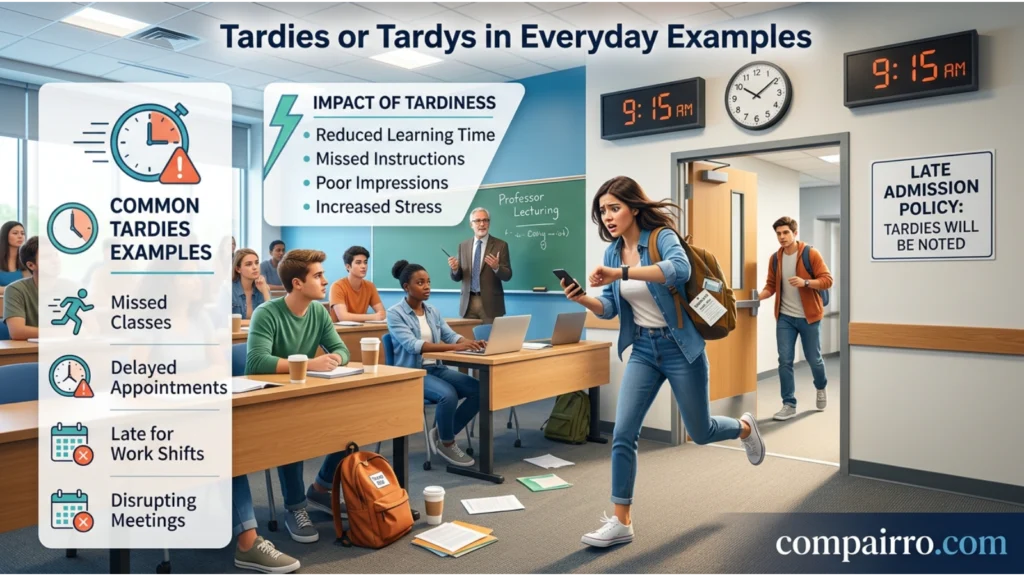
Work
✅ Employees with repeated tardies may receive warnings.
School
✅ The principal reviewed student tardies before issuing attendance notices.
Social Media
✅ Parents discussed school tardies in a community group.
Daily Life
✅ Keeping track of tardies can help improve punctuality.
Text Messages
✅ I already have two tardies this month!
✅ Don’t be late again or you’ll get another tardy.
Tardies or Tardys – Google Trends & Usage Data
Many people search for tardies or tardys because they are unsure which spelling follows English grammar rules.
Why People Search This Keyword
- School attendance questions
- Grammar confusion
- Plural spelling rules
- Educational writing
- Homework assignments
Popular Countries
People commonly search this topic in:
- United States
- United Kingdom
- India
- Pakistan
- Canada
- Australia
Search Trends
Interest usually increases during:
- School seasons
- Exam periods
- Back-to-school months
- Academic writing projects
Internet Popularity
The confusion exists because users often hear the word spoken but are unsure how to spell its plural form.
Comparison Table: Tardies or Tardys
| Feature | Tardies | Tardys |
|---|---|---|
| Correct Spelling | ✅ Yes | ❌ No |
| Standard English | ✅ Yes | ❌ No |
| School Usage | ✅ Common | ❌ Rare |
| Found in Dictionaries | ✅ Yes | ❌ No |
| Academic Writing | ✅ Accepted | ❌ Incorrect |
| Attendance Records | ✅ Used | ❌ Not Used |
Tardies or Tardys in Professional Life
Although the term is most common in schools, it can also appear in professional environments.
Human resource departments may track employee attendance and late arrivals.
Examples:
✅ Excessive tardies may affect performance reviews.
✅ Managers often monitor attendance records.
In professional writing, using the correct spelling demonstrates attention to detail and good communication skills.
Tardies or Tardys for Students or Beginners
Students often struggle with this word because English plural rules can be confusing.
Many beginners assume adding s is enough to create a plural. However, words ending in a consonant followed by y follow a different rule.
Common Confusions
- Why isn’t it “tardys”?
- Why does the y change?
- Is “tardy’s” ever correct?
Easy Learning Tips
- Learn the consonant + y rule.
- Practice with similar words.
- Read examples in sentences.
- Remember that attendance records use “tardies.”
Similar Words
| Singular | Plural |
|---|---|
| Tardy | Tardies |
| Baby | Babies |
| City | Cities |
| Party | Parties |
| Lady | Ladies |
Signs or Characteristics Related to Tardies
Common Characteristics of Tardies
- Recorded when someone arrives late
- Commonly tracked in schools
- Can affect attendance records
- May lead to warnings if repeated
- Used in educational systems
Patterns Often Seen
- Frequent lateness
- Missing morning classes
- Transportation delays
- Poor time management
- Repeated attendance issues
Common Uses
- Attendance reports
- School databases
- Parent notifications
- Administrative records
- Student evaluations
Simple Trick to Remember Tardies or Tardys
👉 Tardy → Tardies
👉 Change Y to IES
Think of it this way:
- Baby → Babies
- Party → Parties
- City → Cities
- Tardy → Tardies
If the word ends with a consonant and then y, the y usually becomes ies in the plural.
This simple pattern works for many English words.
FAQs:
1. Is tardies or tardys correct?
Tardies is correct. Tardys is incorrect.
2. What does tardies mean?
It means multiple instances of being late, usually in school attendance records.
3. Why is tardys wrong?
English grammar changes many consonant + y words to ies when plural.
4. Is tardies used in schools?
Yes. Schools commonly use it to track late arrivals.
5. Can tardies affect attendance records?
Yes. Too many tardies may impact attendance evaluations.
6. Is tardy singular or plural?
Tardy is singular. Tardies is plural.
7. Do British and American English spell it differently?
No. Both use tardy and tardies the same way.
Conclusion
The answer is simple: tardies is the correct plural form, while tardys is not considered correct in standard English. The word follows a common grammar rule where words ending in a consonant and y change to ies when made plural.
Whether you are writing a school report, attendance record, email, or assignment, using tardies will help you write accurately and professionally.
A final memory rule:
👉 Tardy → Tardies
👉 Change Y to IES
Remember this pattern, and you’ll avoid the mistake every time.

Sara Taylor is a passionate English content writer who specializes in word meanings, spelling comparisons, and modern slang explanations. She creates easy-to-understand articles that help readers avoid common English mistakes and improve their writing skills. Her content focuses on simple learning, real-life examples, and clear explanations for everyday readers.